
Lecture
Intuition (Late Latin intuitio, "contemplation," from the verb intueor, "to gaze intently") is a human ability and faculty to understand, form, and penetrate the meaning of events, situations, and objects through insight, illumination, and an instantaneous unconscious inference (based on imagination, empathy, and prior experience) — a "sense," perceptiveness, and possibly a connection with the collective unconscious or the Absolute.
super-intuition - an extraordinarily developed intuition
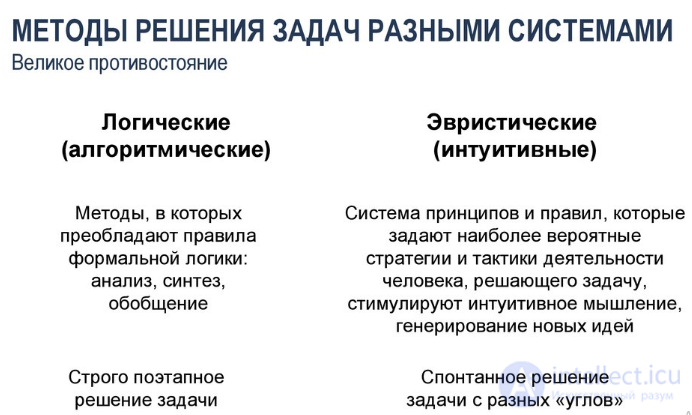
The tendency to distinguish two kinds, or methods, of cognition — intuitive and logical — already appeared in antiquity. Its origins can be found in Plato's doctrine of ideas, which contains the notion of non-discursive (unreasoned) apprehension of them. The Epicureans fixed this phenomenon of direct cognition or apprehension in the Ancient Greek word ἐπιβολή. Terms for the two kinds of cognition appeared in Philo of Alexandria, and later in Plotinus, who distinguished ἐπιβολή (direct, instantaneous apprehension (perception, illumination)) from διεξοδικός λόγος (sequential, discursive cognition, by means of logical inference).
The translation of the concept ἐπιβολή into Latin as "intuitus" (from the verb intueri, meaning "to gaze intently," "to penetrate with the eye" (sight), "to grasp instantaneously") was made in the 5th century by Boethius .
In the 13th century the German monk William of Moerbeke (1215-1286) repeated Boethius's translation, and the concept of "intuition" became part of Western European philosophical terminology.
Christian Wolff translated the concept "intuitio, intuitus" into German with the word "Anschauung." Wolff also used the expression "anschauende Erkenntnis" — intuitive cognition. It is in this sense that the concept is used by Kant.
The English, French, Italians, and Spanish translate Anschauung with the word "intuition" (French, English intuition, Italian intuizione, Spanish intuicion). In Russian, Kant's Anschauung is also translated as "contemplation" to convey the sense of direct apprehension, non-discursiveness, and instantaneous "perception."
In the history of philosophy the concept of intuition has had various content. Intuition was understood as a form of direct intellectual knowledge or contemplation (intellectual intuition). Thus Plato asserted that the contemplation of ideas (the archetypes of things in the world of the senses) is a kind of direct knowledge that comes as a sudden illumination, presupposing lengthy preparation of the mind.
In the history of philosophy, sensory forms of cognition and thinking have often been contrasted. R. Descartes, for example, asserted: "By intuition I mean not the fluctuating testimony of the senses, nor the deceptive judgment of a disordered imagination, but a conception of a clear and attentive mind, so simple and distinct that it leaves no doubt about that which we understand, or, what is the same, a firm conception of a clear and attentive mind, engendered solely by the natural light of reason, and more certain, by virtue of its simplicity, than deduction itself…"
G. Hegel, in his system, dialectically united direct and mediated knowledge.
Intuition was also interpreted as cognition in the form of sensory contemplation (sensory intuition): "…unconditionally indubitable, clear as the sun… only sensory," and therefore the mystery of intuitive cognition is "…concentrated in sensibility" (L. Feuerbach).
Intuition was also understood as instinct, directly, without prior learning, determining the forms of an organism's behavior (A. Bergson), and as a hidden, unconscious first principle of creativity (S. Freud).
In some currents of philosophy, intuition is interpreted as divine revelation, as an entirely unconscious process incompatible with logic and practical life (intuitionism). The various interpretations of intuition have something in common — an emphasis on the moment of immediacy in the process of cognition, as opposed to (or in contrast with) the mediated, discursive character of logical thinking.
Materialist dialectics discerns the rational kernel of the concept of intuition in the characterization of the moment of immediacy in cognition, which represents a unity of the sensory and the rational.
The process of scientific cognition, as well as various forms of artistic mastery of the world, are not always carried out in an expanded, logically and factually demonstrable form. Often the subject grasps a complex situation with a single act of thought — for example, during a military battle, in making a diagnosis, or in determining the guilt or innocence of the accused, and so on. The role of intuition is especially great where it is necessary to go beyond existing methods of cognition in order to penetrate the unknown. But intuition is not something irrational or supra-rational. In the process of intuitive cognition, not all the features by which the inference is made, nor the methods by which it is carried out, are consciously recognized. Intuition does not constitute a special path of cognition bypassing sensations, representations, and thinking. It represents a distinctive type of thinking in which individual links of the thought process flash through consciousness more or less unconsciously, while it is precisely the result of the thought that is realized with utmost clarity — perceived as "truth," with a higher probability of determining the truth than mere chance.
Intuition can be sufficient for discerning a truth, but it is not sufficient to convince others, or oneself, of that truth. For that, proof is necessary.
Both Eastern and Western philosophers have studied this concept in great detail. Philosophy of mind deals with the concept.
In the East, intuition is largely intertwined with religion and spirituality, and different meanings arise from different religious texts.
In Hinduism various attempts have been made to interpret Vedic and other esoteric texts.
For Sri Aurobindo, intuition belongs to the domain of knowledge through identity; he describes the psychological plane in human beings (often called manas in Sanskrit) as having two arbitrary natures, the first of which is the imprinting of psychological experiences built up through sensory information (the mind striving to know the external world). The second nature is action, in which the mind strives to become aware of itself, as a result of which people become aware of their own existence, or become aware that they are angry and aware of other emotions. He calls this second nature knowledge by identity. He finds that, as a result of evolution, the mind has currently grown accustomed to relying on certain physiological functions and their reactions as the normal means of entering into relation with the external material world. As a result, when we seek to know about the external world, the prevailing habit is to obtain truth about things through what our senses convey to us. However, knowledge by identity, which at present we grant only to the awareness of people's own existence, can be extended beyond ourselves, leading to intuitive knowledge.
He considers that this intuitive knowledge was common among earlier peoples (Vedic), and was later taken over by reason, which now organizes our perception, thought, and action, evolving from Vedic philosophy into metaphysical philosophy, and then into experimental science. He finds that this process, which seems respectable, is actually a cycle of progress, since the lower faculties are compelled to take just as much from the higher mode of working. He finds that when self-awareness in the mind is applied to itself and to the external (other) self, it leads to a vivid, self-manifested identity; the mind is also transformed into a form of self-luminous intuitive knowledge.
Osho believed that human consciousness exists in an ascending order from basic animal instincts to intellect and intuition, and that people who continually live in this conscious state often move between these states depending on their proximity to them. He also suggests that living in a state of intuition is one of humanity's ultimate goals.
Advaita Vedanta (a school of thought) regards intuition as an experience through which one can come into contact with the experience of Brahman.
Buddhism regards intuition as a faculty of the mind for direct knowledge, and takes the term intuition beyond the mental process of conscious thought, since conscious thought cannot necessarily access subconscious information or convert such information into a communicable form. In Zen Buddhism various techniques have been developed to help cultivate intuitive abilities, such as koans, the resolution of which leads to states of minor enlightenment (satori). In some parts of Zen Buddhism, intuition is regarded as a mental state between the Universal Mind and the individual, discriminating mind.
In the West, intuition is not singled out as a separate field of research, but the topic occupies a prominent place in the works of many philosophers.
The earliest mentions and definitions of intuition go back to Plato. In his book The Republic he attempts to define intuition as a fundamental faculty of the human mind for grasping the true nature of reality. [19] In his works Meno and Phaedo, he describes intuition as pre-existing knowledge residing in the "soul of eternity," and as the phenomenon by which a person becomes aware of pre-existing knowledge. He gives the example of mathematical truths and asserts that they did not come by way of reason. He argues that access to these truths can be obtained through knowledge already present in an inactive form and accessible to our intuitive faculty. This concept of Plato's is also sometimes called anamnesis. The study was later continued by his intellectual followers, the Neoplatonists.
In Islam there are various scholars with different interpretations of intuition (often called hads (Arabic: حدس), a correct hitting of the mark), which is sometimes linked to the faculty of intuitive knowledge with prophecy. Shihab al-Din al-Suhrawardi, in his book The Philosophy of Illumination (ishraq), following Plato's influence, finds that intuition is knowledge acquired through illumination, has a mystical nature, and also proposes mystical contemplation (mushahada) for correct judgment. Also under the influence of Plato's ideas, Ibn Sina (Avicenna) considers the faculty of intuition to be a "prophetic faculty" and describes it as knowledge obtained without deliberate acquisition. He finds that ordinary knowledge is based on imitation, whereas intuitive knowledge is based on intellectual certainty.
In his book Meditations on First Philosophy, Descartes refers to "intuition" as pre-existing knowledge obtained through rational reasoning, or the discovery of truth through contemplation. This definition is usually called rational intuition. [23] Later philosophers, such as Hume, have more ambiguous interpretations of intuition. Hume argues that intuition is the recognition of relations (relations of time, place, and causality), while he asserts that "resemblance" (the recognition of relations) "strikes the eye" (requiring no further examination), yet goes on to claim that it is, "or rather, in the mind" — attributing intuition to a power of reason,
Immanuel Kant's conception of "intuition" differs significantly from the Cartesian notion and consists of basic sensory information provided by the cognitive faculty of sensibility (roughly equivalent to what might conventionally be called perception). Kant held that our mind expresses all our outer intuitions in the form of space, and all our inner intuitions (memory, thought) in the form of time. [26]
Intuition is usually invoked independently of any particular theory of how intuition provides evidence for claims, and there are various views on what the mental state of intuition is, ranging from a simple spontaneous judgment to a special representation of a necessary truth. [27] In recent years a number of philosophers, such as George Bealer, have tried to defend appeals to intuition against Quine's doubts regarding conceptual analysis. Another challenge to appeals to intuition has recently come from experimental philosophers, who have argued that appeals to intuition should be based on the methods of the social sciences.
The metaphilosophical assumption that philosophy should depend on intuitions has recently been called into question by experimental philosophers (for example, Stephen Stich). One of the main problems raised by experimental philosophers is that intuitions vary, for example, from one culture to another, and it therefore seems problematic to cite them as evidence for a philosophical claim. [30] Timothy Williamson responded to such objections to philosophical methodology by arguing that intuition plays no special role in philosophical practice and that skepticism about intuition cannot meaningfully be separated from skepticism about judgment in general. From this point of view there are no qualitative differences between the methods of philosophy and those of common sense, the sciences, or mathematics. Others, such as Ernest Sosa, seek to defend intuition, arguing that objections to intuition merely highlight verbal disagreement.
Intuitionism is a position put forward by Luitzen Egbertus Jan Brouwer in the philosophy of mathematics, based on Kant's claim that all mathematical knowledge is knowledge of pure forms of intuition, that is, intuition that is not empirical.
Intuitionistic logic was developed by Arend Heyting to accommodate this position (and was adopted by other forms of constructivism in general). It is characterized by the rejection of the law of excluded middle: as a consequence, it generally does not accept rules such as the elimination of double negation and the use of reductio ad absurdum to prove the existence of something
The formation of an intuitive decision proceeds outside direct conscious control. The well-known American philosopher and cognitive psychologist Daniel Dennett explains:
Intuition is simply knowing something without understanding how that knowledge was obtained.
Intuition is a premonition directed toward the future, based on knowledge (without understanding how it was obtained) multiplied by experience.
In C. Jung's conception of analytical psychology, intuition is regarded as one of the four basic psychological functions, determining a person's attitude toward themselves and the surrounding world, and the way they make vitally important decisions. "…Things have their past and their future. They arise from somewhere, they flow toward somewhere, and it is hard to say with certainty where they came from and where they will disappear to; and yet a person has… a premonition. A premonition in such matters is often a matter of life. Intuition is used by inventors and judges. Where concepts and evaluations are powerless, we are entirely dependent on the gift of intuition. I would add that intuition is a special kind of perception, one not limited to the sense organs but passing through the sphere of the unconscious. … I do not know what happens when a person knows something that they definitely cannot know. I do not know how he manages it, but he manages it rather well, and he is able to act."
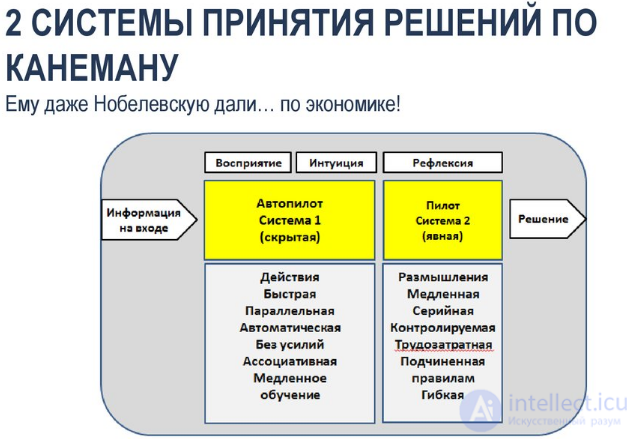
According to the work of Daniel Kahneman, intuition is the ability to automatically generate solutions without lengthy logical reasoning or proof .
According to yet another interpretation, intuition is the mind's direct apprehension of truth, not derived by logical analysis from other truths and not perceived through the sense organs.
In cognitive psychology, intuitive processes are studied within research on implicit learning (a person's ability to unintentionally and unconsciously process complex information), implicit memory, and priming. The result of implicit learning is the formation of implicit knowledge, which is detected indirectly when performing tasks, without any awareness of the fact of its application, and almost always manifests itself without the participation of attention.
According to Sigmund Freud, knowledge can be achieved only through intellectual manipulation of carefully made observations and the rejection of any other means of acquiring knowledge, such as intuition, and his discoveries may have been an analytical turn of his mind toward the subject.
In Carl Jung's theory of the ego, described in 1916 in Psychological Types, intuition is an "irrational function," most directly opposed by sensation, and to a lesser degree by the "rational functions" of thinking and feeling. Jung defined intuition as "perception via the unconscious": the use of sensory perception only as a starting point for identifying ideas, images, possibilities, and ways out of a blocked situation through a process that is largely unconscious
Jung said that a person dominated by intuition, an "intuitive type," acts not on the basis of rational judgments but on the basis of the sheer intensity of perception. The extraverted intuitive type, "the natural champion of every minority with a future," is oriented toward new and promising but unproven possibilities, often rushing off in pursuit of a new opportunity before old undertakings have borne fruit, paying no attention to their own well-being in the country and their constant striving for change. The introverted intuitive type is oriented toward images of the unconscious, continually exploring the psychic world of archetypes, seeking to understand the meaning of events, but often uninterested in playing any role in those events and seeing no connection between the content of the psychic world and themselves. Jung believed that extraverted intuitive types were most likely to be entrepreneurs, speculators, and cultural revolutionaries, often driven by a desire to escape any situation before it settles and becomes limiting — even repeatedly leaving lovers for new romantic possibilities. His introverted intuitive types were likely to be mystics, prophets, or eccentrics who struggled with the tension between protecting their visions from the influence of others and making their ideas comprehensible and sufficiently convincing to others — a necessity if those visions were to bear real fruit.
In contemporary psychology, intuition may include the ability to know the right solutions to problems and to make decisions. For example, the recognition-primed decision (RPD) model explains how people can make relatively fast decisions without needing to compare options. Gary Klein found that under conditions of time pressure, high stakes, and shifting parameters, experts used their experience to identify similar situations and intuitively select possible solutions. Thus the RPD model represents a blend of intuition and analysis. Intuition is a pattern-matching process that quickly suggests possible courses of action. Analysis is mental simulation, a conscious and deliberate review of courses of action.
Recognition-primed decision making (RPD) is a model of how people make fast and effective decisions when faced with complex situations. In this model it is assumed that the decision-maker generates a possible course of action, compares it against the constraints imposed by the situation, and selects the first course of action that is not rejected. RPD has been described in various groups, including trauma nurses, fire commanders, chess players, and stock traders. It works well under time pressure, when information is incomplete and goals are poorly defined. Limitations of RPD include the need for decision-makers to have extensive experience (in order to correctly recognize the characteristic features of a problem and model solutions), and the problem of failures of recognition and modeling in unusual or misidentified circumstances. As discussed by Gary A. Klein in Sources of Power, , it appears to be a valid model of how human decision-makers actually make decisions.
Instinct is often mistaken for intuition, and its reliability is considered to depend on past knowledge and events in a specific domain. For example, someone who has had more experience dealing with children will better understand what they should do with them in certain situations. This does not mean that a person with greater experience will always have accurate intuition.
Intuitive abilities were quantitatively tested at Yale University in the 1970s. Studying non-verbal communication, researchers noted that some subjects could read non-verbal facial cues before reinforcement occurred. Using a similar design, they noted that highly intuitive subjects made decisions quickly but could not identify their reasoning. However, their accuracy level did not differ from that of non-intuitive subjects.
According to the work of Daniel Kahneman, intuition is the ability to automatically generate solutions without lengthy logical arguments or proof
Adaptive programs and artificial intelligence algorithms, based on machine learning methods, exhibit behavior that mimics human intuition. They produce knowledge from data without a logical formalization of the paths and conditions of its acquisition, as a result of which this knowledge appears to the user as the result of "direct discernment."
For simulating intuitive decision-making, neuron-like devices called neural networks and neurocomputers, as well as their software simulators, are convenient. M. G. Dorrer and coauthors created an approach to psychodiagnostics, unconventional for computer methods, that is intuitive and consists in generating recommendations while excluding the construction of a described reality. For classical computer psychodiagnostics [10] the formalizability of a psychodiagnostic method is of great importance, whereas the experience accumulated by researchers in the field of neuroinformatics shows that, with the aid of neural network technology, it is possible to meet the needs of practicing psychologists and researchers for creating psychodiagnostic methods based on their experience, bypassing the stage of formalization and the construction of a diagnostic model.
Intuition, as intuition based on experience, has proven useful to business executives in making judgments about people, culture, and strategy. Law enforcement officers often report that, watching suspects, they immediately "know" that they have a weapon or prohibited narcotic substances, which may also be an action of instincts. Often unable to articulate why they reacted or what prompted them during the event, they can sometimes retrospectively plan their actions based on explicit and existing danger cues. Such examples liken intuition to "instinctive feelings," and when viable, illustrate preconscious activity.
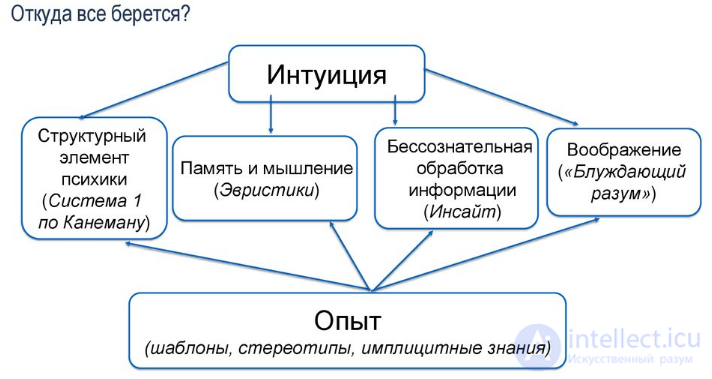
1. Certain knowledge in a given field, a high level of professionalism, and rich life experience
2. The presence of a problem or task that gives rise to a search situation
3. The desire to find a solution by any means - a search dominant
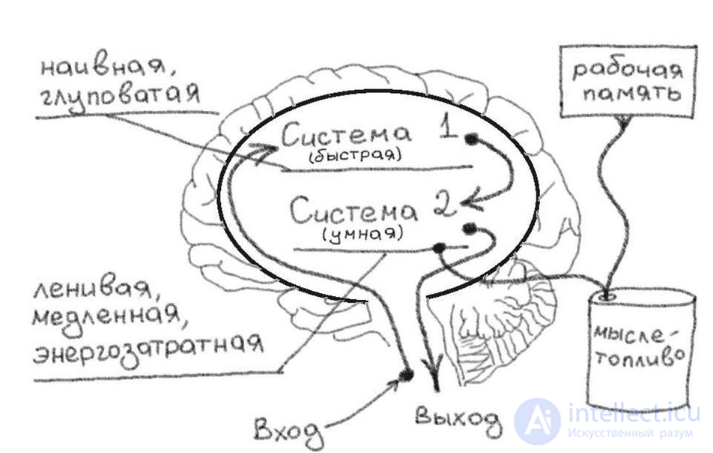
4. The operation of Kahneman's System
5. Active work of the imagination - the "mind-wandering" phenomenon
6. Illumination in the course of solving a difficult problem - the insight phenomenon
Where does it all come from?
Intuition
Many authors offer various trainings for developing intuition, but it is worth remembering that some of them have not been experimentally proven, that is, they are the authors' "musings" on the subject. One aspect of intuition is based on life experience, so the only way to develop it is to accumulate experience in a specific field of knowledge. "Positive thoughts and the conviction that you deserve not just an answer, but the best answer, spur intuition toward positive activity"[11] — this is one such training, based on affirmation or self-suggestion aimed at removing barriers. D. I. Mendeleev's discovery of the periodic law of chemical elements, as well as the formula for benzene developed by Kekulé, both made by them in a dream, confirm the value of life experience and the store of knowledge for developing intuition, for acquiring intuitive knowledge.
Sometimes trainers propose, for example, exercises for developing intuition that are actually more like exercises for developing clairvoyance or clairaudience. Here is one such exercise:[12]
Before the start of the working day, try to picture each of your employees. Feel what is hidden behind their words, and what is left unsaid. Before reading a letter, intuitively imagine what it is about and how it will affect you. Before picking up the telephone receiver, try to intuitively guess who is calling, about what, and how that person will speak…
The term "intuition" is widely used in various occult, mystical, and pseudoscientific teachings and practices

Comments