
Lecture
Personality is a concept developed to reflect the social nature of a human being, to consider them as a subject of sociocultural life, and to define them as a bearer of an individual principle that reveals itself in the context of social relations, communication, and purposeful activity.
The phenomenon of personality has no single interpretation; definitions of the concept of personality depend on the author's point of view regarding its process of development and formation.
Some authors believe that the process of forming and developing personality is based on innate abilities, with the role of the social environment being secondary. Researchers who hold a different point of view are convinced that the primary source of personality development is precisely the social environment, while innate qualities play an insignificant role.
In addition to these extreme viewpoints, there is a theory concerning the interrelation of biological and social principles in the process of an individual's personality development.
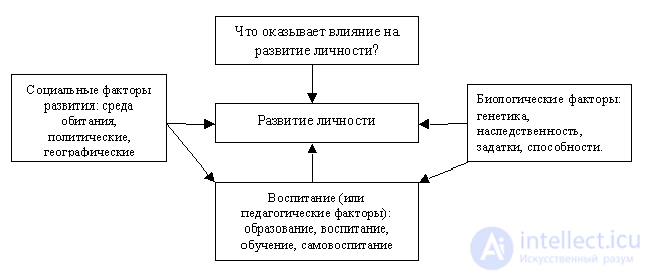
For a more complete definition and analysis of the process of personality development, it is necessary to identify the main factors that influence it to one degree or another.
The basis of the process of personality socialization is the group experience of interaction of a specific individual. On the basis of this experience, a self-image is formed, depending on how those around the person evaluate this personality. For successful perception, the individual tries on the roles of others and evaluates their own behavior and inner world through their eyes. Thus, the process of socialization occurs individually for each person, whose experience is unique and unrepeatable.
Conditions are the fundamental elements and characteristics of the environment in which the process of personality development takes place.
The existing system of conditions of an individual's life activity forms the personality's habitat. It includes biological, psychological, and social conditions. The conditions for personality development can be divided into necessary and sufficient. Let us examine them in more detail.
Thus, it can be said that personality is social by its very nature, and the main sources and, accordingly, the conditions for its development lie in the individual's surrounding environment.
Considering the process of personality development in this light, it can be described as the individual's assimilation of existing social experience through direct communication with the people around them. The result of this process is the formation of the individual's psychological characteristics: interests, character, inclinations, and behavioral reactions.
In psychology, a person's psychological characteristics are defined as ontogenetic formations acquired during the person's lifetime, in whose formation the leading role is played by the individual's existing social experience, the conditions surrounding them, and their level of upbringing and education.
The foundations for the formation of a person's psychological characteristics are the environment, upbringing, and education. A major role in this is played by the influence of the older, more experienced generation on the younger one, aimed at passing on accumulated experience and shaping certain personality traits.
However, it should be emphasized that a person is not a passive object of environmental influence. In this regard, external influence affects the human psyche not directly, but through the process of the individual's direct interaction with the surrounding environment. It is precisely through the mutual penetration and mutual influence of the person and the environment that the process of development of the personality and of society as a whole takes place.
When speaking of external conditions and influences on the development of the human psyche, one must not forget the internal conditions, which are an indispensable prerequisite for development. The distinctiveness of an individual's psyche, their unique personal experience, has an enormous influence on the course of the developmental process.
A person, being an active being, is capable of consciously and independently changing their own personality through self-education and self-improvement throughout their entire life. The source of motivation for such changes is most often the social environment with which the person is in active interaction. So here too the influence of the environment turns out to be mediated.
One generation succeeds another, ensuring the continuity of culture, including language, values, norms, customs, and morality.
It is precisely through systematic interaction with other people that an individual forms their own beliefs, moral standards, and habits — everything that creates the uniqueness of a personality. Thus, socialization has two functions: the transmission of culture from one generation to another and the development of the self.
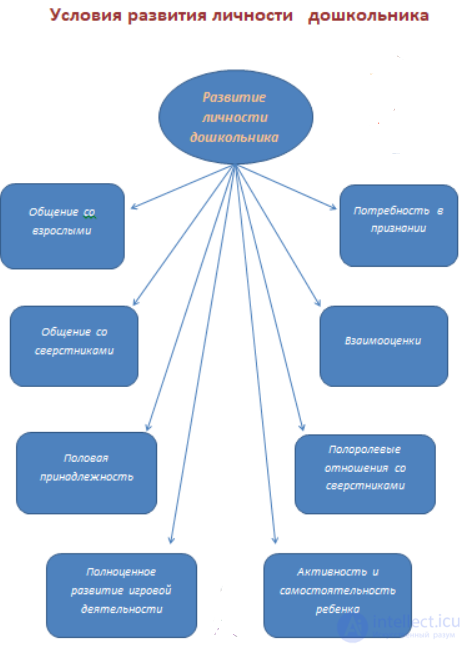
For a deep and complete knowledge of oneself and one's individual characteristics, it is necessary to purposefully organize the process of personality development. There are many types and ways of stimulating this process: intellectual development, physical development, mental and spiritual development. Harmonious personality development is characterized by a combination of the above-mentioned types of development.
In the process of a personality's growth and development, an important role is played by the drive toward the process itself, constant self-improvement, and the search for the most optimal paths and solutions, individually and precisely tailored to each specific person and situation. Deep and significant questions in the process of personality development include:
Development occurs:
in the unity of the biological and the social within a person;
2. dialectically (the transition of quantitative changes into qualitative transformations of the physical, psychological, and spiritual characteristics of a personality); development proceeds unevenly (each organ develops at its own pace), intensively in childhood and adolescence, and then slows down.
There are optimal periods for the formation of individual types of mental activity — sensitive periods.
3. through the resolution of contradictions (between needs and the possibilities of satisfying them, between a child's abilities and society's demands, between the goals one sets for oneself and the conditions for achieving them, etc.);
4. through activity — play, study, and labor.
A process is dynamics, a flow, and describing personality development as a process means describing the ongoing dynamics, its stages, and its mechanisms.
Development usually occurs in waves, in a spiral, but it may also follow other lines and forms: it may proceed in a straight line or in waves, continuously or with delays, cyclically or in the direction of degradation. Development may proceed through obligatory stages, may be defined only by a peak, or may have several different peaks.
More often the source of development is something external — parental upbringing, the influence of one's surroundings, the demands of professional growth, the challenges of life — however, without internal conditions and sources, personality development is impossible. And what makes reality interesting is that these sources are not always of good quality and often conflict with one another.
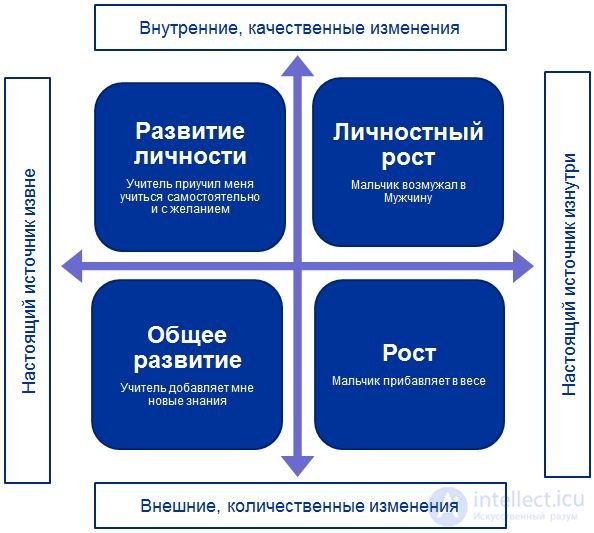
The growth and development of a personality can be observed, but what actually caused it, what its mechanism was, still needs to be figured out. Behind a visible result may lie very different processes: sometimes a process of growth proper, initiated from within; sometimes a process of development, initiated largely from outside; and sometimes a process of transformation or directed formation... — the causes can be very varied. If we examine the growth and development of a personality in more detail, we should distinguish the following as separate lines and components:
Understanding "personality development" as a complex but predominantly natural process is more characteristic of theoretical psychology. Practical psychology is concerned not with the "natural" but with the artificial — with the art of personal growth and development, that is, with what a person can do for themselves, or how a specialist, a teacher or a psychologist, can help a person. The forms this activity takes vary, and the names used for it are also quite varied: self-education, personal self-improvement, personal growth trainings, spiritual practices...
When it is said that a person is engaged specifically in self-improvement, this emphasizes primarily the independence of this work — that the person is doing it themselves. If, on the other hand, a person writes "I'm into personal growth," this may mean that they themselves do specifically little, but they attend psychological (for example) groups and enjoy what happens to them there. Personal growth trainings promise (and often deliver) personal growth as a result, although the processes that take place during the training relate more to formation and development than to growth as such. Growth is a lengthy process, whereas development and formation yield faster results...
Sometimes psychotherapy is called a method of personality development, but this is merely a consequence of the fact that nowadays people call anything they like both "personality development" and "psychotherapy." If we take the concept of "growth and development of personality" in its strict, narrow sense, it applies only to a healthy personality. Positive changes in an unhealthy personality are, strictly speaking, recovery, not personal growth. That is psychotherapeutic work, not personality development. In cases where psychotherapy removes barriers on the path to personal growth, it is more accurate to speak not of a process of personal growth but of psychocorrection.
Various difficulties arise on the path of personal growth and development. First, attitudes toward personal growth and development can vary greatly. Someone around you may note that your gains are at the same time your losses. On the other hand, development means stepping outside one's comfort zone; for a time you become "not yourself" while you are working through skills and knowledge, you must monitor yourself closely, and there is no room for relaxation. This means that every change or movement makes us not ourselves, followed by a period of integrating something into one's life or consciousness — and then I become myself again, only slightly different. And this causes tension, and raises many internal questions... Still, if you know how to work on yourself, you will succeed.

Comments