
Lecture
The most general emotional state that colors all of a person's behavior over an extended period of time is called mood. It is highly varied and can be joyful or sorrowful, cheerful or dejected, energetic or depressed, calm or irritable, and so on. Mood is an emotional reaction not to the direct consequences of particular events, but to their significance for a person's life in the context of their overall life plans, interests, and expectations.
A person's activity and its results are determined not only by their stable individual qualities, but also to a significant extent by temporary shifts that arise in their body and are defined as psychophysiological states.
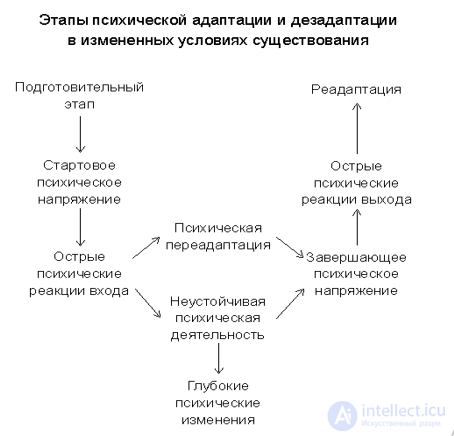
Stages of mental adaptation
Affect (from Latin affectus — passion, emotional agitation) is an emotional process of an explosive nature, characterized by brevity and high intensity, often accompanied by sharply pronounced motor manifestations and changes in the functioning of internal organs. Affects are distinguished from emotions, feelings, and moods.
S. L. Rubinstein noted the distinctive feature of mood in that it is not object-directed but personal in nature, and that the most powerful emotional reaction is affect.
Affect (from Latin affectuctus — "emotional agitation") is a strong and relatively brief emotional state associated with a sharp change in life circumstances important to the subject, accompanied by sharply pronounced motor manifestations and changes in the functioning of internal organs.
Affect completely overtakes a person's psyche. This entails a narrowing, and sometimes even a switching off, of consciousness, changes in thinking, and, as a result, inadequate behavior. For example, in a state of strong anger many people lose the ability to resolve conflicts constructively. Their anger turns into aggression. The person shouts, turns red, waves their arms, and may strike their opponent.
Affect arises sharply and suddenly, like a flash or a burst. It is very difficult to control and cope with this state. Any feeling can be experienced in an affective form.
Affects have a negative effect on a person's activity, sharply reducing its level of organization. In the grip of affect, a person seems to lose their head; their actions become irrational and are carried out without regard for the situation. If objects unrelated to the cause of the affect happen to be within the person's reach, they may, in a fury, fling aside whatever they can grab, push over a chair, or slam their hand on a table. Losing control over themselves, the person surrenders entirely to the experience.
It would be wrong to think that affect is entirely uncontrollable. Despite its seemingly sudden onset, affect has definite stages of development. And while at the final stages, when a person completely loses control over themselves, it is practically impossible to stop, at the beginning any normal person can do so. This, of course, requires tremendous willpower. The most important thing here is to delay the onset of the affect, to "extinguish" the affective flare-up, to restrain oneself, and not lose control over one's own behavior.
Affect is excessive nervous-psychic overexcitation that arises suddenly in an acute conflict situation, manifesting itself in a temporary disorganization of consciousness (its narrowing) and an extreme activation of impulsive reactions.
Deep resentment from an insult that is severe for a given person, the sudden emergence of great danger, brutal physical violence — all these circumstances, depending on individual personality traits, can trigger affect.
The state of affect is characterized by a significant disruption of the conscious regulation of a person's actions. A person's behavior during affect is governed not by a premeditated goal, but by the feeling that completely overtakes the personality and triggers impulsive, subconscious actions. In a state of affect, the most important mechanism of activity — selectivity in choosing a behavioral act — is disrupted; a person's habitual behavior changes sharply, their attitudes and life positions become distorted, the ability to establish connections between phenomena is impaired, and consciousness begins to be dominated by a single, often distorted, notion.
From a neurophysiological standpoint, this "narrowing of consciousness" during affect is associated with a disruption of the normal interaction between excitation and inhibition. In a state of affect, it is primarily the inhibitory process that suffers; excitation begins to spread haphazardly into the subcortical regions of the brain, and conscious control over emotions is lost. During affect, subcortical structures acquire a certain degree of independence, which is expressed in violent, primitive reactions.
Affect causes a sharp disturbance in the balance of nervous processes, a "clash" of nervous processes, and is accompanied by shifts in the system of neural connections, significant changes in blood chemistry, disruptions in the activity of the autonomic nervous system and cardiac function, and in psychomotor regulation (gesticulation, specific facial expressions, sharp screaming, crying, and so on). The state of affect is associated with a disruption in the clarity of consciousness and is accompanied by partial amnesia — a memory disorder.
In all the varied manifestations of affect (fear, anger, despair, an outburst of jealousy, a surge of passion, and so on), three stages can be distinguished. In the first stage, all mental activity becomes sharply disorganized, and orientation in reality is disrupted. In the second, overexcitation is accompanied by sharp, poorly controlled actions. In the final stage, nervous tension subsides, and a state of depression and weakness sets in.
Subjectively, affect is experienced as a state that seems to be imposed on the person from outside, against their will. However, intensified volitional control at the initial stage can prevent the development of affect. It is important to focus consciousness on the extremely negative consequences of affective behavior. Techniques for overcoming affect include voluntarily delaying motor reactions, changing one's surroundings, and switching to a different activity. However, the most important condition for overcoming negative affects is a person's certain moral qualities, life experience, and upbringing. People with unbalanced processes of excitation and inhibition are more prone to affects, but this predisposition can be overcome through self-education.
Affect can arise as a result of memories of a traumatic event (residual affect), as well as from the accumulation of feelings. Affective actions are emotionally impulsive, that is, they are driven by feelings: they have no conscious motive. A strong feeling that overtakes the entire personality is in itself the impulse to act. Actions performed in a state of affect are marked neither by consciously formulated specific goals nor by conscious tactics. The general direction of the chaotic actions during affect is the drive to eliminate the traumatic stimulus. Even Immanuel Kant noted that during affect, feelings leave no room for reason. Volitional regulation of behavior can only be exercised at the very earliest stage of the emergence of affect. At later stages, a person loses volitional control.
The outcome achieved during affect creates only the illusion of a prior awareness of a goal. And if the action did involve a conscious goal, then by this very criterion the action cannot be considered to have been committed in a state of affect.
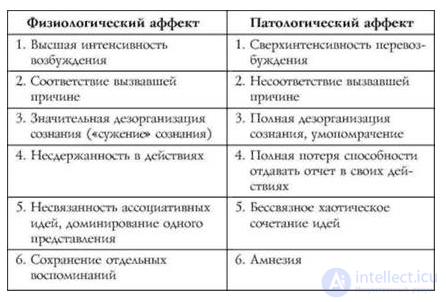
Since the state of affect affects the classification of a crime and the severity of punishment, this state is subject to proof, and establishing it requires a forensic psychological examination. Physiological affect should be distinguished from pathological affect — a morbid nervous-psychic overexcitation associated with a complete clouding of consciousness and paralysis of will.
Affect arose in the course of evolution to ensure a rapid response by an organism in situations requiring decisive action. In the animal world, affect is linked to biological needs and instincts and is an important factor in survival. Affect, like any other emotional process, is a psychophysiological process of internal regulation of activity and reflects an unconscious subjective evaluation of the current situation. Affect always arises in response to a situation that has already taken shape, mobilizing the organism and organizing behavior so as to ensure a rapid response to it. Its unique characteristics are brevity and high intensity, combined with pronounced manifestations in behavior and in the functioning of internal organs. The content and character of human affects have undergone significant change under the influence of society; affects in people can arise as a result of social relations, for example, as a result of an insult or a feeling of injustice.
Specialists draw a distinction between the concept of "affect" and the concepts of "feeling," "emotion," "mood," and "experience."
Affects differ from feelings, moods, and emotions primarily in their intensity and brevity, as well as in the fact that they always arise in response to a situation that has already occurred.
By "experiences" is meant only the subjective-psychic side of emotional processes, not including their physiological components.
The onset of affect is accompanied by changes in autonomic reactions (changes in pulse and breathing, spasms of the peripheral blood vessels, sweating, and others), and sharply pronounced changes in voluntary motor activity (inhibition, excitation or overexcitation, impaired coordination of movements). It is on this effect that the operating principle of the lie detector is based, which records numerous physiological indicators of the body.
Strong affect usually disrupts the normal course of higher mental processes — perception and thinking — and sometimes causes a narrowing of consciousness or its clouding.
Signs of physiological and pathological affects
Affect is often preceded by a state of fear or anger. Fear and anger can reach the degree of affect, but they can also be expressed in a weaker emotional state.
People with a weakened psyche (psychasthenics) may hold obsessive, exaggerated notions about a particular kind of danger — phobias (fear of heights, of confined spaces, of sharp objects, and so on).
Frustration is a conflict-laden, negatively toned emotional state that arises in connection with the collapse of hopes, or unexpectedly arising insurmountable obstacles on the path to achieving highly significant goals. Frustration is often linked to aggressive behavior directed against the source of the frustration. If the causes of frustration cannot be eliminated, a depressive state may arise, associated with a significant and prolonged disorganization of the psyche (weakened memory, difficulty concentrating attention, reduced capacity for logical thinking, and so on). In a state of frustration, a person seeks some sort of compensatory outlet, sometimes retreating into a world of fantasy, and sometimes beginning to display behavior characteristic of earlier stages of mental development (regression).
A stressor is a physicochemical or emotional-psychological factor that causes physiological or psychological tension and can be a cause of illness.
Another broad area of human states is united under the concept of stress.
Stress (from English stress — "pressure," "tension") is understood as an emotional state that arises in response to all manner of extreme influences.
Stress is physiological and/or psychological tension arising as a result of exposure to stressors that have disrupted an existing equilibrium.
No one manages to live and work without experiencing stress. Everyone, from time to time, goes through heavy life losses, failures, trials, conflicts, and tension while performing difficult or responsible work. Some people cope with stress more easily than others — that is, they are stress-resistant.
An emotional state closely related to stress is the syndrome of "emotional burnout." This state arises in a person who, in a situation of mental or physical strain, experiences negative emotions over a long period of time. At the same time, they can neither change the situation nor cope with the negative emotions. Emotional burnout manifests itself in a decline in overall emotional background, indifference, avoidance of responsibility, negativism or cynicism toward other people, loss of interest in professional achievements, and a narrowing of one's own capabilities. As a rule, the causes of emotional burnout are the monotony and sameness of the work, the absence of opportunities for career growth, professional mismatch, age-related changes, and social-psychological maladjustment. Internal conditions for the emergence of emotional burnout may include certain types of character accentuation, high anxiety, aggressiveness, conformity, and an inadequate level of aspiration. Emotional burnout hinders professional and personal growth and, like stress, leads to psychosomatic disorders.
Stress has: physiological, psychological, personal, and medical signs.
Physiological signs: rapid breathing, rapid pulse, reddening or paling of the facial skin, increased adrenaline in the blood, sweating.
Psychological signs: changes in the dynamics of mental functions, most often
Personal signs: complete suppression of will, reduced self-control, passivity and stereotyped behavior, inability to make creative decisions, increased suggestibility, fear, anxiety, unmotivated restlessness.
Medical signs: increased nervousness, the presence of hysterical reactions, fainting, affects, headaches, insomnia.
At least four groups of stress symptoms can be distinguished: physiological, intellectual, emotional, and behavioral.
PHYSIOLOGICAL SYMPTOMS:
INTELLECTUAL SIGNS OF STRESS:
EMOTIONAL SYMPTOMS:
BEHAVIORAL SIGNS OF STRESS:
Each symptom is scored as one point. A stress level of up to 10 points is considered acceptable, while more than 10 requires action to be taken. A score of 20 to 30 points indicates a high level of stress, and more than 30 indicates a very high level.
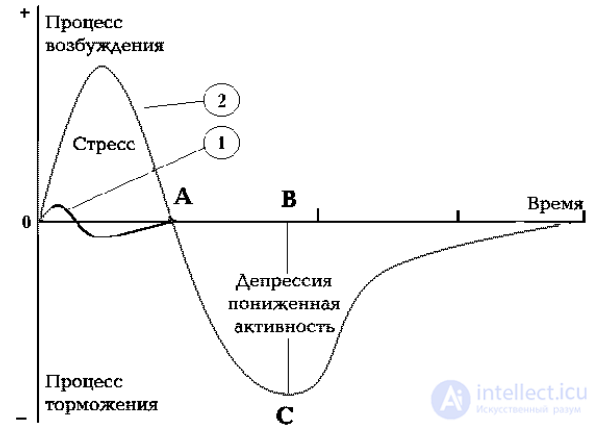
The graph shows the processes (two curves) of excitation and inhibition of the body under different stress situations. The first graph reflects the body's response to a mild stress (of small amplitude and duration), the kind we encounter every day. Curve 2 reflects the body's response to strong stress. In the negative phase, the body is at its most energetically depleted, and against this background various illnesses can develop, especially during periods of prolonged depression. According to statistics, up to 70% of people who visit a clinic for somatic complaints have some form of depression.
An emotional state similar in its manifestations to stress is frustration.
Frustration (from Latin frustratio — "deception," "disruption," "the ruin of plans") is a person's state caused by objectively insurmountable (or subjectively perceived as such) difficulties arising on the path toward achieving a goal.
Frustration is accompanied by a whole set of negative emotions capable of disrupting consciousness and activity. In a state of frustration, a person may display bitterness, depression, and external and internal aggression.
For example, while performing some activity, a person suffers a failure, which triggers negative emotions in them — disappointment, dissatisfaction with themselves. If, in such a situation, the people around them offer support and help correct the mistakes, the emotions experienced will remain only an episode in that person's life. If the failures are repeated, and significant people meanwhile reproach, shame, or call them incapable or lazy, this person typically develops the emotional state of frustration.
The level of frustration depends on the strength and intensity of the influencing factor, the person's state, and the forms of response to life's difficulties that they have developed. A negative social evaluation that touches on significant relationships of the personality is an especially frequent source of frustration. A person's resistance (tolerance) to frustrating factors depends on the degree of their emotional excitability, their type of temperament, and their experience of dealing with such factors.
A special form of emotional experience is passion. In the intensity of its emotional arousal, passion approaches affect, while in its duration and stability it resembles mood. What, then, is distinctive about passion? Passion is the name given to a strong, persistent, all-consuming feeling that determines the direction of a person's thoughts and actions. The causes of passion are varied — they may stem from conscious convictions, from bodily drives, or have a pathological origin. In any case, passion is connected to our needs and other personality traits. Passion, as a rule, is selective and object-directed. For example, a passion for music, for collecting, for knowledge, and so on.
Passion takes hold of all of a person's thoughts, in which all the circumstances connected with the object of passion revolve, as the person envisions and thinks through ways to fulfill the need. Whatever is not connected with the object of passion seems secondary, of no importance. For example, some scientists who work passionately on a discovery attach no importance to their appearance, often forgetting about sleep and food.
The most important characteristic of passion is its connection with the will. Since passion is one of the significant drivers of activity, it possesses great force. In reality, the assessment of the significance of passion is twofold. Public opinion plays a large role in this assessment. For example, a passion for money, for accumulation, is condemned by some people as greed, avarice, while at the same time, within another social group, it may be regarded as thriftiness, prudence.
An inability to regulate one's emotional states, to cope with affects and stress, is an obstacle to effective professional activity; it disrupts interpersonal relationships at work and in the family, hinders the achievement of set goals and the carrying out of intentions, and undermines a person's health.
There are special techniques that help one cope with a strong emotion and prevent it from turning into affect. To do this, it is recommended to notice and become aware of the undesirable emotion in time, to analyze its origins, to release muscular tension and relax, to breathe deeply and rhythmically, to draw on a pre-prepared "standby image" of a pleasant event in one's life, and to try to look at oneself from the outside. Affect can be prevented, but this requires self-restraint, self-control, special training, and a culture of interpersonal relationships.
The means of preventing emotional burnout are the optimization of working conditions and psychological correction at the early stages of emotional disturbances.
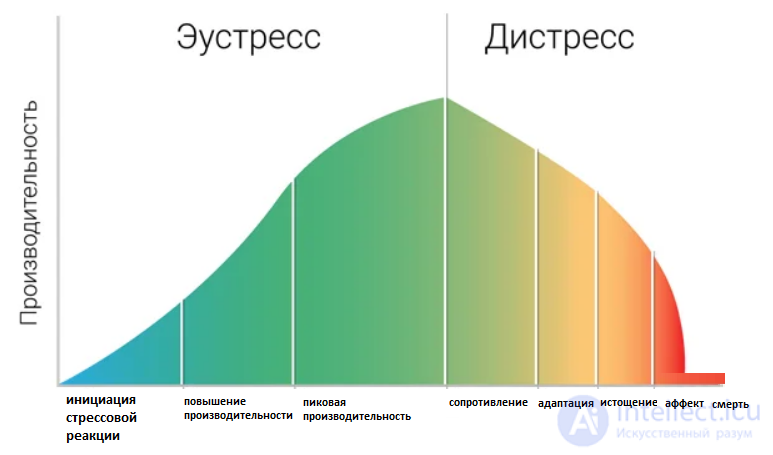
The factor of stress duration also matters. Prolonged exposure to stress is especially dangerous. It has been observed, for example, that after 10 to 15 years of work in extreme conditions, the human body wears out as if it had survived the most severe heart attack. Conversely, brief intense stress activates a person, as if "shaking them up."
So, the following should be remembered:
The methods of effectively managing stress can be compared to the actions of an experienced mountaineer. If a person gripped by fear turns their back on an avalanche and runs from it, it will catch up with and destroy them. It is necessary to face the danger head-on in order to know how to protect oneself from it.
The most successful people, both professionally and in their personal lives, are those who have learned to master themselves and who possess a well-developed technique of personal self-regulation. They know their strengths and weaknesses, are able to restrain themselves, show patience, and hold back their inner "explosions."
People with a well-developed personal psychological technique carry out four basic actions:
To relieve emotional tension, one needs to:
Anxiety has been diagnosed using a highly varied range of tests, most often using the so-called Taylor Manifest Anxiety Scale, which is constructed as a questionnaire. The composition of the psychological components of anxiety cannot be considered entirely definite and established. The most stable and constant components of this complex are: a state of emotional tension (stress), an experience of personal threat, heightened sensitivity to failures and mistakes, attributing failures and mistakes to one's own personality traits, worry, self-doubt, and dissatisfaction with oneself (Sarason, 1960).
A state of anxiety is not an inherent property belonging to a particular temperament. It arises only under certain disturbances in the system of a person's motives and relationships.
At the point of overcoming a psychological barrier, a person is in a state of mental tension caused by the need to suppress subcortical emotions through an act of will. Overcoming a psychological barrier, especially one associated with a threat to life, brings about a state of emotional release, based on the removal of the cortex's inhibitory influence on the subcortex and the induction of excitation within it. With each repeated overcoming of a psychological barrier, emotional reactions become smoother and more stenic. This is due to sufficiently complete information support, confidence in the equipment, in the means of rescue, and in the correctness of one's own actions in the event of emergency situations.

Comments