
Lecture
The Sheth–Newman–Gross Theory of Consumption Values
Value is a multidimensional phenomenon that includes: Functional value: the capacity to perform a utilitarian or physical role. Social value: perceived utility, association with one or more social groups. Emotional value: the capacity to arouse feelings or affective reactions. Epistemic value: the capacity to arouse curiosity, provide novelty, and/or satisfy a desire for knowledge. Conditional value: determined by a specific situation. These values make differentiated contributions to a particular market choice, i.e., they are independent of one another.
By applying the concept of "value" to purchasing behavior, Sheth, Newman, and Gross described market choice as a multidimensional phenomenon comprising a set of values: functional, social, emotional, epistemic, and conditional. They define these values as follows:
V = F + E + S + C + Ep
where:
1. Functional value: the perceived utility of a service arising from its capacity to perform its utilitarian or physical role. Services acquire functional value as a result of possessing distinct functional or physical attributes. Specifically, functional value lies in the ability to satisfy a basic need. In the case of the service under consideration, the functional value is the constant availability, to all consumers, of the necessary information about the client company's business presented on its website.
2. Emotional value: the perceived utility of a service arising from its capacity to arouse feelings or affective reactions. Services acquire emotional value when they are associated with particular feelings or when they help express or preserve feelings. This service is associated with a sense of confidence and reliability. By purchasing this service, the consumer is freed from worrying about the site's continued operation and from the need to constantly monitor it. It also removes the fear of having wasted the money already invested in the site.
3. Social value: the perceived utility of a service arising from its association with one or more social groups. Services acquire social value through association with a positive or negative stereotype of demographic, socio-cultural, or ethno-cultural groups. For WebOptima's website support service, in combination with its other website development and promotion services, social value can be expressed through the client's association with a group of successful businesspeople who keep pace with the times and use cutting-edge technology to run their business.
4. Conditional value: the perceived utility of a service arising from the specific situation in which the person making the choice finds themselves. Services acquire conditional value in the presence of extraordinary physical or social situations that highlight the functional or social significance of these goods. It can be linked to factors such as seasonality of demand, the dictates of fashion, and various trends and movements. In today's highly technological world, having a company website has become a mandatory condition for doing business and implementing a marketing strategy. Companies without a website nowadays provoke bewilderment and, often, distrust, since communication in the web environment has become routine for many consumers. In light of these trends, the importance of website support services also becomes apparent, as an accompanying, complementary part of a company's overall internet solutions package.
5. Epistemic value: the perceived utility of a good arising from its capacity to arouse curiosity, provide novelty, and/or satisfy a desire for knowledge. Goods acquire epistemic value when they are able to offer something new or different from what is already known. The cognitive value of the service under consideration can be realized by involving the client in the service delivery process, as well as through the monthly fashionable "trends" for their website offered by WebOptima.
The consumption values postulated by Sheth, Newman, and Gross are additively related to one another and make differentiated contributions to the consumer's choice.
The scholarly literature also contains other approaches to classifying consumption values [1; 4]. One such classification is presented in Table 1.

Core values are important not only from the standpoint of consumers wishing to purchase a product, but also from the standpoint of comparing it with competitors' products.
The latter plays an important role in positioning a product on the market and promoting it. Constant, temporary, accompanying, and introduced consumer values complement the core values, reinforcing or nuancing their effect in the eyes of consumers.
Value orientations and perceptions shape various types of consumption and the corresponding patterns of consumer behavior:
– functional (minimal functionality and minimal price);
– standard lower (fixed functionality, quality, standardized service, and minimal price);
– standard upper (fixed price, maximum functionality or quality);
– premium (maximum functionality, high quality and price).
Consequently, when making decisions about creating value, companies should focus on specific consumers based on their individual experience.
The modern consumer differs significantly from the consumer of the transactional marketing era, in which they played a passive role. They are more informed, educated, mobile, and capable of demonstrating patterns of professional behavior not only in traditional but also in electronic markets for goods and services. Consumers are increasingly aware of their sense of power over producers given the possibility of a wide choice of goods and services. Their expectations now go beyond quality and price, shifting increasingly toward service components (warranties, insurance, training, consulting, after-sales service, etc.).
The model of interacting with consumers based on the principle of persuading them to buy a product is a thing of the past. The modern consumer wants to actively participate in creating consumer value themselves. In this regard, the best companies are increasingly directing their efforts toward involving consumers in the processes of generating ideas for new products, developing and promoting them, and evaluating and monitoring the performance of supplier (seller) companies. They strive to cultivate in their customers (especially key ones) a sense of emotional attachment, trust, and loyalty by using branding techniques and implementing loyalty programs. Consequently, a focus on creating consumer value pushes companies to be more dynamic, flexible, and creative in working with consumers — not simply giving them what they want, but giving them more and faster than they expect.
This process of transformation is also taking place in the activities of Chinese companies.
It is reflected in the "Tao of creating consumer value" (Fig. 3).
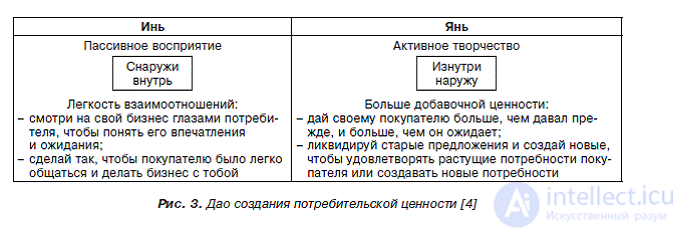
According to ancient Chinese symbolism, "yin and yang" are two fundamental forces that form the Universe and bring it into harmony through their interaction [2, p. 44]. Figure 3 shows how these two opposing forces can transform and harmoniously complement one another. Modern companies must move from a passive perception of relationships with consumers, and understanding of their needs and value orientations, toward active creativity aimed at creating new, more meaningful values for consumers — values that consumers sometimes not only are unaware of, but do not even dream of. In the goods and services they purchase, modern consumers seek satisfaction not only of their functional and emotional needs, but also of the needs of the human soul. It is no coincidence that marketing guru Philip Kotler calls modern marketing the era of values, or Marketing 3.0 [3, p. 18]. In his view, Marketing 3.0 elevates the marketing concept to the level of human aspirations, values, and spirit. Operating within this concept, producers of goods and services must act as good corporate citizens, for whom solving the problems of consumers and society is the foundation of their business models.
The difficulties of implementing a customer-oriented approach to company management in real practice stem not only from the complexity of the processes of forming, analyzing, evaluating, and forecasting consumer value amid the growing uncertainty of the business environment, the rapid pace of scientific and technological progress, and changing perceptions of people's standard and quality of life, but also from the inability of many companies' leaders and managers to develop management mechanisms adequate to this business model.

Comments