
Lecture
Emotional-volitional sphere (English: emotionally volitional sphere) — the set of properties of a person characterizing the content, quality, and dynamics of their emotions and feelings, including the ways of regulating them. A component of emotional stability. The degree to which a person volitionally masters their own emotions.
The idea of a connection between the development of emotions and other aspects of personality was put forward by L. S. Vygotsky. Speaking about the development of emotions in childhood, he noted: "This makes important and understandable what was discovered from the psychological side by other experimenters — the closest connection and dependence between the development of emotions and the development of other aspects of a person's mental life"
This idea is further developed by E. O. Smirnova. The regulatory role of a rule, and awareness of it, also presupposes the involvement of emotional processes as a condition. "For a rule to become truly conscious, it must become emotionally attractive, personally meaningful — it must become a motive for the child's actions. The discovery of the content of the rule (that is, knowledge of it) and the formation of its emotional attractiveness (that is, the attitude toward it) must occur in inseparable unity. Only in this case can the rule become a genuine motive and, consequently, acquire personal meaning and prompt the corresponding actions."
Difficulties in carrying out emotional-volitional regulation at this stage are also linked to the uneven development of individual aspects of the psyche that actively participate in the voluntary regulation of activity. Particularly significant in this respect are delays in the development of the moral qualities of personality, which are closely related to features of the motivation of the leading activity and to self-esteem (its instability and inadequacy). Alongside this, the development of will is hindered by the dominance of psychobiological formations (properties of the nervous system, features of emotionality) over the newly formed mental structures.
An interesting approach to understanding the nature of volitional effort in the regulation of activity is currently being developed by V. K. Kalin. He identifies a special inner activity of a person, which manifests, in the simplest cases of action, as volitional effort, and in complex conditions, as an extended inner action of mobilizing resources and organizing mental processes in accordance with the task the person is solving. V. K. Kalin believes that emotions provide the general mobilization of all systems of the organism, while volitional regulation provides the selective mobilization of a person's psychophysical capabilities. Volitional regulation is assigned the function of consciously changing the degree of "activation" of emotions. V. N. Kalin notes that emotional and volitional regulation can either coincide in direction or create competing dominants. Along with distinguishing between these two types of regulation, the author draws attention to their close connection.
Emotional-volitional regulation also includes regulatory components that are not fully conscious to the individual, which participate as necessary elements in situations of overcoming difficulties and obstacles on the way to achieving a goal. In this sense, the concept of emotional-volitional regulation is close to the concept of a synthetic mental process that ensures the functioning of the regulatory circuit in situations of difficulty and tension. The inclusion of such not-fully-conscious components distinguishes the concept of emotional-volitional regulation from the concept of volitional regulation .
In the personality structure empirically identified in our study, all the components necessary for effective emotional-volitional regulation are represented: personality orientation, emotions, and will.
An experience is a person's active subjective attitude toward significant phenomena of reality.
In the process of cognizing and transforming reality, a person usually singles out some objects and ignores others.
In this way, a person distinguishes what is important and unimportant for themselves, revealing their attitude toward these things by experiencing their reflection.
Types of experiences:
Properties of experiences:
Functions of experiences:
Emotion is a general, active form of experience — an immediate reaction of the psyche to the satisfaction or non-satisfaction of needs.
Emotions — a mental reflection in the form of a partial (biased) experiencing of the life meaning of phenomena and situations, based on the relationship between their objective properties and the needs of the subject.
Emotions have been studied by such outstanding Russian and foreign psychologists and neurophysiologists as Pyotr Kuzmich Anokhin, Lev Semyonovich Vygotsky, Charles Darwin, William James, Carroll Izard, Carl Georg Lange, Alexei Nikolaevich Leontiev, Konrad Lorenz, Alexander Romanovich Luria, Ariadna Efimovna Olshannikova, Herbert Spencer, Konstantin Viktorovich Sudakov, Paul Fraisse, and others.
Charles Darwin's evolutionary theory of emotions. Having published the book "The Expression of the Emotions in Man and Animals" in 1872, Charles Darwin demonstrated the evolutionary path of the development of emotions and explained the origin of their physiological manifestations.
The "peripheral" theory of W. James and C. Lange is based on the idea that emotions are connected with certain physiological reactions, being an extension of them.
The cognitive theory of emotions of M. Arnold and R. Lazarus holds that the cognitive source of emotion is an intuitive appraisal of an object. Emotion, like action, follows this appraisal.
The physiological theory holds that the emergence of emotions is caused by a disruption of the dynamic stereotype and of conditioned-reflex connections. The appearance of emotions is linked to the work of the subcortical centers of the brain: the reticular formation, the thalamus, the hypothalamus, and the limbic system.
Types of emotions
Functions of emotions
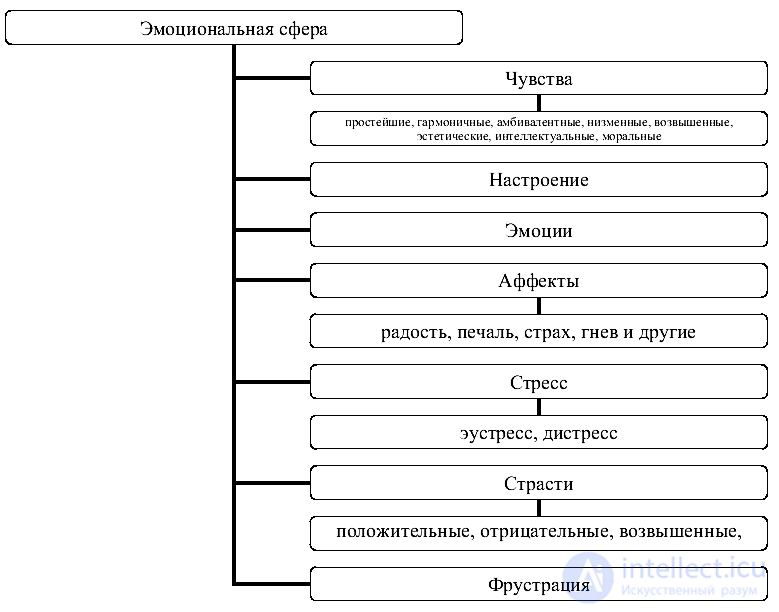
Feelings are a complex combination of various emotions that a person associates with certain people, objects, or events. Feelings have an object-relatedness, that is, they arise and manifest only in relation to specific objects: people, things, events, and so on. Feelings are a person's experiencing of the life meaning of objects and phenomena.
The second signaling system plays a major role in the emergence and course of feelings. Feelings develop gradually. They remain in the psyche for a relatively long time and even for a whole lifetime (patriotism, friendship, love, pride, dignity).
Feelings are an internal mental reflection that is constantly present in a person's psyche, influencing their behavior.
Differences between feelings and emotions
Types of feelings
1. moral (a person's experience of their attitude toward other people),
2. intellectual (feelings connected with cognitive activity),
3. aesthetic (feelings of beauty when perceiving art or natural phenomena),
4. praxic (feelings connected with a person's activity).
Types of emotional states: mood, affect, passion, apathy, frustration,
Mood is a general emotional state that, over a considerable period of time, colors particular mental processes and a person's behavior. Mood depends significantly on a person's general state of health, on the functioning of the endocrine glands, and especially on the tone of the nervous system. It is precisely this kind of mood that is called one's general state of well-being. Mood is influenced by the surrounding natural environment, events, the activity being performed, and other people. Moods can differ in duration. The stability of mood depends on many factors: a person's age, individual characteristics of their character and temperament, willpower, and the level of development of the leading motives of behavior. Mood leaves a substantial imprint on behavior. Mood can either stimulate and strengthen, or suppress and disorganize, a person's activity.
Emotion, in the strict sense of the word, is an immediate, temporary experiencing of some feeling. From the standpoint of their effect on a person's activity, emotions are divided into sthenic and asthenic. Sthenic emotions stimulate activity, increase a person's energy and effort, and prompt them toward actions and statements. Asthenic emotions are spoken of when a person experiences a kind of stiffness or passivity.
Affects are brief but powerful emotional experiences that manifest violently in a person's behavior and have a vivid external expression in their gestures, facial expressions, pantomime, and vocal modulations. Unlike mood, affect arises suddenly, builds up quickly, and passes comparatively quickly. Affects appear either at the beginning or at the end of the corresponding activity, reflecting a person's expectations regarding an upcoming activity that is significant to them, or its expected final result.
Stress is an emotional state that arises in response to a variety of extreme influences. Contemporary psychologists agree that, at the initial stage of its development, stress has a positive effect on a person, since it promotes the mobilization of mental resources and does not cause physiological changes ( ). However, stress gradually transforms into what is called
  , and this state has a clearly negative effect on the organism. If a person's protective mechanisms cannot cope with the stress, they eventually develop a psychosomatic or other mental disorder.
Passion is the name given to a strong, stable, all-encompassing feeling that determines the direction of a person's thoughts and actions. Passion is selective and always object-directed. Passion seizes hold of all of a person's thoughts; often it cannot be controlled, and it itself begins to control the person.
Frustration is a mental state of a person caused by objectively insurmountable (or subjectively perceived as such) difficulties that arise on the way to achieving a goal or solving a task — the experience of failure. Frustration is accompanied by a range of mostly negative emotions: anger, irritation, feelings of guilt, and so on. The level of frustration depends on the strength and intensity of the frustrating factor, on the functional state of the person who finds themselves in a frustrating situation, and also on the stable forms of emotional response to life's difficulties that developed during the formation of the personality.
If an obstacle arises on the way to achieving a goal and the components of a single activity become insufficient for the subject, the person makes use of will. Will manifests itself in how capable a person is of overcoming difficulties and how well they are able to manage their own behavior.
Will is a mental process of a person's conscious and purposeful regulation of their activity in order to achieve set goals.
Will is a conscious self-regulation of behavior, manifested in the deliberate mobilization of behavioral activity toward the achievement of goals that the subject recognizes as necessary and possible — a person's capacity for self-determination, self-mobilization, and self-regulation (M. I. Enikeev).
Volitional behavior is conditioned by an internal plan of action, a conscious choice of goal and means of activity that takes into account the conditions necessary for achieving the planned result, and an anticipatory reflection of reality.
Every volitional act is accompanied by a certain degree of volitional effort aimed at overcoming external and internal obstacles.
Functions of will:
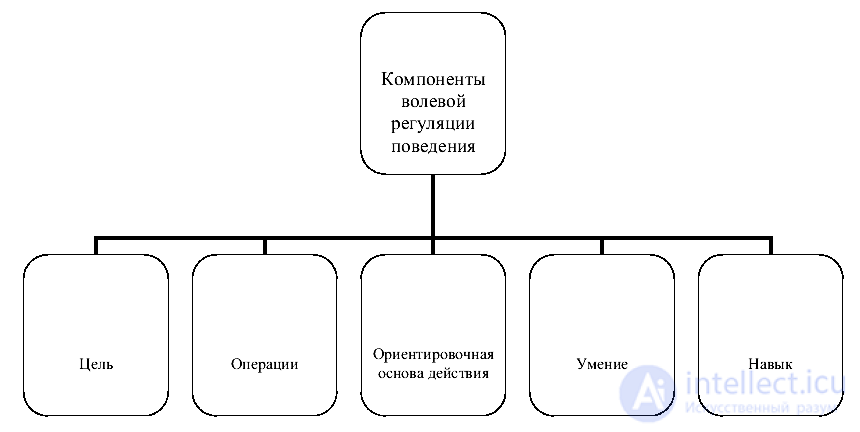
Every action is performed in order to achieve a particular goal.  is the mental image of the future result of an action or of an activity as a whole. The goals of an activity determine the character and sequence of actions, while the specific conditions of the actions determine the character and sequence of operations. An operation is a structural unit of an action.
The system of an individual's ideas about a goal, the order of its achievement, and the means necessary for this is called the orienting basis of an action.
Each operation within the structure of an action is determined by the conditions of the situation, as well as by the abilities and skills of the subject performing the activity.
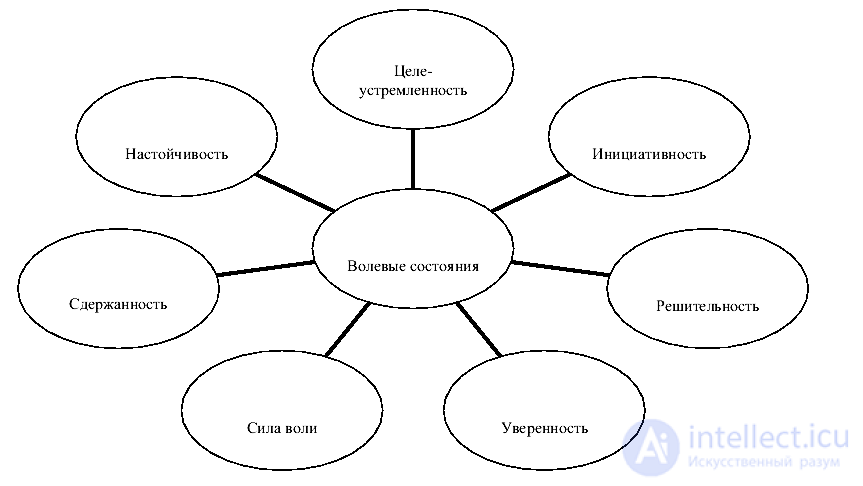
A skill (умение) is a person's ability to successfully carry out certain actions or activity with high quality and good quantitative results. A habit/automatism (навык) is a fully automated movement or system of movements (actions) of a person that proceeds quickly, precisely, without conscious control on the part of the person, and always (invariably) leads to a specific, previously known result. (R. S. Nemov) In an automatism, needs, motives, and goals are fused into one, and the methods of execution are stereotyped. Conscious regulation of activity manifests itself in a system of volitional mental states.
Diagnosing the emotional-volitional sphere can be carried out using the "Draw-a-Person" technique, the "Signs of Mental Tension in Children" questionnaire, E. T. Dorofeeva's method for studying emotional states, the Children's Apperception Test (CAT), the Color Relationship Test, the "Emotional Faces" technique, the "Politeness" technique, and S. Rosenzweig's "Picture Frustration Study."
Affective disorders.
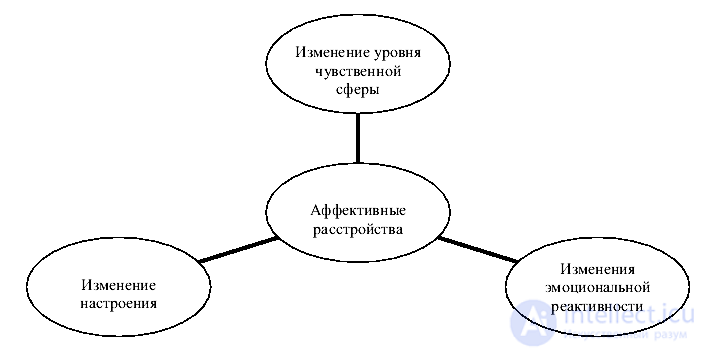
Changes in the level of the sensory-feeling sphere manifest as two groups of disorders: regression of feelings and progression of feelings.
 of feelings is observed in the form of the disappearance of higher (object-related and worldview-related) feelings and the predominance of lower (elementary) feelings arising from organic needs.
Progression of feelings is characterized by the dominance of higher feelings, that is, feelings of moral and aesthetic satisfaction, personal dignity, and others.
Changes in mood appear in the form of elevated (hyperthymia) and lowered (hypothymia) mood. Varieties of pathologically elevated mood include hypomania, mania, euphoria, moria, and ecstasy.
Hypomania, or a hypomanic mood, is characterized by heightened activity combined with erratic behavior, cheerfulness, increased sociability, wit, enterprise, and self-confidence.
Mania, or a manic mood, manifests as a triad of disorders: elevated mood, accelerated mental activity, and an increased pace of motor activity. In childhood, mixed, not sharply defined hypomanias are noted, manifesting as heightened cheerfulness, excessive mobility combined with capriciousness, disobedience, silliness, inflated self-esteem, fragmentary grandiose ideas, and signs of disinhibited drives.
Euphoria. A benevolent, thoroughly satisfied and contented, carefree mood without any heightening of ideational processes or striving toward activity — an uncritical state that usually arises against a background of a more or less pronounced intellectual deficit.
Moria. An unmotivated elevated mood combined with absurd and silly behavior in the presence of a decline in intellect.
Ecstasy. A tense experiencing of bliss, extraordinary happiness, and the highest degree of rapture, up to frenzied admiration, often with a narrowing of consciousness.
Pathologically lowered mood is observed in the form of depression, dysphoria, anxiety, and fear. Characteristic features of depression are a depressed mood, slowing of mental processes, and motor retardation.
Dysphoria manifests as a tensely hostile or gloomily discontented, depressed mood.
Anxiety. An affect of tense experiencing of a vague, indeterminate, objectless danger or catastrophe. It may be combined with distrustfulness, wariness, inner restlessness, disruption of goal-directed activity, fidgetiness, disorderly movements, changeable facial expressions, a restless gaze, incoherent speech, rapid heartbeat, irregular breathing, cold sweat, pallor, dilation of the eyes and pupils, and involuntary urination.
Fear can be defined as an emotional state that appears when a person becomes aware of impending danger. Toward the end of early childhood (by ages 2-3), specific fears appear: objects, creatures, phenomena. Starting at around age three, a period of symbolic fears begins. For example, fear of the dark. Fear is also linked to a state of anxiety, which arises when a situation fraught with dangerous consequences is not very well defined.
Changes in emotional reactivity include pathological affect, apathy, and ambivalence.
Age-related features. The development of a child's affective sphere begins even before birth. The leading type of activity for a child in infancy is direct emotional communication with those around them.
An important new development at this age is the formation in the child of a need for communication with other people and a particular emotional attitude toward them.
Observations of newborns have shown that the first manifestations of emotion are expressed through crying, accompanied by wrinkling of the face, reddening, and uncoordinated movements.
A true smile appears on an infant's face in the first week of life in response to various sound stimuli, including in response to a high-pitched human voice. By this age, various visual stimuli, including the sight of a human face, begin to act as activators of smiling. In the 2nd and 3rd months of life, the child already smiles spontaneously, not only in response to external stimuli. During this same period, the child freezes and focuses on the face of a person leaning over them, smiles, waves its arms, moves its legs, and vocal reactions appear. All of this indicates the emergence of the "animation complex."
Primary empathic reactions of a child to the mother's negative state — anxiety, fear, distress — can be detected at the age of 2-3 months. They take the form of crying, motor agitation, and refusal of food.
With the increase in waking time and the further development of the analyzer systems, conditions arise in the child for the emergence of positive emotions. Thus, in the process of communicating with adults in the second year of life, an emotional reaction to praise is formed in the child. This helps create in the child the internal conditions for the development of self-esteem and self-love, and for the formation of a stable positive emotional attitude of the child toward themselves and their qualities.
In the second year of life, in addition to positive emotional forms of communication, negative emotional reactions may also arise. When in a state of displeasure about something, the child not only screams or cries but also stamps their feet, fights, and sometimes even bites. The child is capable of experiencing such emotions as joy, love, fear, hurt, and others.
Starting at around age four, children develop the ability to distinguish between true and outwardly displayed emotions. This ability becomes clearly formed in a child by age 6, at which point they recognize negative emotions better.
During preschool childhood, many higher feelings are formed in the child. For example, jealousy, pride and self-respect, self-love and egoism.
An important place in the development of a child's personality is occupied by aesthetic feelings: the feeling of the beautiful and the ugly, a sense of harmony, a sense of rhythm, and a sense of the comic.
The most vivid of the intellectual feelings are feelings of surprise and curiosity. They reflect the child's attitude toward new facts of reality that are revealed to them every day.
A special group of emotional experiences directly connected with a child's activity is made up of the so-called praxic feelings (feelings caused by activity, by its success and failure, and by difficulties in carrying it out and completing it).
The development of the emotional sphere proceeds in parallel with the formation of the child's motivation and needs. According to J. Piaget's conception, the first year of a child's life is defined as a period of absolute egocentrism — "the solipsism of the first year of life" — during which the infant is limited largely to satisfying the simplest life needs.
In the first half-year of life, the leading motive of the child's communication with the adult is the personal motive. It is embodied in the person of the adult as an affectionate benefactor who at the same time serves as the central object of the child's cognition and activity.
Starting from the second half-year and later, up to age 2.5, the leading role in the development of the child's mental development is occupied by the business (task-related) motive of communication. It is embodied in the adult as a skilled play partner, a model for imitation, and an expert who evaluates the child's skills and knowledge.
At age 2, the child enters a period of intensive formation of their motivational sphere
One of the characteristic features of ages 2-3 is the appearance of negativism and stubbornness, disobedience, and defiance, which form the basis of the three-year-old's crisis. The child's demands on the adult change, as the adult now acts primarily as a partner in interaction, from whom not only attention and love but also understanding, empathy, and respect are required. In the third year of life, a need for communication with other children emerges.
Approximately between the ages of 2.5 and 3.5, the child begins to develop an achievement motive. Success or failure affects whether the child follows through on what they set out to do.
Between the ages of 5 and 6, gender-related and individual differences in achievement motivation can be observed in children.
By the end of preschool childhood, motives of self-esteem, rivalry, and cognition begin to play a major role.
Thus, three main directions can be distinguished in the development of will in preschoolers: the development of goal-directedness of actions, changes in motivation, and the inclusion of speech in the process of regulating behavior and activity.
Features of the emotional-volitional sphere in speech disorders. Among the relatively few works devoted to the study of the features of the emotional-volitional sphere in speech disorders, one can mention the works of such scholars as Lidia Ivanovna Belyakova, Tatyana Vyacheslavovna Vinogradova, Galina Anatolyevna Volkova, Svetlana Vitalyevna Leonova, Sergei Semyonovich Lyapidevsky, Olga Svyatoslavovna Orlova, Vladimir Ilyich Seliverstov, Olga Nikolaevna Usanova, Viktor Markovich Shklovsky, and several others.
Lyudmila Mikhailovna Shipitsyna and Larisa Stepanovna Volkova, as a result of studies carried out in particular using M. Luscher's "Color Choice" technique, identified certain features of the emotional-personal qualities of first- and second-grade children with general speech underdevelopment.
Unlike children with normal speech development, many children with speech disorders are characterized by passivity and sensitivity, dependence on those around them, and a tendency toward spontaneous behavior. Among second-graders, as among children with normal speech, there is a clear predominance of the trait of eccentricity, in which children show a lively interest in their surroundings as a source of help and information.
However, in a considerable proportion (40%) of first-graders, both with speech disorders and with normal speech development, the trait of concentricity is found, which indicates that they are focused on their own problems, tend to keep all their experiences to themselves, and are withdrawn. The authors suggest that the higher percentage of the trait of concentricity among first-graders compared with second-graders is related to their still insufficient adaptation to the conditions of schooling.
First-graders at speech schools show lower working capacity, which in half of the children correlates with the severity of stress reactions and the predominance of negative emotions. In the second year of schooling at a special school, children's working capacity increases, an optimal level of emotional responding predominates, and the tendency toward stress states decreases. This improvement in the emotional state of children with speech pathology is related not only to their adaptation to the school routine and normalization of relationships within the peer group, but also to the development of the capacity for self-regulation as a result of properly organized corrective-pedagogical work.
Studies of the level of aspiration of younger schoolchildren with speech disorders have shown that, in most cases, these children's reaction to failure differs from what is observed in typical development. This is expressed in the fact that, after successfully completing a task, some children move on not to a more difficult task but to an easier one. This fact can be interpreted as the formation of a defensive reaction in children with speech development disorders — a striving to maintain success even at a lowered level. An especially pronounced lowered level of aspiration, according to research findings (O. N. Usanova, O. A. Slinko, 1987), is observed among first-grade students, less so among second-grade students, and among third-graders such phenomena are practically not observed. This suggests that, with age, students at schools for children with speech disorders develop a realistic level of aspiration.
Using the Erikson scale, patients with a defect of the velopharyngeal closure, patients who had undergone reconstructive operations on the larynx, and patients suffering from dysphonias of organic and functional origin were examined. Differences among these groups of patients on this indicator were established. The most pronounced and persistent distress over their own defect was found among people who had lost their larynx. Functional dysphonia is characterized by more pronounced and variable anxiety compared with those who have an organic defect of the vocal folds.
Speech defects and the distress associated with them exist in a complex relationship. In some cases, anxiety is regarded as a predisposing factor for the illness (F. Alexander, F. Dunbar), while in others it is treated only as the personality's reaction to an illness that arose independently (M. M. Orlova).
Children with expressive alalia often display pathological traits of a neurotic type: withdrawal, negativism, self-doubt, a tense state, heightened irritability, touchiness, and tearfulness. Sometimes children use speech only in emotionally charged situations. Heightened self-criticism gives rise to a feeling of helplessness, even despair, which can develop into a state of depression.
Children with motor alalia are characterized by deficiencies in the motivational and emotional-volitional spheres, reduced observational ability, and psychophysical disinhibition or inhibition.
Awareness of the speech defect and the degree to which the child is fixated on it have been studied mainly in relation to stuttering children and adults (S. S. Lyapidevsky, S. I. Pavlova, V. I. Seliverstov, L. A. Zaitseva) and people with voice disorders (O. S. Orlova, L. E. Goncharuk).
Researchers distinguish three variants of the emotional attitude of stutterers toward their defect: indifferent, moderately restrained, and hopelessly desperate — and three variants of volitional effort in fighting it: its absence, its presence, and its transformation into obsessive actions and states.
Vladimir Ilyich Seliverstov (1989) distinguishes the following degrees of children's fixation on their speech defect:
1) Zero degree of fixation on their defect. The children do not feel diminished by an awareness of the inadequacy of their speech, or do not even notice its shortcomings at all. They readily engage in contact with peers and adults, both familiar and unfamiliar people. They show no elements of shyness or touchiness.
2) Moderate degree. The children experience unpleasant feelings in connection with the defect and conceal it, compensating for their manner of speech communication with various tricks. Nevertheless, these children's awareness of their shortcoming does not turn into a constant, oppressive feeling of their own inferiority in which every step and every action is evaluated through the prism of their defect.
3) Pronounced degree. The children are constantly fixated on their speech shortcoming, experience it deeply, and make all of their activity dependent on their speech failures. They are characterized by withdrawal into illness, self-abasement, morbid suspiciousness, obsessive thoughts, and a pronounced fear of speaking.
Men and women suffering from stuttering show a distinctive pattern in the development of the emotional-personal sphere. Thus, psychasthenic traits predominate among men, that is, they show anxious and suspicious character traits, a constant feeling of anxiety, timidity, extreme indecisiveness, and a tendency to doubt. They are extremely sensitive and easily hurt, constantly fearing possible, imagined troubles, which sometimes obscures actual reality.
A distinctive feature of women who stutter, alongside rigidity and individualism, is impulsivity, which manifests as a tendency toward social maladjustment. This may be the result of heightened sensitivity to the speech defect, which sensitizes them in this respect. Women are characterized by unstable mood, touchiness, excitability, and sensitivity. In difficult situations, they quickly lose control over their emotions and behavior and become easily irritated. They tend to "look for someone to blame" for problems that arise.
Studies by T. V. Vinogradova found that patients with damage to the posterior parts of the left hemisphere showed adequate emotional reactions, whereas those with damage to the posterior parts of the right hemisphere showed inadequate ones. Damage to the frontal parts of the left hemisphere led to a decrease in incentive motives, while damage to the right, as well as bilateral damage, led to an impoverishment of the motivational sphere. Damage to the left hemisphere also gave rise to depressive experiences, while damage to the right hemisphere led, in extreme cases, to euphoria. The first reaction apparently results from the functioning of the intact right hemisphere and can be regarded as relatively adequate, indicating an awareness of one's illness. The second indicates an uncritical attitude of the patient toward their own condition.

Comments