
Lecture
Self-concept ("self-image", "image of self", also known as one's self-concept, as well as: self-construction, self-identity, or self-perspective) is a system of an individual's ideas about themselves — the conscious, reflective part of personality. These ideas about oneself are, to a greater or lesser extent, conscious and possess relative stability.
The self-concept (or self-image) is a relatively stable idea of oneself that is, to a greater or lesser degree, conscious and fixed in verbal form. This concept is the result of knowing and evaluating oneself through individual images of oneself in a wide variety of real and imagined situations, as well as through the opinions of other people and comparison of oneself with others. .
The self-concept is characterized, among other things, by adequacy or inadequacy: a person may construct an image of themselves (and believe in it) that does not correspond to reality and leads to conflicts with it; conversely, an adequate self-concept promotes more successful adaptation to the world and to other people .
The term "self-concept" appeared in scientific language at the turn of the 19th–20th centuries in connection with ideas about the dual nature of the human being as both a knowing subject and a known object. The American psychologist William James (1842–1910) was the first to propose the idea of the self-concept and made a substantial contribution to its development.
The concept of "self-concept" was developed in the 1950s within phenomenological and humanistic psychology, whose representatives (A. Maslow, C. Rogers), unlike behaviorists and Freudians, sought to consider the holistic human "self" as a fundamental factor in behavior and personality development .
The term is often used as a synonym for "self-awareness," but unlike the latter, the "self-concept" is less neutral, incorporating an evaluative aspect of self-awareness .
The "self"-concept, in essence, defines not merely what the individual represents, but also what they think of themselves, how they view their own capacity for action and their prospects for future development .
The complexity of the problem of defining the "self"-concept has been emphasized by many researchers. Its essence lies in the overly general nature of what we define as the "self."
"Even such a simple material object as a glass can be defined in different ways, depending on the practical or theoretical context. This is even truer with respect to such concepts as 'personality,' 'consciousness,' or 'self-awareness.' The issue is not so much the terminological imprecision of the humanities as the fact that different researchers are concerned with different aspects of the problem of personality and the human 'self.' But what, exactly, is its mystery? F. T. Mikhailov is concerned with the question of the source of human creative abilities, the dialectic of the creator and the created. For A. G. Spirkin, the 'self' is of interest as both the bearer and an element of self-awareness. D. I. Dubrovsky approaches the 'self' as the central integrating and activating factor of subjective reality. Psychologists (B. G. Ananyev, A. N. Leontiev, V. S. Merlin, V. V. Stolin, I. I. Chesnokova, E. V. Shorokhova, and others) view the 'self' now as the inner core of personality, now as its conscious principle, now as the concentrated essence of individual self-awareness, a system of a person's ideas about themselves. Neurophysiologists' research interest is directed toward identifying where in the brain the regulatory mechanisms of the psyche are localized that allow a living being to distinguish itself from others and ensure the continuity of its life activity. For psychiatrists, the problem of the 'self' is focused on the relationship between the conscious and the unconscious, the mechanisms of self-control ('strength of the self'), and so on," reflects the well-known philosopher and sociologist Igor Semyonovich Kon on the problem of the "self" in his celebrated book "In Search of Oneself" (p. 7) .
In Burns's work, the "self"-concept is linked to self-esteem as the totality of attitudes "toward oneself" and represents the sum of all of an individual's ideas about themselves. This, in his view, follows from distinguishing descriptive and evaluative components. The author calls the descriptive component of the "self"-concept the self-image or self-picture. The component related to one's attitude toward oneself or toward particular qualities of one's own he calls self-esteem or self-acceptance. He writes that the "self"-concept defines not merely what the individual represents, but also what they think of themselves, how they view their own capacity for action and their prospects for future development. Describing the adolescent "self"-concept, R. Burns points to a well-known contradiction: on the one hand, the "self"-concept becomes more stable, while on the other hand, it "…undergoes certain changes caused by a number of factors. First, the physiological and psychological changes associated with puberty inevitably affect how an individual perceives their own physical appearance. Second, the development of cognitive and intellectual abilities leads to a more complex and differentiated "self"-concept, in particular to the ability to distinguish between real and hypothetical possibilities. Finally, the demands coming from the social environment — parents, teachers, peers — may prove mutually contradictory. Changes in roles and the need to make important decisions regarding profession, values, lifestyle, and so on can cause role conflict and status uncertainty, which also leaves a clear mark on the "self"-concept during adolescence." .
Thus, depending on the initial problem and the ways in which it is broken down, the meaning of these concepts and their countless derivatives also changes.
A body of material has accumulated on the content of the self-image and its structure. Many works reveal age-related features of ideas about the content of one's own "self." The question of the levels of development of the self-image, mastery of which at different age groups can signify not only knowledge of one's "self" but also readiness to realize it, has also been the subject of dedicated psychological research. Most authors propose studying the change in the content of ideas about oneself, that is, the transition from objective indicators (physical characteristics) to subjective ones (personal qualities, ideas, attitudes).
Psychologists Carl Rogers and Abraham Maslow had a major influence on popularizing the idea of the self-concept in the West. According to Rogers, everyone strives to achieve their "ideal self." He believed that a person gains the ability to self-actualize when they prove capable of achieving their goals and desires, but in order to fully realize their potential, a person must be raised in a healthy environment consisting of "sincerity, acceptance, and empathy," whereas the absence of relationships with people of healthy character will stop a person's growth "like a tree without sunlight and water" and will affect the process of self-actualization. Rogers also suggested that psychologically healthy people actively move away from roles created by others' expectations and instead seek validation from within themselves. Neurotic people, on the other hand, have "self-perceptions that do not match their experiences. They are afraid to accept their own experience as valid, so they distort it in order to protect themselves or to gain the approval of others." [10]
Abraham Maslow applied his concept of self-actualization in his theory of the hierarchy of needs. In this theory, he explained the process a person must go through to achieve self-actualization. He argues that in order for a person to attain "higher-level growth needs," they must first satisfy "lower deficiency needs." Once the "deficiency needs" are met, the person's goal becomes to fulfill the next step, namely the "being needs." Maslow observed that once people reach this level, they tend to "grow as a person" and achieve self-actualization. However, people who have experienced negative events while at a lower level of deficiency needs are prevented from rising through the hierarchy of needs. [11]
Self-categorization theory, developed by John Turner, holds that self-perception consists of at least two "levels": personal identity and social identity. In other words, self-perception rests both on one's own self-assessment and on how one is perceived by others. The self-concept can switch quickly between personal and social identity. [12] Children and adolescents begin integrating social identity into their self-perception in elementary school, as they assess their standing among peers. [13] By age 5, acceptance by peers significantly affects children's self-esteem, influencing their behavior and academic performance.
The objects of an individual's self-perception and self-assessment can include, among other things, their body, their abilities, their social relationships, and many other personal manifestations . According to James, the "global self" (personality) contains two aspects: the empirical object (Me), known by the subjective evaluating consciousness (I). The self as object consists of four aspects: the spiritual self, the material self, the social self, and the bodily self, which together form, for each person, a unique image or set of ideas about oneself as a person. On the basis of the "self"-concept, an individual builds their interactions with other people and with themselves.
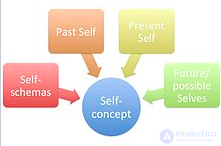
A person's self-concept consists of self-schemas and their past, present, and future "selves."
Traditionally, the cognitive, evaluative, and behavioral components of the "self"-concept are distinguished. The cognitive component is the individual's ideas about themselves, the set of characteristics they believe they possess. The evaluative component is how the individual assesses these characteristics, how they feel about them. The behavioral component is how the person actually acts .
A person usually believes they possess certain characteristics. These characteristics cannot be derived or reduced to a single current moment of their life — if a person believes they are "strong," it does not mean that they are currently lifting something heavy. Moreover, this person may not actually be objectively strong. Or they may be. The set of beliefs about oneself is precisely the cognitive component of the "self"-concept.
These beliefs may carry different degrees of significance for the individual. They may believe, for example, that they are primarily brave, and only strong as a tenth priority. This hierarchy is not fixed and can change depending on context or over time. The combination and relative importance of characteristics at any given moment largely determine the individual's attitudes and their expectations of themselves .
Among other things, the cognitive component of the "self"-concept is represented in the individual's consciousness in the form of social roles and statuses.
The individual not only believes they possess certain characteristics but also evaluates them in a particular way, has a certain attitude toward them. They may like or dislike, for example, being strong. Important roles in forming this evaluation are played by:
Whatever a person considers themselves to be, they cannot ignore how they actually behave, what they actually manage to accomplish. This "objective" part is precisely the behavioral component of the "self"-concept .
Most contemporary scholars working on personality issues conclude that it is most productive, in studying the self-image, to move from metaphors to the spheres and properties of the psyche that "work" on the self-image. Like vectors, these define a certain overall load and direction for the central structure often referred to as the "selfhood."
T. Yu. Kaminskaya identifies two approaches to developing the problem of the structure of the self-image. In the first approach, the structure of the self-image does not include a motivational component, or includes only insignificant elements of one. Thus, S. Stein defines the "self"-concept as "a system of representations, images, and evaluations existing in the individual's consciousness that relates to the subject itself." L. A. Wenger speaks of the self-image as a set of generalized substantive and evaluative representations.
The second approach consists in recognizing the influence of the motivational component (the link between the self-image and behavior) on the development of the self-image. In other words, the groundwork is laid for incorporating the motivational component into the structure of the self-image.
The most widespread view is one of the structure of the self-image as a unity of cognitive (the image of one's qualities, abilities, appearance, etc.), emotional (self-respect, self-deprecation, etc.), and evaluative-volitional (the desire to raise one's self-esteem, to earn respect, etc.) components (A. V. Petrovsky, M. G. Yaroshevsky).
G. E. Zalessky distinguishes two components of the self-image — motivational and cognitive. In studying age-related features of the development of the self-image, particular attention is given to clarifying how each of the components forms and when the two components of the self-image begin to interact.
The cognitive block of the self-image reflects substantive ideas about oneself. This understanding of the cognitive block of the self-image is close to how other researchers understand the self-image. But this block also includes evaluative components (self-esteem) and goal-related components (level of aspiration, system of prohibitions and rewards). The motivational block is responsible for the functional significance of these qualities — that is, whether these qualities serve as criteria in the choice of motives, goals, and actions. And if they do, whether the qualities function as active or meaning-forming motives.
According to many foreign authors, whose position was summarized by W. Huitt, the "self-concept" includes several components.
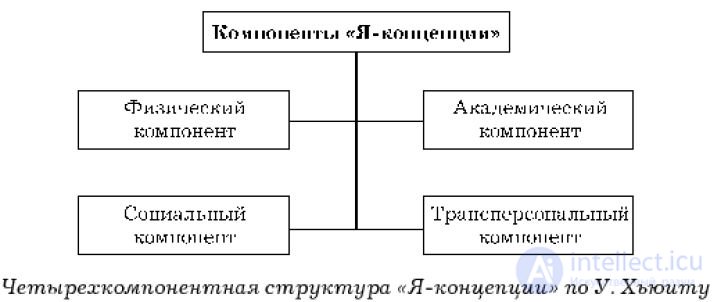
Fig. The four-component structure of the self-concept according to W. Huitt
The physical aspect of the "self-concept" manifests itself in the psychophysiological and anatomical features of our body and organism: vision, hearing, weight, sex, height, and so on. This also includes clothing style, preferred car brands, type of dwelling, and neighborhood of residence. Indeed, our "self" shows itself in the housing we choose, how we dress (whether or not we follow fashion), how we eat, what we hear and listen to, how much we weigh and whether we consider our weight excessive (excess weight often lowers self-esteem). Each of us establishes a particular relationship with our own body: we love it or dislike it, pamper it or ignore its ailments, exercise or wear the body down with idleness, alcohol, and drugs.
The academic side of the "self-concept" is expressed in school grades and achievements, in the desire and ability to learn, and so on. Two levels are typically distinguished:
The influence of school and university grades (certificates and diplomas) on career and professional advancement is well known. It often happens that a person, once grown, regrets having spent their student years on empty pursuits rather than on diligent study that would have allowed them to achieve greater results at work. Self-esteem and academic success are two closely linked variables. Success in school or university can undoubtedly raise or lower self-esteem. But an even greater predictive power belongs to self-esteem itself, whose level — low or high — directly influences future academic success (good or bad). In 1890, the founder of pragmatism, the outstanding American philosopher William James, even devised a special formula for this case:
Self-esteem = Success / Pretensions
The equation states that an increase in self-esteem is observed only when academic success grows faster than our expectations. Because of its simplicity and empirical obviousness, it gained wide popularity. Indeed, we can see for ourselves that low pretensions combined with average performance will yield high self-esteem. And conversely, high pretensions combined with mediocre performance will result in low self-esteem.
A logical corollary of James's equation is another equation:
Success = Pretensions × Self-esteem.
The new equation states that success can be improved by raising one's own expectations (pretensions) and/or self-esteem. When James defined self-esteem using his formula, he in fact pointed to two ways of increasing self-esteem: an individual can improve their self-image either by increasing the numerator of this fraction or by decreasing its denominator, since for self-esteem only the ratio of these values matters. As James wisely observed, "our self-feeling in this world depends entirely on what we back ourselves to be and to do."
The social component of the "self-concept" depends on the relationships we build with the people around us — within the family circle, in the neighborhood community, at work. Relationships with strangers, such as passersby on the street or fellow passengers on a train, have the least influence on individual self-esteem.
The social "self" arises because all of us are embedded in the lives of other people and of society as a whole, and we fulfill certain duties toward that society. In other words, we play social roles: "schoolchild," "son (daughter)," "friend," "athlete," "top student," "young man (young woman)." We spend a great deal of time interacting with other people at the level of roles. Many of our roles become an important part of our "self."
The transpersonal component of the "self-concept" is no less important, since it is responsible for addressing the problem of the meaning of life and correlates closely with a person's religious beliefs or lack thereof. Among some peoples, the Russians in particular, resolving broad worldview questions about the meaning of life precedes everyday and practical matters.
The "self-concept" can be broken down internally. The number of constituent elements of the "self-concept" varies among different psychologists. For example, D. Hamachek distinguishes the perceived "self" (how a person sees themselves), the "real self" (what a person actually is according to the results of objective tests or clinical examination), and the "ideal self" (what a person would like to become). Personality is composed of these elements, and depending on who is describing it, personality may be a totality either of aspects of an individual's inner self-perception or of external aspects of the individual's perception by another person. Ruth Strang identified four basic aspects of the "self": the general, basic "self-concept"; temporary, or transitional, "self-concepts"; the social "self"; and the ideal "self."
The phenomenological approach to understanding the "self-concept," developed by C. Rogers, rests on the following propositions:
According to the theory of self-actualization of C. Rogers and M. Kingel, a person's inner world is divided into two systems of representations, two "selves."
The "real self" is formed on the basis of the varied experience a person has to go through in interacting with other people and their behavior toward them.
The "ideal self" is formed from inflated ideas about oneself: a person sees themselves as who they would like to become through the realization of their own potential.
The two "selves" may coincide fully or partially, contradict each other, or simply differ. Full coincidence is an extremely rare case, but the most comfortable one for the individual; contradiction is likewise not a very common situation. But it carries the risk of a deep internal disorder of the personality. Usually our opinion of "our beloved self" and other people's opinion of us differ to a greater or lesser degree.
What we think of ourselves is always better than what others think of us. Each of us has a strong need for self-respect, which drives us to seek a positive attitude toward ourselves or toward what we do. If others, as often happens, approve of our emotions, feelings, thoughts, and behavior only on the condition that they match their own, it is quite likely that we will hide our true thoughts and feelings, displaying instead those that will win others' approval. As a result, we will increasingly cease to be ourselves. This will lead to a rift between the real "self," shaped by the environment, and the part of the psyche that we are forced to disown, which will become a source of anxiety for us. Conversely, if we feel that we are accepted as we are, we will tend to reveal our true emotions, feelings, and thoughts. Thus, a personality is balanced to the extent that there is agreement between a person's real "self" and their feelings, thoughts, and behavior.
According to C. Rogers, on the one hand, the individual strives to bring as much of their external experience as possible into line with these ideas about themselves, that is, with their "real self." On the other hand, they try to bring their self-image closer to those deep experiences that make up their "ideal self" and correspond to what they would like to be. Thus, the "real self" may never achieve correspondence with the "ideal self," either because, under the pressure of external circumstances, a person is forced to deny themselves certain life experiences, or because they impose on themselves feelings, values, or attitudes that only distance their "real self" from their "ideal" one.
The result of a mismatch between the "real self" and life experience, on the one hand, and between the "real self" and the ideal image a person has formed of themselves, on the other, may be anxiety and impaired psychological adjustment.
R. Burns identifies the following basic angles, or modalities of self-attitudes.
A more detailed classification of self-images was proposed by M. Rosenberg: the "present self," the "dynamic self," the "actual self," the "probable self," and the "idealized self." S. Samuel distinguishes four "dimensions" of the "self-concept": body image, "social self," "cognitive self," and self-esteem. Practically any of the images of "self" has a complex structure that is ambiguous in its origin. M. Rosenberg and H. Kaplan, examining the idea of a multilevel organization of "self-images" (the structure of the "self-concept"), distinguish various "planes of functioning" of the "self-concept" (the plane of reality, the plane of fantasy, the plane of the future, and so on, including the plane of possibility). The "possible self," corresponding to the plane of possibilities, is a person's idea of what they could become. It is not identical to the "ideal self," which is set by social norms and obligations, since it includes negative self-characteristics; it also differs from the "desired self," which is directly determined by our motivations, since it includes a reflection of moments of involuntariness in self-development.
The "ideal self" is composed of a whole range of representations reflecting the individual's deepest hopes and aspirations, and these representations can be detached from reality. According to Horney, a large discrepancy between the "real" and "ideal self" often leads to depression caused by the unattainability of the ideal. Allport believes that the "ideal self" reflects the goals an individual associates with their future. Combs and Soper regard the "ideal self" as the image of the person the individual wants or hopes to become, that is, as the set of traits of one's own personality that are necessary, in their view, to achieve adequacy, and sometimes even perfection. Many authors link the "ideal self" to the internalization of cultural ideals, representations, and norms of behavior, which become personal ideals through mechanisms of social reinforcement; ideals of this kind are characteristic of every individual. The ideal image, like the "superego," is considered an authority performing a regulatory function responsible for selecting actions.
The components of the "reflexive self" in the model proposed by Rosenberg form two parts — nouns (answering the question "Who am I?") and adjectives ("What am I like?"). The structure of these components is built according to the following criteria. The first is the degree of distinctness of awareness, of how represented a given component is in consciousness. The second is the degree of their importance, their subjective significance. The third is the degree of consistency, of logical coherence with one another, on which the consistency and non-contradictoriness of the image of the "self" as a whole depend. The criteria for building the structure of the components of the "reflexive self" in M. Rosenberg's model correspond to the concept of personal constructs in G. Kelly's theory.
The literature presents a diverse set of methods for studying the "self"-concept (the "self"-image) or its components.
Various questionnaires Examples:
The Self-Attitude Research Method (SARM) was developed by R. S. Panteleev (1989) and contains 9 scales:
The Socio-Psychological Adaptation Diagnostic Method was developed by C. Rogers and R. Diamond (1954). The method has been tested and standardized on various samples of students in Russian schools and universities. It was adapted for a Russian-speaking sample by A. K. Osnitsky. As a measuring instrument, the scale demonstrated a high discriminating ability in diagnosing features of self-perception, their restructuring during critical age periods of development and in critical situations that prompt the individual to reassess themselves and their capabilities, acceptance or rejection of themselves and others, emotional comfort or discomfort, internal or external control, dominance or submissiveness, and avoidance of problem-solving.
I. S. Kon raises the question of whether an individual can adequately perceive and evaluate themselves, in connection with the problem of the relationship between the main functions of self-awareness — the regulatory-organizing function and the ego-defensive function. In order to successfully direct their behavior, the subject must have adequate information both about the environment and about the states and properties of their own personality. The ego-defensive function, in contrast, is oriented primarily toward maintaining self-respect and the stability of the self-image, even at the cost of distorting information. Depending on which function predominates, the same subject may produce either adequate or false self-assessments. A neurotic's diminished self-respect is both the motive for and the self-justification of withdrawal from activity, whereas the self-criticism of a creative person is a stimulus for self-improvement and for overcoming new frontiers.
Projective techniques
Practically all projective methods are aimed at studying the personal domain in its various aspects — level of aspiration, degree of self-acceptance, attachment to loved ones, level of conflict, and so on. The idea that a distinctive "self-portrait" can be seen in a drawing or a story underlies the "Draw-a-Person" test (K. Machover), the "House-Tree-Person" test (Goodenough–Harris), the Thematic Apperception Test (H. Murray), the Psychogeometric Test (Dellinger), the Symbol Apperception Test (Nagibina–Afanasyeva), and others.
The "self"-image (the image of the "self," the "self"-concept) is a kind of global self-assessment. The "self"-image can be adequate or inadequate, real or ideal, structured or disintegrated, and so on.
Practically any of the images of the "self" has a complex structure that is ambiguous in its origin.
V. V. Stolin notes that the analysis of the end products of self-awareness, expressed in the structure of a person's ideas about themselves, the "self-image" or the "self-concept," is carried out either as a search for types and classifications of images of the "self," or as a search for the "dimensions" (that is, the substantive parameters) of this image. The best-known distinction among images of the "self" is that between the "real self" and the "ideal self," which is present in one form or another already in the works of W. James, S. Freud, K. Lewin, C. Rogers, and many others, along with the distinction proposed by W. James between the "material self" and the "social self." S. Samuel distinguishes four "dimensions" of the "self"-concept: body image, the "social self," the "cognitive self," and self-esteem.
A more detailed classification of images was proposed by M. Rosenberg:
Recognizing and accepting all aspects of one's "self," as opposed to "conditional self-acceptance," ensures the integration of the "self"-concept, establishes the "self" as the measure of oneself and of one's position in one's living space. The "self"-concept (the "self"-image) is the seed that carries within itself both the germ and the potential for its own growth and development. The coherent functioning of all structures, their harmonious interaction, is a necessary condition for psychological comfort.
V. Rotenberg, in his book "The 'Image of Self' and Behavior," gives examples of how the self-image is perceived under hypnosis: "When one subject was told he was Paul Morphy — the brilliant American chess player — and invited to play a game of chess, his first reaction was to demand an enormous fee — a million dollars. He was handed a stack of blank paper and told that this was the coveted million, and at that moment the encephalograph registered a powerful surge in skin electrical activity, indicating a pronounced emotional reaction. Incidentally, the person who played against this subject was Mikhail Tal himself, and Tal also played a game against him in his normal state, outside of hypnosis. The photographs showed how confidently the subject carried himself during the game while he believed himself to be Paul Morphy, for whom Tal's name meant nothing — and how timidly the same subject shrank into his chair outside of hypnosis, well aware of whom he was playing against. Incidentally, Tal admitted that although "in character" the subject was certainly not playing at Morphy's level, he was nonetheless playing roughly two rating classes higher than without hypnosis. A few months later, when a journalist asked, "Which game from recent times has stayed with you the most?", Tal answered, "The meeting with Morphy," and explained to the stunned reporter that he was not yet having hallucinations."
Thus, it is precisely the suggestion of a holistic image that allows unique capabilities, of which the person themselves is unaware, to be revealed under hypnosis. Of course, these capabilities are merely revealed, not created, by the state of hypnosis"[10].
Psychological conflicts become distinctive quality-checkpoints on the path to personal growth and self-realization, occurring when the interaction, the dialogue between images of the "self," is interrupted, "split apart" — each image, though an essential part of the "self"-concept, straining to "assert itself," to "speak up," to "be heard," yet not accepted as one's own, being rejected or defensively transformed.
The complexity and unpredictability of the self-image create difficulties for its study. Sometimes an educator deals with a student in whom the various parts and components of the self-image are "blurred," disconnected from one another. Three interrelated characteristics result from the psychological undifferentiation and dependency that constitute the main system-forming property of "borderline self-awareness":
"The factor creating the greatest risk of destabilizing one's self-attitude is a low degree of differentiation of the "self"-concept and, as a consequence, insufficient autonomy of cognitive and affective processes, which increases the stress-susceptibility of the entire integral system," believes E. T. Sokolova.[11]
In the structure of personality, a mental component responsible for the integrity of the psyche is especially singled out. This is a kind of core — the selfhood.
Selfhood is the "center of gravity." The system is balanced when the selfhood (like the sun) illuminates, warms, and gives energy to all the other components of the personality.
Carl Jung's book Psychological Types incorporated reflections on many philosophical and epistemological problems.
It sheds light on various aspects of consciousness, on possible worldview attitudes, while examining human consciousness from a so-called clinical point of view… In my book, I argued that every mode of thought is conditioned by a particular psychological type and that every point of view is in some sense relative. This raised the question of the unity needed to compensate for this diversity. In other words, I arrived at Taoism… It was precisely then that my reflections and research began to converge toward a certain central concept — the idea of selfhood, of self-sufficiency.
— Carl Jung. Memories, Dreams, Reflections. The Origin of My Works.
C. Jung regarded "selfhood" as a primary image, an archetype — a complex existing in the collective unconscious. Selfhood is the archetype of wholeness, a symbol of the fullness of human potential and the unity of personality.
I. S. Kon, in unpacking the concept of the "self" as an actively creative, integrative principle that allows the individual not only to be aware of themselves but also to consciously direct and regulate their activity, notes the dual nature of this concept: consciousness of oneself contains a twofold "self":
It is characteristic of a person to have and construct not only a theory of themselves as they actually are today, but also a theory of an ideal "self," as they would like to be in the future. It is held that the presence of such a concept of an ideal "self," or a future "self," is a crucial motivating factor that drives a person toward actions aimed at self-development, self-realization, self-actualization, and the search for an authentic life. Self-realization manifests itself in constructing and adjusting, restructuring, the "concept of self," including the "ideal self," one's picture of the world and life plan, and in becoming aware of the results of one's prior activity (forming a concept of the past).
Karen Horney distinguishes the actual, or empirical, "self" from both the idealized "self," on the one hand, and the real "self," on the other. The actual self is an all-encompassing concept for everything a person is at a given time: for their body and soul, health and neuroticism. The actual self is what the subject has in mind when they say they want to know themselves — that is, they want to know what they are actually like. The idealized self is what the subject is in their irrational imagination, or what they are supposed to be according to the dictates of neurotic pride. The real self is the "primal" force acting in the direction of individual growth and self-realization, with which the subject can once again achieve full identification once free of neurosis. The real self is what the subject is referring to when they say they want to find themselves. For neurotics, the real self is a possible self, in contrast to the idealized self, which cannot be attained.
Some methods for determining psychological type are based on the person choosing their type as the preferred one — that is, highlighting their most attractive characteristics.
There are methods in which a person provides an image of themselves and an image of someone close to them, thereby highlighting their particular traits that distinguish them from that other person. One example is Timothy Leary's method for diagnosing interpersonal relationships (the Leary test). The method is designed to study a subject's ideas about themselves and about their ideal "self," as well as to study relationships within small groups. This method reveals the predominant type of attitude toward others in self-assessment and mutual assessment.
Despite its stability, the "self"-image is not a static but a dynamic formation. The formation of the self-image is influenced by a whole complex of factors, among which contacts with "significant others" are especially important, essentially shaping one's ideas about oneself. An individual's ideas about themselves, as a rule, seem convincing to them regardless of whether they are based on objective knowledge or subjective opinion. The objects of a person's perception can include, in particular, their body, their abilities, their social relationships, and many other personal manifestations. "Self"-identity is the "self"-image formed by comparing oneself with others and determining one's place in the social structure. "The human "self" exists only through constant dialogue with others" (I. S. Kon). Forming an adequate "self"-concept, like self-awareness as a whole, is an important condition for raising a conscious member of society[12].
Infants at first do not distinguish between themselves and the surrounding world. As they grow, the bodily "self" begins to develop, and with awareness of it comes an understanding of the non-identity of the inner and outer worlds. Later, young children begin to compare themselves with their parents, peers, and relatives, finding various differences. By middle childhood, their knowledge of themselves has expanded so much that it already includes a whole system of evaluations of their own qualities.
In adolescence and youth, self-esteem takes on a more abstract character, and adolescents become noticeably preoccupied with how others perceive them. Finding oneself, assembling one's own identity from a mosaic of self-knowledge, becomes the paramount task for young men and women. It is during this period that their intelligence reaches a level of development that allows them to reflect on what the surrounding world is like and what it should be[13].
It can be said that a teenager tries to develop whatever is embedded in the "self"-concept. For example, in a physically ill child, the "self"-concept contains the notion of being healthy. Such a child will try to physically improve themselves. If the level of aspiration is high while one's own abilities are perceived as insufficient, neuroticism may arise (touchiness, stubbornness)[14].
Throughout the entire adult period of life, a person's "self"-concept simultaneously strives to maintain continuity and undergoes change. Important life events — changing jobs, marriage, the birth of children and grandchildren, divorce, job loss, war, personal tragedies — compel us to reconsider our attitude toward ourselves[13].
It has been found that the dynamics of change in a person's "self"-concept begin with a shift in attitude toward oneself and the external world, which serves as the trigger for a shift in all the interdependent components of this multilevel system. As contradictions in the structure of the self-image increase, stability is disrupted, internal consistency among the elements of the "self"-concept model disappears, "loss of self" occurs, and psychological tension arises. The process of change, which proceeds either along the path of simplifying or of complicating the content of the "self"-concept, culminates in a transformation of its entire structure.
All researchers note the complexity and ambiguity of the formation and development of the self-image. The self-image is a systemic, multicomponent, and multilevel formation of the human psyche. All the components of this system have an innumerable number of degrees of freedom, which complicates the possibility of a scientific approach to diagnosing and predicting the formation of the self-image. Apparently, the growth points and points of personal development along the path of self-realization coincide with such human realities as selfhood, self-actualization, the ideal "self," and a person's striving to find a harmonious correspondence of these realities within their self-image.
Gergen (Gergen, 1971) identifies the following factors related to others' evaluations that influence an individual's perceptions of themselves:
Based on this, an external evaluation will pose a threat to the "self"-concept in cases where:
The reflective "self" is a kind of cognitive schema underlying the implicit theory of personality, in light of which an individual structures their social perception and their views of other people. In the psychological ordering of a subject's ideas about themselves and their own dispositions, the leading role is played by higher-order dispositional formations — in particular, the system of value orientations.
G. E. Zalessky identifies the following stages in the formation of personal meanings:
Worldviews about oneself in relation to others differ across and within cultures. [38] Western cultures place special emphasis on personal independence and the expression of one's own qualities [39] (i.e., the individual matters more than the group). This does not mean that members of an independent culture do not identify with or support their society or culture — there is simply a different type of relationship. [40] Non-Western cultures tend to prefer an interdependent view of the self: [38] interpersonal relationships matter more than individual achievements, and people feel a sense of unity with the group. [38] Such identity fusion can have both positive and negative consequences. [38] Identity fusion can give people a sense of the significance of their existence, provided that the person feels included in society (for example, in Japan the definition of the word "self" (jibun) roughly translates as "a share in a shared living space"). [40] Identity fusion can also harm a person's self-esteem, because their behavior and thoughts must keep changing in order to remain aligned with those of the entire group. [40] Non-interdependent views of the self can also vary depending on cultural traditions. [41]
In addition, social norms and cultural identity have a great influence on self-esteem and psychological well-being. [40] When a person can clearly define the norms of their culture and how those norms play a role in their life, that person is more likely to have a positive self-identification, which leads to better self-esteem and psychological well-being. [40] One example of this is consistency. One of the social norms of Western independent culture is consistency, which allows each person to maintain their self-esteem over time. [42] The social norm in non-Western, interdependent cultures is focused more on a person's ability to be flexible and to change as the group and environment change. [42] If this social norm is not followed in either type of culture, it can lead to a break with social identity, which affects personality, behavior, and overall self-esteem. [40] Buddhists emphasize the impermanence of any self-concept. [43]
Anit Somech, an organizational psychologist and professor who conducted a small study in Israel, showed that the gap between independent and interdependent self-concepts exists within cultures as well. Researchers compared mid-level traders in an urban community with traders from a kibbutz (a collective community). [44] Managers from the urban community followed an independent culture. When asked to describe themselves, they mostly used descriptions of their personal qualities without comparison to others in their group. [44] When the independent urban managers did give interdependent answers, most of them focused on work or study, since these were the two largest groups identified within the independent culture. [44] Kibbutz managers adhered to an interdependent culture. They used hobbies and preferences to describe their traits, which is more common in interdependent cultures, since these serve as a means of comparison with others in their community. Considerable attention was also given to housing, which is explained by the fact that they share resources and living space with other kibbutz residents. These types of differences were also observed in a study conducted with Swedish and Japanese adolescents. [45] Generally, both are considered [by whom?] non-Western cultures, but the Swedes showed more independent traits, while the Japanese followed the expected interdependent traits. [44]
Alongside considering one's identity as part of a group, another factor that coincides with self-esteem is stereotype threat. Many working names have been used for this term: "stigmatization," "stigma pressure," "vulnerability to stigma," and "stereotype vulnerability." The terminology adopted by Claude Steele and Joshua Aronson to describe this "situational predicament" was "stereotype threat." This term reflects the idea of a situational predicament as a contingency of one's [marginalized] group identity — a real threat of judgment or treatment in one's environment that goes beyond any internal limitations." [46] Steele and Aronson described the concept of stereotype threat in their study of how this social-psychological phenomenon affects the intellectual abilities of African Americans. [47] Steele and Aronson tested the hypothesis by administering a diagnostic exam to two different groups: African American and white students. Stereotype threat was induced for one group, while the other served as a control. It was found that the academic performance of African American students was significantly lower than that of their white counterparts when stereotype threat was activated, after controlling for intellectual ability. Since Steele and Aronson introduced stereotype threat, other studies have demonstrated the applicability of this concept to other groups. [47]
When a person's actions might negatively affect general assumptions about a stereotype, these actions are consciously highlighted. Society treats social groups as an objective category rather than as individual characteristics, which can be perceived as a negative stereotype, creating a threat. "The notion that stereotypes about a particular group can create psychologically threatening situations, tied to the fear of confirming a judgment about one's group, which in turn hinders learning and performance." [48]
The same prejudices that exist in stereotype threat also exist within the education system, as it serves its communities, families, and individuals. These discriminatory practices in schools are the focus of various educational and psychological studies. Research aims to increase equity in the classroom, as well as the academic achievement of students from minority groups.
The presence of stereotype threat perpetuates a "hidden curriculum," which further marginalizes minority groups. The hidden curriculum refers to the covert expression of biases, in which one standard is accepted as the "established and correct way of doing things." More specifically, the hidden curriculum is the unintentional transmission of social constructs that operate within the social environment of an educational institution or classroom. In the United States education system, this serves the dominant cultural groups in American society. "A major source of stereotypes is often the very curriculum used to train teachers. It is in these programs that teachers learn that poor students and students of color should be expected to achieve less than their 'regular' peers." These assumptions of deficiency in children, which are embedded in the curriculum that instructs teachers, lead to the unintentional testing of all students against a "conventional" standard that is not necessarily academic and that fails to account for the social values and norms of "non-regular" students. [clarification needed]
For example, the "teacher as formal authority" model is the role of the orthodox teacher, entrenched [by whom?] for many years, until the 21st-century model of education came onto the scene. As part of the 5 basic teaching styles proposed by Anthony Grasha, a cognitive and social psychologist, before his death in 2003, the authoritarian style is described as the belief that there are "correct, acceptable, and standard ways of doing things." [50] This system dominated for as long as the education system in America existed; however, the belief that there is an "established and acceptable way of doing things" was a thing of the past and can now perpetuate a "hidden curriculum," which is a form of institutional racism against marginalized groups such as Mexican Americans, Asian Americans, African Americans, and students with learning disabilities. This paves the way for the rule of deficit thinking and a weakening of the growth mindset.
A 1997 study, inspired by cross-cultural differences in self-esteem, found that men tend to be more independent, while women tend to be more interdependent. [51] A 1999 study found that although men and women do not differ in terms of independence or interdependence, they do differ in the types of interdependence. Women use relational interdependence (identifying more with one-on-one relationships or small groups), while men use collective interdependence (defining themselves in the context of larger groups). [52] In addition to their views on interdependence, men and women also differ in how they view themselves with respect to some other traits related to self-esteem. For example, a study conducted in 1987 found that men consider themselves more successful and financially oriented, as well as more competitive, than their female counterparts. In contrast, women were more likely to consider themselves sociable, moral, dependent, and less assertive than men. These differences potentially affect a person's subjective well-being. [53]
Boys and girls engage in different social interactions and relationships. Girls tend to prefer one-on-one (dyadic) communication, forming close, intimate bonds, whereas boys prefer group activities. [54] One study, in particular, found that boys performed almost twice as well in groups as in pairs, whereas girls showed no such difference. [55] In early adolescence, males are more likely to have a positive physical self-image. At this stage of development, boys who mature early tend to have a more positive attitude toward themselves, in contrast to early-maturing girls, who view themselves more negatively. The biggest difference at this stage of development between males and females is how they view their appearance. At this age, it is assumed that a more attractive person possesses greater social power. By the time they reach college age, women still have a lower physical self-image than men. [56]
Girls are more likely to wait their turn to speak, to agree with others, and to acknowledge others' contributions. Boys, on the other hand, build relationships in larger groups based on shared interests and activities. Boys are more likely to threaten, boast, and call names, which reflects the importance of dominance and hierarchy in groups of male friends. [54] In mixed-sex pairs of children around 33 months of age, girls were more likely to passively observe their male partner's play, and boys were more likely not to respond to what their female partners said. [57] The social characteristics of boys and girls as they develop in childhood tend to persist into later life as they become men and women, although the characteristics displayed in early childhood do not necessarily fully reflect later behavior. [54]
Several studies have shown a difference between men and women based on their academic self-concept. In general, men are more inclined to rate their overall academic self-concept higher, especially in mathematics, science, and technology. Women tend to have higher perceived abilities in language skills. This differing view of academic ability has led to a gap in academic achievement in countries such as Norway. These perceived self-assessments tend to reflect typical gender stereotypes that are widely represented in most cultures. [58] In recent years, more women have begun to enter STEM fields, working predominantly in mathematics and science. Many factors play a role in women adjusting their
продолжение следует...
Часть 1 Self-Concept
Часть 2 - Self-Concept

Comments