
Lecture
The primacy effect (also known as the "primary effect" or "first-order effect") in political science refers to which particular issues or candidates attract the most attention from voters and how this influences their preferences at elections.
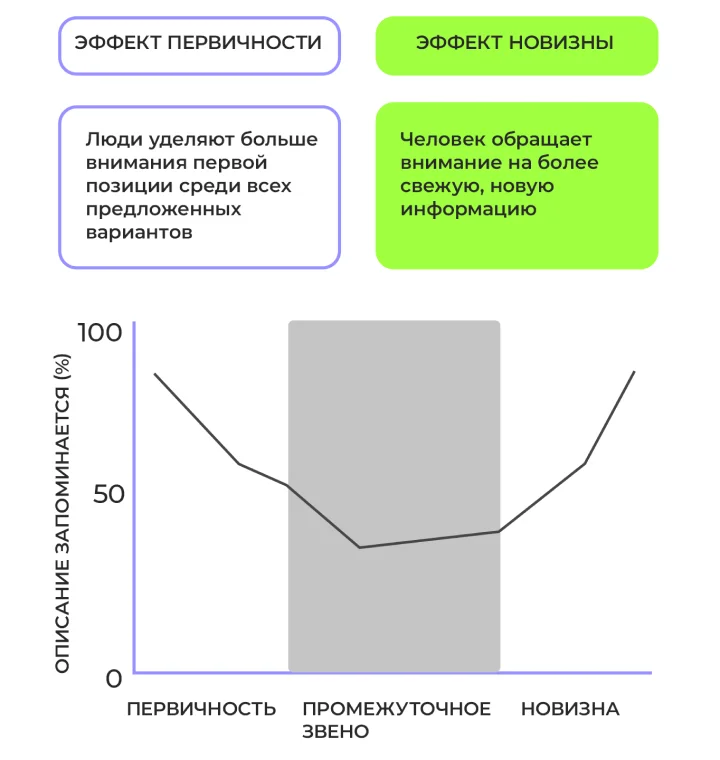
The primacy effect is commonly understood as the tendency to judge events that occurred first as more significant against the backdrop of all events that happened later. In other words, people tend to remember events and phenomena that occurred at the beginning of some notional process better than those that occurred in its middle or at its end. There is a serial position effect, characterised by the fact that the first and last items of a series are remembered better than the middle ones.
In practice, the primacy effect is reflected in how a person perceives the surrounding reality. When a person encounters an object that once made an impression on them, they recall their very first sensations and are guided by them in drawing conclusions and inferences.
From the standpoint of sociology, the study of this phenomenon is interesting because individuals encounter its influence every day when interacting with other members of society. People tend to justify all subsequent actions of those around them by their initial manners, deeds and words, regardless of how long ago the first contact took place.
In the context of political elections and campaigns, when voters have limited information about candidates or issues, the primacy effect can have a substantial impact on election outcomes. Candidates who are front-runners or who receive initial support at the start of a campaign may attract more attention from voters, which in turn can lead to additional support and improve their chances of winning.
One of the causes of the primacy effect is a psychological phenomenon known as the "expectancy effect" or "confirmation bias". Voters who hear about a candidate or an issue for the first time tend to seek confirmation of their own opinions or expectations, which introduces an additional emotional factor into their decision to vote for that candidate or to support that issue.
Thus, the primacy effect can play an important role in shaping voters' attitudes towards candidates and their decisions at the polls. This makes a "fast start" strategy important for candidates and campaign teams in order to attract voters' attention and support from the very beginning of the electoral process.
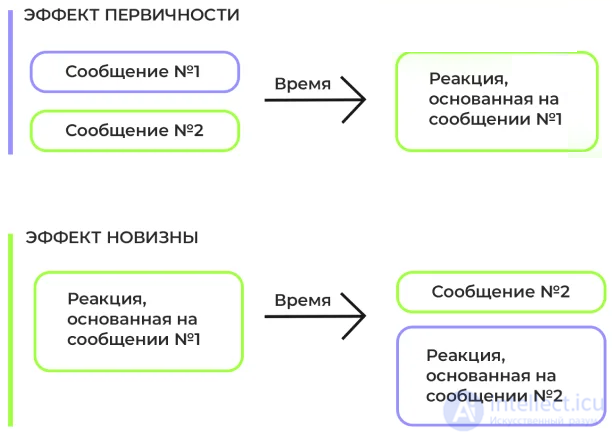
Long before the primacy effect was formally established in science and proven empirically, it was mentioned in theoretical scholarly works, one of whose authors is M. Lundt. He described the so-called law of precedence as early as 1925. The first attempts at applied research into this phenomenon are associated with the name of Solomon Asch, who in 1946 advanced the theory that the first message makes a stronger impression on a person than all subsequent ones, distorting the processes of perceiving reality.
The history of in-depth empirical research into the primacy effect begins in the second half of the nineteenth century, when it became an object of study in experimental psychology. The first fundamental applied studies date to the 1870s and 1880s. At that time researchers focused mainly on studying the workings of rote memory, above all the serial position effect.
As new data on the regularities of human memory emerged, the study of the primacy effect acquired a methodology. Throughout the twentieth century new and ever more refined techniques appeared for establishing connections and regularities among serial position phenomena, for example the "free recall" method.
In the twentieth century a large number of studies based on an already elaborated methodological foundation had as their main aim the identification of the factors determining the degree to which the primacy effect influences the accuracy of reproducing a memorised series. Interest in studying the phenomenon was shown not only by representatives of psychological science, but also by sociologists, political scientists, educators, criminologists and so on.
Scholarly works still appear today that examine the time intervals required to memorise information, the role of first impressions, the influence of initial experience on subsequent decision-making, methods of taxing memory and others.
Since A. Solomon's description of the primacy effect was insufficiently elaborated, his point of view was subjected to criticism. Thus, in the opinion of C. Hovland, the theory proposed by Solomon overlooks such important factors as the worldview, level of education and general outlook of the subjects. Moreover, Solomon's theory was criticised for the absence of any boundary between the primacy and recency effects. N. Miller and D. Campbell managed to establish the boundary between these phenomena, while larger-scale empirical research belongs to H. Ebbinghaus.
Thus, the German psychologist H. Ebbinghaus, while studying the regularities of rote memory, was able to prove and substantiate experimentally the existence of the primacy effect. The result of his experiments was the substantiation of the existence of the so-called serial position effect of memory. According to H. Ebbinghaus, there are two serial position effects: primacy (also known as the primacy effect) and recency. The primacy effect is characterised by more successful recall of items located at the beginning of a list, while the recency effect involves a higher level of retention of the final positions in the list.
H. Ebbinghaus's experiments attracted wide attention from the scientific community, primarily from psychologists and sociologists, who continued research in this direction. Almost simultaneously with him, a number of researchers made attempts to explain the primacy effect by means of a technique known as "free recall". Using this method, D. Brodie and B. Murdock managed to establish the interdependence between the "primacy" and "recency" effects.
Such experiments became especially popular at the end of the twentieth and the beginning of the twenty-first century. E. Coluccia, N. Gamboz and M. Brandimonte, as representatives of the contemporary stage of memory research, explain the free recall phenomenon by the fact that it is difficult for experiment participants to memorise information without any cues or warnings about the forthcoming task.
This regularity was preceded by the discovery of another feature of the structure of human memory: experiments at the end of the twentieth century revealed that participants who were aware of the forthcoming test on a list tended to rehearse the items named as they were presented. That is, by repeating the items in the given sequence, the subjects each time added newly heard items to the memorised series, thereby gradually lengthening it.
In the course of such experiments it was established that the primacy effect influences responses more strongly when a sufficiently long interval passes between the addition of new items, allowing the sequence of items to be rehearsed more often (D. Rundus, A. Glenberg, M. Bradley, J. Stevenson, M. Tkachuk, A. Gretz).
Today researchers' interest is directed towards studying the influence of the primacy effect on decision-making (in the political, educational, professional, social and other spheres of life). In 2013 S. Hanan, T. Neiman and Y. Loewenstein established the influence of the primacy effect on learning outcomes using the principle of operant conditioning (a learning process in which the learner's behaviour is modified by reward or punishment). In addition, the influence of the first experience gained in some activity on decision-making in subsequent analogous situations was identified: experience acquired earlier may cause subsequent events to be underestimated.
The consequences of the discovery of the edge effect, of which the primacy effect is a component, can be divided into several groups. The first comprises the development of ideas about the features of memory put forward by H. Ebbinghaus as the founder of the phenomenon; the second, the emergence of new lines of scientific research based on his discoveries set out in the study "On Memory".
Thus, H. Ebbinghaus himself, drawing on the edge effect and conducting experiments on himself, demonstrated the existence of the forgetting curve, which, along with the learning curve, became a classic determinant frequently used as a basis for developing professional skills and solving a range of psychological problems. In the course of studying the edge effect he developed mathematical models of memory and showed their non-linear character. The fact that memory can be trained was discovered, and along with it special methods were proposed for better retention of information in memory, as well as several techniques for investigating these processes. In addition, in the course of studying memory the "trace trampling effect" was discovered, which consists in the fact that on contact with new information similar to that received earlier, the older information becomes distorted or is erased from memory altogether.
Subsequently the data obtained by H. Ebbinghaus were developed further and supplemented in the works of other researchers. In particular, it has been repeatedly proven that the items of material located at its beginning and end are remembered significantly better, and that the probability of retaining the first few items of a series in memory is considerably greater than the probability of retaining the middle items. Moreover, on the basis of the phenomenon identified by H. Ebbinghaus, one of the best-known phenomena of retention and forgetting in memory was discovered, known as the Zeigarnik effect, and "Jost's law" was formulated.
Medical research developed widely, in particular research devoted to cases of amnesia and its attendant regularities, and to the dynamics of forgetting. Over time the accumulated theoretical and experimental basis was substantially supplemented by S. Freud, who formulated the law of motivated forgetting, generating fresh interest in the psychological component of memory.
The most widespread manifestation of the use of the primacy effect can be observed in the economic sphere of social life, namely in marketing. Knowing the merits of the product being sold that qualitatively distinguish it from competitors' goods, the marketer places them at the beginning or the end of the material addressed to the consumer or buyer.
In politics the primacy effect is used in propaganda according to the principle "the politician who speaks first is always right" . A candidate who is the first to convince voters of the inevitability of his own victory is thereby fixed in the public consciousness as the winner.
In the media the primacy effect is directly related to the term "post-truth". Once "fake news" has already stirred up the public, the effect of subsequent publications of true information is negligible.
Descriptions of acts of memory distortion are also found in art. For example, J. W. von Goethe wrote the lines: "We are highly susceptible to first impressions and are ready to believe the most implausible things; they at once implant themselves firmly within us…".
The primacy effect manifests itself daily in everyday situations occurring in society. For example, company managers most often perceive their subordinates on the basis of impressions formed as early as the job interview.
This phenomenon is very often encountered by students and by members of professions that require memorising large volumes of sequential information.

Comments