
Lecture
Accentuation, character accentuation, personality accentuation, accentuated personality trait (from Latin accentus — stress, emphasis) — a character trait (in other sources, a personality trait) that falls within the clinical norm, in which certain traits are excessively pronounced, resulting in selective vulnerability to certain psychogenic influences while maintaining good resistance to others. Accentuations are not mental disorders, but in a number of their properties they resemble personality disorders, which allows for assumptions about a connection between them.
The term "accentuation" was introduced in 1968 by the German psychiatrist Karl Leonhard, who used it in the phrases "accentuated personality" and "accentuated personality trait." He describes accentuations as excessively intensified individual personality traits that have a tendency to develop into a pathological state under unfavorable conditions. Leonhard characterizes accentuations as a "deviation from the norm," but notes that, in his opinion, "the population of Berlin is 50% accentuated personalities and 50% the standard type of people." He also developed his own classification of accentuations, in which one can see a significant influence of psychoanalytic ideas about the typology of mental disorders.
In 1977, Andrei Yevgenyevich Lichko, building on Leonhard's work and Pyotr Borisovich Gannushkin's classification of psychopathies, developed the concept further and began using the phrase "character accentuation," considering personality too complex a concept for accentuations. The typology he developed has a clear connection to Gannushkin's classification of psychopathies and, moreover, is intended only for adolescence.
At present, with Russian psychiatry's transition to ICD-10, Gannushkin's classification of psychopathies has become outdated, and accentuations, for the sake of practical convenience, are often classified on the basis of the international typology of personality disorders or psychoanalytic typologies of personality disorders, although this approach is not rigorous or recognized by the scientific community.
In ICD-10, accentuation is classified as one of the problems related to difficulties in maintaining a normal lifestyle (Z73). In this classification, the diagnosis "accentuation of personality traits" (Z73.1) refers to a behavioral pattern characterized by unrestrained ambition, a drive for high achievement, as well as impatience with a sense of urgency.
A normal state of the psyche can smoothly transition into accentuation, which, in turn, gradually transitions into psychopathy or personality disorder. These are links in the same chain, united by common processes with varying degrees of intensity. At present, the classification of accentuation and psychopathy is purely descriptive (phenomenological) in nature and does not reflect the essence of the mental process that shapes them. Therefore, the basis for classification should not be the external behavioral manifestations of accentuations and psychopathies, but the fundamental elements of the psyche and models of the world (as part of the psyche) that are directly involved in the formation of all accentuations and psychopathies.
The concept of "accentuation" is close to the concept of "personality disorder." The main difference is that the three key characteristics of a personality disorder (impact on all spheres of a person's life, stability over time, social maladjustment) are never present simultaneously in accentuation:
Although this is usually not specifically emphasized, one can see that the concept of "accentuation" is defined through the concept of "personality disorder" ("psychopathy") and is secondary to it. From Lichko's statements about the differences between accentuations and personality disorders, one can conclude that in all other respects they are similar.
A. Ye. Lichko developed his concept and diagnostic methods exclusively for working with adolescents, which is why one can sometimes come across statements by other authors that the concept of accentuation applies only to adolescence. However, he himself nowhere limits the scope of application of this concept and speaks only about the scope of application of his theoretical and practical work. Later on, he applied his work and developed the concept further with regard to adults.
A. Ye. Lichko distinguishes two degrees of expression of accentuations:
Unlike a personality disorder (formerly "constitutional psychopathy"), character accentuation leads to maladjustment only in certain situations. A personality disorder, on the other hand, is a severe disturbance of characterological constitution and behavioral tendencies, almost always accompanied by maladjustment.
With accentuation, distinctive features manifest not everywhere and not always, in contrast to personality disorders. Maladaptive traits appear only occasionally, under certain conditions, in difficult life situations or psychological trauma. With a personality disorder, on the other hand, pathological character traits are total and relatively stable.
Character accentuation is an excessive intensification of individual character traits and their combinations, representing an extreme variant of the mental norm. In some people, certain character traits are so sharpened (accentuated) that, under certain circumstances, this leads to recurring conflicts and nervous breakdowns. With character accentuation, a person becomes vulnerable not to any (as with psychopathies) but only to certain traumatic influences directed at the so-called "point of least resistance" of that character type, while maintaining resistance to others. Accentuations can transform into one another under the influence of various factors, among which upbringing, social environment, professional activity, and physical health play an important role.
Taking shape by adolescence, most accentuations, as a rule, smooth out and become compensated over time, and only under complex, traumatic situations that affect the "weak link" of character over a prolonged period can they become the basis for acute emotional reactions and neuroses.
Character accentuation vs. personality disorders
Although a pronounced character accentuation may resemble a personality disorder, there are clear differences between them.
Unlike personality disorders, accentuation is never marked by the simultaneous presence of social maladjustment, that is, behavioral inflexibility, stability over time, and impact on all spheres of a person's life. That is, with personality disorders, specific reactions are observed to absolutely all psychogenic influences, while with accentuation they occur not always and not everywhere, but only in certain situations, only under special conditions.
Accentuation may be most pronounced during a certain period of life and, as a rule, smooths out over the years. Personality disorders, on the other hand, are usually characterized by stability, meaning that once manifestations appear in early years, they do not disappear and may even intensify.
With accentuation, social maladjustment often does not occur at all, or is temporary in nature. With personality disorders, social adaptation is clearly impaired.
When does accentuation manifest?
Accentuation can be overt or latent. Overt accentuations manifest almost always, in all life situations, while latent ones manifest only under extreme conditions, at which point the sharpened character traits become noticeable.
Can accentuation lead to pathology?
Under unfavorable conditions, in which a person struggles to adapt to a changing situation, during prolonged stress, in difficult periods of life, such as adolescence or early school age, accentuation can develop into psychopathy
Over the course of the existence of the concept of "accentuation," several typologies of accentuated personalities have been developed. The first of these (1968) belongs to the author of the concept, Karl Leonhard. The next, more widely known classification, from 1977, was developed by Andrei Yevgenyevich Lichko.
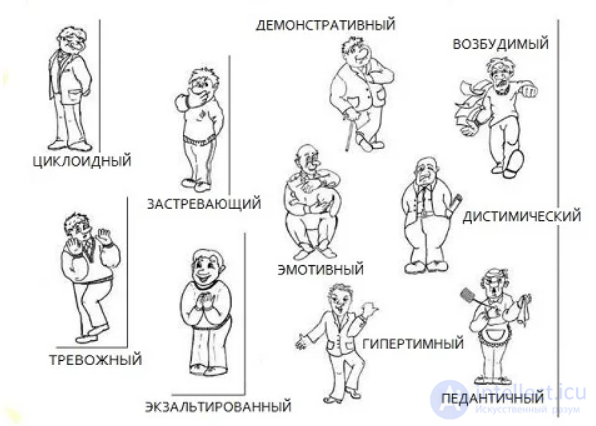
Classification of accentuations is a psychological typology developed on the basis of the concept of accentuation (of character, of personality). Over the course of the existence of the concept of "accentuation," several such typologies have been developed. The first of these (1968) belongs to the author of the concept, Karl Leonhard. The next, more widely known classification was developed by Lichko (in 1977) and was based on Gannushkin's classification of psychopathies, made in 1933.
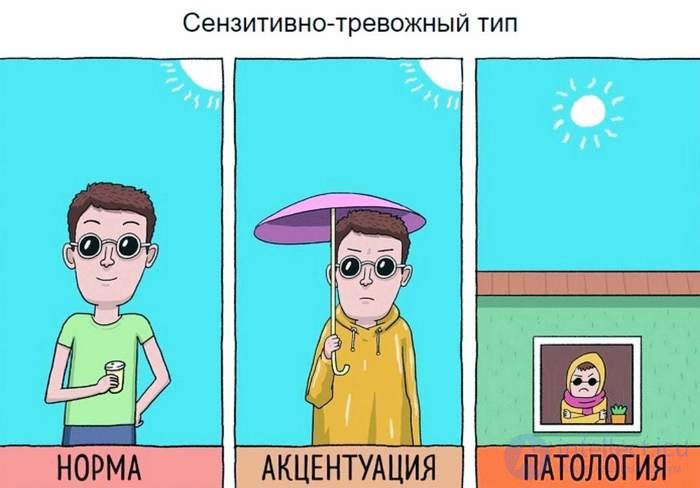
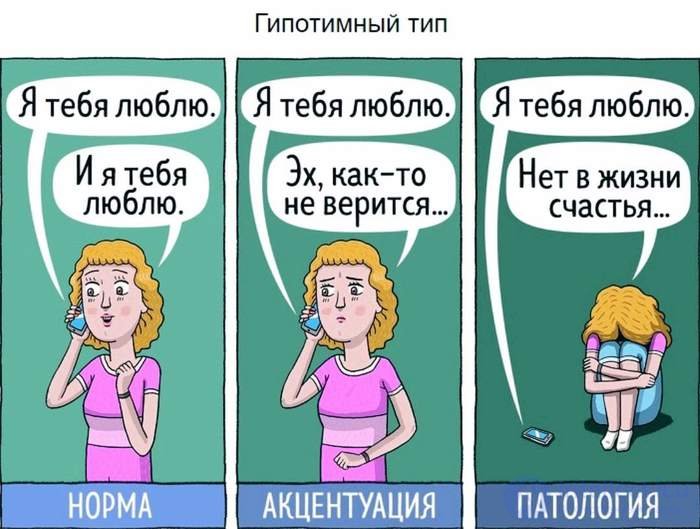


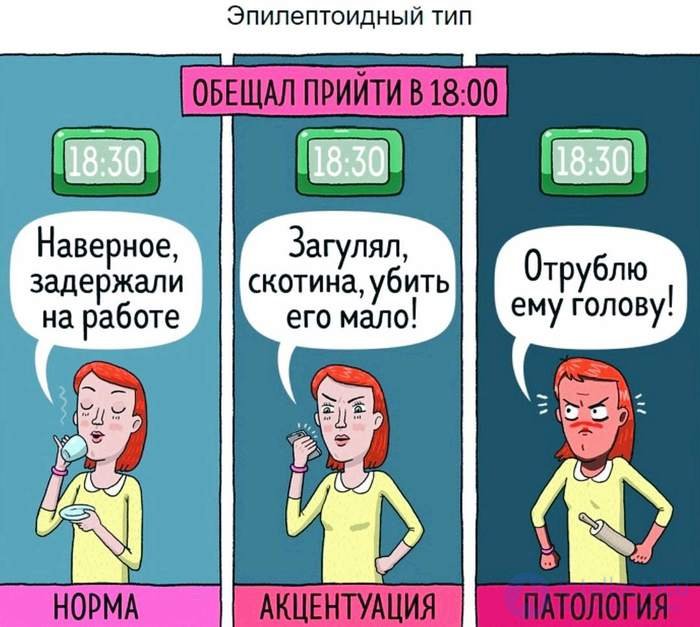
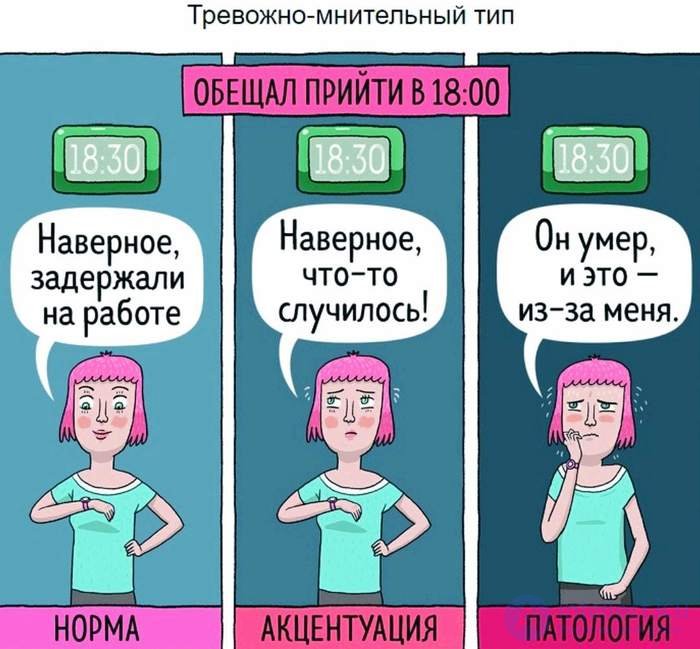
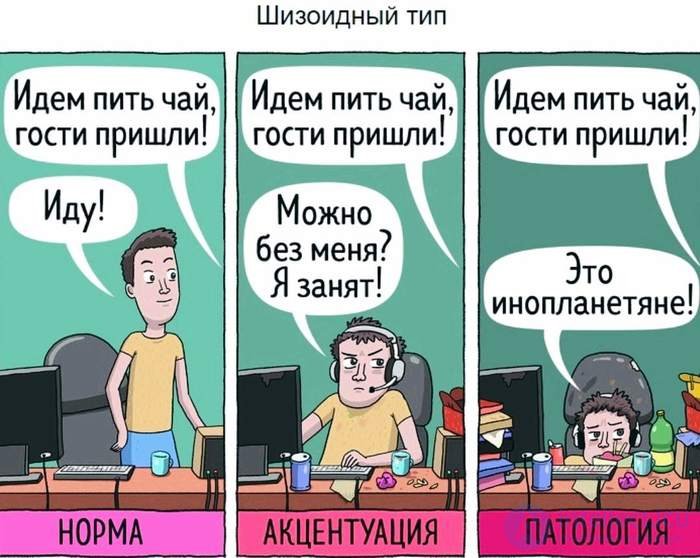

Karl Leonhard identified twelve types of accentuation. By their origin, they have different localizations.
Leonhard attributed the following types to temperament, as a natural formation:
He attributed the following types to character, as a socially conditioned formation:
He attributed the following types to the personality level:
It should be noted that the concepts of extraversion and introversion used by Leonhard are closest to Jung's ideas: an extravert, according to Leonhard, is a person oriented toward external, "objective" stimuli, receptive to and interested in the influence of the environment, while an introvert is oriented toward their own "subjective" perceptions, little affected by outside influence and uninterested in it. This understanding of extraversion and introversion is not the only correct one — psychology has other descriptions of these characteristics, for example, in Eysenck.
The asthenic-neurotic type is characterized by increased fatigability and irritability. Asthenic-neurotic people are prone to hypochondria, and they experience high fatigue during competitive activity. They may exhibit sudden affective outbursts over trivial reasons, and emotional breakdown when they realize their plans are unattainable. They are neat and disciplined.
The hyperthymic (hyperactive) type of accentuation is expressed in constantly elevated mood (of the hyperthymic type) and energy level, unstoppable activity and a thirst for socializing, and a tendency to take on too much and not finish what they start. People with a hyperthymic character accentuation cannot tolerate monotonous surroundings, monotonous work, solitude and limited contacts, or idleness. Nevertheless, they are distinguished by energy, an active outlook on life, sociability, and their good mood depends little on circumstances. People with hyperthymic accentuation easily change their hobbies and enjoy risk.
People with the hysteroid type have pronounced egocentrism and a craving to be the center of attention. They cope poorly with blows to their egocentrism, experience fear of exposure and fear of being ridiculed, and are prone to demonstrative suicide (parasuicide). They are characterized by persistence, initiative, sociability, and an active stance. They choose the most popular hobbies, which they easily change on the fly.
The conformist type is characterized by conformity to one's surroundings; such people strive to "think like everyone else." They cannot tolerate abrupt changes, disruption of their life pattern, or loss of their familiar environment. Their perception is extremely rigid and strongly limited by their expectations. People with this type of accentuation are friendly, disciplined, and non-conflictual. Their hobbies and sex life are determined by their social environment. Bad habits depend on the attitude toward them within the immediate social circle they orient themselves by when forming their values.
The labile type of accentuation implies extremely pronounced mood swings. People with labile accentuation have a rich emotional sphere and are highly sensitive to signs of attention. Their weak point manifests under emotional rejection by loved ones, loss of loved ones, and separation from those to whom they are attached. Such individuals demonstrate sociability, good nature, sincere attachment, and social responsiveness. They are interested in socializing, drawn to their peers, and content with the role of being cared for.
The unstable type of character accentuation is defined by laziness and an unwillingness to engage in work or study. These people have a strongly pronounced craving for entertainment, idle pastimes, and doing nothing. Their ideal is to be free of supervision and left to their own devices. They are sociable, open, and helpful. They talk a great deal. Sex serves them as a source of entertainment, their sexual life begins early, and the feeling of love is often unfamiliar to them. They are prone to alcohol and drug use.
The psychasthenic type is defined by a tendency toward introspection and reflection. Psychasthenics often waver when making decisions and cannot tolerate high demands and the burden of responsibility for themselves and others. Such individuals demonstrate neatness and prudence, and self-criticism and reliability are characteristic traits for them. They usually have an even mood without sharp changes. In sex, they often fear making a mistake, but in general their sex life proceeds without particular issues.
People with the sensitive type of accentuation are highly impressionable, characterized by a sense of their own inferiority, timidity, and shyness. They often become objects of ridicule during adolescence. They are readily capable of showing kindness, calmness, and mutual support. Their interests lie in the intellectual-aesthetic sphere, and social recognition is important to them.
With the cycloid type of character accentuation, two phases are observed — hyperthymia and subdepression. They are not sharply expressed, are usually short-lived (1–2 weeks), and may alternate with long breaks. A person with cycloid accentuation experiences cyclical mood changes, in which despondency gives way to elevated mood. During a mood downswing, such people show heightened sensitivity to reproach and cope poorly with public humiliation. However, they are proactive, cheerful, and sociable. Their hobbies are unstable in nature, and during a downswing they tend to abandon their tasks. Sex life depends strongly on the rise and fall of their general state. In the elevated, hyperthymic phase, such people closely resemble hyperthymics.
Schizoid accentuation is characterized by the individual's withdrawnness and detachment from other people. Schizoid people lack intuition and the ability to empathize. They have difficulty establishing emotional contacts. They have stable and enduring interests. They are quite reticent. Their inner world is almost always closed to others and filled with hobbies and fantasies intended solely for their own pleasure. They may show a tendency toward alcohol use, but it usually does not produce a pronounced euphoria in them. For schizoids, alcohol can play the role of "communicative doping," that is, easing contact with other people and instilling confidence.
The epileptoid type of accentuation is characterized by excitability, tension, and authoritarianism in the individual. A person with this type of accentuation is prone to periods of sullen, malicious moods, irritation with affective outbursts, and seeking targets to vent anger on. Petty precision, meticulousness, scrupulous adherence to all rules even at the expense of the task at hand, and pedantry that wears others down are usually seen as compensation for their own inertness. They cannot tolerate insubordination toward themselves or material losses. However, they are thorough, attentive to their health, and punctual. They strive for dominance over their peers. In intimate-personal matters, jealousy is strongly pronounced in them. Cases of alcohol intoxication with outbursts of anger and aggression are frequent.
Comparative table of types of personality and character accentuation:
| Personality accentuations (K. Leonhard, 1964) |
Character accentuations (A. Ye. Lichko, 1977) |
|---|---|
| Affectively labile | — |
| Affectively exalted | — |
| Excitable | Epileptoid |
| Hyperthymic | Hyperthymic |
| Demonstrative | Hysteroid |
| Dysthymic | Cycloid |
| Stuck (paranoid) | — |
| Introverted | Schizoid |
| Pedantic | Psychasthenic |
| Anxious (fearful) | — |
| Extraverted | Conformist |
| Emotive | — |
| — | Asthenic-neurotic |
| — | Unstable |
| — | Sensitive |

Comments