
Lecture
Feeling is an emotional process of a person, reflecting a subjective evaluative attitude toward real or abstract objects. Feelings are distinguished from affects, emotions, and moods.
The word chuvstvo (feeling) was borrowed from Old Church Slavonic, where it was spelled chuv'stvo and was formed with the suffix -ьств- (modern -ств-) from the word chuti; the consonant в between the vowels у and ь (chu-ьstvo) is an inserted sound. The word chuti occurs in many Slavic languages (for example, Old Russian, Ukrainian, Belarusian, Polish, Bulgarian) with the meaning to listen, to hear, to sense, to understand, to feel. The word chuvstvo shares the same root as the word chuyat' (to sense).
The word chuvstvo was already in use in the "Izbornik of 1073." Since the Izbornik of 1073 is a copy of an earlier Bulgarian collection (the "Symeon Collection"), the word was already in use as early as the beginning of the tenth century.
It can be concluded that the Russian word chuvstvo relates to the process of understanding something, of being receptive to something.
Feelings are processes of internal regulation of a person's activity, reflecting the meaning (significance for the course of their life activity) that real or abstract, concrete or generalized objects hold for them — in other words, the subject's attitude toward them. Feelings necessarily have a conscious component in the form of subjective experience .
Feelings reflect not an objective but a subjective, usually unconscious, evaluation of an object. The emergence and development of feelings expresses the formation of stable emotional relationships (in other words, "emotional constants") and is based on the experience of interacting with the object. Because this experience can be contradictory (containing both positive and negative episodes), feelings toward many objects tend to be contradictory (ambivalent) in nature.
Feelings can have varying degrees of concreteness — from immediate feelings toward a real object to feelings related to social values and ideals. These different levels are linked to different forms of generalization of the object of feeling. Social institutions, social symbolism supporting their stability, and certain rites and social acts play a significant role in the formation and development of the most generalized feelings. As emotional processes, feelings develop, and although they have biologically determined foundations, they are a product of a person's life in society, of communication, and of upbringing .
Specialists draw a distinction between the concept of "feeling" and the concepts of "emotion," "affect," "mood," "experience," and "sensation."
Unlike emotions and moods, the emotional processes described by the concept of "feeling" are tied to objects: they arise in relation to someone or something, rather than to a situation as a whole. "I am afraid of this person" is a feeling, while "I am scared" is an emotion .
Feelings differ from affects in the same way they differ from emotions. In addition, affects, unlike feelings, almost always have overt outward manifestations .
By experiences is meant exclusively the subjective-psychological side of emotional processes, not including their physiological components.
A sensation is the mental reflection of properties and states of the external environment, arising from direct action on the sense organs.
Feelings, unlike emotions, are structured in a more complex way and do not always play an adaptive or motivational role in a person's life.
Higher feelings are unique to humans . They are closely tied to a person's personality, to their attitude toward life, toward people, and to their beliefs and views.
In terms of structure, feelings consist of two or more fundamental emotions and a logical mechanism linking them together. For example, the feeling of envy consists of the emotions of anger, resentment, and contempt, and the linking mechanism is a comparison with a person who has achieved success in something the envious person values (material or spiritual), along with the desire to be in their place. It should not be confused, however, with the feeling of healthy competition — so-called benign envy.
The same feeling can be experienced and expressed differently depending on the emotional state a person is in at a given moment. For example, the feeling of friendship may, at different times, be accompanied by emotions of joy, interest, resentment, shame, and irritation.
Feelings manifest differently in different people because each person has their own set of individual traits and personal qualities that influence their feelings.
In science, feelings are conventionally divided into four main types: moral, intellectual, aesthetic, and social.
Moral feelings are feelings expressing a person's stable attitude toward social events, toward other people, and toward themselves. Their source lies in people's shared life, their relationships, and their struggle to achieve social goals. A person's moral feelings were formed over the course of the social-historical life of people, in the process of their interaction, and have become an important means of evaluating actions and behavior and of regulating personal relationships.
Aesthetic feelings are feelings of beauty in the phenomena of nature, in labor, in the harmony of colors, sounds, movements, and forms. Harmonious coherence between the whole and its parts, rhythm, consonance, and symmetry evoke a feeling of pleasantness, an enjoyment that is deeply experienced and ennobles the soul. These feelings are evoked by works of art. A person asserts themselves in the objective world not only through thought but also through feelings.
Depending on the level of general and artistic culture, people respond differently to beauty. Some deeply experience harmoniously expressed rhythm and rhyme, transitions and interplay between colors, sounds, forms, and movements, while others do not sense this harmony and are drawn instead to harsh, jarring sounds, chaotic movements, and random combinations of colors.
Aesthetic feelings are closely linked to moral feelings. They ennoble a person, inspire them with lofty aspirations, and restrain them from negative actions. Thus, aesthetic feelings are significant factors in shaping a person's moral character.
The highest levels of development of aesthetic feeling are found in the feelings of the sublime, the exalted, the tragic, the comic, and humor. These varieties of aesthetic feeling are organically connected with moral feelings and serve as an important means of forming them.
Practical feelings are a person's experiences of their attitude toward activity. A person responds to various kinds of activity — work, study, sport. This is expressed in enthusiasm, in satisfaction with the activity, in a creative approach, in joy over successes, or, conversely, in dissatisfaction or indifference toward it. Practical feelings arise in the course of activity. A vivid conception of the content and forms of the activity, its process and result, and its social value is the main precondition for the emergence and development of practical feelings.
Practical feelings develop or fade depending on the organization and conditions of the activity. They develop most successfully and become stable when the activity appeals to a person's interests, inclinations, and abilities, when the activity contains elements of creativity, and when prospects for its further development open up.
Practical feelings become richer when combined with moral feelings. Treating work as a matter of honor, along with a humanistic attitude toward activity, makes practical feelings an important factor in the struggle for high productivity and quality of work.
Intellectual feelings represent an emotional echo of a person's attitude toward cognitive activity in the broad sense. These feelings manifest as curiosity, a sense of the new, surprise, confidence, or doubt. Intellectual feelings are vividly expressed in cognitive interests, love of knowledge, and educational and scientific preferences.
Cognitive feelings have different levels of development depending on living conditions, education, and upbringing. Their levels include curiosity, inquisitiveness, purposeful and stable interest in a particular field of knowledge, and enthusiasm for cognitive activity. The mechanism underlying cognitive feelings is an innate orienting reflex, but its content is entirely shaped by education, upbringing, and the surrounding living conditions.
Lower feelings are connected with satisfying a person's basic physiological needs. For example, the feeling of fullness or thirst, of safety or calm.
Higher feelings reveal a person's inner world. They are connected with the satisfaction of a person's social needs. They form the basis of all kinds of human life activity, easing or complicating social activity.
Social feelings
These ensure a person's emotional interaction with the world around them. They include such common feelings as justice, honor, duty, responsibility, patriotism, and solidarity, as well as shyness, confusion, boredom, and greed.
Emotions and feelings are very closely related concepts, often used as synonyms. "The feeling of anger" or "the emotion of anger" — you can say it either way and be understood. At the same time, for certain specific purposes these concepts sometimes need to be kept separate.

"I love her, I really can't live without her,"
"he was depressed yesterday,"
"I'm disappointed in you" — when people say these phrases, they usually mean to be talking about their feelings. Strictly speaking, however, they are actually talking about their emotions. What is the difference between the two?
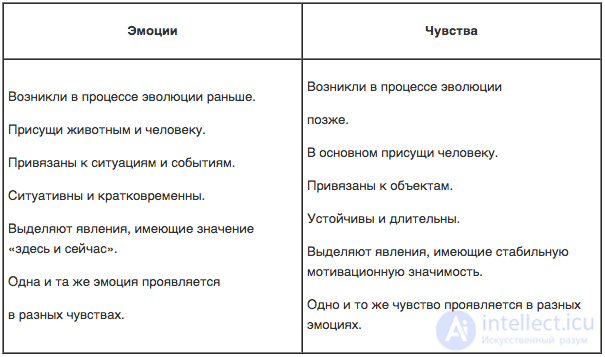
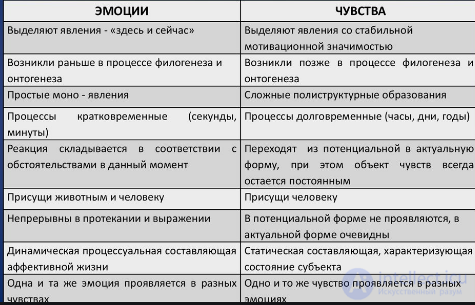
Emotions are brief and situational:
— these are usually reactions to some specific situation. Feelings, flowing beneath the surface of flickering emotions, are more stable and reveal more about the person themselves than about the particulars of a given situation.
If a young man is angry because the girl he likes is silent and doesn't answer his messages, the girl won't confuse the two: his anger is his emotion, while the fact that he likes her is his feeling. Hooray!
Speaking at a meeting, a girl was nervous and stiff, not emotional. When the nervousness passed (the feeling of anxiety settled), her emotions awakened and she began to speak vividly and expressively. Here the feeling was suppressing the emotions, and only once the feeling receded did the emotions come to life.
The difference between emotions and feelings lies in the speed and duration of the processes.
If a face changes expression quickly and quickly returns to its original (calm) state, that is an emotion. If a face slowly begins to change its expression and remains in the new expression for a (relatively) long time, that is a feeling. And since "quickly" and "slowly" are highly relative, there are no sharp boundaries between these two concepts.
Emotions are the fast, brief elements of feelings. Feelings are the enduring and more stable foundation from which flaring emotions arise.
It is easier to talk about emotions because they are less intimate — emotions lie on the surface, while feelings lie deeper. Emotions, unless a person deliberately hides them, are obvious. Emotions are visible on the face, they are vivid, they manifest strongly, and sometimes resemble an outburst. Feelings, on the other hand, are always something of a mystery. They are something smoother and deeper, and, at least at first, need to be deciphered — both by the people around and by the person themselves. It sometimes happens that a person, not understanding what they actually feel, talks about emotions instead, which misleads those trying to understand them. Moreover, the meaning of any specific emotion can only be understood in the context of the feeling it expresses.
The hesitation "should I say it or not" can mean quite different things: "will I be able to put it into words precisely," "is now the right moment to tell you this," and "maybe it's finally time to admit it?"
Feelings cannot be conveyed directly; they can only be conveyed through an external language, the language of emotions. It is fair enough to say that emotions are feelings expressed for the purpose of showing them to others.
Experiences kept to oneself are more properly feelings. An outpouring of feelings onto another person, a display of feelings, expressive gestures meant for someone... — that is already more properly emotion.
Feelings and sensations are often similar and frequently confused, but in fact they are easy to distinguish: sensations are elementary kinesthetic input, while feelings are sensations already processed by the mind — an already integrated and meaningful perception of what is happening.
By the word "to feel" one should understand the state that arises in a person under the influence of external or internal factors, which the person becomes aware of in a certain way, fixes in the form of thoughts, and remembers. Feelings are born at the boundary between sensations and reason. Feelings are a product of sensations being processed by the mind. Feelings give rise to emotions.
By the word "to sense" one should understand the direct response of a living organism to external influences that affect its state, behavior, and decision-making.
Feelings are characterized by valence (or tone) — that is, they can be pleasant (positive), unpleasant (negative), or ambivalent (dual, contradictory).
Feelings can differ in intensity (strength). The stronger the feeling, the stronger its physiological manifestations and its influence on a person's behavior.
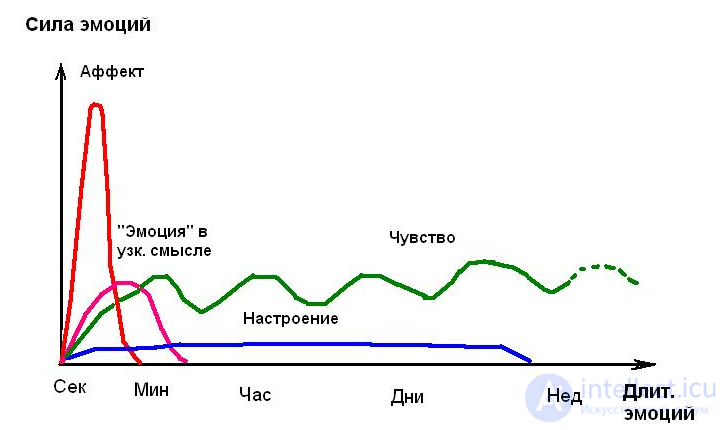
Diagram of the intensity and duration of emotions and feelings
Depending on their effect on activity, feelings are divided into sthenic (from Ancient Greek σθένος — strength) and asthenic (from Ancient Greek ἀσθένεια — weakness). Sthenic feelings prompt active behavior and mobilize a person's strength (love, hatred, and others). Asthenic feelings relax or paralyze one's strength (for example, fear, in some of its manifestations, or contempt).
In addition to the characteristics listed above, feelings also differ in content, reflecting various aspects and particular meanings of the objects that give rise to them.

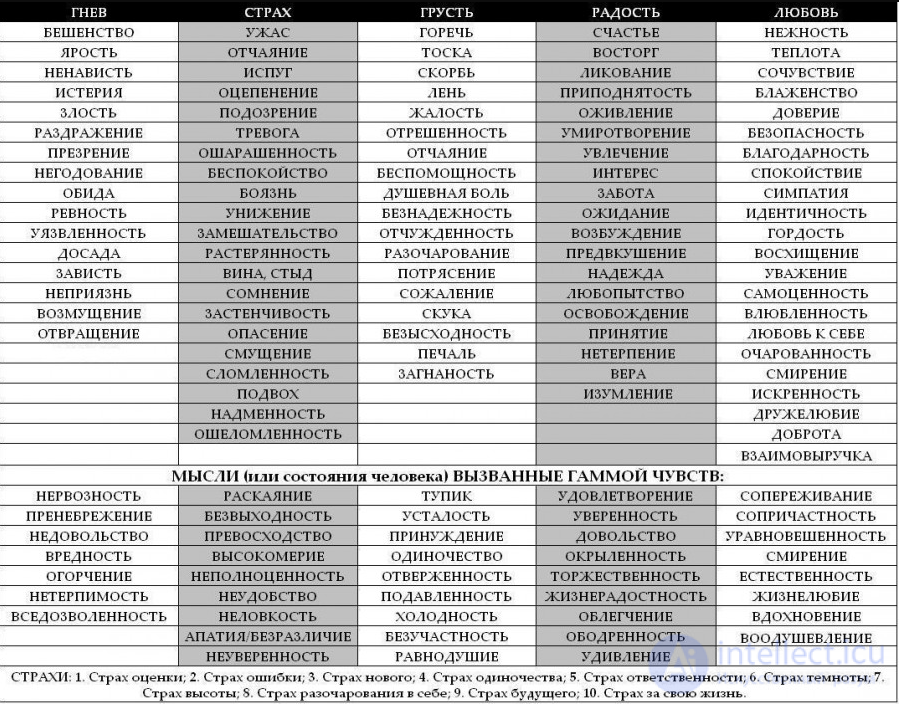
A table of feelings — a tool for identifying emotions
Robert Plutchik's wheel of emotions consists of: the central circle — affects — emotions. The middle ring — basic or simple emotions. The outer ring — complex emotions, obtained by combining simple feelings in a particular way.
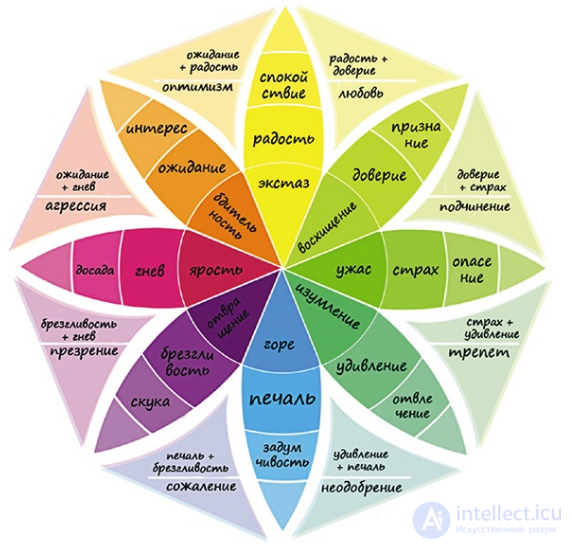
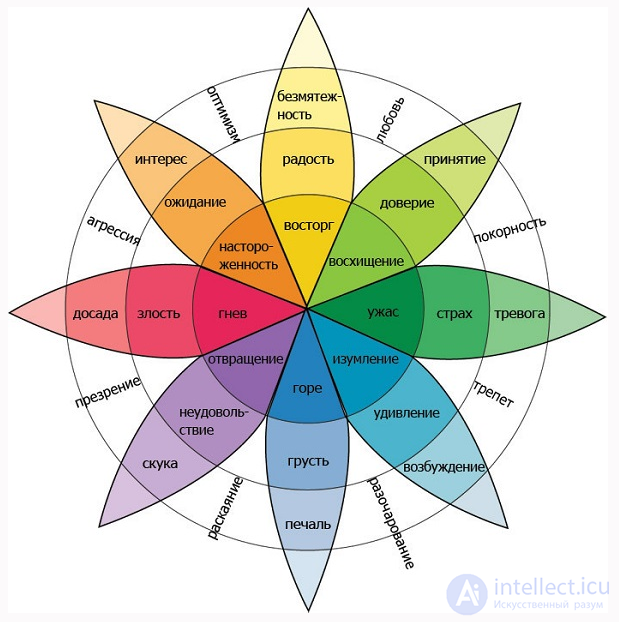
table of feelings
In therapeutic work with clients, one encounters varying degrees of awareness, identification, and expression of their feelings. In this article, we will focus solely on the content and nature of those feelings that characterize the particulars of a client's relationships with people who are significant to them, as well as on the particulars of the therapeutic process with such feelings. It is precisely these feelings that, as a rule, underlie clients' psychological problems. Most often, in therapy, one can observe the following types of feelings that clients express toward people who are significant to them: primary feelings, secondary feelings, and a demonstrated absence of feelings.
Primary feelings. These are feelings of rejection, fear, loneliness... Behind them one can very easily see needs; primary feelings, as a rule, express those needs directly. Most often, behind such feelings lie the following needs: for unconditional love, acceptance, attachment... A client presenting primary feelings at the start of therapy is a fairly rare occurrence, and it indicates good contact with their own self. This is most often the case in states of life crisis or depression. Secondary feelings. These are anger, rage, fury, irritation, resentment... These feelings arise when it is not possible to present primary feelings to people close to oneself. Most often this happens because of fear (of rejection) or shame (of non-acceptance).
Secondary feelings, such as anger or resentment, overshadow the primary feelings that speak to emotional needs for attachment. The absence of feelings, or emotional anesthesia. In this case, the client states that they have no feelings at all toward people close to them (toward their father, mother), that these people are strangers to them, and that they no longer need them. This particular focus of therapy is rarely the client's original request and most often emerges in the course of therapy addressing other concerns.
|
Emotional processes
|
||
|---|---|---|
| Fundamental emotions (according to K. Izard) |
|
|
| Emotions and feelings |
|
|
| Affects |
|
|
| Moods |
|

Comments