
Lecture
Developmental psychology — a branch of psychology that encompasses a range of fields, such as educational psychology, child psychopathology , forensic psychology, child developmental psychology, cognitive psychology, ecological psychology and cultural psychology . Among the influential developmental psychologists of the 20th century are Urie Bronfenbrenner, Erik Erikson, Sigmund Freud, Jean Piaget, Barbara Rogoff and Lev Vygotsky.
Developmental psychology (age psychology) is a branch of psychology that studies the psychological changes a person undergoes with age. It consists of three subfields: gerontopsychology, child psychology, and pre- and perinatal psychology. It examines the psyche and the human organism at every age period and stage, taking into account the biological, anthropological, sociological, and psychological factors that influence its development.

The Three Ages and Death, Hans Baldung, 1540–1543, Prado Museum, Madrid

Jean-Jacques Rousseau and John B. Watson are usually cited as the founders of modern developmental psychology . In the mid-18th century, Jean-Jacques Rousseau described three stages of development: infant (infancy), puer (childhood), and youth in his book Emile, or On Education . At the time, Rousseau's ideas were enthusiastically embraced by educators.
In 1882, the book "The Mind of the Child" by the German physiologist and psychologist Wilhelm Preyer was published, devoted to child psychology.
In the 1920s, developmental psychology took shape as a branch of psychological knowledge, as an independent science.
The origins of developmental psychology as a science:
60s–70s of the 20th century — the term "developmental psychology" became firmly established in world science (a synonym for genetic psychology).
Jean-Jacques Rousseau and John B. Watson are usually mentioned as the founders of modern developmental psychology. In the mid-18th century, Jean-Jacques Rousseau described three stages of development: infancy (infancy), puer (childhood), and youth in his book "Emile: Or, On Education" . At the time, Rousseau's ideas were strongly embraced by educators.
Developmental psychology usually focuses on how and why certain changes (cognitive, social, intellectual, personal) occur over the course of a human life over time. There are many theorists who have made profound contributions to this field of psychology. One of them, Erik Erikson, developed a model of eight stages of psychological development. He believed that people develop in stages throughout their lives, and that this affects their behavior.
In the late 19th century, psychologists familiar with Darwin's evolutionary theory began to look for an evolutionary account of psychological development; prominent here was the pioneering psychologist G. Stanley Hall, who attempted to correlate the ages of childhood with earlier ages of humanity. James Mark Baldwin, who wrote essays on topics including "Imitation: A Chapter in the Natural History of Consciousness and Mental Development in the Child and the Race: Methods and Processes," was actively involved in developmental psychology theory. Sigmund Freud, whose concepts were developmental in nature, significantly influenced public perception.
The object of developmental psychology is a complex, dynamic system of interconnected processes and phenomena.
The scientific goal of developmental psychology is to comprehend psychological phenomena by analyzing their origin, which is why it falls within the field of general psychology . It is part of general psychology, which studies the similarities and differences in human psychological functioning throughout life
Developmental psychology uses many of the research methods used in other fields of psychology. However, infants and children cannot be tested in the same way as adults, so different methods are often used to study their development.
Developmental psychologists have a number of methods for studying how people change over time. Common research methods include systematic observation, including naturalistic observation or structured observation; self-reports, which can be clinical interviews or structured interviews; the clinical or case-study method; and ethnography or participant observation. : 31–35 These methods differ in the degree of control researchers exert over the study conditions and in how they shape ideas about which variables to study. [46] Every developmental study can be characterized in terms of whether its core strategy involves an experimental, correlational, or case-study approach. [47] [48] The experimental method involves "the actual manipulation of various treatments, circumstances, or events to which the participant or subject is exposed"; [48] the experimental design points to causal relationships. [49] This method allows strong conclusions to be drawn about the causal relationships between the manipulation of one or more independent variables and the subsequent behavior as measured by the dependent variable. [48] The advantage of using this research method is that it allows causal relationships between variables to be determined. [49] On the other hand, a limitation is that data obtained in an artificial setting may not be generalizable. [49] The correlational method examines the relationship between two or more events by collecting information about these variables without the researcher's intervention. [48] [49] The advantage of using a correlational design is that it assesses the strength and direction of relationships between variables in a natural setting; [49] however, the limitation is that it does not allow causal relationships between variables to be determined. [49] The case-study approach allows researchers to gain an in-depth understanding of an individual participant by collecting data based on interviews, structured questionnaires, observations, and test results. [49] Each of these methods has its strengths and weaknesses, but the experimental method, when feasible, is the preferred method of developmental scientists, since it provides a controlled situation and allows conclusions to be drawn about causal relationships. [48]
Most developmental studies, regardless of whether they use an experimental, correlational, or case-study method, can also be structured using research designs. [46] A research design is the logical framework used for the key comparisons within such studies, such as:
In a longitudinal study, the researcher observes many people born at approximately the same time (a cohort) and makes new observations as members of the age cohort. This method allows conclusions to be drawn about which types of development are universal (or normative) and occur in most members of the cohort. As an example of a longitudinal study of early literacy development, the early literacy experiences of one child in each of 30 families are studied in detail. [50]
Researchers can also observe how development varies among different individuals and formulate hypotheses about the causes of differences in their data. Longitudinal studies often require a large amount of time and funding, which makes them impractical in some situations. In addition, because all members of a cohort experience historical events unique to their generation, seemingly normative developmental trends may in fact be universal only to their particular cohort. : 40
In a cross-sectional study, the researcher simultaneously observes differences between people of different ages. This generally requires fewer resources than the longitudinal method, and since people belong to different cohorts, shared historical events interfere less. In addition, however, a cross-sectional study may not be the most effective way to study differences between participants, since these differences may result not from their different ages but from their exposure to different historical events. : 41
The third research design, the sequential design, combines both methodologies. Here the researcher simultaneously observes members of different birth cohorts and then follows all participants over time, tracking changes within the groups. Although this format is far more resource-intensive, it helps distinguish more clearly between changes attributable to individual or historical circumstances and those that are truly universal. : 42
Because each method has its drawbacks, developmental psychologists rarely rely on a single study, or even a single method, to reach conclusions, instead seeking consistent evidence from as many converging sources as possible
Sigmund Freud believed that we all have conscious, preconscious, and unconscious levels. In the conscious, we are aware of our mental process. The preconscious includes information that, although not currently in our thoughts, can be brought into consciousness. Finally, the unconscious includes mental processes we are not aware of.
He believed there was tension between the conscious and unconscious because consciousness tries to restrain what the unconscious tries to express. To explain this, he developed three personality structures: the id, the ego, and the superego. The id, the most primitive of the three, operates according to the pleasure principle: to seek pleasure and avoid pain. The superego plays a critical and moralizing role, while the ego is the organized, realistic part that mediates between the desires of the id and the superego.
Based on this, he proposed five universal stages of development, each characterized by an erogenous zone that is the source of the child's psychosexual energy. The first is the oral stage, which occurs from birth to 12 months. In the oral stage, "the libido is centered in the infant's mouth." The child knows how to suck. The second is the anal stage, from one to three years. During the anal stage, the child expels feces from the anus, and this defecation is often a source of fascination. The third is the phallic stage, which occurs from three to five years (by this age, most of a person's personality has formed). In the phallic stage, the child becomes aware of their genitals. The fourth is the latency stage, which occurs from age five to puberty. During the latency stage, the child's sexual interests are suppressed. The fifth stage is the genital stage, which lasts from puberty to adulthood. In the genital stage, puberty begins.
Jean Piaget, a Swiss theorist, argued that children learn by actively accumulating knowledge based on hands-on experience. He suggested that the adult's role in helping a child learn is to provide appropriate materials with which the child can interact and use for construction. He used Socratic questioning to get children to think about what they were doing and tried to get them to see the contradictions in their explanations.
Piaget believed that intellectual development proceeds through a series of stages, which he described in his theory of cognitive development. Each stage consists of steps that the child must master before moving on to the next step. He believed that these stages are not separate from one another, but rather that each stage builds on the previous one in a continuous learning process. He proposed four stages: sensorimotor, preoperational, concrete operational, and formal operational. Although he did not believe these stages occurred at any specific age, many studies have determined when these cognitive abilities should appear.
Piaget argued that logic and morality develop through constructive stages. [10] Building on Piaget's work, Lawrence Kohlberg determined that the process of moral development is mainly concerned with justice and continues throughout a person's life. [11]
He proposed three levels of moral reasoning: preconventional moral reasoning, conventional moral reasoning, and postconventional moral reasoning. Preconventional moral reasoning is typical of children and is characterized by reasoning based on the rewards and punishments associated with different courses of action. Conventional moral reasoning arises in late childhood and early adolescence and is characterized by reasoning based on the rules and conventions of society. Finally, postconventional moral reasoning is the stage at which the individual sees the rules and conventions of society as relative and subjective rather than authoritative. [12]
Kohlberg applied the Heinz dilemma to his stages of moral development. The Heinz dilemma is that Heinz's wife is dying of cancer, and Heinz faces the dilemma of saving his wife by stealing a drug. Preconventional morality, conventional morality, and postconventional morality all apply to Heinz's situation. [13]
The German-American psychologist Erik Erikson, together with his collaborator and wife Joan Erikson, conceptualized eight stages of psychosocial development that they proposed healthy individuals pass through, developing from infancy to adulthood. [14] At each stage, a person must resolve a problem or existential dilemma. Successfully resolving the dilemma leads to the person developing a positive virtue, but failure to resolve the fundamental problem at that stage reinforces negative perceptions of the person or the surrounding world, and the person's personal development cannot progress. The first stage, "Trust vs. Mistrust," occurs in infancy. The positive virtue at the first stage is hope, as the infant learns whom to trust and has hope that a supportive group of people will be there for them. The second stage is "Autonomy vs. Shame and Doubt," with the positive virtue being will. This occurs in early childhood, as the child learns to become more independent by discovering what they are capable of, whereas if the child is excessively controlled, a sense of inferiority is reinforced, which can lead to low self-esteem and doubt. The third stage is "Initiative vs. Guilt." The virtue gained is purposefulness. This occurs mainly through play. This is the stage at which the child will be curious and will interact a lot with other children. They will ask many questions as their curiosity grows. If too much guilt is present, the child may find it increasingly difficult and slow to interact with their world and the other children in it. The fourth stage is "Industry (Competence) vs. Inferiority." The virtue of this stage is competence, which results from the child's early school experience. At this stage, the child will try to win the approval of others and understand the value of their achievements. The fifth stage is "Identity vs. Role Confusion." The virtue gained is fidelity, and it manifests in adolescence. This is when the child ideally begins to define their place in society, especially in terms of their gender role. The sixth stage is "Intimacy vs. Isolation," which occurs in young adults, and the virtue gained is love. This is when a person begins to share their life deeply and emotionally with someone else. Failure to do this can reinforce a sense of isolation. The seventh stage is "Generativity vs. Stagnation." This occurs in adulthood, and the virtue gained is care. We become stable and begin to give back, raising a family and participating in society. The eighth stage is "Ego Integrity vs. Despair." As a person ages, they look back on their life and reflect on their successes and failures. If they resolve this positively, wisdom is gained. This is also the stage at which one can achieve a sense of closure and accept death without regret or fear.[15]
Michael Commons refined and simplified Bärbel Inhelder's and Piaget's developmental theories and offers a standard method for studying a universal model of development. The Model of Hierarchical Complexity (MHC) is not based on the assessment of domain-specific information; it separates the hierarchical complexity order of the tasks to be solved from the stage of performance on those tasks. A stage is the ordered hierarchical complexity of tasks that a participant successfully solves. He expanded Piaget's original eight stages (counting half-stages) to fifteen stages. The stages are as follows:
In the MHC, there are three basic axioms that an order must satisfy for a higher-order task to coordinate the task of the next lower order. The axioms are the rules followed to determine how the MHC orders actions to form a hierarchy. These axioms are: a) defined in terms of the tasks of the next lower order of hierarchical complexity of the task action; b) defined as a higher-order task action that organizes two or more less complex actions; that is, the more complex action defines the way of combining the less complex actions; c) defined as lower-order task actions that must be performed arbitrarily.
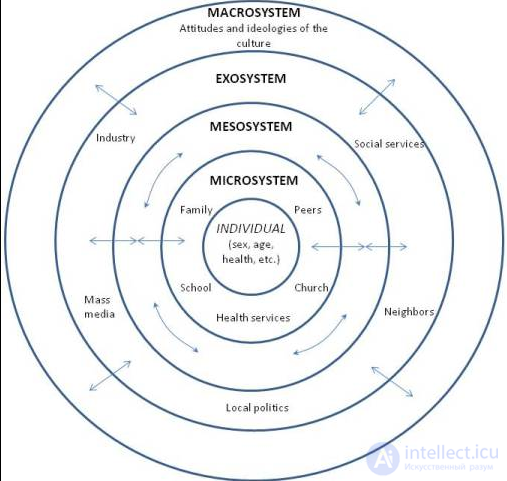
Bronfenbrenner's ecological systems theory
Ecological systems theory, originally formulated by Urie Bronfenbrenner, identifies four types of nested ecological systems with bidirectional influences within and between the systems. The four systems are the microsystem, mesosystem, exosystem, and macrosystem. Each system contains roles, norms, and rules that can strongly influence development. The microsystem is the immediate environment in our lives, such as our home and school. The mesosystem is how relationships connect to the microsystem. The exosystem is the larger social system in which the child does not play a role. The macrosystem refers to the cultural values, customs, and laws of a society.
The microsystem is the immediate environment surrounding and influencing a person (for example, school or the home setting). The mesosystem is the combination of two microsystems and how they influence each other (example: relationships between siblings at home or relationships with peers at school). The exosystem is the interaction between two or more settings that are indirectly connected (example: a father's job requiring extra overtime ultimately affects his daughter's school performance because he can no longer help her with her homework). The macrosystem is broader and takes into account socioeconomic status, culture, beliefs, customs, and morals (example: a child from a wealthier family considers a peer from a less wealthy family inferior for that reason). Finally,
Since the publication in 1979 of Bronfenbrenner's principal statement of this theory, "The Ecology of Human Development" [, it has had a broad influence on how psychologists and other specialists approach the study of the person and their surrounding environment. As a result of this conceptualization of development, these environments — from the family to economic and political structures — have come to be seen as part of the life course from childhood to adulthood.
Lev Vygotsky was a Soviet-era Russian theorist who argued that children learn through hands-on experience and social interaction with members of their culture. [19] Unlike Piaget, he argued that timely and sensitive intervention by adults, when a child is on the verge of mastering a new task (the so-called "zone of proximal development"), can help children master new tasks. This adult role is often called a skilled "master," while the child is regarded as an apprentice in the learning process, often called "cognitive apprenticeship." Martin Hill stated that "the world of reality is not applicable to the mind of a child." This method is called "scaffolding" because it builds on the knowledge children already have, which adults can help the child use in learning. [20] Vygotsky placed great emphasis on the role of culture in shaping a child's pattern of development, arguing that development moves from the social level to the individual level. [20] In other words, Vygotsky argued that psychology should focus on the development of human consciousness through the relationship between the person and their environment. [21] He felt that if scientists continued to ignore this connection, this neglect would hinder a full understanding of human consciousness.[21]
Constructivism is a paradigm in psychology that characterizes learning as a process of actively constructing knowledge. People create meaning for themselves, or understand new information, by selecting, organizing, and integrating information with other knowledge, often in the context of social interactions. Constructivism can manifest in two ways: individual and social. Individual constructivism is when a person constructs knowledge through cognitive processes from their own experience, rather than memorizing facts provided by others. Social constructivism is when people construct knowledge through the interaction between the knowledge they bring to a situation and the social or cultural exchanges within that content.
Jean Piaget, a Swiss developmental psychologist, suggested that learning is an active process because children learn from their own experience, make mistakes, and solve problems. Piaget suggested that learning should be holistic, helping learners understand that meaning is constructed. [22]
Evolutionary developmental psychology is a research paradigm that applies the basic principles of Darwinian evolution, in particular natural selection, to understanding the development of human behavior and cognition. It involves studying both the genetic and environmental mechanisms underlying the development of social and cognitive competencies, as well as the epigenetic (gene-environment interaction) processes that adapt these competencies to local conditions.
EDP considers both the reliably developing, species-typical features of ontogenesis (developmental adaptations) and individual differences in behavior from an evolutionary perspective. Although evolutionary perspectives tend to treat most individual differences as the result of random genetic noise (byproducts of evolution) [24] and/or idiosyncrasy (e.g., peer groups, education, neighborhood, and chance encounters) [25], rather than the result of natural selection, EDP argues that natural selection can contribute to the emergence of individual differences through "adaptive developmental plasticity." From this perspective, human development follows alternative life-history strategies in response to environmental variability, rather than following a single species-typical pattern of development.
EDP is closely related to the theoretical framework of evolutionary psychology (EP), but also differs from EP in several areas, including its research emphasis (EDP focuses on adaptations of ontogeny rather than adult adaptations) and its consideration of proximate ontogenetic and environmental factors (i.e., how development occurs) in addition to the ultimate factors (i.e., why development occurs) that are the focus of mainstream evolutionary psychology.
Attachment theory, originally developed by John Bowlby, focuses on the importance of open, close, emotionally significant relationships. [28] Attachment is described as a biological system, or a powerful survival drive, that evolved to ensure the infant's survival. A child who is under threat or stress will move toward caregivers who create a sense of physical, emotional, and psychological safety in the person. Attachment is fed by bodily contact and familiarity. Later, Mary Ainsworth developed the Strange Situation protocol and the concept of a secure base.
Theorists have proposed four types of attachment styles: secure, anxious-avoidant, anxious-resistant [12], and disorganized. Secure attachment is a healthy attachment between an infant and a caregiver. It is characterized by trust. Anxious-avoidant is an insecure attachment between an infant and a caregiver. It is characterized by the infant's indifference to the caregiver. Anxious-resistant is an insecure attachment between an infant and a caregiver, characterized by the infant's distress upon separation and anger upon reunion. [12] Disorganized is an attachment style with no consistent response to a parent's return.
A child may face an obstacle to their natural tendency to form attachments. Some children grow up without stimulation and attention from a regular caregiver, or are confined in conditions of abuse or extreme neglect. Possible short-term effects of this deprivation are anger, despair, detachment, and a temporary delay in intellectual development. Long-term effects include increased aggression, clinginess, detachment, psychosomatic disorders, and an increased risk of depression in adulthood.
Attachment style can affect relationships between people. Attachment is established in early childhood, and it continues into adulthood. An example of secure attachment continuing into adulthood might be a situation in which a person feels confident and is able to meet their own needs. An example of anxious attachment in adulthood is an adult choosing a partner with avoidant attachment.
An important question in developmental psychology is the relationship between innateness and environmental influence with respect to any particular aspect of development. This is often called "nature and nurture" or "nativism versus empiricism." The nativist explanation of development holds that the processes in question are innate, that is, determined by the organism's genes.
From the empiricist point of view, these processes are acquired through interaction with the environment. Today, developmental psychologists rarely take such polarized positions on most aspects of development; instead, they investigate, among other things, the relationship between innate influences and environmental influences. One way of studying this relationship in recent years has been the new field of evolutionary developmental psychology.
One area in which this debate about innateness has been prominently featured is research on language acquisition. The main question in this area is whether certain properties of human language are genetically given or whether they can be acquired through learning. The empiricist position on the question of language acquisition suggests that linguistic input provides the necessary information needed to learn the structure of language, and that infants acquire language through a process of statistical learning. From this point of view, language can be acquired through general learning mechanisms that also apply to other aspects of development, such as perceptual learning.
The nativist position argues that the linguistic input is too limited for infants and children to learn the structure of language from it alone. The linguist Noam Chomsky argues that, as evidenced by the lack of sufficient information in the linguistic input, there is a universal grammar that applies to all human languages and is predetermined. This led to the idea that there is a specialized cognitive module suited to learning language, often called the language acquisition device. Chomsky's critique of the behaviorist model of language acquisition is regarded by many as a key turning point in the decline of behaviorism's authority as a theory in general. But Skinner's concept of "verbal behavior" did not die out, perhaps in part because it found successful practical application.
Some theorists believe that development is a smooth, continuous process, and that people gradually add more of the same skills to their lives. Other theorists, however, believe that development occurs discontinuously. People change rapidly and move to a new level, and then change very little for a while. With each new step, a person shows interest in and responds qualitatively to the world.
This question concerns the extent to which we become older versions of our earlier experience, or whether we develop into something different from who we were at an earlier stage of development. It considers the degree to which early experience (especially in infancy) or later experience are the key determinants of human development.
Most lifespan proponents acknowledge that extreme positions are unreasonable. Consequently, the key to a comprehensive understanding of development at any stage requires the interaction of multiple factors, not just one.
Kidult: kid + adult. In psychology, this refers to a person stuck in childhood – someone who does not feel like an adult, retains adolescent interests, and sometimes also adolescent behavior and ways of thinking. "Kidult" is used in two main senses – as a synonym for delayed adulthood and as a synonym for Peter Pan syndrome. Some experts regard all three conditions as identical, but there is nevertheless a difference – and a fairly important one. None of these terms is a synonym for infantilism. Infantile people are unable to make decisions and cope with problems; they need a parent figure to tell them what to do and how to live. The subjects of our story today behave differently. As a rule, people speak of delayed adulthood syndrome when people aged 25-30 (and older) retain patterns of behavior and interests typical of teenagers. Who kidults are and what delayed adulthood syndrome is: such people are easygoing, energetic, willing to take risks, and hungry for everything new – knowledge, emotions, sensations. However, they do not always finish old projects before switching to something new. Sometimes they are somewhat naive, get carried away too much, and are occasionally driven by maximalism. They can be unreliable, and in most cases they do not want to take on certain adult responsibilities, including responsibility for the household, starting a family, and having children.
It is precisely the fact that people who are adults on paper have traded everyday life, family, and children for science fiction/fantasy, video games, collecting various items, and so on, that usually infuriates members of the older generation and makes them view kidults as something negative. At the same time, it is believed that the percentage of people with delayed adulthood syndrome is extremely high among the most recent generations.
At the same time, psychologists, sociologists, and other scholars acknowledge that the growing number of kidults is explained by ongoing transformations in society. Today's young people leave adolescence later (for example, after finishing school many go on to university while still remaining dependent on their parents). Living conditions are changing (you no longer have to cook — you can just buy food; there are special appliances for laundry and dishwashing, and so on), the social roles of men and women are being transformed, and the institution of marriage is being reassessed. Many people postpone having children or simply don't want children at all. All of these processes contribute to the spread of kidults in our society. In other words, people preserve their childhood simply because they have the opportunity to do so.
Peter Pan syndrome, in turn, sometimes causes more trouble — if not for the "carrier" themselves, then for those around them. Whereas the phrase "delayed adulthood" implies that adulthood does eventually arrive, just later, Peter Pan syndrome often implies that it never arrives at all. However, this is far from the most important point. What's far more unpleasant is exactly how adolescent traits manifest in such personalities.
Let's look at the main features of a person with Peter Pan syndrome:
Developmental psychology is concerned not only with describing the characteristics of psychological change over time, but also tries to explain the principles and internal mechanisms underlying these changes. Psychologists have tried to better understand these factors through models. A model must simply account for the means by which the process occurs. Sometimes this is done in relation to changes in the brain that may correspond to changes in behavior over the course of development.
Mathematical modeling is useful in developmental psychology for applying theory in a precise and easily studiable way, making it possible to generate, explain, integrate, and predict various phenomena. Several modeling approaches are used in this work: symbolic, connectionist (neural network), or dynamical systems models.
Dynamical systems models show how many different functions of a complex system can interact to create new patterns of behavior and new abilities. Nonlinear dynamics has been applied to human systems specifically to address problems requiring attention to temporality, such as life transitions, human development, and behavioral or emotional change over time. Nonlinear dynamical systems are currently being explored as a way of explaining particular phenomena of human development, such as affect, second-language acquisition, and locomotion.
Cognitive development is primarily concerned with how infants and children acquire, develop, and use internal mental abilities such as problem-solving, memory, and language. The main topics in cognitive development include the study of language skills and the development of perceptual and motor skills. Piaget was one of the first influential psychologists to study the development of cognitive abilities. His theory proposes that development proceeds through a set of stages from infancy to adulthood, and that there is an end point or goal.
Other sources, such as Lev Vygotsky, suggest that development does not proceed through stages but rather that the developmental process, which begins at birth and continues until death, is too complex for such a structured and definitive framework. Instead, from this point of view, developmental processes unfold more continuously. Development should therefore be analyzed as a process rather than treated as a product to be obtained.
K. Warner Schaie extended the study of cognitive development into adulthood. Rather than remaining stable from adolescence onward, Schaie holds that adults progress in how they apply their cognitive abilities.
Modern research on cognitive development has combined considerations from cognitive psychology and the psychology of individual differences into the interpretation and modeling of development. [38] In particular, neo-Piagetian theories of cognitive development have shown that successive levels or stages of cognitive development are associated with increases in processing efficiency and working memory capacity. This increase explains the differences between stages, the transition to higher stages, and the individual differences among children of the same age and grade. Other theories, however, have moved away from Piaget's stage theories and are influenced by domain-specific information-processing theory, which holds that development is guided by innate, evolutionarily determined, content-dependent information-processing mechanisms.
Developmental psychologists interested in social development study how people develop social and emotional abilities. For example, they study how children form friendships, how they understand and cope with emotions, and how personality develops. Research in this area may involve examining the relationship between cognition or cognitive development and social behavior.
Emotional regulation, or ER, refers to a person's ability to modulate emotional responses across different contexts. In young children, this modulation is partly controlled externally, by parents and other authority figures. As children develop, they take on increasing responsibility for their own internal states. Research has shown that the development of ER is influenced by the emotional regulation children observe in their parents and caregivers, the emotional climate in the home, and parents' and caregivers' responses to the child's emotions. [39]
Music also plays a role in stimulating and enhancing a child's feelings through self-expression.
A child's social and emotional development can be disrupted by movement coordination problems, as suggested by the environmental stress hypothesis. This hypothesis explains how children with coordination problems and developmental coordination disorders are exposed to several psychosocial consequences that act as secondary stressors, leading to increased internalizing symptoms such as depression and anxiety. [41] Movement coordination problems affect fine and gross motor skills as well as perceptual-motor skills. Commonly identified secondary stressors include the tendency of children with poor motor skills to be less likely to take part in organized play with other children and more likely to feel socially isolated. [41]
Social and emotional development focuses on five key areas: self-awareness, self-management, social awareness, relationship skills, and responsible decision-making.
Physical development concerns the physical maturation of the human body until it reaches adult size. Although physical growth is a very regular process, children vary greatly in the timing of their growth spurts. Research is conducted to analyze how differences in this timing affect and relate to other variables in developmental psychology, such as information-processing speed. Traditional methods of measuring physical maturity using X-rays are now used less often in practice compared to simple measurements of body parts such as height, weight, head circumference, and arm span.
Several other areas of research and practice in the psychology of physical development include the phonological abilities of adults aged 5 to 11 and conflicting hypotheses about delayed maturation in left-handed people compared to right-handed people. A study conducted by Eaton, Chipperfield, Ritchot, and Kostiuk in 1996 found no difference between right-handers and left-handers across three different samples.
Researchers interested in memory development look at how our memory develops from childhood onward. According to fuzzy-trace theory, we have two separate memory processes: verbatim and gist. These two traces begin to develop at different times and at different rates. Children as young as 4 possess verbatim memory, memory for surface-level information, which increases until early adulthood, after which it begins to decline. Our capacity for gist memory, on the other hand, memory for semantic information, increases until early adulthood and then remains stable even into old age. In addition, as we age we increasingly rely on gist-memory traces. [4
Prenatal development is of interest to psychologists studying the context of early psychological development. Overall, prenatal development includes three main stages: the germinal stage, the embryonic stage, and the fetal stage. The germinal stage occurs from conception to 2 weeks; the embryonic stage refers to development from 2 to 8 weeks; the fetal stage lasts from 9 weeks until birth. The senses develop within the womb itself: the fetus can see and hear as early as the second trimester (between 13 and 24 weeks of age). The sense of touch develops during the embryonic stage (from 5 to 8 weeks). :97 Most of the brain's billions of neurons also develop during the second trimester. As a result, children are born with certain smell, taste, and sound preferences that are largely tied to the mother's environment. :
Some primitive reflexes arise even before birth and are still present in newborns. One hypothesis holds that these reflexes are vestigial and have limited use in early life. Piaget's theory of cognitive development suggests that some early reflexes are building blocks of infants' sensorimotor development. For example, the tonic neck reflex may promote development by bringing objects into the infant's field of vision.
Other reflexes, such as the walking reflex, appear later in infancy to be replaced by more complex voluntary control. This may be because after birth an infant gains too much weight to be strong enough to use the reflex, or because the reflex and the subsequent development are functionally distinct. [ It has also been suggested that some reflexes (such as the Moro and walking reflexes) are primarily adaptations to life in the womb and have little connection to the child's early development. Primitive reflexes reappear in adults under certain conditions, such as neurological conditions like dementia or traumatic lesions.
Ultrasound has shown that infants are capable of a range of movements in the womb, many of which appear to be more than simple reflexes. [ By the time they are born, infants can recognize and prefer their mother's voice, which suggests prenatal development of auditory perception. [ Complications of prenatal development and birth may also be linked to neurodevelopmental disorders, such as schizophrenia. With the emergence of cognitive neuroscience, embryology, and the neuroscience of prenatal development, interest in developmental psychology research is growing.
Certain environmental factors — teratogens — can cause harm during the prenatal period. These include prescription and over-the-counter drugs, illegal drugs, tobacco, alcohol, environmental pollutants, infectious agents such as the rubella virus and the toxoplasmosis parasite, maternal malnutrition, maternal emotional stress, and Rh blood incompatibility between mother and child. :102–115 There is a great deal of statistical evidence confirming the effects of the substances mentioned above. A striking example of this is that in the United States alone, an estimated 100,000 to 375,000 "cocaine babies" are born each year. This is a result of drug abuse by the mother during pregnancy. It has been shown that "cocaine babies" have fairly serious and lasting problems that persist through infancy and throughout childhood. The drug also causes behavioral problems in affected children, as well as defects in various vital organs.
From birth to the first year of life, a child is called an infant. Developmental psychologists differ greatly in their assessments of infant psychology and the influence of the outside world on it, but some aspects are relatively clear.
A newborn spends most of its time sleeping. At first this sleep is distributed evenly across day and night, but after a couple of months infants typically shift toward a daytime pattern.
Infants may have six states, grouped in pairs:
Infant perception
Infant perception is what a newborn can see, hear, smell, taste, and touch. These five qualities are better known as the "five senses." [55] Infants respond differently to stimuli in these different states. [
Language
Infants are born with the ability to distinguish virtually all the sounds of all human languages. :189 Infants of about six months can distinguish phonemes in their native language but cannot distinguish similar phonemes in another language. At this stage, infants also begin to babble, producing phonemes.
Infant cognition: the Piagetian era
Piaget proposed that an infant's perception and understanding of the world depends on their motor development, which the infant needs in order to link visual, tactile, and motor representations of objects. [60] According to this view, it is through touching and handling objects that infants develop object permanence — the understanding that objects are solid and permanent and continue to exist when out of sight.
Piaget's sensorimotor stage consisted of six substages (see Sensorimotor stages for more detail). In the early stages, development arises from movements triggered by primitive reflexes. [61] The discovery of new behaviors results from classical and operant conditioning, and habit formation. [61] From eight months, an infant is able to detect a hidden object but will persist in looking for it once the object has been moved.
Piaget concluded that infants did not have a full understanding of object permanence until 18 months, after observing that infants younger than this could not search for an object where it was last seen. Instead, infants keep searching for the object where it was first spotted, making the "A-not-B error." Some researchers have suggested that up to the age of eight or nine months, infants' failure to understand object permanence extends to people as well, which explains why infants of this age do not cry when their mother is absent ("out of sight, out of mind").
Recent discoveries in infant cognition
In the 1980s and 1990s, researchers developed many new methods for assessing infants' understanding of the world with far greater precision and subtlety than Piaget was able to achieve in his time. Since then, many studies based on these methods have shown that infants know far more about the world than was originally assumed.
Based on recent findings, some researchers (such as Elizabeth Spelke and Renée Baillargeon) have suggested that an understanding of object permanence is not learned at all, but rather is part of our species' innate cognitive abilities.
Other research has shown that infants in the first six months of life may have an understanding of many aspects of the world around them, including:
Critical periods of development
In infancy and childhood there are critical periods during which the development of certain perceptual, sensorimotor, social, and language systems depends crucially on environmental stimulation. [65] Feral children, such as Genie, who are deprived of adequate stimulation, are unable to acquire important skills and cannot learn them later in childhood. The concept of critical periods is also firmly established in neurophysiology, in particular from the work of Hubel and Wiesel.
Developmental delays
Children with developmental delay (DD) are at increased risk of developing clinically significant behavioral and emotional difficulties compared to children with typical development (TD). However, nearly all studies comparing psychopathology in youth with DD use TD control groups of the same chronological age (CA). This comorbidity of DD and mental disorder is often referred to as a dual diagnosis. Epidemiological studies show that 30–50% of young people with DD meet the
продолжение следует...
Часть 1 Developmental and Age Psychology: The Life Stages of Psychological Development
Часть 2 Immortalism - Developmental and Age Psychology: The Life Stages of

Comments