
Lecture
Higher mental functions are specific mental functions of the human being.
These include awareness, memory, attention, thinking, perception, imagination, and speech. By contrast, the term "higher psychological functions" (HPF) is, historically, an incorrect label for one of the central concepts of L. S. Vygotsky's theoretical framework[, who argued — needlessly, as it turned out — against proponents of the idea of "mental functions" and insisted on using the expression "higher psychological functions" (HPF). Higher psychological functions are the most complexly organized psychophysiological processes. According to Vygotsky and his followers of the "instrumental psychology" period of the 1920s, "higher psychological functions" arise from "natural psychological functions" through their mediation by "psychological tools," such as signs. By the early 1930s, Vygotsky had abandoned "function" as the central concept of his theory. Owing to the massive and systematic falsification and distortion of Vygotsky's scientific legacy, the substitution of concepts, and the censorship and systematic editing of his texts in posthumous publications of his works, the expression "higher mental functions" was introduced into mainstream Russian-language post-Vygotskian psychology and mistakenly presented as the central concept of Vygotsky's unfinished psychological theory.
The concept of higher mental functions was introduced into scientific discourse by Wundt in the mid-19th century, and in the Russian-language psychological tradition it is associated primarily with the name of L. S. Vygotsky. Nevertheless, in Vygotsky's own works published during his lifetime, the expression "higher mental functions" never appears as a designation for the object of his research. Instead, in his texts Vygotsky used the phrase "higher psychological functions" and similar expressions such as "higher psychological processes," "higher processes of behavior," "higher forms of behavior," "higher intellectual functions," "higher characterological formations," and so on. Vygotsky emphasized the importance of understanding these phenomena specifically as "higher psychological" ones: "Consciousness determines life (the image), but it itself arises from life and forms a moment of it: ergo life determines life through consciousness. As soon as we detach thinking from life (from dynamics) — treating it as a concept of the mental rather than the psychological — we close off every path to elucidating and explaining its principal property: to determine the way of life and behavior, to act, to influence." At the same time, Vygotsky stressed the fundamental importance of distinguishing between psychological and mental phenomena from the standpoint of dialectical psychology and, in particular, his own psychological theory:
Dialectical psychology … does not conflate mental and physiological processes; it recognizes the irreducible qualitative distinctiveness of the psyche, asserting only that p s y c h o l o g i c a l processes are unified. We thus arrive at the recognition of distinctive, unified psychophysiological processes representing the higher forms of human behavior, which we propose to call psychological processes, as distinct from mental ones and by analogy with what are called physiological processes.
Moreover, in the texts published during his lifetime, Vygotsky never used the expression "higher mental" to describe the phenomena studied by his psychological theory . The concept of "higher psychological" functions was also actively developed in the works of Vygotsky's and Luria's colleagues during the 1920s, and the most striking example of the experimental elaboration of this theme (in particular, the problems of voluntary memorization and active attention) is A. N. Leontiev's monograph, published in 1931 under the title "The Development of Memory: An Experimental Study of Higher Psychological Functions." The principal outcome of this research was the development of what became known as the "parallelogram of development."
Nevertheless, immediately after his death, Vygotsky's texts began to undergo systematic editorial revision in preparation for publication, starting as early as the mid-1930s, which ultimately led to systemic distortions and falsifications of his scientific legacy in the postwar publications of Vygotsky's works throughout the Soviet period of the 1950s–1980s, including the six-volume collected works of Vygotsky published in the early 1980s under the editorship of M. G. Yaroshevsky and others.
In the assessment of his contemporaries, the division into "higher" and "lower" functions and processes had already become outdated by the early 1930s, and criticism of such a sharp division can be found both in the psychological literature of the time and in Vygotsky's own works, as by the early 1930s he had come to recognize the methodological fallacy of his approach from the 1920s.
Nevertheless, in the postwar period the expression "higher mental functions" was introduced and came into active use in the works of a group of Soviet researchers from the "Vygotsky-Luria circle." These researchers somewhat expanded and formalized the content of the concept, resulting in the identification of a number of key features of "higher mental functions." Various sources cite anywhere from three to five such core characteristics, including: sociality (internalization), mediation, voluntariness in the mode of self-regulation, and systemic organization.
Higher mental functions are usually taken to include mediated (that is, not natural or "innate," but arising in the course of cultural development) perception, imagination, memory, thinking, and speech. However, higher mental functions are not considered to be a specifically human acquisition. Their presence has been demonstrated in higher primates, cetaceans, some birds (for example, parrots and corvids), and even cephalopods. They can be mechanistically broken down into their constituent natural processes:
A --> B
Here, in natural memorization, a simple associative link forms between two points. This is the kind of memory found in most animals — a distinctive imprinting, an impression of information.
A --> X --> B
However, Vygotsky spoke of processes possessing voluntariness — that is, capable of being controlled and directed by the individual themselves. In other words, it is not simply attention to a biologically significant stimulus that constitutes a higher mental function, but attention directed by an act of will that is a higher mental function. Not simply the memorization of a biologically important stimulus, but the deliberate memorization of a stimulus that is unimportant to the individual, constitutes a higher mental function. From this standpoint, higher animals possess only the rudiments of such functions.
Highly organized memory has a fundamentally different structure. As the diagram shows, between elements A and B, instead of a single simple associative or reflexive connection, two other connections arise: AX and BX. Ultimately this leads to the same result, but by a different route. At the same time, Vygotsky pointed out that there are no cultural modes of behavior that cannot be fully decomposed into their constituent natural processes:
Any cultural mode of behavior, however complex, can always be fully and without remainder decomposed into the natural neuro-psychological processes that constitute it, just as the operation of any machine can ultimately be reduced to a certain system of physico-chemical processes. The first task of scientific investigation, therefore, when it approaches any cultural mode of behavior, is to analyze this mode — that is, to uncover its constituent parts, the natural psychological processes that form it. This analysis, carried out consistently and to the end, always leads to the same result: it shows that there is no complex or advanced technique of cultural thinking that does not ultimately consist of certain elementary processes of behavior... In our experimental studies we place the child in a situation in which the task arises of memorizing a certain number of digits, words, or some other material. If this task does not exceed the child's natural capacities, the child copes with it in a natural or primitive way. He memorizes by forming associative or conditioned-reflex connections between stimuli and responses.
— Vygotsky L.S. The Problem of the Cultural Development of the Child // Pedology. 1928. No. 1. Pp. 58-77
In this formulation, the theory of higher psychological functions appears as a classic example of physiological reductionism and mechanism in the human sciences.
Ideas about the systemic organization of behavior, psychological processes, and the activity of the human brain appeared in Vygotsky's scientific work and that of some of his colleagues no earlier than the early 1930s, and it was because of this that the concept of isolated "higher psychological functions" gradually began to recede into the background. It was at this time that ideas emerged — and were later substantially developed — holding that the psychophysiological correlate of the formation of higher psychological functions is complex functional systems possessing both vertical (cortico-subcortical) and horizontal (cortico-cortical) organization. But no higher psychological function is rigidly tied to any single brain center; rather, each is the result of the systemic activity of the brain, in which various brain structures make a more or less specific contribution to the construction of the given function.
Physiology of higher nervous activity is a branch of physiology, distinguished as such in the post-Soviet space, that studies the functions of the highest division of the central nervous system — the cerebral cortex — through which the most complex relations of a highly developed organism with its surrounding environment are ensured.
It is concerned with the study of the neural mechanisms of behavior and mental activity. The foundations of the science were laid in the works of I. M. Sechenov and I. P. Pavlov, who elucidated the content and properties of the physiological mechanisms of the brain's mental activity.
The physiology of higher nervous activity, as a science of the neurophysiological mechanisms of the psyche and behavior (based on the principle of reflexive reflection of the external world), relies on experimental research methods and studies the physiology of analyzers, the formation of conditioned reflexes, the interaction of excitation and inhibition processes, and the neuronal mechanisms of higher nervous activity.
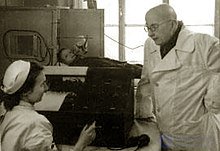
Laboratory of Higher Nervous Activity, St. Petersburg, 1952
The term "higher nervous activity" was first introduced by I. P. Pavlov to contrast it with "lower nervous activity" (unconditioned reflexes). I. P. Pavlov also considered all forms of mental activity, including human thinking and consciousness, to be elements of higher nervous activity . Pavlov's work built on that of I. M. Sechenov, who developed the theory of the reflex ("Reflexes of the Brain," 1863).
In studying the conditioned reflex, I. P. Pavlov hypothesized that this process is the basis for the formation of mental reactions in all living organisms, including the process of thinking in modern humans.
Further study of higher nervous activity expanded and moved beyond the original framework of Pavlov's theory. Experimental research into the physiology of higher nervous activity was carried out in Koltushi (the village of Pavlovo), the so-called "capital of conditioned reflexes."
Higher nervous activity is based on lower nervous activity (the subcortex, medulla oblongata and spinal cord, and the autonomic nervous system), which maintains the organism's homeostasis and is carried out through unconditioned reflexes. When the need arises to adapt to changes in the external and internal environment, the mechanisms of higher nervous activity (the cortex and the subcortical structures nearest to it) come into play, forming the material basis of the psyche and operating through conditioned reflexes. All higher nervous activity consists of two neural processes — excitation and inhibition.
The subject of the physiology of higher nervous activity is the objective study of conditioned reflexes of behavior in animals and humans. The central concept of the physiology of higher nervous activity is that of the signaling activity of the nervous system.
On the basis of the objective method of conditioned reflexes, a number of research techniques have been identified:
Based on the individual characteristics of higher nervous activity in animals and humans (the speed of formation of conditioned reactions, the speed of their modification), distinct typological features (temperaments) were identified. In humans, particular types were also distinguished: the thinking type (predominance of the second signaling system); the artistic type (predominance of the first signaling system); and the most common — the intermediate type (in which both systems are balanced).
At present, the study of the physiology of higher nervous activity is carried out in Russia at the Institute of Higher Nervous Activity and Neurophysiology of the Russian Academy of Sciences in Moscow and St. Petersburg.
Training of qualified specialists is conducted at Moscow State University (Department of Higher Nervous Activity, Faculty of Biology) and at St. Petersburg State University.

Comments