
Lecture
Quantitative psychological research is amenable to statistical hypothesis testing. Although randomized and controlled experiments in laboratory settings are widely used in this field, such studies can only assess a limited range of short-term phenomena. Thus, psychologists also rely on creative statistical methods to extract knowledge from clinical trials and population data .
A true experiment with random assignment of subjects to conditions allows researchers to draw convincing conclusions about cause-and-effect relationships. In an experiment, the researcher changes the influencing parameters, called independent variables, and measures the outcomes, called dependent variables. Rigorous experimental studies are conducted in a laboratory with a carefully controlled environment.
Repeated-measures experiments are experiments conducted on several occasions. In studies of psychotherapy effectiveness, experimenters often compare a given treatment with a placebo treatment or compare different types of treatment with each other. The type of treatment is the independent variable. The dependent variables are the outcomes, which ideally are assessed by different specialists . Using a crossover design, researchers can further strengthen the power of their findings by testing both of two treatments on two groups of subjects.
Experimental researchers typically use a statistical hypothesis-testing model, which involves making a prediction before conducting the experiment and then assessing how well the data support the predictions. (These predictions may stem from a more abstract scientific hypothesis about how the phenomenon under study actually works.) Statistical methods of variance analysis are used to distinguish the experiment's unique results from the null hypothesis that the variations are the result of random fluctuations in the data. In psychology, a widely used standard assigns statistical significance to results whose probability of being due to chance is less than 5%
Statistical surveys are used in psychology to measure attitudes and personality traits, monitor changes in mood, verify the validity of experimental manipulations, and for other psychological topics. Psychologists most often use paper-and-pencil surveys. However, surveys are also conducted by telephone or email. Web surveys are increasingly used for conveniently reaching many subjects.
Neuropsychological tests, such as the Wechsler scales and the Wisconsin Card Sorting Test, are mainly questionnaires or simple tasks that assess a particular type of mental function in the respondent. They can be used in experiments, as in the case of lesion studies, which assess the outcomes of damage to a specific part of the brain
A classic and popular tool used to correlate mental and neural activity is the electroencephalogram (EEG), a technique that uses refined electrodes on a person's scalp to measure voltage changes in various parts of the brain. Hans Berger, the first researcher to use EEG on an intact skull, discovered that the brain is characterized by "brain waves": electrical oscillations that correspond to different states of consciousness. Subsequently, researchers refined statistical methods for synthesizing electrode data and identified unique brain wave patterns, such as delta waves observed during slow-wave sleep[
New functional neuroimaging methods include functional magnetic resonance imaging and positron emission tomography, which track blood flow through the brain. These technologies provide more precise localization of brain activity and create multifaceted representations of it. They also provide understanding based on objective data, which avoids the classic problems of subjective self-report. However, it remains difficult to draw firm conclusions about the localization in the brain of the occurrence of specific thoughts, or even about how usefully such localization corresponds to reality. Nevertheless, neuroimaging has provided unmistakable evidence of a correlation between mind and brain. Some of this evidence is based not on a model of localized functions but on a model of a system of neural networks.
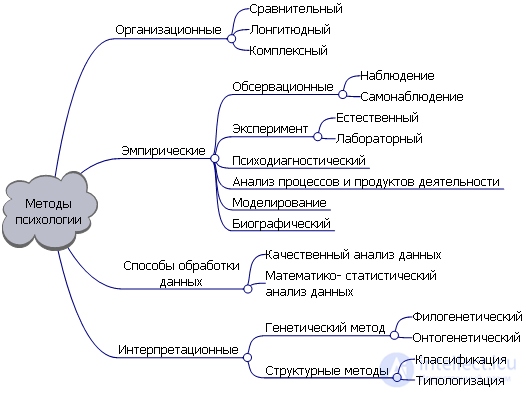
The comparative method - (the "cross-sectional" method) consists of comparing different groups of people by age, education, activity, and communication. For example, two large groups of people, matched by age and gender (students and workers), are studied using the same empirical methods of gathering scientific data, and the resulting data are compared with each other.
The longitudinal method (the "longitudinal-section" method) consists of repeatedly examining the same individuals over an extended period. For example, repeatedly examining students throughout their entire period of study at a university.
The complex (integrated) method - a way of studying in which representatives of various sciences participate in the research, which makes it possible to establish connections and dependencies between phenomena of different kinds, for example, between the physiological, mental, and social development of a personality.
Observation (external) — a method consisting of the deliberate, systematic, purposeful, and recorded perception of external manifestations of the psyche.
Self-observation (introspection) — a person's observation of their own psychic phenomena.
Experiment differs from observation in the active intervention in a situation by the researcher, who carries out planned manipulation of certain factors and records the corresponding changes in the state and behavior of the subject under study.
A laboratory experiment is conducted under artificial conditions, usually with the use of special apparatus, with strict control of all influencing factors.
A natural experiment - a psychological experiment incorporated into an activity or interaction unnoticed by the subject.
A formative (learning) experiment - a method for studying and shaping a mental process, state, or personality trait.
A test - a system of tasks that make it possible to measure the level of development of a particular quality (trait) of a personality.
Achievement tests - one of the psychodiagnostic methods that reveals the degree to which a subject has mastered specific knowledge, abilities, and skills.
Intelligence tests — a psychodiagnostic method for identifying an individual's mental potential.
Creativity tests - a set of methods for studying and assessing creative abilities.
Personality tests - a psychodiagnostic method for measuring various aspects of an individual's personality.
Projective tests - a set of methods for the holistic study of personality, based on psychological interpretation, i.e., the conscious or unconscious transference by the subject of their own properties and states onto external objects under the influence of dominant needs, meanings, and values.
A questionnaire — a methodological tool for obtaining primary socio-psychological information based on verbal communication, representing a survey form for obtaining answers to a predetermined system of questions.
Sociometry - a method of psychological research into interpersonal relationships within a group, aimed at determining the structure of relationships and psychological compatibility.
An interview— a method of social psychology consisting of gathering information obtained in the form of answers to questions that are, as a rule, prepared in advance.
A conversation - a method involving the direct or indirect acquisition of psychological information through verbal communication.
The effective application of an empirical method depends on how valid it is (how well it corresponds to what it was originally designed to obtain and assess) and how reliable it is (whether it allows the same results to be obtained upon repeated and multiple use).
Psychodiagnostics
Self-portrait
The biographical method
Verbal-communicative methods
Dichotomous question
Ebbinghaus's classic methods of memory research
The linguistic associative experiment
The international "10-20" electrode placement system
Semantic differential
Theoretical sampling
The maximum difference scale
The methods of psychology bring the researcher back to the object under study and deepen their understanding of it. In essence, methods are a way of studying reality. Any method consists of several operations and techniques carried out by the researcher in the process of studying the object. But each method corresponds to its own unique set of techniques and operations, suited to the goals and objectives of the research. Several individual techniques can be created on the basis of just one method. It is also an indisputable fact that psychological science has no single, unambiguous set of research methods.
In this lesson we have divided the methods of psychology into two groups: methods of theoretical psychology and methods of practical psychology:
Fundamental (general) psychology deals with psychological research into the general patterns of the human psyche, a person's beliefs, patterns of behavior, character traits, and everything that influences these. In everyday life, the methods of theoretical psychology can be useful for studying, analyzing, and predicting people's behavior.
Practical (or applied) psychology is aimed at working with specific people, and its methods make it possible to carry out psychological procedures designed to change the mental state and behavior of the subject.
The methods of theoretical psychology are the tools and techniques by which researchers are able to obtain reliable data and subsequently use it to build scientific theories and formulate practical recommendations. These methods are used to study psychic phenomena, their development, and their changes. But it is not only human characteristics that are studied, but also "external" factors: age-related characteristics, the influence of environment and upbringing, and so on.
Psychological methods are quite diverse. First of all, a distinction is made between scientific research methods and, only after that, practical methods. Among the theoretical methods, the main ones are observation and experiment. Additional ones are self-observation, psychological testing, the biographical method, survey, and conversation. Combinations of these methods are used to study psychological phenomena.
EXAMPLE: If an employee of an organization displays irresponsibility and this has been repeatedly noticed through observation, then to determine the causes contributing to this, one should resort to a conversation or a natural experiment.
It is very important that the main methods of psychology be used in combination and be "tailored" to each specific case. First, it is necessary to clarify the task and define the question that needs to be answered, i.e., there must be a specific goal. Only after that should the method be chosen.
So, the methods of theoretical psychology.
In psychology, observation is understood as the purposeful perception and recording of the behavior of the object under study. Moreover, when using this method, all phenomena are studied under conditions normal for the object. This method is considered one of the oldest. But it was scientific observation that came into widespread use only at the end of the 19th century. It was first applied in developmental psychology, as well as in educational, social, and clinical psychology. Later it began to be used in occupational psychology. Observation is usually used in cases where it is not recommended or not possible to intervene in the natural course of events.
There are several types of observation:
As already mentioned, observation should be used in cases where the researcher's intervention could disrupt the natural process of a person's interaction with the surrounding world. This method is necessary when it is important to get a comprehensive picture of what is happening and to record a person's/people's behavior in full detail. Important features of observation are:
Observation is conducted to identify various features of behavior – this is the subject matter. The objects, in turn, can include:
That is, the object of observation is what can be visually recorded. In this case, the researcher does not observe psychic properties as such, but records the object's overt manifestations. Based on the data obtained and assumptions about which psychic characteristics they manifest, the scientist can draw certain conclusions about the psychic properties of the individual.
The results of this method are usually recorded in special protocols. The most objective conclusions can be drawn if the observation is carried out by a group of people, since it then becomes possible to generalize different results. Certain requirements should also be observed during observation:
Observation consists of several stages:
It is also necessary to decide on the means of observation – it can be carried out by a specialist or recorded by instruments (audio, photo, video equipment, observation charts). Observation is often confused with experiment. But these are two different methods. The difference between them is that in observation:
There is a certain code of ethics developed by the American Psychological Association (APA). This code implies conducting observations according to certain rules and precautions. The following can be cited as examples:
Every person, even without being a specialist in the field of psychology, can use the observation method in order to obtain data on some question, if necessary.
EXAMPLE: You want to enroll your child in some club or activity group. To make the right choice, you need to identify their inclinations, i.e., what they are drawn to on their own, without outside influence. To do this, you need to conduct an observation. Watch your child from the side to see what they do when left alone, what actions they take, what they enjoy doing. If, for example, they are constantly drawing everywhere, then perhaps they have a natural inclination toward drawing, and you could try enrolling them in an art school. If they like taking things apart/putting them together, they might be interested in technology. A constant urge to play ball suggests it is worth enrolling them in a football or basketball school. You can also ask the caregivers at daycare or the teachers at school to observe your child and draw certain conclusions based on that. If your son constantly picks fights and tussles with other boys, this is not a reason to scold him, but an incentive to enroll him in some martial arts class. If your daughter likes braiding her friends' hair, she might be interested in starting to learn the art of hairdressing.
There can be an enormous number of observation options. The main thing is to understand exactly what you want to determine and to think through the best ways to conduct your observations.
An experiment in psychology is understood as a trial conducted under certain conditions in order to obtain new data through the experimenter's direct intervention in the life activity of the subject. In the course of the study, the scientist changes a certain factor/factors and observes what happens as a result. A psychological experiment can include other methods as well: testing, survey, observation. But it can also be a fully independent method.
There are several types of experiments (by method of conduct):
There are also experiments classified by level of awareness:
The researcher must set a clear task – why the experiment is being conducted, with whom, and under what conditions. Next, a certain relationship must be established between the subject and the scientist, and the subject is given instructions (or not given any). Then the experiment itself is conducted, after which the data obtained are processed and interpreted.
An experiment, as a scientific method, must meet certain qualities:
But despite the fact that experiment is one of the most respected research methods, it has both advantages and disadvantages.
Advantages:
Disadvantages (in the opinion of some specialists):
For these reasons, when conducting psychological experiments, researchers cannot rely solely on the data from this one method for their results and must resort to combining it with other methods and take into account many different indicators. When conducting experiments, one should also adhere to the APA code of ethics.
It is possible to conduct various experiments in the course of everyday life without the help of certified specialists and experienced psychologists. Naturally, the results obtained in the course of independent experiments will be purely subjective. But it is still possible to obtain some information.
EXAMPLE: Suppose you want to learn more about people's behavior in various circumstances, to see how they react to something, and perhaps even understand their train of thought. To do this, model some situation and use it in real life. As an example, one can cite the following: a person was curious how people around him would react to someone sitting next to them on public transport, falling asleep, and leaning on them. To find out, he took a friend along who filmed what was happening on camera, and he repeated the same action several times: he pretended to be asleep and leaned on the person next to him. People's reactions varied: some moved away, some woke the person up and expressed displeasure, some sat there peacefully, offering their shoulder to the "tired" person. But based on the video recordings obtained, a conclusion was drawn: most people react negatively to a "foreign object" in their personal space and experience unpleasant emotions. But this is only the "tip of the iceberg," and the psychological rejection people show toward one another can be interpreted in very different ways.
When conducting your own personal experiments, always be careful and be sure to make sure that your research does not cause any harm to those around you.
Self-observation is observation of oneself and the characteristics of one's own behavior. This method can be applied in the form of self-control and plays a major role in psychology and in human life. However, as a method, self-observation can, for the most part, only establish the fact of something (having forgotten something, but not knowing why). That is why self-observation, although an important research method, cannot be the primary and independent method in the process of understanding the essence of psychic manifestations.
The quality of the method under consideration is directly dependent on a person's self-esteem. People with low self-esteem, for example, are more prone to self-observation. And a consequence of hypertrophied self-observation can be excessive self-analysis, fixation on wrongful actions, feelings of guilt, self-justification, and so on.
Adequate and effective self-observation is facilitated by:
Applying self-observation in life is a very effective way to understand yourself, the motives behind your actions, get rid of certain problems in life, and resolve difficult situations.
EXAMPLE: You want to increase your effectiveness in daily activities (communicating with people, at work, at home) or get rid of bad habits (negative thinking, irritability, even smoking). Make it a rule to be in a state of mindfulness as often as possible every day: pay attention to your thoughts (what you are thinking about right now) and your actions (what you are doing at this moment). Try to analyze what causes your various reactions (anger, irritation, envy, joy, satisfaction). What "hooks" people and circumstances pull you by. Get yourself a notebook in which you will record all your observations. Simply watch what is happening inside you and what contributes to it. After analyzing, after some time (a week, a month), what you have learned about yourself, you will be able to draw a conclusion about what is worth cultivating in yourself and what you should start getting rid of.
Regular practice of self-observation has a very positive effect on a person's inner world and, as a result, on their outward manifestations.
Psychological testing belongs to the field of psychodiagnostics and is concerned with studying the psychological qualities and traits of personality through the use of psychological tests. This method is often used in counseling, psychotherapy, and also by employers when hiring. Psychological tests are needed when it is necessary to learn more about a person's personality in detail, which cannot be done through conversation or survey.
The main characteristics of psychological tests are:
A truly effective test is created through trials and modifications (changing the number of questions, their composition, and wording). A test must go through a multi-stage process of verification and adaptation. An effective psychological test is a standardized assessment, based on the results of which it becomes possible to evaluate the psychophysiological and personality characteristics, as well as the knowledge, abilities, and skills, of the subject.
There are various types of tests:
There are also other test variants aimed at studying a person and the characteristics of their personality: color tests, linguistic tests, questionnaires, handwriting analysis, psychometrics, the lie detector, various diagnostic methods, and others.
Psychological tests are very convenient to use in everyday life in order to get to know yourself or people you care about better.
EXAMPLE: You are tired of earning money in a way that brings neither moral, psychological, nor emotional satisfaction. You dream of finally quitting and doing something else. But you don't know what exactly. Find several career-orientation tests and test yourself. It is quite possible that you will learn things about yourself that you previously had no idea about. The results of such tests can help you discover new facets of yourself and will help you understand what you would actually like to do, and what you have a natural inclination toward. And knowing all this, it is much easier to find an occupation that suits you. Moreover, this is also good in that a person who is engaged in something they love and enjoys it becomes happier and more satisfied with life and, on top of everything else, starts earning more.
Psychological testing promotes a deeper understanding of oneself, one's needs and abilities, and often points to a direction for further personal development.
The biographical method in psychology is a way of studying, diagnosing, correcting, and projecting a person's life path. Various modifications of this method began to develop at the beginning of the 20th century. In modern biographical methods, the personality is studied in the context of the history and prospects of its individual development. This involves obtaining data from sources such as autobiographical materials (autobiographies, interviews, questionnaires), as well as eyewitness accounts, and analysis of notes, letters, diaries, and so on.
This method is often used by the heads of various enterprises, by biographers studying the lives of particular people, and simply in communication between people who barely know each other. It is easy to apply it when communicating with a person in order to build a psychological portrait of them.
EXAMPLE: You are the head of an organization and you are hiring a new employee. You need to find out what kind of person this is, what their personality characteristics are, what their life experience is, and so on. In addition to filling out forms and conducting interviews, you can use the biographical method for this. Talk to the person, let them tell you facts from their biography and some significant moments along their life path. Ask them what they can tell you about themselves and their life from memory. This method does not require any special skills or preparation. Such a conversation can take place in a light, relaxed atmosphere and will most likely be pleasant for both parties.
Using the biographical method is a wonderful way to get to know a new person and an opportunity to see their strengths and weaknesses, as well as to envision the possible prospects of interacting with them.
A survey is a verbal-communicative method in the course of which interaction takes place between the researcher and the person being studied. The psychologist asks questions, and the subject (respondent) gives answers to them. This method is considered one of the most widespread in psychology. The questions in it depend on what information needs to be obtained in the course of the research. As a rule, a survey is a mass method, because it is used to obtain information about a group of people rather than about a single person.
Surveys are divided into:
In the process of creating surveys, the first step is to formulate program questions, which are understandable only to specialists. After that, they are translated into questionnaire questions that are more understandable to the ordinary layperson.
Types of surveys:
When composing questions, certain rules should be followed:
Depending on the objectives set, questions are divided into several types:
A survey, as already mentioned, is best suited for obtaining information from a large number of people. This method makes it possible to establish the needs of the masses or determine their opinion on a specific issue.
EXAMPLE: You are the director of a company providing some kind of services, and you need to find out your employees' opinions about improving working conditions and attracting more clients. In order to do this as quickly and effectively as possible, you can put together (for example, together with a staff analyst) a series of questions, the answers to which will help you solve the tasks at hand. Namely: to make the employees' work process more pleasant for them and to find some ways (possibly very effective ones) to expand the client base. Based on the results of such a survey, you will get information on some very important points. First, you will know exactly what changes your employees need in order for the atmosphere in the team to improve and for the work to bring positive emotions. Second, you will have on hand a list of all sorts of methods for improving your business. And third, you will probably be able to single out from the general mass of employees a promising and up-and-coming person who could be promoted, thereby improving the overall performance of the enterprise.
Surveys and questionnaires are a wonderful way to obtain important and relevant information on pressing topics from a large number of people.
Conversation is one of the forms of observation. It can be oral or written. Its purpose is to identify a particular range of questions that are not accessible through direct observation. Conversation is widely used in psychological research and has great practical significance. Therefore, it can be considered, even if not a primary one, an independent method in its own right.
A conversation is conducted in the form of a relaxed dialogue with the person who is the object of study. The effectiveness of a conversation depends on meeting a number of requirements:
Conversation as a psychological method promotes obtaining information "from the source" and establishing more trusting relationships between people. With the help of a well-conducted conversation, one can not only get answers to questions, but also get to know the interlocutor better, understand what kind of person they are and "what they live for."
EXAMPLE: An everyday one. You notice that your close friend has been going around looking downcast and dejected for several days now. They answer questions in monosyllables, rarely smile, and avoid the company they usually keep. The changes are obvious, but they themselves say nothing about it. This person is close to you and you are not indifferent to their fate. What should you do? How can you find out what's going on and help them? The answer is on the surface – talk to them, have a conversation. Try to time it for a moment when no one else is around, or specifically invite them to have a cup of coffee with you. Don't start the conversation directly – with phrases like: "What happened?" or "Come on, tell me what's up with you!" Even if you have a good friendly relationship, start the conversation with sincere words about how you've noticed changes in them, that they matter to you, and that you would like to help them, to give some advice. "Turn" the person toward you. Let them feel that you REALLY care about knowing what happened and that you will understand them no matter what. Most likely, under your gentle pressure, your friend will "switch off" their defense mechanism and tell you what's going on. Almost every person needs other people to take part in their life. It is important to feel that one is not alone and that someone cares. Especially from one's friends.
A conversation is always good when there is an opportunity to talk one-on-one, because it is precisely during a conversation (formal or confidential) that one can freely talk about things that, for one reason or another, don't get discussed in the bustle of everyday affairs.
The methods of theoretical psychology are far from exhausted by this. There are many variations and combinations of them. But we have familiarized ourselves with the main ones. Now, in order to make our understanding of the methods of psychology more complete, we need to consider practical methods.
Methods of practical psychology
The methods of practical psychology include the methods of the fields that make up general psychological science: psychotherapy, counseling, and pedagogy. The main practical methods are suggestion and reinforcement, as well as the methods of counseling and psychotherapeutic work. Let's talk a little about each of them.
Suggestion is the process of instilling in the subject certain formulas, attitudes, positions, or views outside their conscious control. Suggestion can be direct or indirect communicative (verbal or emotional). The task of this method is to form a required state or point of view. The particular means of suggestion is not especially important. The main task is to carry it out. This is precisely why, in suggestion, wide use is made of emotional imprinting, confusion, distraction of attention, intonation, remarks, and even the shutting down of a person's conscious control (hypnosis, alcohol, drugs).
Suggestion differs from other forms of address (requests, threats, instructions, demands, etc.), which are also methods of psychological influence, in the involuntariness and automaticity of the reactions it produces, and in the fact that it does not involve consciously exerted acts of will. In the process of suggestion, everything happens on its own. Suggestion affects every person, but to varying degrees.
There are several types of suggestion:
There are also various techniques of suggestion:
Suggestion was originally used unconsciously by people whose communication skills had developed to a high level. Today, suggestion plays a huge role in psychotherapy and hypnotherapy. Very often this method is used in hypnosis or in other cases where a person is in a trance state. Suggestion has been part of human life since early childhood, since it is applied in upbringing, advertising, politics, relationships, and so on.
EXAMPLE: A widely known example of suggestion is the so-called "placebo" effect — the phenomenon of a patient's condition improving after taking a medication which, in their opinion, has certain properties, when in fact it is a dummy. You can apply this method in practice. For example, if one of your loved ones suddenly develops a headache, give them a plain empty capsule disguised as a headache remedy — after a while the "medicine" will take effect and the headache will stop. This is the placebo effect.
Reinforcement is the instantaneous reaction (positive or negative) of the researcher (or the surrounding environment) to the actions of the subject. The reaction must indeed be instantaneous, so that the subject can immediately connect it with their own action. If the reaction is positive, it is a sign that one should continue to act or behave in that way in the future. If the reaction is negative, the opposite is true.
Reinforcement can be of the following types:
Reinforcement is a huge part of a person's life. Like suggestion, it has been present in it since early childhood, in the process of upbringing and the acquisition of life experience.
EXAMPLE: Examples of reinforcement are all around us at every turn: if you put your hand in boiling water or try to touch fire, you will certainly get burned — this is negative spontaneous reinforcement. A dog, performing some command, receives a treat and happily repeats it — positive intentional reinforcement. A child who gets a bad grade at school will be punished at home and will try not to bring home any more bad grades, since if they do, they will be punished again — one-time/systematic negative reinforcement. A bodybuilder knows that only regular training will produce results — systematic positive reinforcement.
Psychological consultation is, as a rule, a one-time conversation between a psychologist and a client that helps orient the client within their current life situation. It involves a quick start to the work, since the client does not need any special preparation, and the specialist, together with the client, can work through the circumstances and outline steps toward achieving the desired result.
The main problems for which people turn to a psychologist for consultation include:
Psychological consultation consists of several stages:
The method of psychological consultation, like any other method in psychology, consists of a combination of both theoretical and practical research methods. Today there are various variations and types of consultation. Turning to a psychologist for help can be the solution to many of life's problems and a way out of difficult situations.
EXAMPLE: The impetus to resort to psychological consultation can be absolutely any life situation that a person is unable to cope with on their own. This includes problems arising at work, troubles in family relationships, depression, loss of interest in life, inability to get rid of bad habits, inner disharmony, an inner struggle with oneself, and many other reasons. So, if you feel that over a prolonged period of time you are being overwhelmed and troubled by some intrusive thoughts or states, and you understand that you cannot cope with this alone, and there is no one nearby who could support you, then without a shadow of doubt or embarrassment, seek help from a specialist. Today there is a huge number of offices, clinics, and centers of psychological assistance, where experienced, highly qualified psychologists offer their services.
Other (auxiliary) methods include: the method of experimental-psychological tests, the method of explanation and instruction, trainings, coachings, business and role-playing games, counseling, the method of correcting behavior and states, the method of transforming one's living and working space, and many others.

Comments