
Lecture
Self-esteem is an individual's subjective evaluation of themselves — an assessment of their own actions, qualities, feelings, and merits.
An adequate attitude toward oneself is a subjective experience of harmonious, successful, free (spontaneous) functioning, which leads a person toward a sense of coherence and constancy and forms in them the ability to quickly restore their previous physical and mental state. Therefore, in order to study a person's adequate attitude toward themselves, in our counseling practice we need to "recognize" this subjective experience, which is so necessary for the constructive development of the personality and its mental health.
Social-psychological readiness of the personality
| Type of attitude | Characteristic of the attitude |
| Adequate | The attitude corresponds to the objective state: without exaggeration or underestimation. |
| Dismissive | Underestimation of one's own state. Denial — active disregard of the presence of one's own disorder or deviation |
| adequate (objective) self-esteem | provides a favorable emotional state, stimulates activity, instills in a person confidence in achieving set goals, equanimity, a sense of self-respect, self-confidence, modesty |
| inadequate low self-esteem | forms timidity, lack of self-belief, withdrawal, shyness, suggestibility, passivity, touchiness, cowardice |
| inadequate inflated self-esteem | forms self-assurance, arrogance, uncritical thinking, haughtiness, insolence, conceit, irritability |
| Aggravating | Exaggeration of the severity of one's own state or deviation. |
| Hypochondriac | Immersion, "withdrawal" into oneself, focusing solely on one's own state. |
| Exploitative (rent-seeking) | Using one's own state to manipulate other people in order to obtain moral or material benefits. |
| Indifferent | Passive acceptance of one's own state, loss of interest in everything that used to be of interest. |
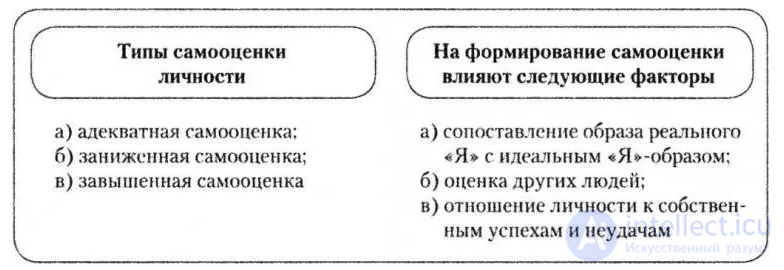
Functions of self-esteem:
The opinions of others and a person's achievements play a significant role in shaping self-esteem. In theory, self-esteem is a person's evaluation of themselves.
Self-awareness is not only knowledge of oneself, but also a certain attitude toward oneself: toward one's own qualities and states, capabilities, physical and spiritual strengths — that is, self-esteem. A human being as a person is a self-evaluating creature. People can evaluate themselves, their deeds and actions. Without self-esteem it is difficult, even impossible, to find one's place in life. Accurate self-esteem presupposes a critical attitude toward oneself, constantly measuring one's own capabilities against the demands life presents, the ability to independently set achievable goals, to strictly evaluate the course of one's own thinking and its results, to thoroughly test the hypotheses one puts forward, to thoughtfully weigh all the arguments "for" and "against," and to abandon hypotheses and versions that have not been confirmed. Accurate self-esteem upholds a person's dignity and gives them moral satisfaction, and not only that. An adequate or inadequate attitude toward oneself leads either to harmony of spirit, which provides reasonable self-confidence, or to constant conflict, which sometimes brings a person to a neurotic state.
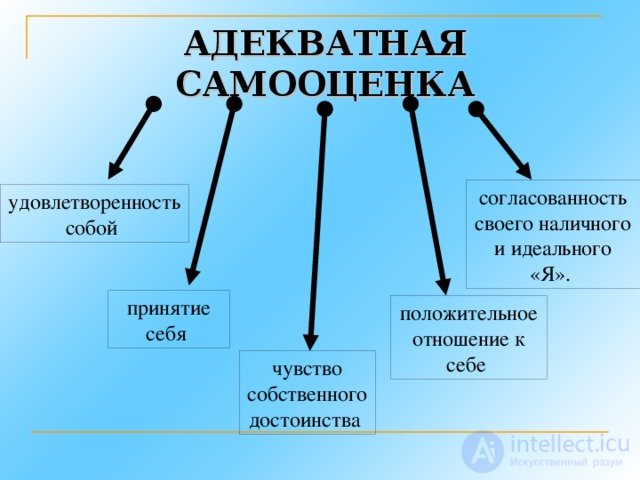
In modern psychology there are three types of self-esteem:
According to American writer Robert Greene, self-esteem largely depends on the attention received from others. Greene notes that in order to gain the attention of those around them, people are willing to do almost anything, up to and including crime or suicide. He also argues that the need for other people's attention lies at the root of almost every act.

Comments