
Lecture
Scintillators — substances that exhibit scintillation (emitting light upon absorption of ionizing radiation (gamma quanta, electrons, alpha particles, etc.). As a rule, the emitted number of photons for a given type of radiation is approximately proportional to the absorbed energy, which makes it possible to obtain energy spectra of the radiation.
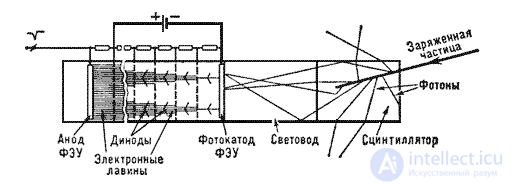
Scintillation detectors of nuclear radiation — the main application of scintillators. In a scintillation detector, the light emitted during scintillation is collected on a photodetector (usually the photocathode of a photoelectron multiplier — PMT, much less often photodiodes and other photodetectors are used), converted into a current pulse, amplified and recorded by one or another registering system.
Light yield — the number of photons emitted by a scintillator upon absorption of a certain amount of energy (usually 1 MeV). A high light yield is considered to be a value of 50—70 thousand photons per MeV. The higher the light yield, the more sensitive the scintillator, so scintillators with a high light yield are preferred. However, for detecting high-energy particles, scintillators with a significantly lower light yield may also be used (for example, lead tungstate).
The emission spectrum should, if possible, be optimally matched to the spectral sensitivity of the photodetector used. A spectral mismatch with the photodetector negatively affects the energy resolution.
Even when absorbing particles of the same energy, the pulse amplitude at the output of the photodetector of the scintillation detector varies from event to event. This is related to:
As a result, in a statistically accumulated energy spectrum, the line (which for an ideal detector would represent a delta function) turns out to be blurred; it can often be represented as a Gaussian with variance σ2. As a characteristic of the energy resolution of the detector, the root-mean-square deviation σ (the square root of the variance) is used, and, more often, the full width of the line at half maximum (FWHM, from the English Full Width on Half Maximum; sometimes called the half-width), referred to the median of the line and expressed as a percentage. The FWHM of a Gaussian is  times greater than σ. Since the energy resolution depends on the energy (as a rule, it is proportional to E−1/2), it should be specified for a particular energy. Most often the resolution is specified for the energy of the gamma line of cesium-137 (661.7 keV).
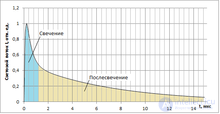
The time during which the energy absorbed in a scintillator excited by the passage of a fast charged particle is converted into light emission is called the decay time. The dependence of scintillator emission on time from the moment of particle absorption (the decay curve) can usually be represented as a decaying exponential or, in the general case, as a sum of several decaying exponentials:
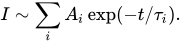
The term in the formula with the largest amplitude  and time constant
  characterizes the overall decay time of the scintillator. Almost all scintillators, after a fast decay, have a slowly decaying afterglow «tail», which is often a drawback from the point of view of the time resolution and counting rate of the registered particles.
Usually the sum of many exponentials in the formula above can, with sufficient practical accuracy, be represented as a sum of two exponentials:

where  — the time constant of the «fast» decay,
 — the time constant of the «slow» decay,

 — the amplitudes of the fast and slow components respectively.
The amplitudes of the fast and slow components depend on the energy absorbed in the scintillator and the ionizing ability of fast particles and gamma quanta. For example, in scintillators made of doped barium fluoride, the amplitude of the glow caused by absorption of a gamma quantum significantly exceeds the amplitude of the glow caused by absorption of an alpha particle, whereas for the latter, on the contrary, the afterglow amplitude prevails. This phenomenon makes it possible to distinguish the nature of the ionizing radiation.
The typical decay time of inorganic scintillators ranges from hundreds of nanoseconds to tens of microseconds. Organic scintillators (plastic and liquid) decay within nanoseconds.
Irradiated scintillators gradually degrade. The radiation dose that a scintillator can withstand without significant deterioration of its properties is called radiation hardness.
Particles of different nature but with the same energy give, generally speaking, a different light yield when absorbed in a scintillator. Particles with a high ionization density (protons, alpha particles, heavy ions, fission fragments) give, in most scintillators, a smaller number of photons than gamma quanta, beta particles, muons or X-rays. The ratio of the light yield of a given type of particle to the light yield of gamma quanta of equal energy is called the quenching factor (from the English quenching). The quenching factor of electrons (beta particles) is usually close to unity. The quenching factor for alpha particles is called the α/β ratio; for many organic scintillators it is close to 0.1.
| Decay time, μs |
Emission spectrum maximum, nm |
Efficiency coefficient (relative to anthracene) |
Note | |
|---|---|---|---|---|
| NaI(Tl) |
0.25
|
410
|
2.0
|
hygroscopic |
| CsI(Tl) |
0.5
|
560
|
0.6
|
phosphorescence |
| LiI(Sn) |
1.2
|
450
|
0.2
|
very hygroscopic |
| LiI(Eu) | very hygroscopic |
|||
| ZnS(Ag) |
1.0
|
450
|
2.0
|
powder |
| CdS(Ag) |
1.0
|
760
|
2.0
|
small single crystals |
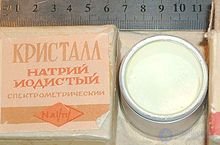
Most often, inorganic single crystals are used as scintillators. Sometimes, to increase the light yield, the crystal is doped with an activator (or so-called dopant). Thus, in the NaI(Tl) scintillator, the crystalline matrix of sodium iodide contains activating thallium centers (an impurity at the level of hundredths of a percent). Scintillators that glow without an activator are called intrinsic.
Transparent ceramic scintillators are obtained from transparent ceramic materials based on the oxides Al2O3 (Lucalox), Y2O3 (Yttralox) and derivative oxides Y3Al5O12 and YAlO3, as well as MgO, BeO .
 emission [nm] |
Decay time [ns] |
Light yield (relative to NaI) |
|
|---|---|---|---|
| Naphthalene |
348
|
96
|
0.12
|
| Anthracene |
440
|
30
|
0.5
|
| Para-terphenyl |
440
|
5
|
0.25
|
Organic scintillators usually consist of two- or three-component mixtures . The primary fluorescence centers are excited by excitation from incoming particles. Upon decay of these excited states, light is emitted in the ultraviolet wavelength range. The absorption length of this ultraviolet light, however, is quite small: the fluorescence centers are opaque to their own emitted light.
Light extraction is achieved by adding to the scintillator a second component that absorbs the primarily emitted ultraviolet light and re-emits it isotropically at longer wavelengths (the so-called spectrum shifter, or shifter).
The two active components in organic scintillators are either dissolved in an organic liquid or mixed with an organic material so as to form a polymer structure. Using this technology, a liquid or plastic scintillator of any geometric shape and size can be produced. In most cases, scintillator sheets from 1 to 30 mm thick are manufactured.
Organic scintillators have much shorter decay times (of the order of units to tens of nanoseconds) compared to inorganic ones, but have a lower light yield.
There are also other organic scintillators, for example those from the American company BICRON. Bicron BC 400…416 scintillators are produced based on polyvinyltoluene .
Gas scintillation counters use light emitted by atoms that are excited during interaction with charged particles and then return to the ground state. The lifetimes of the excited levels lie in the nanosecond range. The light yield in gas scintillators is comparatively low due to the low density of gases. However, liquefied inert gases can also be used as gas scintillators.
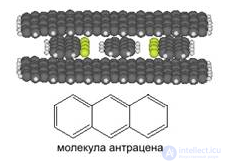
Scintillators come in different types depending on the substance they are made of. Overall this division into types can be represented as a division into organic and inorganic scintillators. Inorganic scintillators — are most often inorganic single crystals. There are also gas scintillators and glasses. Organic scintillators — are organic crystals, as well as plastics and, of interest to us, liquid scintillators. All these types are characterized, first of all, by a different scintillation mechanism. Inorganic scintillators are characterized by a high light yield, but also by a longer decay time (of the order of microseconds). Organic ones, on the contrary, are characterized by a small light yield, but their decay time is short (of the order of tens of nanoseconds). An example of an inorganic scintillator is NaI (sodium iodide), a hygroscopic substance with an enormous light yield. An example of organic ones — anthracene (C14H10).
In addition to the different luminosity properties there is also another important practical difference. Inorganic crystals are difficult to grow to a large size. As are crystals in general. Whereas gas scintillators, glasses, plastics and liquid scintillators can be of substantial volume.
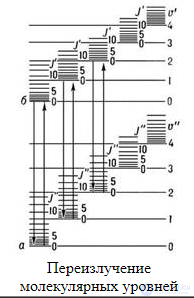 Re-emission of molecular levels |
Overall, the scintillation mechanism consists in the fact that the excitation created by a passing particle first falls on a certain non-emitting medium, and only then reaches a certain emitting center. In the general case, it can also be absorbed by an introduced shifter substance, which re-emits light at the wavelength best received by the PMT. In inorganic crystals, the transfer of excitation of lattice atoms is provided by a hole-particle mechanism, and the emitting centers are impurities in the crystal. In organic scintillators, it is not the band levels of the whole substance that are excited, but the molecular levels of individual atoms, and the transfer is carried out by re-emission. Let us consider this in more detail.
In organic scintillators, under the influence of the detected radiation, the molecule transitions to an excited electronic state. Ionization and dissociation of molecules are also possible (this leads to aging of the scintillator).
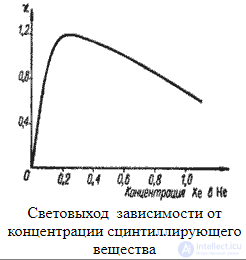 Light yield as a function of the concentration of the scintillating substance |
As a result of the recombination of the ionized molecule, it is, as a rule, formed in an excited state. The initially excited molecule may be at high excitation levels and after a short time emits a high-energy photon. This photon is absorbed by another molecule, and part of the excitation energy of this molecule can be spent on thermal motion, and the subsequently emitted photon will already have a lower energy compared to the previous one. And so it continues until all the re-emission energy has gone into thermal energy. But scintillators contain some small (of the order of a few percent) addition of another substance, such that it can be excited by a photon re-emitted by the main substance, and then emit at a different frequency. The scintillator glows thanks to it. The peculiarity is that with a small amount of this scintillating substance the yield will be small, because the chance of excitation of its molecules will be small, and with a large amount it will be small because the radiation will be reabsorbed, and the energy will go into thermal motion.
Also, organic scintillators emit mainly in the ultraviolet range. In order to make the scintillator glow in the optical range, as already mentioned, a special substance is introduced — a shifter, which absorbs ultraviolet radiation and re-emits it at the required wavelength. For example, phenyloxazolylbenzene — POPOP is used.
In principle, the detector consists of two parts: a vessel with the scintillator and a light receiver. The vessel should be surrounded by mirrors that reflect light well. The PMT must be protected from magnetic fields, to which it is sensitive. It should be positioned so that its readings do not depend on exactly where in the vessel the flash occurred. Also, the entire structure must be shielded from extraneous light sources.
Liquid scintillators — are solutions of a scintillating substance in some organic liquid. Their features, as organic scintillators, are a short decay time (of the order of tens of nanoseconds) and low efficiency, even in comparison with organic crystals. The excitation mechanism is described above for all organic scintillators.
These scintillators, due to the fact that they are liquid, have unique fields of application. First, additives sensitive to a particular type of radiation can be introduced into liquid scintillators without any problems. For example, to neutrons (for this, isotopes that undergo fission as a result of a reaction with a neutron are introduced). Second, liquid scintillators can be made of any volume. They can literally be poured into giant vessels, in order to reliably register particles that interact weakly with matter (for example, neutrinos). Likewise they can be made of any shape required by the experiment. For this, it is necessary to properly arrange the scintillator PMTs in a vessel of whatever volume and shape is needed.
Thus, liquid scintillators are qualitatively different from all others. Whereas solid scintillators — are already finished, and most often not very large (with the exception of plastic ones), detectors, a liquid scintillation detector can literally be assembled for a specific task.
Different particles are registered differently in liquid scintillators. Electrons are reliably registered in any scintillation detectors. A feature of organic, and liquid scintillators among them, is that they register low-energy electrons better and high-energy ones worse. Ions, protons and alpha particles are not registered ideally. First, because of strong ionization effects, and second, because of their large mass. This leads, first, to a decrease in light yield at low energies, and second, to the fact that the spectrum of light and heavy particles differs. Heavy particles usually have stronger afterglow during scintillation.
Neutrons do not interact electromagnetically with matter. Therefore, in order to register them, it is necessary for the neutron to interact with a proton. Organic detectors themselves acceptably register fast neutrons, thanks to the hydrogen in their composition. For registering slow neutrons, for example, 6Li or 10B can be introduced. These isotopes have a high cross-section for capturing a slow neutron. With a liquid scintillator this is done without difficulty.
Finally, to register gamma quanta a large atomic weight is needed, which liquid scintillators do not have, or a large volume, which they do have. And for registering neutrinos they have no competitors at all, since here what matters above all is the volume of substance.
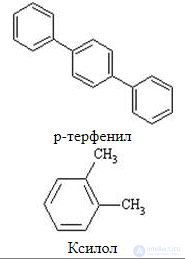
p-terphenyl
Xylene
There are now many types of scintillators, and often the manufacturing company names them with its own name. However, a feature of liquid scintillators is that the experimenter can mix the substance needed for the detector himself from purchased ingredients. Obviously, the same cannot be done with crystals. An example is such mixtures as a solution of p-terphenyl (C18H14) in xylene (C6H4(CH3)2) with an addition of the POPOP shifter. This is a fairly commonly used scintillator, historically. At a p-terphenyl concentration of 5g/l, its density: 0.86 g/cm3. The luminosity maximum falls on 350 nm. Decay time: 2 ns. Luminosity relative to NaI: 0.25, relative to anthracene respectively: 0.5. Other commonly used solvents are: toluene, phenylcyclohexane and PXE (PhenyloXylylethane). Scintillating substances: diphenyloxazole (PPO) and tetraphenylbutadiene (PBD).
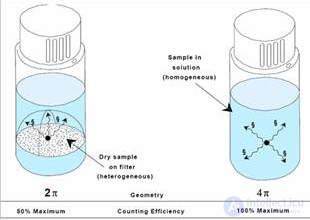
A common method of measuring beta radioactivity under laboratory conditions — is the so-called Liquid scintillation counting. The essence of this method is that the sample whose radioactivity needs to be measured is dissolved in a liquid scintillator, and then placed in a transparent flask, which is placed in a special instrument with two PMTs connected in a coincidence circuit (to filter out noise).
This method of measuring radioactivity is effective because any emitted electron will in any case end up in the scintillator.
Perhaps one of the most interesting applications of liquid scintillators — is their use as neutrino detectors. The point is that neutrinos interact poorly with matter. They require a large detector volume for reliable registration. However, in this case the problem lies in the actual registration of the interaction itself. One of the solutions — is the use of liquid scintillation detectors of gigantic volume. In this case the reaction products are easily tracked by scintillations, and by comparing the results of many PMTs the location of the reaction can be determined.
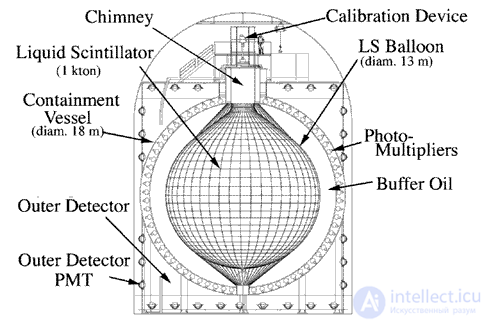
One such detector is the famous KamLAND (Kamioka Liquid scintillator Anti-Neutrino Detector) – a large neutrino detector on the island of Honshu in Japan. 12 institutes from the USA and Japan participate in the experiment. This detector was the first to obtain convincing proof of neutrino oscillation.
The idea of the experiment — was to compare the result of measurements of the antineutrino flux at KamLAND with the precisely calculated antineutrino flux from reactors in Korea and Japan. The main detector of the facility contains a kiloton of liquid scintillator in a transparent nylon sphere 13 m in diameter (it must be said that there are now even larger-scale projects with 18 kilotons of scintillator). The scintillator consists of a one-to-four solution of pseudocumene in dodecane with a small addition of diphenyloxazole, which improves the scintillation characteristics. On the inner surface of the steel sphere there are 1879 photomultipliers of two types (17- and 20-inch diameter). The trigger moment of each PMT is tracked with an accuracy of about 3.5 ns, which makes it possible not only to measure the energy of events, but also to reconstruct the coordinates of the scintillation flash. The result of this experiment was the registration over 150 days of 54 antineutrinos, while the calculated figure was 86. The presence of a deficit in the antineutrino flux is evidence in favor of the existence of antineutrino oscillations, i.e. the transition of an electron antineutrino into antineutrinos of other types — muon or tau.
The first advantage of scintillators is their price. Technologically, scintillation detectors are quite simple, and as a consequence cheap. This makes it possible to use them where what is required is precisely a large number of detectors, rather than their quality (for example, as will be discussed later, in neutrino detectors and various calorimeters). Second, these detectors make it possible to determine the energy lost by a particle while traveling through the scintillator medium. They do not measure momentum and coordinates (because PMTs are very sensitive to the magnetic and electric fields necessary for such measurement). The fraction of the energy of the detected particle that is converted into the energy of the light flash is called the light yield. For example, the light yield of anthracene is about 0.05, which means about 1 photon per 50 eV for high-energy particles. For the commonly used NaI the light yield is about 0.1, or 1 photon per 25 eV. It is customary to compare the light yield of a given scintillator with the light yield of anthracene, which is used as a standard.
However, a drawback is that scintillators determine this same energy rather imprecisely (compared to proportional counters and semiconductor detectors). This is influenced by a whole range of factors at once: the statistical nature of scintillations, inaccuracies of the PMT itself, as well as specific characteristics of the scintillator related to afterglow (residual glow after scintillation, which makes it difficult to determine the energy of subsequent particles, and which is related to luminescence, although its nature is different in different substances), as well as the very shape of the scintillator's spectrum. This means that scintillators cannot be used as precision detectors.
Scintillators have a dead time of the order of microseconds, or tens of nanoseconds. This can rather be attributed to the merits of the scintillator, because as central detectors the dead time of ionization chambers and many other detectors is significantly longer.
Among the drawbacks of scintillators is also the difficulty of operating some of them. Thus many scintillators are hygroscopic, and once wet (or having absorbed water vapor from the air) stop glowing. Others require low temperature. However, this is a problem for most detectors in general, and in this respect scintillation detectors are actually less demanding than others, which often require both low temperature and high vacuum.
Also, determining the energy of a particle in a scintillator is complicated by the fact that different particles lose energy differently and have different light yields. The so-called quenching factor reflects how much fewer photons heavy particles will give compared to light ones.

Comments