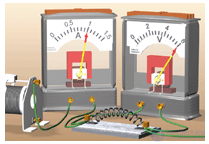
In the previous article we began getting acquainted with the physical quantity «electrical resistance». Let us continue – let us carry out an experiment. We will need a source of electrical energy, an ammeter, a voltmeter, a rheostat, and two resistors (two nichrome coils) with different resistances.
Electrical resistance – a physical quantity equal to the ratio of the voltage across the ends of any conductor to the current strength in it. The unit is 1 ohm (1 Ω).
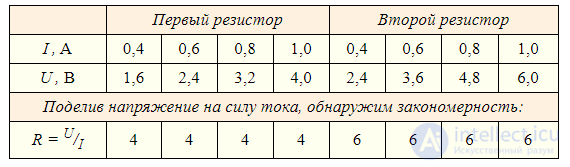
Let us assemble the circuit as shown in the figure on the left or in the diagram at the end of the section. By moving the rheostat's slider, let us in turn set the current strength values 0.4 A, 0.6 A, 0.8 A, 1 A. Let us record the readings of the ammeter and voltmeter in a table. Let us repeat the experiment, replacing the resistor, and add to the table:
The regularity is that, regardless of the values of voltage and current strength, their quotient remains constant for each resistor. Check this: after dividing each number in the row (U, V) by the number located above it in the row (I, A), the same results are obtained in all columns of the left half of the table: 4 V/A, and in all columns of the right half of the table: 6 V/A. This shows that the quantity R is a characteristic specifically of the section of the circuit under study – the resistor.
Note that this regularity always holds for metallic conductors in the solid or liquid state; for other conductors it does not always hold. However, the quantity R, equal to the ratio U/I, is always called the electrical resistance of the conductor regardless of its material and state, and 1 V/A is called 1 ohm. Consequently, 1 ohm is the resistance of a conductor in which a current of 1 A will arise if the voltage across the ends of the conductor is 1 V.
Self-check questions
- To carry out the experiment and the measurements, let us connect the instruments ...
- By changing the position of the rheostat's slider, ...
- By changing the strength of the electric current in the circuit, we ...
- To complete the experiment, let us carry it out once more, ...
- How will we discover the regularity?
- What does the regularity we discovered consist of?
- What does this regularity indicate?
- What are the limits of applicability of this regularity? It ...
- What is called the electrical resistance of a conductor?
- What in physics is called one ohm?
-
Ohm's law for a section of a circuit:
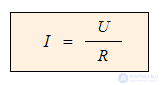
The relationship between the quantities U, I, R is usually written in the form of a formula known as Ohm's law for a section of a circuit:
I – current strength in the section of the circuit, A
U – applied voltage, V
R – resistance of the section of the circuit, Ω
[[s|ohms]]
Ohm's law for a section of a circuit: the current strength in a conductor is directly proportional to the voltage applied to its ends and inversely proportional to the resistance of the conductor. The law always holds for solid and liquid metallic conductors, as well as for certain other substances (as a rule, solid or liquid ones).
To work out how this formula should be read, let us recall our knowledge from algebra about the types of proportionality between quantities.
direct proportionality:

inverse proportionality:

From the first line it follows: at constant resistance, the quantity 1/R is also constant, so the current strength is directly proportional to the voltage across the ends of the section of the circuit. From the second line: at constant voltage, the current strength is inversely proportional to the resistance of the section of the circuit. Combining this, we obtain the formulation of Ohm's law for a section of a circuit: the current strength in a section of a circuit is directly proportional to the voltage across its ends and inversely proportional to the resistance of that section.
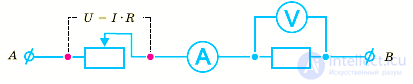
Note. From the algebraic point of view, the formula of Ohm's law can be written in the following form: U=I·R. Let us apply it to study the circuit shown in the diagram. Suppose terminals A and B are connected to a source with a voltage of 10 V, but the voltmeter allows measuring a voltage of no more than 6 V (see the figure at the beginning of the section). Therefore we need to create a voltage drop across the rheostat of 4 V or more. How can this be done? The further to the right we move the slider, the greater the resistance of the rheostat, and, according to the formula U=I·R, the greater the voltage across the rheostat, which is what is called the voltage drop. As a result, the voltage across the resistor decreases and can become less than 6 V, which is what we need.
Self-check questions
- Ohm's law for a section of a circuit expresses ...
- The quotient of dividing the voltage across a section of a circuit by its resistance is ...
- The quotient of dividing the voltage across a section of a circuit by the current strength in it is ...
- In algebra, direct proportionality of quantities is written: ...
- In algebra, inverse proportionality of quantities is written: ...
- Direct proportionality of the current strength to the voltage is observed ...
- Inverse proportionality of the current strength to the resistance is observed ...
- Formulate Ohm's law from the algebraic point of view.
- Since the upper measurement limit of the voltmeter is 6 V, and the source voltage is 10 V, ...
- How does a voltage drop arise when the rheostat's slider is moved?
See also
- [[b9869]]
- Kirchhoff's laws
See also


Comments