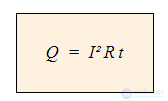
In the 19th century, working independently of each other, the Englishman J. Joule and the Russian H. Lenz studied the heating of conductors by electric current and experimentally discovered a regularity: the amount of heat released in a current-carrying conductor is directly proportional to the square of the current, the resistance of the conductor, and the time the current flows.
Other scientists established that this statement holds for any conductors: solid, liquid, and gaseous. This is why the regularity became known as the Joule-Lenz law:
Q – heat released, J
I – electric current in the conductor, A
R – resistance of the conductor, Ω
t – time the current flows, s
Joule–Lenz law: the amount of heat released by a current-carrying conductor equals the product of the square of the current, the resistance of the conductor, and the time the current flows.
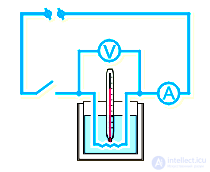
On the right is a diagram of a setup that can be used to verify the Joule–Lenz law experimentally. Dividing the voltage by the current, using the formula R=U/I, gives the resistance. A thermometer measures the rise in water temperature. The formulas Q=I²Rt and Q=cmΔt° give the amounts of heat, which should be equal to each other (allowing for errors).
For those interested in physics in more depth, we note specifically that the Joule–Lenz law can be obtained not only experimentally but also derived theoretically, using formulas already familiar to us.
| According to Ohm's law |
| U = I · R |
I = U / R |
| According to the formula for the work of the current |
| A = I·U·t = I·(I·R)·t |
A = I·U·t = (U/R)·U·t |
| As a result we obtain: |
| A = (I²·R)·t |
A = (U²/R)·t |
We have obtained two new formulas at once; let's find out their physical meaning.
Self-check questions
What experiments did Lenz and Joule carry out? They ...
What scientific fact did they discover?
The Joule-Lenz law is applicable (holds) ...
The product on the right side of the equation represents ...
The Joule-Lenz law can always be ...
The resistance of the coil in the calorimeter is found by ...
A thermometer serves to measure ...
The formulas Q=I²Rt and Q=cmΔt° serve to calculate ...
The Joule-Lenz law can be obtained not only experimentally, but also ...
Applying Ohm's law and the formula for the work of the current, ...
The left-hand formula A=I²Rt resembles the formula of the Joule–Lenz law, but its left side contains the work of the current, not the amount of heat. What gives us the right to consider these quantities equal? To do this we recall the first law of thermodynamics (see § 6-z) and express the work from it.
ΔU = Q + A hence A = ΔU – Q
Here ΔU – is the change in the internal energy of the current-heated conductor; Q – is the amount of heat given off by the conductor (indicated by the «–» sign in front); A – is the work done on the conductor. Let's find out what this work is.
The conductor itself is stationary, but inside it electrons move, colliding with the ions of the crystal lattice and transferring part of their kinetic energy to them. For the flow of electrons not to weaken, the forces of the electric field must constantly do work. Therefore A – is the work of the electric field in moving the conductor's electrons.
Let us now discuss the quantity ΔU with respect to a conductor in which a current begins to flow. The conductor will heat up, and its internal energy will increase. As it heats, the difference between the temperature of the conductor and that of the surrounding medium will grow. According to Newton's law (see § 6-l), the power of heat transfer will increase. This will soon cause the temperature of the conductor to stop rising. And from that moment the internal energy of the conductor will stop changing, that is, the quantity ΔU will become equal to zero.
The first law of thermodynamics for this state is written as: A = –Q. In words: if the internal energy of the conductor does not change, then the work of the current is fully converted into heat. Using this conclusion, let us write all three formulas for calculating the work of the current in other forms:
Q = I·U·t Q = I²·R·t Q = U²/R·t
For now we will consider these formulas equivalent. Later we will learn that the middle formula always holds (which is why it is called a law), while the two outer ones – only under certain conditions (which we will formulate in higher grades).
Since the formulas contain not Q but A, a justification is needed so that ...
Such a justification for us will be ...
In the equation A=ΔU–Q the last term – is ...
On the left side of this same equation stands ...
The work done on the conductor – is ...
After the current is switched on in a circuit, any of its ...
The rise in the power of heat transfer of the conductor ...
Therefore the change in internal energy becomes zero, that is ...
The expression A = –Q of the first law of thermodynamics means: ...
We have justified replacing A with Q, and note for the future that ...
Interesting facts
just 1 kW·h of electricity is enough
- to bake 36 kg of bread,
- extract 30 kg of oil, or
- 40 kg of coal,
- produce 2.7 kg of newsprint, or
- 1.5 kg of writing paper
To generate 1 kW·h of electricity, power plants consume
- about 600 g of coal, or
- 300 g of liquid fuel – fuel oil.
From 1 kg of uranium one can thereby obtain 620 thousand kW-h of energy, that is, 90 thousand(!) times more than when burning coal
See also
Electric heating appliances


Comments