
Lecture
Friction — is the process of mechanical interaction between contacting bodies during their relative displacement in the plane of contact (external friction), or during the relative displacement of parallel layers of a liquid, a gas, or a deformable solid body (internal friction, or viscosity). Further in this article, friction is understood to mean only external friction. The study of friction processes is a branch of physics called the mechanics of frictional interaction, or tribology.
Friction is primarily electronic in nature, provided that the substance is in its normal state. In the superconducting state, far from the critical temperature, the main «source» of friction is phonons, and the coefficient of friction can decrease by several times.
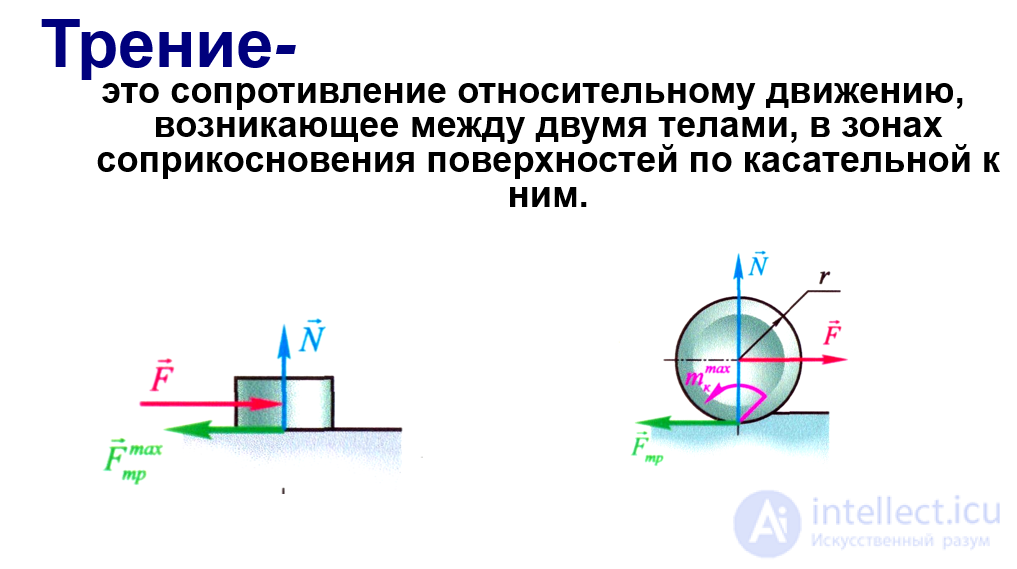
Friction force is the force that arises when two bodies come into contact and that opposes their relative motion. The cause of friction is the roughness of the rubbing surfaces and the interaction of the molecules of these surfaces. The friction force depends on the material of the rubbing surfaces and on how strongly these surfaces are pressed against each other. In the simplest models of friction (Coulomb's law of friction), the friction force is assumed to be directly proportional to the normal reaction force between the rubbing surfaces. In general, however, due to the complexity of the physico-chemical processes occurring in the zone of interaction of the rubbing bodies, friction processes fundamentally cannot be described using simple models of classical mechanics.
the force of mechanical resistance that arises in the plane of contact between two bodies pressed against each other during their relative displacement.
The resistance force acting on a body is directed opposite to the relative displacement of that body.
Friction arises for two reasons:
1) the first and main reason is that at the points of contact the molecules of the substances attract each other, and work must be done to overcome this attraction. The contacting surfaces touch each other only over very small areas. Their total area amounts to 0.01-:0.001 of the overall (apparent) contact area. During sliding, the area of actual contact does not remain constant. The (sliding) friction force will change during the motion. If the sliding body is pressed more firmly against the body it is sliding over, then, due to the deformation of the bodies, the area of the contact spots (and the friction force) will increase in proportion to the pressing force.
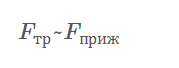
2) the second reason for the appearance of the friction force is the presence of roughness (irregularities) on the surfaces, and their deformation as one body moves over the surface of the other. The depth of penetration (interlocking) of the irregularities depends on the pressing force, and the magnitude of the deformations depends on this in turn.
The latter, in turn, determine the magnitude of the friction force: 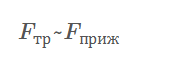 .
.
During relative sliding both causes are present, so the nature of the interaction takes the form of a simple relation:
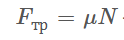 – sliding friction force (the Coulomb–Amontons formula), where
μ – is the coefficient of sliding friction,
N – is the reaction force of the support, equal to the pressing force.
The value of the coefficient of friction differs for different combinations of rubbing substances even with identical surface treatment (the attractive forces and elastic properties depend on the type of substance).
If a lubricant is present between the rubbing surfaces, the attractive force will change noticeably (different molecules will be attracted, and the sliding friction force will be partially replaced by the viscous friction force, which we will consider below).
If a horizontal force `vecF` acts on a body lying on a horizontal surface, motion will be caused by this force only when it exceeds a certain value `(muN)`. Before the onset of motion, the external force is balanced by the static friction force. The static friction force is always equal to the external force, parallel to the surface, and it arises because of the attraction between molecules in the areas of the contact spots, and the deformation of the roughness.
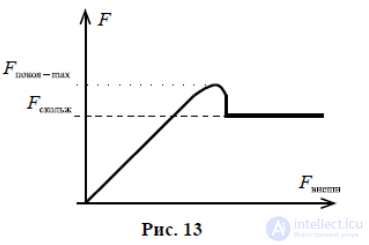
The static friction force differs across different areas of the surface over which the motion will take place. If a body lies on a surface for a long time, then, owing to vibrations (which are always present at the Earth's surface), the area of the contact spots increases slightly. Therefore, to initiate motion, a somewhat larger friction force must be overcome than the sliding friction force. This phenomenon is called stiction.
This phenomenon occurs in:
braking systems (brake squeal),
earthquakes (the buildup and sudden release of stress in tectonic plates),
mechanics (squeaking doors, chattering mechanisms).
The stick-slip phenomenon during the motion of a bow across a string is an alternation of sticking and slipping phases: the bow sticks to the string (static friction), stretching it. The string breaks free (sliding friction) and vibrates, producing sound. It is precisely this phenomenon that allows a violin to sound clean and expressive. This cycle repeats hundreds of times per second, forming a steady sound.
We encounter this phenomenon, for example, when moving furniture in a room. (In Fig. 13 the excess of static friction over sliding friction is greatly exaggerated).
We make use of static friction to move on skis or simply while walking.
The types of friction considered so far belong to dry, or external, friction. But there is one more type of friction – viscous friction.
When a body moves in a liquid or a gas, fairly complex processes of molecule exchange occur between the layers of the surrounding fluid or gas. These processes are called transport processes.
At low speeds of a body's motion relative to a gas or liquid, the drag force is given by the expression:
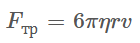 – Stokes' law for a sphere, where
η - is the viscosity of the substance in which the body moves;
r - is the average transverse dimension (radius) of the body;
ν - is the relative velocity of the body;
6π - is the coefficient corresponding to the spherical shape of the body.
A conclusion about the magnitude of the speed (whether it is large or small) can be drawn by determining a dimensionless coefficient called the Reynolds number:
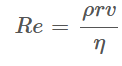 ` - is the Reynolds number, where
ρ - is the density of the substance in which the body moves.
If Re<1700, then the motion of the gas (liquid) around the body is laminar (layered), and the velocities can be considered small.
If Re>1700, then the motion of the gas (liquid) around the body is turbulent (with eddies), and the velocities can be considered large.
In the latter case most of the body's kinetic energy is spent forming eddies, which means the friction force becomes greater, and the dependence ceases to be linear.
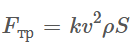 - is the viscous friction force at high speeds, where
S - is the cross-sectional area of the body,
k - is a constant depending on the transverse dimensions of the body.
This last formula can often be seen in the form:
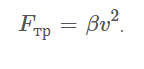
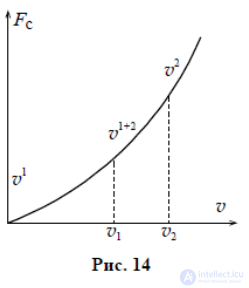
The Reynolds number, taken equal to `1700`, is in reality determined by the specific problem (conditions) and can take other values of the same order. This is explained by the fact that the dependence of the viscous friction force on speed is complex in character: at a certain speed v1 the linear dependence begins to break down, and at a certain speed v2 this dependence becomes quadratic. In the interval from v1 to v2 the exponent takes fractional values (Fig. 14). The Reynolds number characterizes the state of a dynamic system in which the motion of the layers remains laminar, and it depends strongly on the external conditions. For example: a steel ball moving in water far from the boundaries of the liquid (in an ocean or a lake) keeps the motion of the layers laminar at Re=1700, whereas the same ball moving in a vertical tube, of a radius only slightly larger than the ball's, filled with water, will already cause eddies to form around the ball at Re=2. (Note that the Reynolds number is not the only one used to describe such motion. The Froude and Mach numbers, for example, are also used.)
Because of such a complex dependence of the drag force on the size, shape, and speed of the body, it is impossible to calculate the drag force with the required accuracy. That is why models of aircraft have to be built and the drag force measured experimentally, by blowing air through them in wind tunnels.
The air resistance force acting on fog droplets is proportional to the product of the speed and the radius of the droplets: F=krv
. Droplets with a radius of 0.1 mm, falling from a great height, have a speed of about 1 m/s near the ground.
What speed will droplets have whose radius is two times smaller?
Ten times smaller?
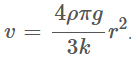
The droplet falls at a constant speed, because the force of gravity is balanced by the viscous friction force of the air:
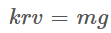 or
or 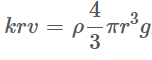 `, whence
  .
.
From the result obtained, it follows that the speed of the droplet is directly proportional to the square of the radius. If the radius of the droplet decreases by a factor of two, its falling speed decreases by a factor of four, and amounts to `v_1~~0.25` m/s; and if the radius turns out to be ten times smaller, the speed will be a hundred times smaller, i.e. v2~0.01 m/s.
This problem is interesting because it can explain why clouds do not fall. After all, a cloud is fog, which does not fall because of the presence of upward air currents. The largest droplets are found at the lower boundary of the cloud. As the flow rises, its speed decreases, because it does work against the air it meets and increases its potential energy. Since the flow speed in the upper part of the cloud is lower, the size of the droplets there is smaller too. The droplets «hang» above the surface of the earth at a constant height.
When there is relative motion between two contacting bodies, the friction forces arising from their interaction can be divided into:
 , where N — is the normal pressure, p — is the coefficient of torsional friction, which has the dimension of length.\

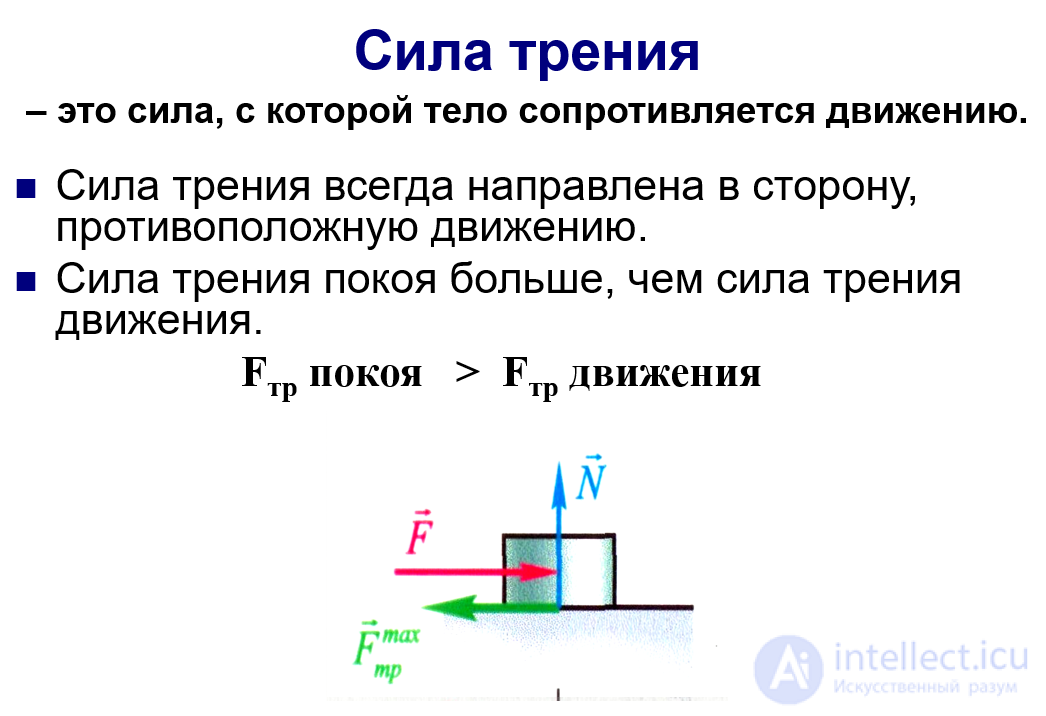
In physics, frictional interaction is customarily divided into:
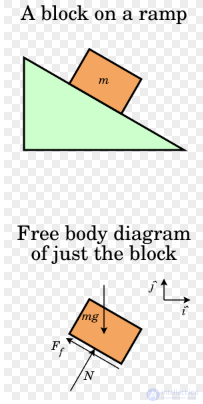
Free-body diagram for a block on a ramp. The arrows are vectors indicating the directions and magnitudes of the forces. N — is the normal reaction force, mg — is the force of gravity, and Ff — is the friction force.
The normal reaction force is defined as the resultant force pressing two parallel surfaces together, and its direction is perpendicular to these surfaces. In the simple case where a mass lies on a horizontal surface, the only component of the normal force is the force of gravity, so that N=mg . In this case, the equilibrium conditions tell us that the magnitude of the friction force equals zero,  . In fact, the friction force always satisfies the condition
  , with equality achieved only at the critical, sufficiently steep ramp angle (given by the formula
  ) for sliding to begin.
The coefficient of friction is an empirical (experimentally measured) structural property that depends only on various aspects of the contacting materials, such as surface roughness. The coefficient of friction does not depend on mass or volume. For example, a large aluminum block has the same coefficient of friction as a small aluminum block. However, the magnitude of the friction force itself depends on the normal reaction force and, consequently, on the mass of the block.
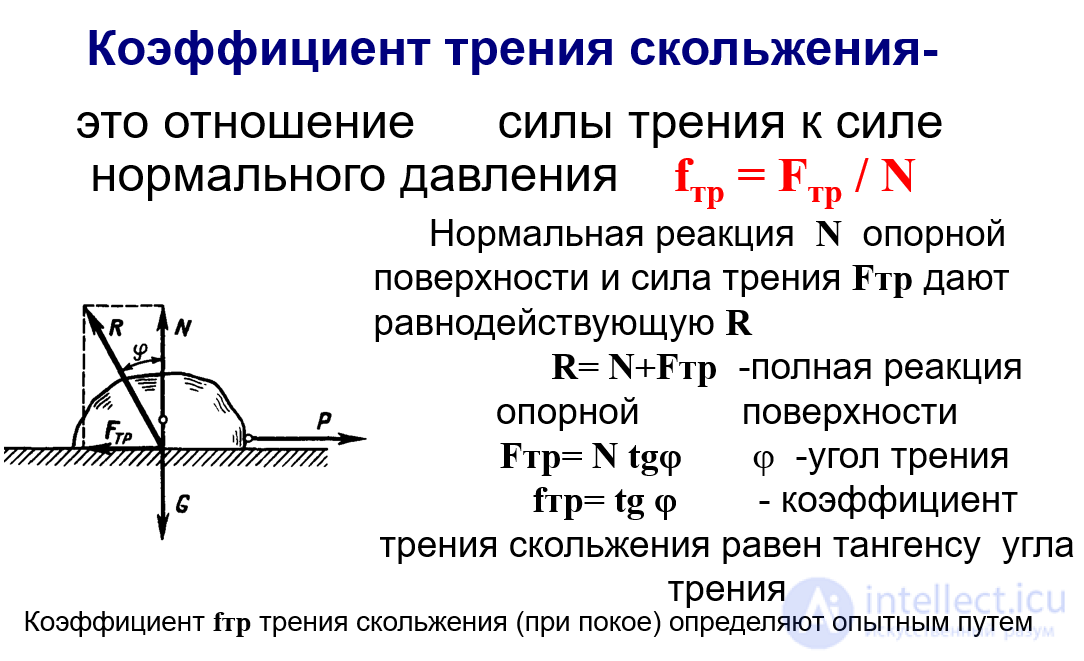
The coefficient ffr of sliding (static) friction is determined experimentally: its values for various conditions are given in reference tables.
Metal on metal without lubrication .............. 0.15. ..0.3
Same, with lubrication ................... ................ 0.1. ..0.18
Wood on wood without lubrication .................. 0.4.. .0.6
Leather on cast iron without lubrication ..................... 0.3. ..0.5
Same, with lubrication .................................... 0.15
Steel on ice ........................................... 0.02
The coefficient of sliding friction during motion is usually smaller than at rest, and to a first approximation does not depend on the relative speed of displacement of the bodies.
Depending on the situation, the calculation of the normal force N includes forces other than the force of gravity. If an object lies on a flat horizontal surface and is subjected to an external force P , causing it to slide, then the normal reaction force between the object and the surface is expressed by the equality
 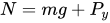 , where mg — is the weight of the block and
  — is the downward-directed component of the external force. Before sliding, this friction force equals
  , where Px — is the horizontal component of the external force. Thus, . Sliding begins only after the friction force reaches the value
  . Until then, friction provides equilibrium, so it can simply be regarded as a reaction.
If an object is on an inclined surface, for example on an inclined plane, the surface-normal component of gravity is smaller than mg , because a smaller component of gravity is perpendicular to the face of the plane. The normal force and the friction force are ultimately determined by means of vector analysis, usually with the help of a Maxwell–Cremona diagram.
In general, the process of solving any static problem involving friction consists in initially treating the contacting surfaces as stationary, so that the corresponding tangential reaction force between them can be calculated. If this reaction force satisfies , then the preliminary assumption was correct, and this is the actual friction force. Otherwise, the friction force must be set equal to , and the resulting force imbalance will then determine the acceleration associated with the sliding.
The coefficient of friction, often denoted by the Greek letter µ, is a dimensionless scalar quantity equal to the ratio of the friction force between two bodies to the force pressing them against each other, during or at the onset of sliding. The coefficient of friction depends on the materials used; for example, ice has a low coefficient of friction against steel, while rubber has a high coefficient of friction when sliding on a road surface. Coefficients of friction range from almost zero to values greater than one. Friction between two metal surfaces of identical metals is greater than between two surfaces of different metals — consequently, brass will have a higher coefficient of friction when moving against brass, but a lower one when moving against steel or aluminum.
For surfaces at rest relative to each other  , where
  — is the coefficient of static friction. It is usually greater than its kinetic counterpart. The coefficient of static friction exhibited by a pair of contacting surfaces depends on the combined effect of the material's deformation characteristics and surface roughness, both of which originate in the chemical bonding between atoms within each of the bulk materials, as well as between the material surfaces and any other adsorbed materials. It is known that the fractality of surfaces, a parameter describing the scale behavior of surface irregularities, plays an important role in determining the magnitude of static friction.
For surfaces in relative motion  , where
  — is the coefficient of kinetic friction. Coulomb friction equals
  , and the friction force on each surface acts in the direction opposite to its motion relative to the other surface.
Arthur Morin introduced this term and demonstrated the usefulness of the coefficient of friction. The coefficient of friction is an empirical quantity — it must be measured experimentally and cannot be determined by calculation. Rougher surfaces usually have higher effective values of the coefficient of friction. Both static and kinetic coefficients of friction depend on the pair of contacting surfaces; for a given pair of surfaces, the coefficient of static friction is usually greater than the coefficient of kinetic friction; in some sets the two coefficients are equal, for example, Teflon on Teflon.
Most dry materials have coefficient of friction values from 0.3 to 0.6. Values outside this range are less common, but Teflon, for example, can have a coefficient as low as 0.04. A value of zero would mean the absence of friction, an unobserved property. Rubber in contact with other surfaces can have a coefficient of friction from 1 to 2. It is sometimes claimed that μ is always <1, but this is incorrect. While in most relevant applications μ <1, a value above 1 simply means that the force required to slide an object along a surface is greater than the normal force exerted by the surface on the object. For example, surfaces coated with silicone rubber or acrylic rubber have coefficients of friction that can be considerably greater than 1.
Although it is often claimed that the coefficient of friction is a «material property», it is better classified as a «system property». Unlike true material properties (such as conductivity, permittivity, yield strength), the coefficient of friction for any two materials depends on system variables such as temperature, velocity, atmosphere, and what is now usually called aging and fracture time; as well as on the geometric properties of the interface between the materials, namely the structure of their surfaces . For example, a copper pin sliding on a thick copper plate may have a coefficient of friction that varies from 0.6 at low velocities (metal-on-metal sliding) to less than 0.2 at high velocities, when the copper surface begins to melt due to frictional heating. The latter velocity, of course, does not uniquely determine the coefficient of friction; if the pin diameter is increased so that frictional heat is quickly removed, the temperature drops, the pin remains solid, and the coefficient of friction rises to the value observed in the «low-speed» test.
Under certain conditions some materials have very low coefficients of friction. An example is (highly ordered pyrolytic) graphite, which can have a coefficient of friction below 0.01 . This ultra-low-friction regime is called superlubricity.
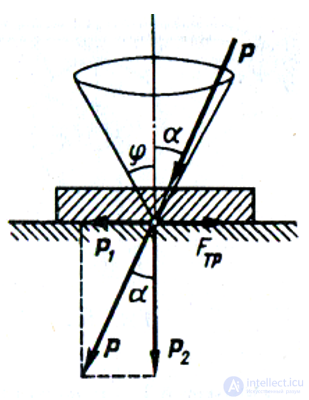
If the coefficient of sliding friction is the same for all directions of motion, then the set of full reactions forms a circular friction cone
For the equilibrium of a body lying on a rough surface, the resultant of the active forces applied to it must pass inside the friction cone.
By the second law of sliding friction
Ffr = ffr P2=P2 tg φ Hence, for α < φ there will be P1
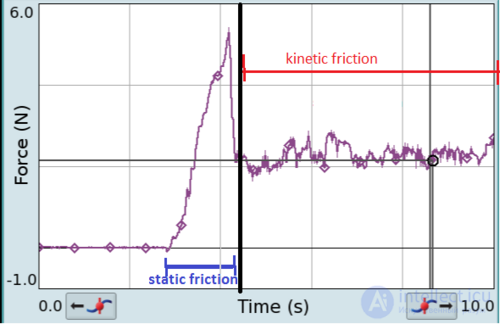
When the mass is stationary, the object experiences static friction. Friction increases as the applied force increases, until the block moves. Once the block begins to move, it experiences kinetic friction, which is less than the maximum static friction.
Static friction — is friction between two or more solid objects that are not moving relative to one another. For example, static friction can prevent an object from sliding down an inclined surface. The coefficient of static friction, usually denoted as μs, is usually higher than the coefficient of kinetic friction. Static friction is believed to arise from surface roughness features at various length scales on solid surfaces. These features, known as asperities, are present down to the nanoscale and cause the true solid-on-solid contact to exist only at a limited number of points, making up only a fraction of the apparent or nominal contact area . The linearity between the applied load and the true contact area, arising from the deformation of asperities, leads to the linearity between the static friction force and the normal force found for typical Amontons—Coulomb friction .
The static friction force must be overcome by the applied force before an object can move. The maximum possible friction force between two surfaces before sliding begins is the product of the coefficient of static friction and the normal force: 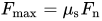 . When no sliding occurs, the friction force takes any value from zero to Fmax . Any force less than Fmax attempting to move one surface across the other is met by an opposing friction force of equal magnitude and opposite direction. Any force greater than Fmax overcomes the static friction force and causes sliding. Sliding then occurs instantly, and static friction no longer applies — the friction between the two surfaces is then called kinetic friction. However, apparent static friction may be observed even when the true static friction is zero .
An example of static friction is the force that prevents a car wheel from slipping as it rolls along the ground. Although the wheel is in motion, the section of tire in contact with the ground is stationary relative to the ground, so this is static, not kinetic, friction.
The maximum value of static friction is sometimes called limiting friction, although this term is not used universally .
Kinetic friction, also known as sliding friction, occurs when two objects move relative to one another and rub against each other (like sled runners on the ground). The coefficient of kinetic friction is usually denoted as μk and is usually less than the coefficient of static friction for the same materials . However, Richard Feynman notes that «with dry metals it is very hard to show any difference». The friction force between two surfaces once sliding has begun is the product of the coefficient of kinetic friction and the normal reaction force:  . This is responsible for the Coulomb damping of an oscillating or vibrating system.
New models show how much greater kinetic friction can be than static friction. Kinetic friction, in many cases, is primarily caused by chemical bonding between the surfaces rather than interlocking asperities ; however, in many other cases roughness effects are dominant, for example in the friction of rubber on a road. Surface roughness and contact area affect kinetic friction for micro- and nanoscale objects, where forces distributed over the surface area dominate over inertial forces .
The origin of kinetic friction at the nanoscale can be explained thermodynamically . During sliding, new surface is formed at the rear of the sliding true contact, while existing surface disappears at the front. Since all surfaces carry thermodynamic surface energy, work must be expended to create new surface, and energy is released as heat when surface is removed. Thus force is required to move the rear of the contact, and frictional heat is released at the front.
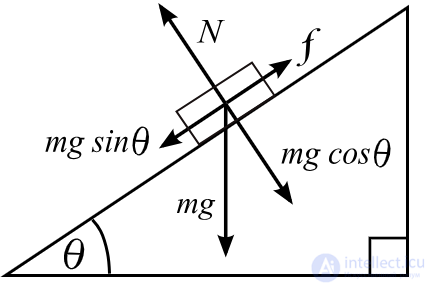
Angle of friction θ, when the block is just beginning to slide.
For some applications it is more useful to define static friction in terms of the maximum angle before one of the elements begins to slide. This is called the angle of friction and is defined as:

where θ — is the angle from horizontal, and μs — is the static coefficient of friction between the bodies . This formula can also be used to calculate μs from empirical measurements of the angle of friction.
Determining the forces required to move atoms past one another is a difficult task in the development of nanomachines. In 2008 scientists were for the first time able to move a single atom across a surface and measure the forces required. Using an ultra-high vacuum and a near-cryogenic temperature (5 K), a modified atomic force microscope was used to move cobalt atoms and carbon monoxide molecules across copper and platinum surfaces .
Ffr =ffr N= ffr G2= ffr G cos a
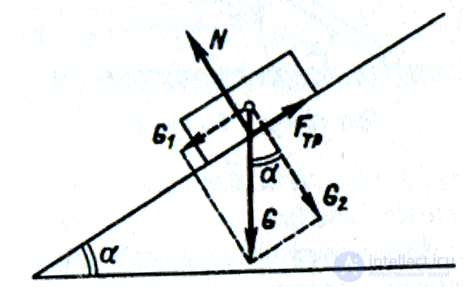
Ffr = ffr mg cos a
a) If the angle of inclination of the plane equals the angle of friction (α = φ), then a body lying on the inclined surface will, under its own weight, either slide uniformly or remain at rest
b)If α < φ – the body is at rest
c)If α > φ – the body will slide uniformly under its own weight
Rolling friction is caused by deformation of the rolling surface, while the rolling body itself is also deformed.
Rolling friction arises when bodies with a curved surface attempt to «roll» relative to one another
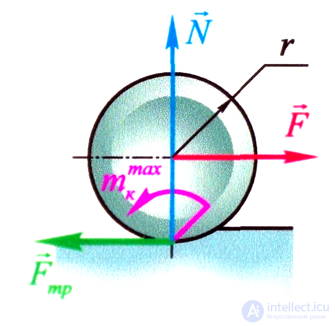
ROLLER AND ROLLING FRICTION
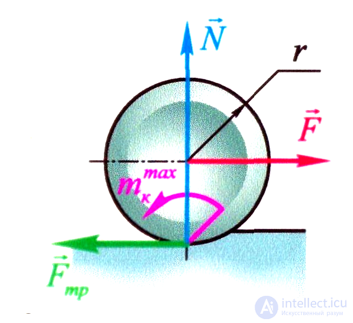
The wheel rolls under the action of the rolling moment
Mk = F r,
where Mk – is the rolling moment;
F – external force
r – radius of the wheel.
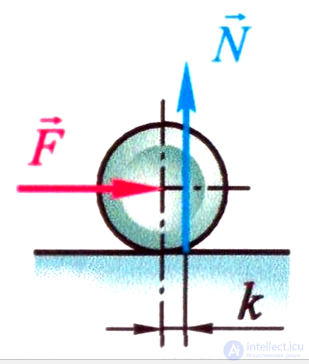
During rolling, rolling friction arises due to a rolling-friction couple with moment Mkmax
Mkmax = k N,
where Mkmax – is the rolling friction moment;
k – the coefficient of rolling friction – is the distance between the vector of gravity and the displaced point of support (a dimensional quantity [m]);
N – the normal pressure force from the displaced point of support
POSSIBLE CASES OF BODY MOTION
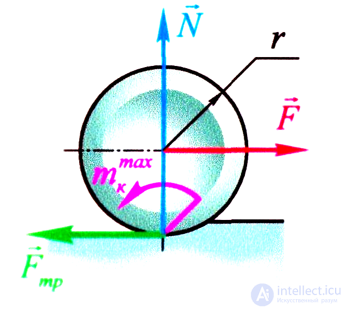
The body rolls only if Mk ≥ Mkmax, i.e. F r ≥ k N
The minimum force required for motion F = k N /r
The larger the radius r, the smaller the force F
a) Mk ≥ Mkmax, but F < Ffr – the body only rolls
b) Mk < Mkmax, but F > Ffr – the body only slides
c) Mk > Mkmax, but F > Ffr – the body rolls with slipping
d) Mk < Mkmax, but F < Ffr – the body is at rest
LAWS OF FRICTION
There are three laws of sliding friction (Coulomb's laws):
1.The friction force does not depend on the size of the area of the rubbing surfaces
If the area of the rubbing surfaces increases, then the number of interlocking asperities also increases, but the pressure decreases and the resistance remains the same.
2.The maximum friction force is directly proportional to the normal component of the external forces acting on the surface of the body.
Whatever the factor by which the normal pressure force or reaction increases, the maximum friction force increases by the same factor.
The friction force is equal to the product of the normal pressure force and the coefficient of sliding friction
(From the second law of friction)
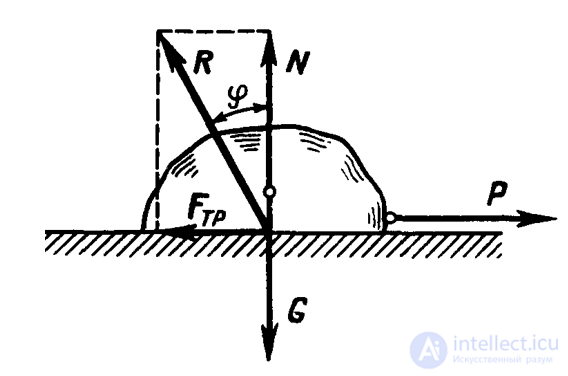
Ffr=ffr N ,
where ffr – is the coefficient of sliding friction
N – the normal pressure force
3.The friction force depends on the material of the bodies, the condition of the rubbing surfaces, and the presence and type of lubrication.
A distinction is made between friction materials (special plastics using asbestos and copper) and anti-friction materials (babbitt, bronze, graphite).
Rough surfaces have greater friction than smooth ones.
When the sliding surfaces are lubricated, the body begins to move with less friction.
The main characteristic of friction is the coefficient of friction μ , determined by the materials from which the surfaces of the interacting bodies are made.
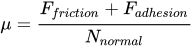
In the simplest cases the friction force F and the normal load (or normal reaction force) Nnormal are related by the inequality

| Pair of materials | μ static | μ sliding |
|---|---|---|
| Steel-Steel | 0.5—0.8 | 0.15—0.18 |
| Rubber-Dry asphalt | 0.95—1 | 0.5—0.8 |
| Rubber-Wet asphalt | 0.25—0.75 | |
| Ice-Ice | 0.05—0.1 | 0.028 |
| Rubber-Ice | 0.3 | 0.15—0.25 |
| Glass-Glass | 0.9 | 0.7 |
| Nylon-Nylon | 0.15—0.25 | |
| Polystyrene-Polystyrene | 0.5 | |
| Plexiglass, acrylic glass | 0.8 |
For most pairs of materials, the coefficient of friction μ does not exceed 1 and lies in the range 0.1—0.5. If the coefficient of friction exceeds 1
  , this means that there is an adhesion force Nadhesion
 between the contacting bodies, and the formula for calculating the coefficient of friction changes to
Stribeck Curve
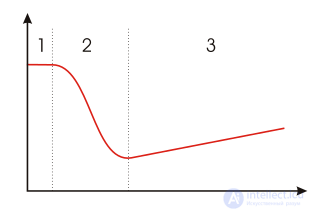
The Stribeck curve is a curve expressing the dependence of the sliding friction force F on the magnitude of the velocity v . It is used in the theory of hydrodynamic friction. It was established in 1902 by the German researcher Richard Stribeck . According to its discoverer, the law expressed by this curve also relates to the hardening of materials and to the theory of shaft bearings.
Properties The Stribeck curve takes into account
If no relative motion occurs, static friction is present. Once a force exceeding the critical friction value FH is applied to the system, relative motion begins. Friction is almost constant and initially barely depends on velocity, as long as, in the newly formed contact areas, the lubricant molecules are fully displaced. In this case one speaks of dry, or boundary, friction (region 1). If this is not the case, and any amount of lubricant separates one body from the other, friction decreases sharply (region 2). At velocity values exceeding a certain critical value (Ausklinkpunkt), the resistance force begins to increase with increasing velocity according to a nearly linear law (region 3). In this case one speaks of hydrodynamic, or elasto-hydrodynamic, friction. As a rule, wear is lowest in the hydrodynamic friction region.
Friction is an important factor in many engineering disciplines.
Friction in mechanisms and machines
In most conventional mechanisms (internal combustion engines, automobiles, gears, etc.) friction plays a negative role, reducing the efficiency of the mechanism. Various natural and synthetic oils and lubricants are used to reduce friction. In modern mechanisms, coating deposition (thin films) on parts is also used for this purpose. With the miniaturization of mechanisms and the creation of microelectromechanical systems (MEMS) and nanoelectromechanical systems (NEMS), the magnitude of friction, relative to the forces acting in the mechanism, increases and becomes quite significant (μ⩾1) , and cannot be reduced by conventional lubricants, which arouses considerable theoretical and practical interest among engineers and scientists in this field. To solve the problem of friction, new methods of reducing it are being developed within tribology and surface science.
The presence of friction makes it possible to move across a surface. Thus, when walking, it is friction that provides the grip of the sole on the floor, as a result of which push-off from the floor and forward motion occur. In the same way, the traction of a car's (or motorcycle's) wheels with the road surface is ensured. In particular, to improve this traction, new shapes and special types of rubber are developed for tires, and racing cars are fitted with rear wings that press the car more strongly against the track.
The Greeks, including Aristotle, Vitruvius and Pliny the Elder, were interested in the cause and reduction of friction . They knew of the differences between static and kinetic friction, and Themistius asserted in 350 that «it is easier to keep a moving body in motion than to move a body at rest» .
The classical laws of sliding friction were discovered by Leonardo da Vinci in 1493, who was a pioneer in the field of tribology, but the laws documented in his notebooks were not published and remained unknown . These laws were rediscovered by Guillaume Amontons in 1699 and became known as the three Amontons laws of dry friction. Amontons represented the nature of friction in terms of surface roughness and the force needed to raise the weight pressing the surfaces against one another. This view was developed further by Bernard Forest de Belidor and Leonhard Euler in 1750, who derived the natural angle of repose of a load on an inclined plane and were the first to distinguish between static and kinetic friction . John Theophilus Desaguliers was the first, in 1734, to recognize the role of adhesion in friction. These microscopic forces cause surfaces to stick together; and he suggested that friction is the force required to break apart adjoining surfaces.
The understanding of friction was further developed by Charles-Augustin de Coulomb (1785) . Coulomb investigated the influence of four principal factors affecting friction: the nature of the contacting materials and the coating of their surfaces; the extent of the surface area; the normal pressure (or load); and the duration of contact between the surfaces (rest time) . Coulomb also considered the effect of sliding velocity, temperature, and humidity, in order to choose between various theoretical explanations of the nature of friction. The distinction between static and kinetic friction appears in Coulomb's law of friction, although this distinction had already been noted by Johann Andreas von Segner in 1758 . The rest-time effect was explained by Pieter van Musschenbroek in 1762 by considering the surfaces of fibrous materials with fibers interlocking together, which takes a finite time, during which friction increases.
John Leslie (1766—1832) noted a weakness in the views of Amontons and Coulomb: if friction arises because the load is raised up the successive protrusions of an inclined plane, then why is it not then balanced by the downward motion on the opposite slope? Leslie was equally skeptical of the role of adhesion proposed by Desaguliers, which should in general lead to both acceleration and deceleration of motion . According to Leslie, friction should be viewed as a time-dependent process of flattening and compressing asperities, which creates new obstacles in areas that were previously cavities.

Arthur-Jules Morin (1833) developed the concept of sliding friction as compared with rolling friction. Osborne Reynolds (1866) derived the equation of viscous flow. This completed the classical empirical model of friction (static, kinetic and fluid) commonly used in engineering today . In 1877, Fleeming Jenkin and James A. Ewing investigated the continuity of static and kinetic friction.

In the 20th century research focused on understanding the physical mechanisms of friction. Frank Philip Bowden and David Tabor (1950) showed that, at the microscopic level, the actual area of contact between surfaces makes up a very small fraction of the apparent area . This actual contact area, caused by asperities, increases with increasing pressure. The development of the atomic force microscope (1986) allowed scientists to study friction at the atomic scale, showing that at this scale dry friction is the product of the interfacial shear stress and the contact area. These two discoveries explain Amontons's first law; the macroscopic proportionality between the normal force and the static friction force between dry surfaces.

Comments