
Lecture
Nuclear reaction is the process of interaction of an atomic nucleus with another nucleus or an elementary particle, which may be accompanied by a change in the composition and structure of the nucleus. The consequence of the interaction may be fission of the nucleus, emission of elementary particles or photons. The kinetic energy of the newly formed particles can be much higher than the initial one, in which case one speaks of energy release by the nuclear reaction.
The nuclear reaction was first observed by Rutherford in 1919, by bombarding the nuclei of nitrogen atoms with α-particles. It was detected by the appearance of secondary ionizing particles having a range in the gas greater than the range of the α-particles and identified as protons. Photographs of this process were subsequently obtained using a Wilson chamber.
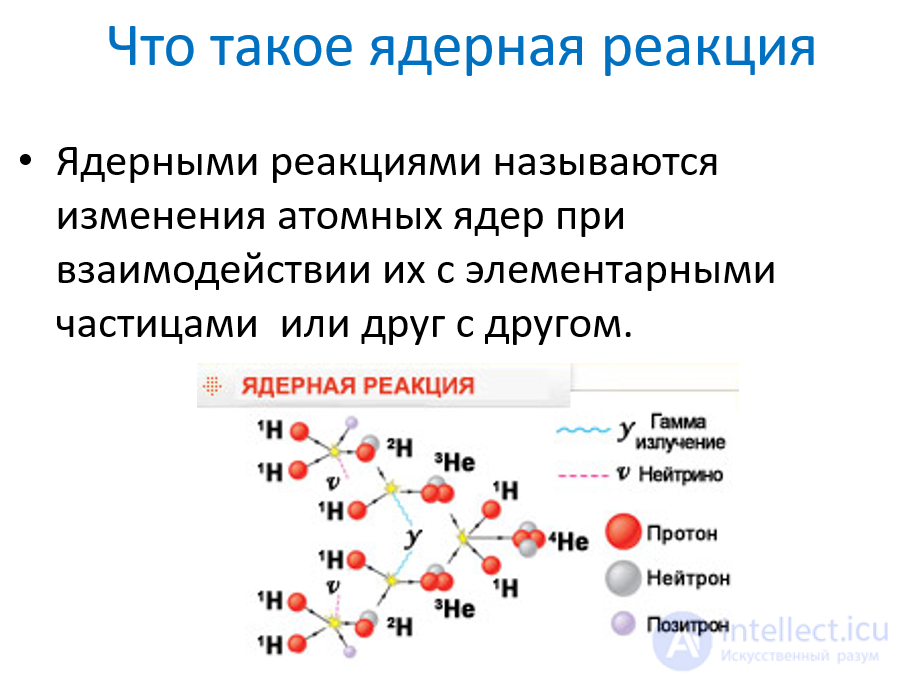
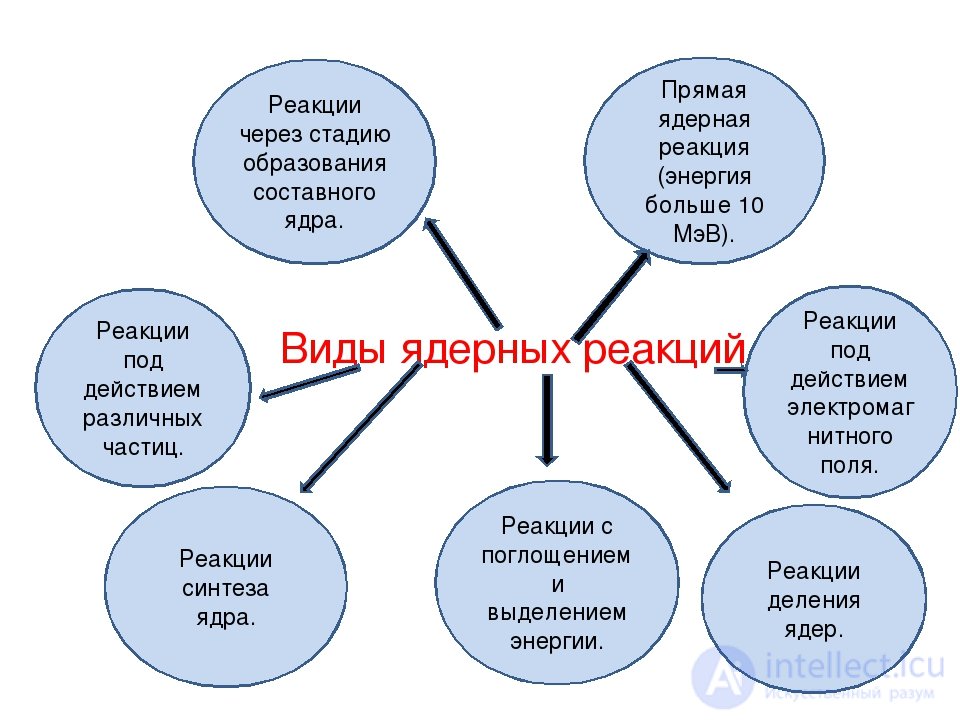
According to the mechanism of interaction, nuclear reactions are divided into two types:
If, after the collision, the original nuclei and particles are preserved and no new ones are born, then the reaction is elastic scattering in the field of nuclear forces, accompanied only by a redistribution of kinetic energy and momentum between the particle and the target nucleus, and is called potential scattering.
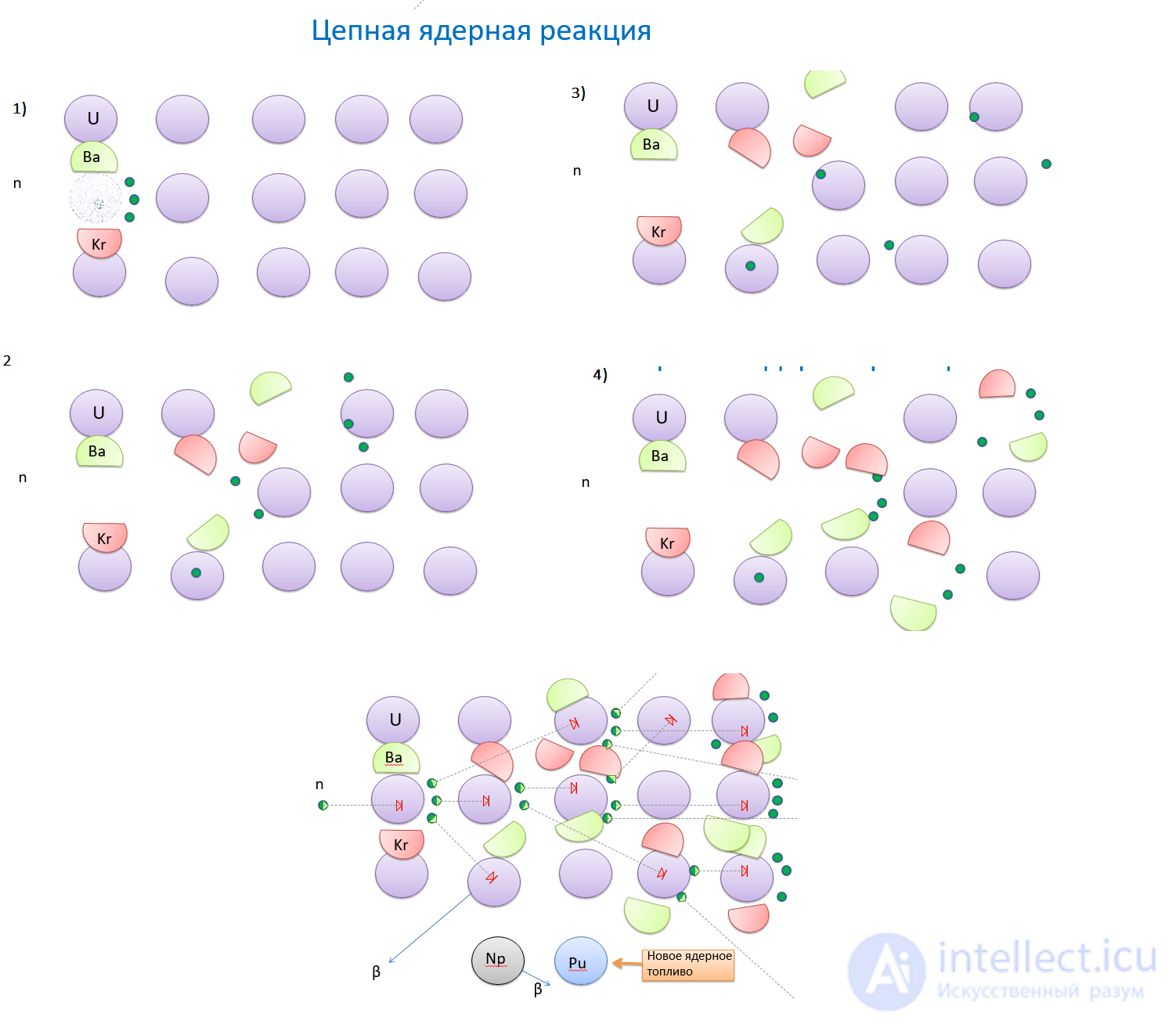
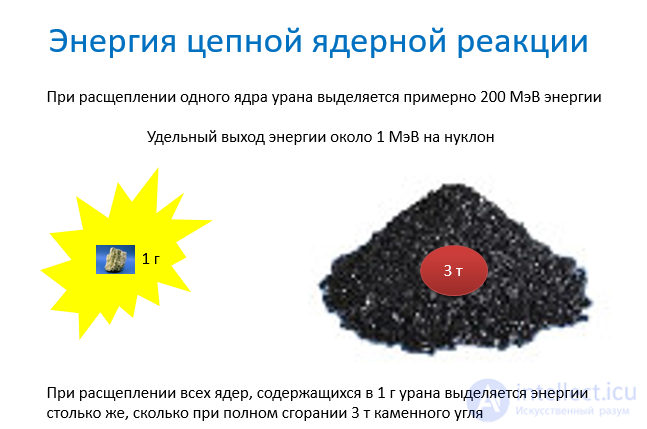
When a uranium-235 nucleus fissions, caused by a collision with a neutron, 2 or 3 neutrons are released. Under favorable conditions these neutrons can strike other uranium nuclei and cause their fission. At this stage, 4 to 9 neutrons already appear, capable of causing new decays of uranium nuclei, and so on. Such an avalanche-like process is called a chain reaction. A diagram of the development of the uranium nuclear fission chain reaction is shown in Fig. 6.8.1.
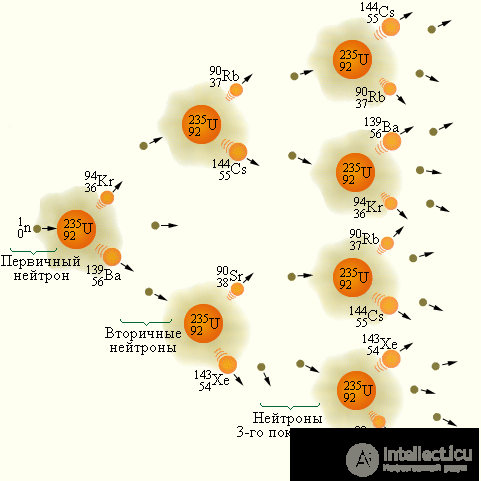
Figure 6.8.1. Diagram of the development of the chain reaction
A chain reaction in uranium with an increased content of uranium-235 can develop only when the mass of uranium exceeds the so-called critical mass. In small pieces of uranium, most neutrons fly out without hitting any nucleus. For pure uranium-235 the critical mass is about 50 kg.
Critical mass of a fissile substance
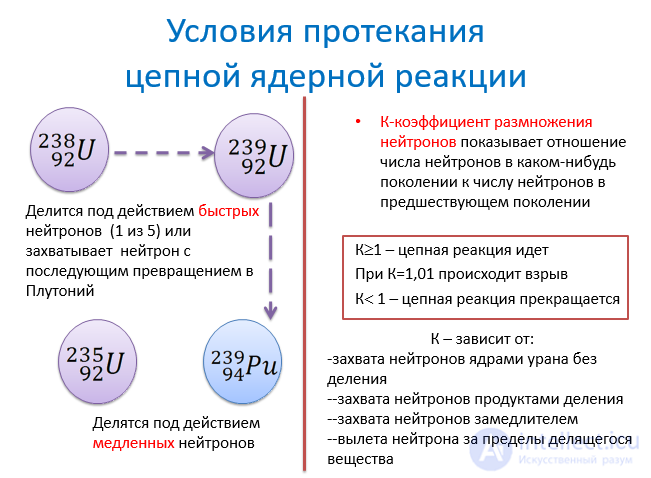
Conditions for a chain nuclear reaction to proceed
Applications of the chain nuclear reaction
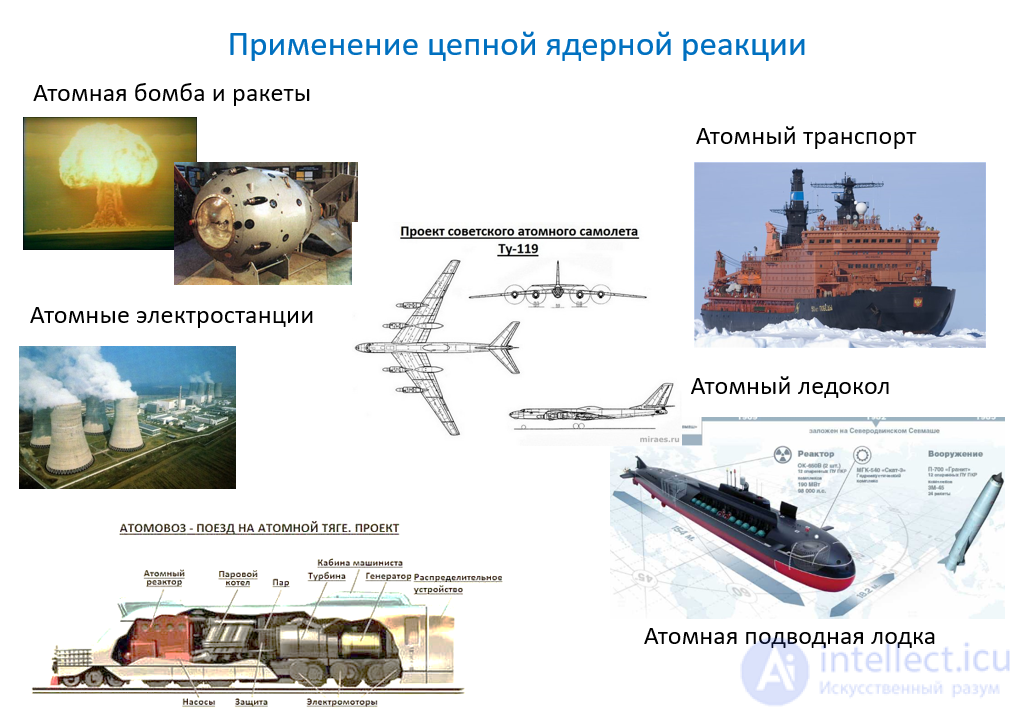
atomic and nuclear weapons, missiles and bombs
atomic transport
atomic aircraft
atomic-powered locomotive
atomic icebreaker
nuclear submarine
nuclear power plants
The critical mass of uranium can be reduced many times over if so-called neutron moderators are used. The point is that the neutrons produced during the decay of uranium nuclei have too high a speed, while the probability of capture of slow neutrons by uranium-235 nuclei is hundreds of times greater than that of fast ones. The best neutron moderator is heavy water D2O. Ordinary water, when interacting with neutrons, itself turns into heavy water.
Graphite is also a good moderator, since its nuclei do not absorb neutrons. Upon elastic interaction with the nuclei of deuterium or carbon, neutrons are slowed down to thermal velocities.
The use of neutron moderators and a special shell of beryllium, which reflects neutrons, makes it possible to reduce the critical mass to 250 g.
In atomic bombs, an uncontrolled chain nuclear reaction arises upon the rapid joining of two pieces of uranium-235, each of which has a mass somewhat below critical.
A device in which a controlled nuclear fission reaction is maintained is called a nuclear (or atomic) reactor. A diagram of a nuclear reactor using slow neutrons is shown in Fig. 6.8.2.
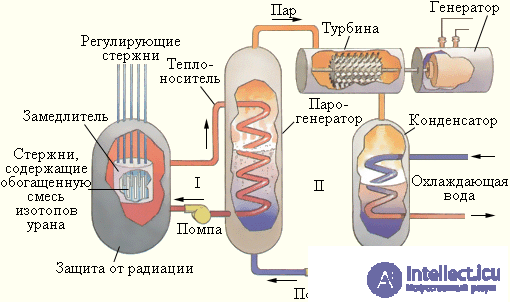
Figure 6.8.2.
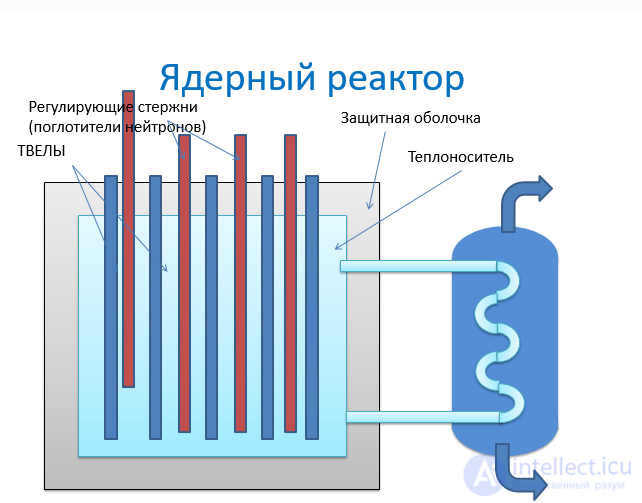
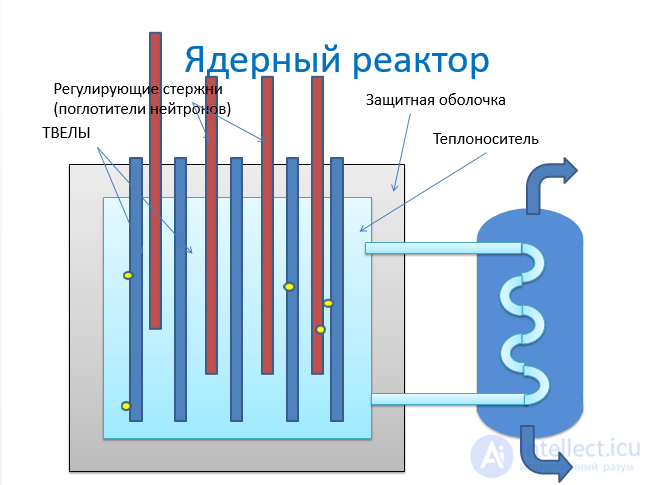
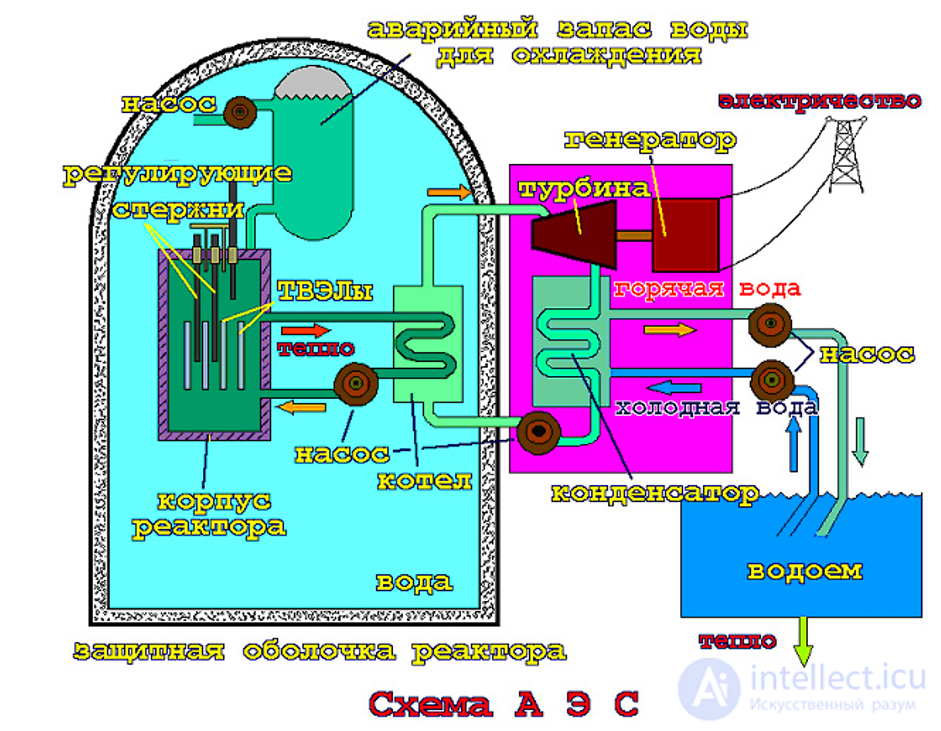
diagram of an NPP
The theory of the mechanism of a reaction with the formation of a compound nucleus was developed by Niels Bohr in 1936 together with the theory of the liquid-drop model of the nucleus, and underlies present-day ideas about a large fraction of nuclear reactions.
According to this theory, a nuclear reaction proceeds in two stages. Initially, the original particles form an intermediate (compound) nucleus over a nuclear time, that is, the time needed for a particle to cross the nucleus, approximately equal to 10−23 — 10−21 s. In this case the compound nucleus is always formed in an excited state, since it possesses excess energy brought into the nucleus by the particle in the form of the nucleon's binding energy in the compound nucleus and part of its kinetic energy, which is equal to the sum of the kinetic energy of the target nucleus with mass number  and of the particle in the center-of-mass system.
The excitation energy  of the compound nucleus, formed upon the absorption of a free nucleon, is equal to the sum of the binding energy
  of the nucleon and part of its kinetic energy
  :
:

Most often, owing to the large difference between the masses of the nucleus and the nucleon,  is approximately equal to the kinetic energy
  of the nucleon bombarding the nucleus.
On average the binding energy is 8 MeV, varying depending on the features of the resulting compound nucleus, but for given target nucleus and nucleon this quantity is a constant. The kinetic energy of the bombarding particle, on the other hand, can be anything at all; for example, when nuclear reactions are excited by neutrons, whose potential has no Coulomb barrier, the value of can be close to zero. Thus, the binding energy is the minimum excitation energy of the compound nucleus .
The transition to the unexcited state can occur along various pathways, called reaction channels. The types and quantum state of the incoming particles and nuclei before the start of the reaction determine the input channel of the reaction. After the reaction is completed, the set of resulting reaction products and their quantum states determines the output channel of the reaction. A reaction is fully characterized by its input and output channels.
The reaction channels do not depend on the way the compound nucleus was formed, which can be explained by the long lifetime of the compound nucleus — it, so to speak, «forgets» how it was formed; consequently, the formation and decay of the compound nucleus can be regarded as independent events. For example,  can be formed as a compound nucleus in an excited state in one of the following reactions:




Subsequently, given the same excitation energy, this compound nucleus can decay by a path that is the reverse of any of these reactions, with a certain probability that does not depend on the history of the formation of this nucleus. The probability of formation of the compound nucleus, however, depends on the energy and on the type of target nucleus .
The course of nuclear reactions is also possible through the mechanism of direct interaction; this mechanism mainly manifests itself at very high energies of the bombarding particles, when the nucleons of the nucleus can be regarded as free. Direct reactions differ from the compound-nucleus mechanism, above all, in the distribution of the momentum vectors of the product particles relative to the momentum of the bombarding particles. In contrast to the spherical symmetry of the compound-nucleus mechanism, direct interaction is characterized by a preferential forward direction of flight of the reaction products relative to the direction of motion of the incoming particles. The energy distributions of the product particles are also different in these cases. Direct interaction is characterized by an excess of particles with high energy. In collisions with nuclei of complex particles (that is, other nuclei), processes of nucleon transfer from one nucleus to another, or nucleon exchange, are possible. Such reactions occur without the formation of a compound nucleus and possess all the features of direct interaction .
The probability of a reaction is determined by the so-called nuclear cross section of the reaction. In the laboratory frame of reference (where the target nucleus is at rest), the probability of interaction per unit time is equal to the product of the cross section (expressed in units of area) and the flux of incident particles (expressed as the number of particles crossing a unit area per unit time). If several output channels can occur for one input channel, then the ratios of the probabilities of the output channels of the reaction equal the ratio of their cross sections. In nuclear physics, reaction cross sections are usually expressed in special units — barns, equal to 10−24 cm².
The number of reaction events, referred to the number of particles that bombarded the target  , is called the yield of the nuclear reaction. This quantity is determined experimentally by quantitative measurements. Since the yield is directly related to the cross section of the reaction, measuring the yield is essentially equivalent to measuring the cross section of the reaction
In nuclear reactions all the conservation laws of classical physics are satisfied. These laws impose restrictions on the possibility of a nuclear reaction taking place. Even an energetically favorable process always turns out to be impossible if it is accompanied by violation of some conservation law. In addition, there are conservation laws specific to the microworld; some of them are always satisfied, as far as is known (conservation of baryon number, of lepton number); other conservation laws (of isospin, parity, strangeness) only suppress certain reactions, since they are not satisfied for some of the fundamental interactions. Consequences of the conservation laws are the so-called selection rules, which indicate the possibility or prohibition of one reaction or another.
If  — are the total energies of two particles before the reaction and after the reaction, then on the basis of the law of conservation of energy:

When more than two particles are formed, the number of terms on the right-hand side of this expression must correspondingly be greater. The total energy E of a particle equals the sum of its mass (in energy-equivalent form) Mc2 and its kinetic energy K, so that:

The difference between the total kinetic energies of the particles at the «output» and «input» of the reaction Q = (K3 + K4) − (K1 + K2) is called the reaction energy (or the energy yield of the reaction). It satisfies the condition:

The factor 1/c2 is usually dropped, when calculating the energy balance by expressing the masses of the particles in energy units (or sometimes the energies in mass units).
If Q > 0, then the reaction is accompanied by the release of free energy and is called exoenergetic, if Q < 0, then the reaction is accompanied by the absorption of free energy and is called endoenergetic.
It is easy to see that Q > 0 when the sum of the masses of the product particles is less than the sum of the masses of the original particles, that is, the release of free energy is possible only owing to a decrease in the masses of the reacting particles. Conversely, if the sum of the masses of the secondary particles exceeds the sum of the masses of the original ones, then such a reaction is possible only on condition that a certain amount of kinetic energy is expended to increase the rest energy, that is, the masses of the new particles. The minimum value of the kinetic energy of the incoming particle at which an endoenergetic reaction is possible is called the threshold energy of the reaction. Endoenergetic reactions are also called threshold reactions, since they do not occur at particle energies below the threshold.
The total momentum of the particles before the reaction equals the total momentum of the product particles of the reaction. If  ,
,  ,
,  ,
,  — are the momentum vectors of two particles before the reaction and after the reaction, then

Each of the vectors can be independently measured experimentally, for example, with a magnetic spectrometer. Experimental data show that the law of conservation of momentum is valid both in nuclear reactions and in the scattering processes of microparticles.
Angular momentum is also conserved in nuclear reactions. As a result of the collision of microparticles, only such compound nuclei are formed whose angular momentum equals one of the possible values of the momentum obtained by adding the intrinsic mechanical moments (spins) of the particles and the momentum of their relative motion (the orbital momentum). The decay channels of the compound nucleus can likewise only be such that the total angular momentum (the sum of the spin and orbital momenta) is conserved.
Nuclear interactions with particles are quite varied in character; their types and the probabilities of one reaction or another depend on the type of bombarding particles, the target nuclei, the energies of the interacting particles and nuclei, and many other factors.
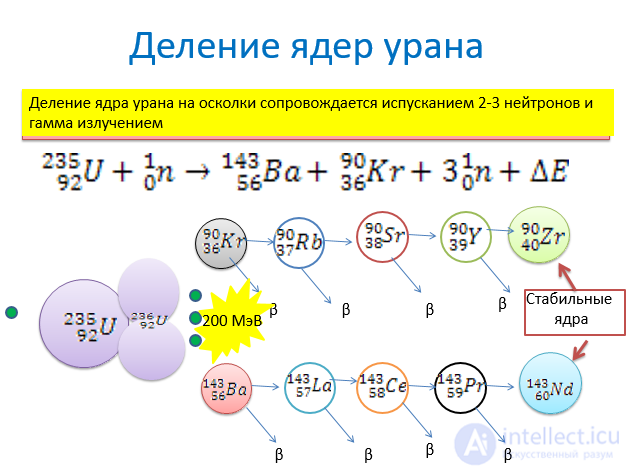
Nuclear fission reaction — the process of splitting an atomic nucleus into two (more rarely three) nuclei of similar masses, called fission fragments. As a result of fission, other reaction products may also arise: light nuclei (mainly alpha particles), neutrons, and gamma quanta. Fission can be spontaneous (occurring on its own) or induced (as a result of interaction with other particles, above all with neutrons). However, it should be noted that spontaneous processes are usually not classified as nuclear reactions, so only induced fission (through neutron capture, photofission, etc.) is a nuclear reaction. The fission of heavy nuclei is an exoenergetic process, as a result of which a large amount of energy is released in the form of the kinetic energy of the reaction products, as well as radiation.
Nuclear fission serves as a source of energy in nuclear reactors and nuclear weapons.
Fission of uranium nuclei
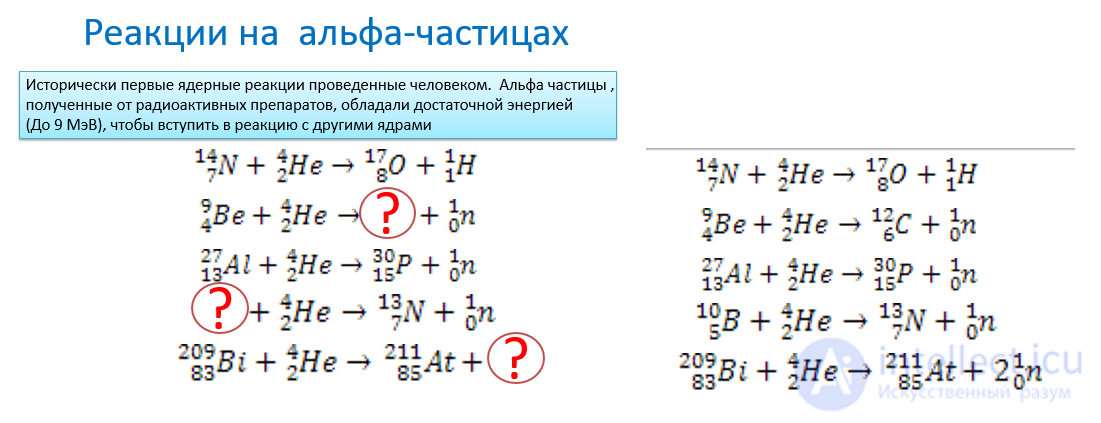
Reactions with alpha particles
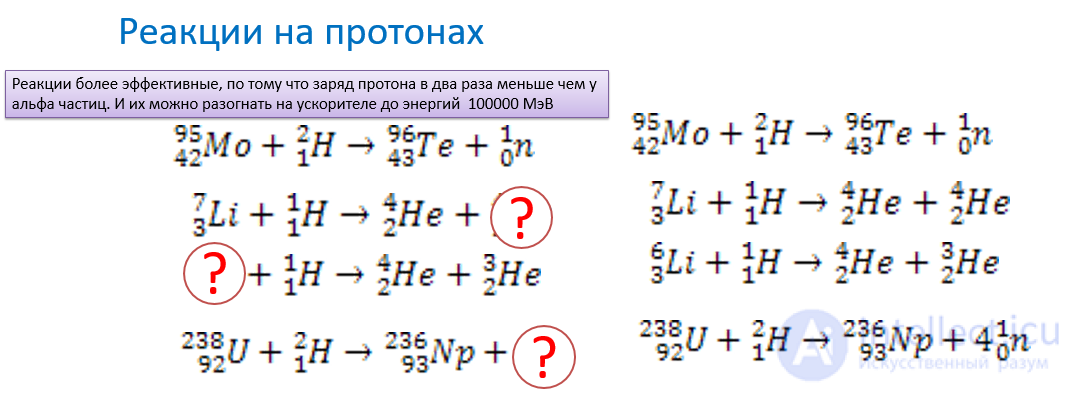
Reactions with protons
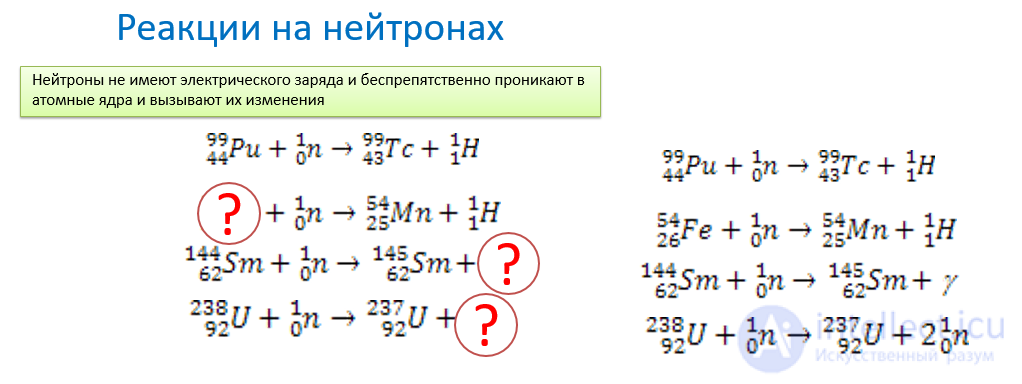
Reactions with neutrons
Nuclear fusion reaction — the process of the merging of two atomic nuclei with the formation of a new, heavier nucleus.
In addition to the new nucleus, various elementary particles and (or) quanta of electromagnetic radiation are also usually formed in the course of the fusion reaction.
Without the input of external energy, the fusion of nuclei is impossible, since positively charged nuclei experience electrostatic repulsion forces — this is the so-called «Coulomb barrier». For the fusion of nuclei, it is necessary to bring them together to a distance of order 10−15 m, at which the action of the strong interaction will exceed the electrostatic repulsion forces. This is possible if the kinetic energy of the approaching nuclei exceeds the Coulomb barrier.
Such conditions can arise in two cases:
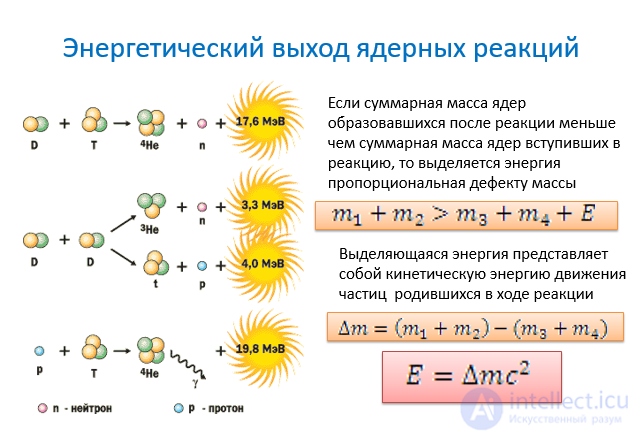
Energy yield
Thermonuclear reaction — the fusion of two atomic nuclei to form a new, heavier nucleus, driven by the kinetic energy of their thermal motion.
For a nuclear fusion reaction, the initial nuclei must possess relatively high kinetic energy, since they experience electrostatic repulsion, being like positively charged.
According to kinetic theory, the kinetic energy of the moving microparticles of matter (atoms, molecules, or ions) can be represented as temperature, and consequently, by heating the substance, a nuclear fusion reaction can be achieved.
Nuclear reactions of natural nucleosynthesis in stars proceed in a similar manner.
Fusion reactions between nuclei of light elements up to iron proceed exoenergetically, which is associated with the possibility of using them in power generation, provided the problem of controlling thermonuclear fusion is solved.
First of all, among them one should note the reaction between two isotopes (deuterium and tritium) of hydrogen, which is very abundant on Earth, as a result of which helium is formed and a neutron is released. The reaction can be written as:
 + energy (17.6 MeV).
The released energy (arising from the fact that helium-4 has very strong nuclear bonds) is converted into kinetic energy, most of which, 14.1 MeV, is carried away by the neutron as the lighter particle . The resulting nucleus is tightly bound, which is why the reaction is so strongly exoenergetic. This reaction is characterized by the lowest Coulomb barrier and a high yield, which is why it is of particular interest for controlled thermonuclear fusion .
A thermonuclear reaction is also used in thermonuclear weapons.
Upon absorption of a gamma quantum, a nucleus acquires an excess of energy without a change in its nucleon composition, and a nucleus with an excess of energy is a compound nucleus. Like other nuclear reactions, absorption of a gamma quantum by a nucleus is possible only when the necessary energy and spin relations are satisfied. If the energy transferred to the nucleus exceeds the binding energy of a nucleon in the nucleus, decay of the resulting compound nucleus most often occurs with the emission of nucleons, mainly neutrons. Such decay leads to the nuclear reactions  and
and  , which are called photonuclear, and the phenomenon of nucleon emission in these reactions is called the nuclear photoeffect.
Pycnonuclear reactions (from Ancient Greek πυκνός — dense) — nuclear fusion reactions occurring in cold matter due to zero-point oscillations of nuclei in a crystal lattice, rather than by overcoming the repulsive barrier between nuclei by means of the thermal energy of motion, as in thermonuclear reactions. A clear distinction between these types of reactions at nonzero temperature is impossible; the Debye temperature of the crystal lattice is used as an approximate boundary for the transition of pycnonuclear reactions into thermonuclear ones.
Pycnonuclear reactions occur in any substance and at any temperature, but under ordinary conditions their rate is extremely low. They become significant in the case of very dense matter, for example, in the degenerate matter of white dwarfs or in the crust of neutron stars. It is believed that pycnonuclear reactions, rapidly accelerating at the centers of white dwarfs owing to the growth of mass through accretion, and the thermonuclear reactions that follow them, serve as the trigger mechanism for Type Ia supernova explosions.
Attention to the possibility of such reactions was probably first drawn by W. Wildhack in 1940. An elementary calculation of the reaction rate, important for astrophysical applications, was carried out by Ya. B. Zel'dovich in 1957, and was later refined and developed by E. Salpeter and H. Van Horn in 1969. Nevertheless, estimates of reaction rates in the literature still differ significantly, which is related to differing extrapolations of nuclear forces to low energies, as well as to the sensitivity of the rate to the presence of crystal lattice defects.
Pycnonuclear reactions are nuclear reactions that proceed in a sufficiently dense and cold (down to T =0) crystalline substance owing to zero-point oscillations of the reacting nuclei at the sites of the crystal lattice.
The rate of pycnonuclear reactions does not depend on temperature, but does depend on density.
For a nuclear reaction to take place it is first of all necessary for the reacting nuclei to overcome, by a quantum-mechanical mechanism, the Coulomb barrier caused by the electrostatic repulsion of the nuclei.
The main difference between a pycnonuclear reaction and thermonuclear ones is that in pycnonuclear reactions, passage through the Coulomb barrier is achieved by means of zero-point oscillations of the nuclei, whereas in thermonuclear reactions it is achieved owing to the thermal motion of the nuclei. At high temperatures reactions proceed as thermonuclear, and at low temperatures — as pycnonuclear. Approximately, one may consider that the transition from one regime to the other occurs at the Debye temperature of the crystal lattice  where
where  is the characteristic frequency of nuclear oscillations in the lattice. At T
  the oscillation amplitude of a nucleus near a lattice site is r
 where M - is the mass of the nucleus. The rate of a pycnonuclear reaction Q (the number of reactions per unit volume of substance per unit time) can be estimated by the formula

Here n - is the concentration of nuclei, R~ n-1/3 is the distance between neighboring nuclei at the lattice sites, P - is the coefficient of passage through the Coulomb barrier, is the cross section of the nuclear reaction divided by the coefficient of passage through the barrier at a relative nuclear energy of
  is the astrophysical factor, varying smoothly with
 Under terrestrial conditions
  is of the order of several hundredths of an eV,
 .~ 10-8 cm. Therefore the coefficient of passage through the barrier is extremely small, pycnonuclear reactions proceed very slowly and usually play no role at all.
Pycnonuclear reactions can be important under astrophysical conditions — in the degenerate cores of white dwarfs and the crusts of neutron stars, where the density of matter  can reach 108 - 1010 g/cm 3 at T<
 Under these conditions
  is close to the plasma frequency of nuclear lattice oscillations,
 where Ze - is the charge of the nucleus. Therefore (R/r)2 is proportional to
 i.e. as the density of matter grows, the probability of passage through the barrier increases and pycnonuclear reactions proceed ever more intensely. At the same time the Debye temperature
  also rises ( A- the mass number of the ion,
 in g/cm 3), owing to which the temperature range in which the reactions are pycnonuclear is expanded.
The possibility of pycnonuclear reactions occurring in sufficiently cold and dense stellar matter was apparently first pointed out by W. Wildhack in 1940. A simple and illustrative model calculation of the rate of pycnonuclear reactions was carried out by Ya. B. Zel'dovich (1957) . The most detailed calculation was performed by E. Salpeter and H. Van Horn (1969) . A rigorous calculation of Q is very difficult, because the Coulomb barrier to be overcome is determined not only by the reacting nuclei, but also by the neighboring nuclei of the crystal lattice. For the exponent in formula (*), which determines the most essential quantity — the coefficient of passage through the barrier — calculations give  where
where  in g/cm 3,
 is a coefficient that, in calculations using various approximations, turns out to equal 180-200. It should be added that the rates of pycnonuclear reactions can increase considerably in the presence of a large number of crystal lattice defects.
Nuclear reactions are written in the form of special formulas, in which notations for atomic nuclei and elementary particles are used.
The first method of writing nuclear reaction formulas is analogous to writing formulas for chemical reactions, that is, the sum of the initial particles is written on the left, the sum of the resulting particles (reaction products) on the right, and an arrow is placed between them.
Thus, the reaction of radiative capture of a neutron by a cadmium-113 nucleus is written as follows:

We see that the number of protons and neutrons on the right and left remains the same (baryon number is conserved). The same applies to electric charges, lepton numbers, and other quantities (energy, momentum, angular momentum, …). In some reactions involving the weak interaction, protons can be transformed into neutrons and vice versa, but their total number does not change.
The second method of writing, more convenient for nuclear physics, has the form A (a, bcd…) B, where A is the target nucleus, a is the bombarding particle (including a nucleus), b, c, d, … are the emitted particles (including nuclei), B is the residual nucleus. The lighter reaction products are written in parentheses, the heavier ones outside. Thus, the neutron capture reaction given above can be written in this form:

Reactions are often named according to the combination of incident and emitted particles given in parentheses; thus, a typical example of an (n, γ)-reaction is written above.
The first forced nuclear transformation of nitrogen into oxygen, carried out by Rutherford by bombarding nitrogen with alpha particles, is written in the form of the formula
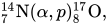 where
where  is the nucleus of the hydrogen atom, the proton.
In «chemical» notation this reaction looks like


Comments