
Lecture
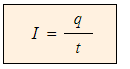
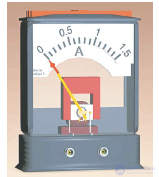
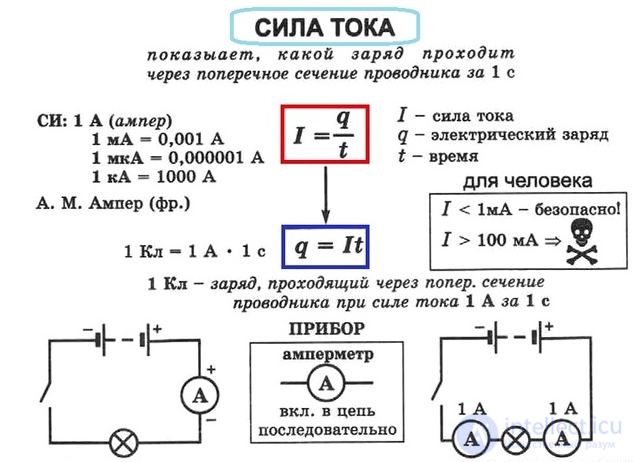
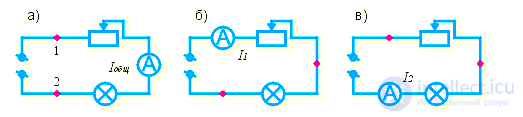
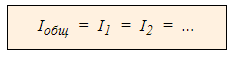
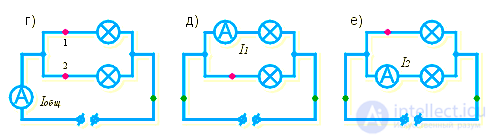
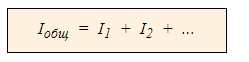
... the strength of electric current is measured in special units – amperes? Physicists have established that at a current strength of 1 A (one ampere) more than 6 thousand million billion electrons pass through a conductor every second! All this enormous number of charged particles moves owing to the existence of an electric field created by the source of electric energy.
... the unit of current strength, the ampere, is named after the French scientist A. Ampere? It was he who introduced the term «electric current» into physics, pointed out its direction inside a conductor, and created the first scientific theory quantitatively linking electrical and magnetic phenomena, which had previously been regarded as independent of one another.
... the current strength arising in conductors is inseparably linked with such a physical quantity as electric voltage? For example, the electric voltage produced by a single galvanic cell is usually about 1 V (one volt), while the voltage between clouds during a thunderstorm can reach 100 million volts!
... both current strength and voltage can be safe for a person, and can also pose a threat to health and even life? For example, a current of only 0.1 A already causes serious disturbances in the human body. The voltage considered safe for a person in a dry room is up to 36 V. For a damp room this value is already up to 12 V.
Ampère's Law — the law of interaction of electric currents. It was first established by André-Marie Ampère in 1820 for direct current. From Ampere's law it follows that parallel conductors with electric currents flowing in the same direction attract each other, and in opposite directions they repel each other. Ampere's law is also the name given to the law that determines the force with which a magnetic field acts on a small segment of a current-carrying conductor. The force turns out to depend linearly both on the current and on the magnetic flux density B. The expression for the force  , with which the magnetic field acts on a volume element dV
 of a current-carrying conductor with current density
  , located in a magnetic field with flux density
  , in the International System of Units (SI) has the form:
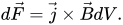
If the current flows through a thin conductor, then  , where dl→
 — the length element of the conductor — a vector equal in magnitude to dl
 and coinciding in direction with the current. Then the expression for the force is rewritten as
 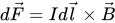 .
.
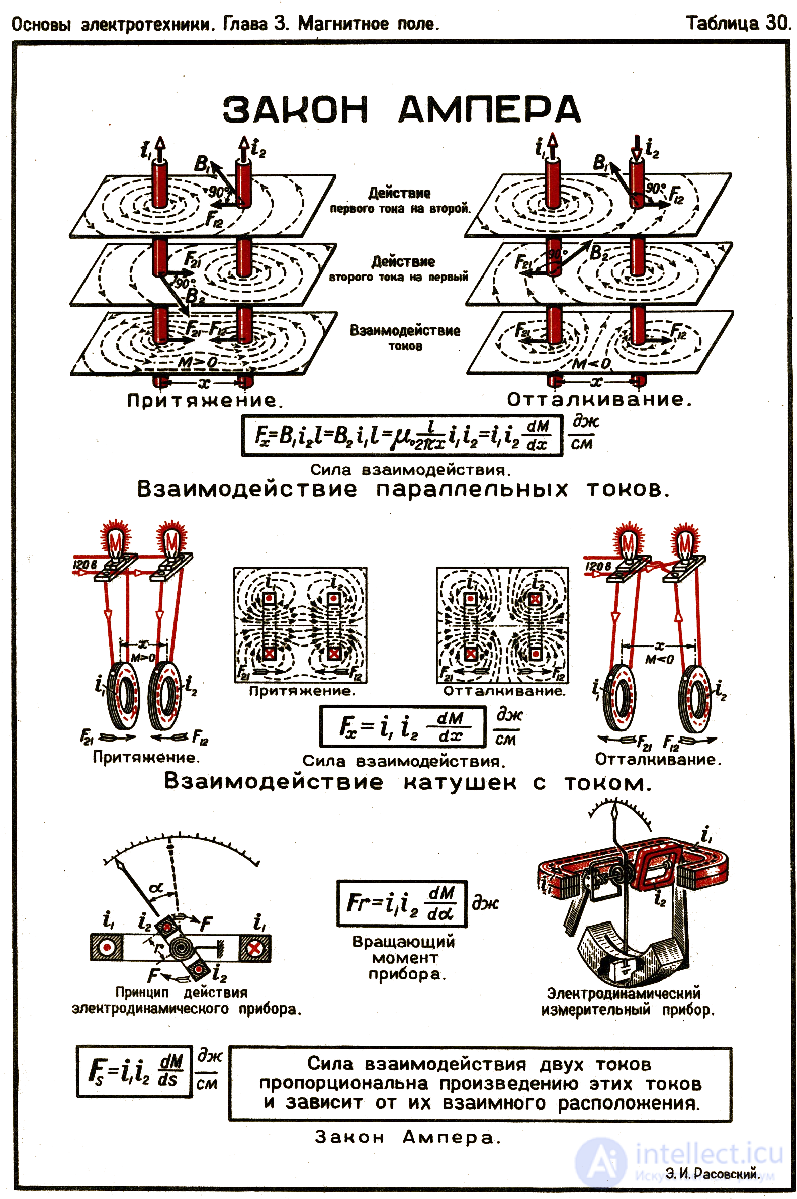
Ampere's law is understood as a set of statements and formulas characterizing the force action on a current-carrying conductor from a magnetic field — possibly created by another current-carrying conductor. The law determines:
 with current
  on another small segment
  with current
  :
:  ,
,
where  and
and  — the radius vectors of the length elements of the conductors
  and
and  , and
, and  — the force of action of the element (creating the field
  at the point r→2) on the element ; μ0 — the magnetic constant;
 and C2
 with currents I1 and I2:
  ,
,
where and — the radius vectors running over all points of the loops , , and  — the force with which loop 1 acts on loop 2. In essence, this is the integration of the expression from the previous point;
carrying a current  (A), a flat portion
  carrying a current
  (A/m) or a small volume carrying a current (A/m2):
  .
.
The direction of the force dF→ is determined by the rule for computing a vector cross product. Its magnitude in the case of a wire is found as dF=IBdlsinα , where α
 — is the angle between B→ and the direction of the current. The force is maximal when the conductor is perpendicular to the lines of magnetic flux density (α=90∘
 ). Integration allows one to obtain the force exerted by the field on the object as a whole.
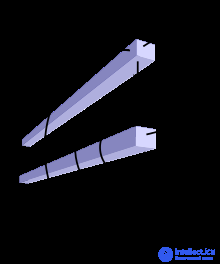
Two infinite parallel conductors carrying currents in a vacuum
The best-known example illustrating the Ampère force is the following problem. In a vacuum, two infinite parallel conductors are located at a distance r from each other, carrying currents and flowing in the same direction. It is required to find the force acting per unit length of a conductor.
According to the Biot — Savart — Laplace law, an infinite conductor carrying a current creates, at a point at a distance r away, a magnetic field with flux density
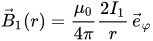 ,
,
where  — is the magnetic constant, e→φ
 — is the unit vector along the circle whose axis of symmetry is the wire carrying the current I1.
Using Ampère's law, let us find the force with which the first conductor acts on a small segment of the second:

By the left-hand rule, dF→12 is directed toward the first conductor (similarly, the force
  acting on the first conductor is directed toward the second conductor). Consequently, the conductors attract each other.
The magnitude of this force (r — the distance between the conductors):
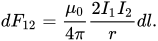
We integrate over a conductor segment of length L (the limits of integration over l
 from 0 to L):
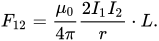
If L — is a unit length, then this expression gives the sought interaction force.
The formula obtained is used in SI to establish the numerical value of the magnetic constant μ0. Indeed, the ampere, being one of the base SI units, is defined therein as «the constant current which, when maintained in two straight parallel conductors of infinite length and negligible circular cross-section, placed 1 metre apart in a vacuum, would produce between these conductors, per metre of length, a force equal to 2⋅10−7 newton» .
Thus, from the formula obtained and the definition of the ampere, it follows that the magnetic constant μ0 is equal to  N/A² or, equivalently, H/m exactly.
Any assembly in electrical engineering in which motion of some element occurs under the action of an electromagnetic field makes use of Ampère's law. The operating principle of electromechanical machines (motion of part of the rotor winding relative to part of the stator winding) is based on the use of Ampère's law, and the most widespread device, used in nearly every technical construction, is the electric motor, or, which is structurally almost the same thing, the generator. It is precisely under the action of the Ampère force that the rotor rotates, since the stator's magnetic field acts on its winding, setting it in motion. Any electrically driven vehicle, in order to rotate the shafts on which the wheels sit, makes use of the Ampère force (trams, electric cars, electric trains, etc.).
Likewise, a magnetic field sets in motion the mechanisms of electric locks (electric doors, sliding gates, elevator doors). In other words, any devices that run on electricity and have moving parts are based on the exploitation of Ampère's law.
It also finds application in many other kinds of electrical engineering, for example in a loudspeaker driver: in a loudspeaker, to excite the diaphragm that forms sound vibrations, a permanent magnet is used, and under the action of the electromagnetic field created by a nearby current-carrying conductor, the Ampère force acts on it, which varies in accordance with the required sound frequency.
Also:
Let there be two thin conductors carrying currents and , having the shape of curves  and
and  , given by the radius vectors
  and
and  .
.
For the interaction forces between infinitesimally small segments of these conductors, Newton's third law does not hold. Namely, the Ampère force with which an element of the first conductor acts on an element of the second  is not equal to the force, taken with the opposite sign, acting on the element of the first conductor from the element of the second
  :
:
 .
.
Here  and
and  — are the fields created by the segment of the first and the segment of the second wire, respectively. This fact in no way compromises Newtonian dynamics, since a steady current can flow only around a closed loop — and consequently Newton's third law is required to hold only for the forces with which two closed current-carrying conductors interact. Unlike individual elements, for closed loops Newton's law does hold:
 ,
,
where  and
and  — are the fields created by the first and second wires as a whole (and not by their individual segments). The field in each case is found using the Biot — Savart — Laplace formula.
In 1820, Hans Christian Ørsted discovered that a wire carrying a current creates a magnetic field and causes a compass needle to deflect. He noticed that the magnetic field was perpendicular to the current, rather than parallel to it, as one might have expected. Ampère, inspired by the demonstration of Ørsted's experiment, found that two parallel current-carrying conductors attract or repel each other depending on whether the current in them flows in the same direction or in opposite directions. Thus a current not only produces a magnetic field, but a magnetic field also acts on a current. Just a week after Ørsted announced his experiment, Ampère proposed an explanation: a conductor acts on a magnet because within the magnet a current flows along a multitude of small closed paths .
The law of interaction of two elementary electric currents, known as Ampère's law, was in fact later proposed by Grassmann (that is, it would be more correct to call it Grassmann's law).
The original Ampère's law, however, had a somewhat different form: the force acting from a current element  , located at point , on a current element
  , located at point , is equal to
 .
.
The force acting from a current element , located at point , on a current element , located at point , can be obtained from the formula for the force simply by symmetry considerations, by swapping the indices: 2 for 1, and 1 for 2.
In doing so,  , that is, the original Ampère's law satisfies Newton's third law already at the differential level. Ampère, having tried a number of expressions, settled precisely on this one.
If, when considering some problem of calculating the interaction force of (in reality, non-steady) open (unclosed) currents, one cannot accept a violation of Newton's third law, there is an option to use the original Ampère's law. In the case of Grassmann's law, one then has to bring an additional physical entity into consideration — the magnetic field — in order to compensate for the failure to satisfy the third law.
It can be proved that, in the integral form of the original Ampère's law, the forces with which two closed conductors carrying steady currents interact turn out to be the same as in Grassmann's law.
Maxwell proposed the most general form of the law of interaction of two elementary current-carrying conductors, in which a coefficient k appears (it cannot be determined without certain assumptions based on experiments in which the active current forms a closed loop):

In his theory Ampère took k=−1 , Gauss set k=+1 , as did Grassmann and Clausius. In non-aether electron theories, Weber took k=−1 , while Riemann took k=+1 . Ritz left k undetermined in his theory.
For the interaction force of two closed loops C1 and C2 with k=+1 the standard expression is obtained.
Although the force is always the same for different values of k , the torque may differ. For example, in the interaction of two infinite wires crossed at a right angle, the interaction force will be equal to zero. If the torque acting on each of the wires is calculated using Grassmann's formula, neither one will be equal to zero (although they will sum to zero). If, however, the torque is calculated using the original Ampère's law, each of them will be equal to zero.
 |
This section needs expansion.
Please improve and expand the section. (December 27, 2018)
|
Electric current in a conductor is the motion of charges relative to other charges. This motion, in special relativity, leads to effects that in classical physics are explained by a separate physical entity — magnetism. In special relativity these effects do not require the introduction of magnetism, and, to a first approximation, it suffices to consider Coulomb interactions. To describe Ampère's law within special relativity, a metal conductor is described as a straight line with a certain linear density of positive charges and a straight line with mobile charges. Charge is invariant, so the effect of Lorentz length contraction creates a difference between the density of positive and negative charges in an originally neutral metal wire. Hence arises the force of attraction or repulsion between two current-carrying conductors.

Comments