
Lecture
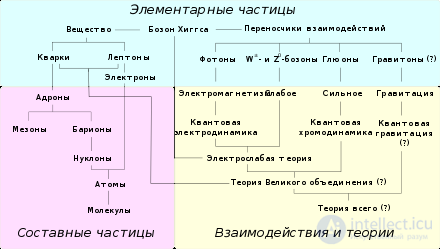
Electron (from Ancient Greek ἤλεκτρον «amber» ) — a stable, negatively charged elementary particle. It is considered fundamental (having, as far as is known, no constituent parts) and is one of the basic structural units of matter. It is classified as a fermion (having spin equal to ½) and as a lepton. It is the only one (along with its antiparticle — the positron) of the known charged leptons that is stable. Electrons form the electron shells of atoms, the structure of which determines most of the optical, electrical, magnetic, mechanical, and chemical properties of matter . The motion of electrons is responsible for the flow of electric current in many conductors (in particular, in metals). In the rationalized system of units, the Compton wavelength of the electron is the unit of length, and the mass of the electron is the unit of mass.
| Probability picture of the location of a single electron in an atom in an s-orbital | |
| Composition | fundamental particle |
|---|---|
| Family | Fermion |
| Group | Lepton |
| Participates in interactions | gravitational , weak, and electromagnetic |
| Antiparticle | Positron |
| Mass |
9.1093837015(28)⋅10−31 kg , |
| Lifetime | ∞ (not less than 6.6⋅1028 years ) |
| Quantum numbers | |
| Electric charge | −1.602176634⋅10−19 C |
| Baryon number | 0 |
| Lepton number | +1 |
| Spin | 1/2 ħ |
| Magnetic moment | −9.2847647043(28)⋅10−24 J/T |
| Intrinsic parity | +1 |
| Isospin | 0 |
The charge of the electron was directly measured in the experiments of A. F. Ioffe (1913) and R. Millikan (1911). The present value of the electron charge is defined exactly as −1.602176634⋅10−19 C , or −4.803204712570263⋅10−10 esu (exactly) in the CGS-ESU system, or −1.602176634⋅10−20 CGS-EMU units (exactly) in the CGS-EMU system. In 2019, the base SI units were tied to fundamental constants; in particular, the coulomb was tied to the elementary electric charge, so the numerical value of the electron charge is by definition exact and is given without uncertainty . The absolute value of the electron charge serves as the unit for measuring the electric charge of other elementary particles.
 kg — the mass of the electron.
 C — the charge of the electron.
 C/kg — the specific charge of the electron.
 — the spin of the electron in units of
Unlike most other particles known to science, the electron is stable (more precisely, within the sensitivity of experiments its lifetime is not less than 6.6⋅1028 years at a 90% confidence level ). Decay of a free electron into a neutrino and photons is forbidden by the law of conservation of electric charge, while decay into other elementary particles is prevented by the law of conservation of energy.
Modern science regards the electron as a fundamental elementary particle possessing no internal structure or size .
Like any charged particle with spin, the electron has a magnetic moment, and this magnetic moment is divided into a normal part and an anomalous magnetic moment (an addition of about 0.116%). The magnetic moment of the electron is μe = -9.2847647043(28)⋅10−24 J/T . For experiments on the ultra-precise determination of the electron's magnetic moment, H. Dehmelt and W. Paul were awarded the 1989 Nobel Prize in Physics. Measurements of the electron's magnetic moment to an accuracy of 13 decimal places [10] showed that the size of the electron does not exceed 10−20 cm [10]. Earlier experiments on the collision of high-energy electrons gave a significantly cruder limit on the size of the electron: 10−17 cm[11].
The intrinsic parity of the electron is +1[12]. The electron participates in the weak, electromagnetic, and gravitational interactions. Examples of the electron's participation in weak interactions are beta decay and electron capture. It belongs to the lepton group and is (together with its antiparticle, the positron) the lightest of the charged leptons and the lightest elementary particle carrying an electric charge. Before the discovery of neutrino mass, the electron was considered the lightest of the massive particles — its mass is approximately 1836 times smaller than the mass of the proton. The spin of the electron is equal to 1⁄2, and thus the electron belongs to the fermions.
Sometimes the term "electrons" is used to refer to both electrons proper and positrons (for example, when they are regarded as a common electron-positron field, a solution of the Dirac equation), especially in problems where their common properties are more significant than their differences. With this choice of terminology, the negatively charged electron is called[13] a negatron[14], and the positively charged one a positron.
Being in the periodic potential of a crystal, the electron is regarded as a quasiparticle whose effective mass can differ significantly from the mass of the electron in vacuum.
A free electron cannot absorb a photon, although it can scatter it (see the Compton effect).
Owing to their small mass, electrons easily penetrate, via the tunnel effect, potential barriers with a height of a few electron-volts and a thickness of up to about a dozen atomic diameters. The phenomenon of the tunnel effect for electrons explains why electric current can flow between a metal electrode and ions in solution, or between two metals in contact, despite the fact that the metal surface is usually covered with layers of oxide or is contaminated[15].
The ratio of electric charge to mass for the electron is many times greater than the corresponding ratio for any other elementary particle or system of particles. Electrons can be obtained from solids relatively easily compared with any other particles. These two circumstances underlie the numerous applications of electrons in electrovacuum devices[16].
The name «electron» comes from the Greek word ἤλεκτρον, meaning «amber»: even in ancient Greece, natural philosophers conducted experiments — pieces of amber were rubbed with wool, after which they began to attract small objects. The term «electron», as the name of the fundamental indivisible unit of charge in electrochemistry, was proposed[17] by G. J. Stoney in 1894 (the unit itself had been introduced by him in 1874). The discovery of the electron as a particle is credited to E. Wiechert[18][19] and J. J. Thomson, who in 1897 established that the charge-to-mass ratio for cathode rays does not depend on the material of the source.
According to de Broglie's hypothesis (1924), the electron (like all other material microobjects) possesses not only corpuscular but also wave properties. The de Broglie wavelength of the electron is equal to  , where
  is Planck's constant,
  is the momentum of the electron. In the non-relativistic case
  it is equal to
  , where
  is the speed of the electron,
  is the mass of the electron. In the ultra-relativistic case
  it is equal to
  , where {\displaystyle c}
 is the speed of light,
  is the energy of the electron.
In accordance with this, electrons, like light, can undergo interference and diffraction. The wave properties of electrons were discovered experimentally in 1927 by the American physicists C. Davisson and L. Germer (the Davisson–Germer experiment) and independently by the English physicist G. P. Thomson[20][21].
The discovery of the electron and the possibilities of its application in various technical devices led to the emergence of a large number of new concepts in modern physics[22].
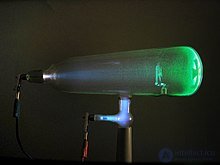
Most sources of low-energy electrons make use of the phenomena of thermionic emission and photoelectron emission. High-energy electrons, with energies from a few keV to several MeV, are emitted in the processes of beta decay and internal conversion of radioactive nuclei. Electrons emitted in beta decay are sometimes called beta particles or beta rays. Accelerators serve as sources of electrons with even higher energy.
The motion of electrons in metals and semiconductors makes it easy to transfer and control energy. This phenomenon (electric current) is one of the foundations of modern civilization and is used practically everywhere in industry, communications, information technology, electronics, and everyday life. The drift velocity of electrons in conductors is extremely small (~0.1—1 mm/s), yet the electric field propagates at the speed of light. Because of this, the current is established throughout the entire circuit practically instantaneously.
Beams of electrons accelerated to high energies, for example in linear accelerators, are one of the primary means of studying the structure of atomic nuclei and the nature of elementary particles. A more mundane application of electron beams is found in television sets and monitors with cathode-ray tubes (CRT) — picture tubes. The electron microscope likewise makes use of the ability of electron beams to obey the laws of electron optics. Accelerated electron beams are also used to produce X-ray radiation: when an electron beam strikes a metal target, the electrons are scattered by the electrostatic field of the atomic nuclei and electrons, generating bremsstrahlung. Before the invention of transistors, practically all radio engineering and electronics were based on vacuum electron tubes, in which the motion of electrons in a vacuum is controlled by electric (and sometimes magnetic) fields. Electrovacuum devices (EVDs) continue to see limited use even today. The most common applications are magnetrons in microwave oven generators and the above-mentioned cathode-ray tubes in television sets and monitors.
Electron beams are used in devices for cleaning flue gases[23] and in drilling rigs for drilling rock[24].
If an electron is in a periodic potential, its motion is regarded as the motion of a quasiparticle[25]. Its states are described by a quasi-wave vector. The main dynamical characteristic in the case of a quadratic dispersion law is the effective mass, which can differ significantly from the mass of a free electron and is, in the general case, a tensor[26].
One hundredth of a second after the Big Bang, the Universe consisted of a mixture of electrons, positrons, neutrinos, photons, protons, and neutrons. For every proton and neutron there were about a billion electrons, positrons, neutrinos, and photons. About 14 seconds after the Big Bang, when the temperature of the Universe had dropped to 3 billion degrees, almost all the electrons annihilated with positrons[27].
It is known[28] that out of every 100 nucleons in the Universe, 87 are protons and 13 are neutrons (the latter being mostly part of helium nuclei). To ensure the overall neutrality of matter, the number of protons and electrons must be equal. The density of baryonic (optically observable) mass, which consists mainly of nucleons, is fairly well known (one nucleon per 0.4 cubic meters)[29]. Taking into account the radius of the observable Universe (13.7 billion light years), it can be calculated that the number of electrons in this volume is ~1080, which is comparable to Dirac's large numbers.
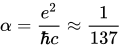
The electric charge of the electron, Planck's constant, and the speed of light determine the fine-structure constant, which determines the intensity of electromagnetic interactions:
 .
.
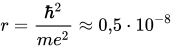
The mass of the electron, the electric charge of the electron, and Planck's constant determine the characteristic size of atoms (the Bohr radius):
 cm[30].
The radio emission of radio galaxies and pulsars is explained by synchrotron radiation of electrons in the magnetic fields near these objects. The fraction of electrons with energy exceeding 1 GeV in primary cosmic rays is about 1% of the total flux[31].
The pressure of degenerate electron gas plays an important role in the final stage of stellar evolution. Stars with a mass below the Chandrasekhar limit, after cooling, are stabilized by the pressure of degenerate electron gas and turn into white dwarfs. In stars of greater mass, atomic nuclei capture electrons and break down into neutrons (a neutron star)[32]. Nuclear reactions involving electrons and positrons play an important role in supernova explosions[33].
Several physical quantities having the dimension of length are associated with the electron[34]:
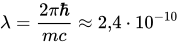 cm;
cm;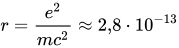 cm;
cm;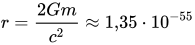 cm.
cm.All electrons in the Universe are absolutely identical in their properties. If the magnitude of the electron's electric charge is denoted as  , then the electric charges of all known elementary particles, with the exception of quarks, are equal to {\displaystyle \pm e,0}
 , while the electric charges of quarks are equal to
  . The mass of the electron stands out sharply in the distribution of the masses of known elementary particles[35]. The classical radius of the electron is nearly equal to the range of nuclear forces[36][37][38]. Can the magnitude of the electron's electric charge be derived from other world constants (the speed of light, Planck's constant, the gravitational constant)[39]? Does the question of the size of the electron make sense? Does the size of the electron depend on the conditions of the experiments[40]? The answers to these questions are not yet known (see Unsolved problems in modern physics).
If the mass of the electron exceeded the difference between the masses of the neutron and the proton, the chemical composition of the Universe would change fundamentally. Hydrogen would be absent from it, and consequently so would stars in their ordinary sense, life, and reason. It is therefore possible that the small mass of the electron is due to the anthropic principle[41].
If the electron had integer spin, the Pauli principle would not hold for it. As a consequence, electron shells would be absent in all atoms, and all atoms would be chemically inert. Molecules, chemical compounds, and life such as ours would be absent from the Universe.
To describe atomic and molecular many-electron systems, instead of an exact solution of the Schrödinger equation one has to resort to one or another approximation, one of which is the one-electron approximation, also called the orbital approximation. It is based on the idea that individual states exist for each electron, representing stationary states of the electron's motion in a certain effective field created by the nucleus (or nuclei) and all the other electrons. These stationary states are described by the corresponding one-electron functions[42] — orbitals.
One-electron universe theory — a hypothetical model of the Universe in which all electrons are a single electron, present alternately at different points in space. The premise for creating the hypothesis was the principle of the identity of electrons, that is, the impossibility of experimentally distinguishing two electrons. Richard Feynman is considered the originator of the hypothesis. Owing to its simplicity, the hypothesis can be formulated within the framework of the school physics curriculum.
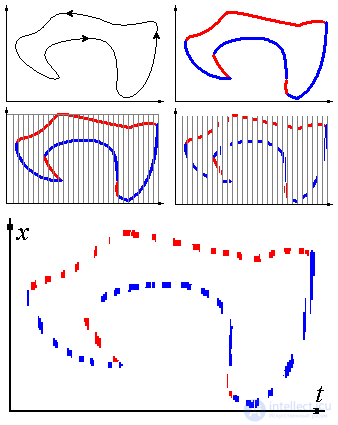
For simplicity, let us consider a two-dimensional Universe — one axis of space and one axis of time. In spacetime, let us draw an arbitrary curve. Let us indicate the direction of traversal of this curve. Let us distinguish two parts of this curve: the part that goes to the right (blue line) and the part that goes to the left (red line). These colors correspond to the electron and the positron. Let us fragment time: divide the time axis into a large number of segments, where the step of the division may vary. Let us choose only one segment of the curve on each strip. Having done all this, we obtain a Universe in which, at every moment of time, there always exists only one electron, although it may appear that there are several of them (in the figure, this number reaches four).
Feynman arrived at his basic idea when he was a graduate student at Princeton in the spring of 1940, during a telephone conversation with his physics professor John Wheeler. In his Nobel lecture, Feynman recounts this story as follows: «Feynman, — said Wheeler, — I know why all electrons have the same charge and the same mass». «Why?» — asked Feynman. «Because, — answered Wheeler, — they are all the same electron!»
In 1948, Richard Feynman developed a mathematical approach to quantum theory in which an antiparticle was regarded as a particle moving backward in time.
Let us begin with the fact that electrons in atoms, according to the classical model, perform directed rotational motions around the nuclei. That is, an electric current is present in every atom. This means every atom possesses a magnetic field. In principle, the magnetic fields of atoms should add up into a single overall resultant field of the macroscopic body. And thus every body should be a permanent magnet.
Perhaps the fields combine in such a way that they cancel each other out, but then the arrangement of atoms in magnetically neutral matter would have to be strictly precise, rather than arbitrary, as physics teaches us. Here the question arises: which is more likely — the absence of magnetic fields in atoms, or a strict orientation of atoms in matter. The former is naturally more likely, since deformation of the structure of macroscopic bodies does not lead to the emergence of magnetic fields in them. Try bending and unbending an aluminum wire. It will heat up, but no magnetic field will appear.
Furthermore, we are assured that metals contain free electrons, which provide metals with their conductivity. In that case, microcurrents should be present in any piece of metal, meaning every metal object should heat up on its own. Its temperature should exceed the ambient temperature, which does not happen in practice.
We are also assured that when a metal is heated, electrons begin to jump out of it and form a cloud around it. All electron tubes operate precisely on this principle. Let us try heating a nail red-hot, and then bringing up to it another, identical but cold, nail. In principle we should obtain a difference of electric potential between the nails, but we do not. This means that no electrons jump out of the heated nail.
So, are electrons a bluff? Yes, a bluff, and scientists confirm this with the claim that the electron has zero rest mass. That is, while standing still it weighs nothing. But as soon as it starts moving, it immediately weighs something. Purely theoretically this can be assumed, but in practice this does not happen.
The absence of electrons in Nature can be proven in many ways, but so as not to tire the reader I will give the last one:
If a high-voltage source is connected to two separated metal balls, we obtain oppositely charged balls. Classically, one will have an excess of electrons, and the other a deficiency. Electrons in a metal are in motion, and therefore have mass even theoretically. This means that the negatively charged ball should become heavier, and the positively charged one lighter. In practice, naturally, no such effect is observed.
In any physics textbook one can find an example of how static electricity arises when a woolen cloth is rubbed against ebonite. It literally says the following: electrons flow from this woolen cloth onto the ebonite. The excess of these electrons charges the ebonite negatively. It all seems clear and obvious. But what about the fact that ebonite is a dielectric? Just a few pages later, in the same textbook, we learn that electrons in the atoms of dielectrics are firmly held in place and cannot move. So what, then, do we observe when we rub this unfortunate rod with a woolen cloth?
This contradiction is also confirmed by the experiment on the distribution of charge in a capacitor.
For example, we have all heard of the electron microscope. But who said that this microscope actually sees electrons? In reality, this device is simply capable of distinguishing smaller details. Everyone has also heard of the Wilson cloud chamber. But in fact, no one has ever actually seen the electron itself. In reality there exists only a physical model recognized by science, which supposedly explains physical phenomena most clearly at present.
In 1897, Joseph John Thomson announced the discovery of the electron, when he carried out his famous experiment with cathode rays. He later even received a Nobel Prize for it.
Decades later, something appeared that until recently stood in every home. We are talking about the television set with a picture tube, or cathode-ray tube. According to scientists, the operating principle of this device specifically shows us what an electron is. But this is not quite so.
No electrons are born in a generator. The device, so to speak, pushes along a closed circuit those electrons that are already present in the material of that circuit. And in a cathode-ray tube they are continuously fired out, as if from a machine gun. By that logic, electrons should be depleted. Eventually they should run out, like an ammunition supply during shooting. But they keep coming from somewhere. From where, then?
And it also turns out that in metals, electrons freely leave their nuclei and, somehow, move en masse under the influence of the applied voltage «from plus to minus».
Thus, any particle, an electron for example, behaves as a particle in some experiments and as a wave in others. The most characteristic case in this respect is the thought experiment of an electron passing through two slits. But who said that an electron is a particle at all? After all, supposedly, under special observation it manifests itself as a particle, but in doing so the setup of the experiment is disturbed, and it is no longer identical to the experiment in which the wave manifests itself.
The next contradiction is that in physics the electron moves freely in matter, and this gives rise to electric current, whereas in chemistry, on the contrary, electrons cannot leave their atoms; they rigidly form valence bonds, a crystal lattice, and so on.
Conclusion: elementary particles called electrons do not exist. They were invented merely to explain electric current. And an electron-free field theory needs to be created and developed.
.

Comments