
Lecture
Atoms are systems of nuclei and electrons bound together by electric forces. In turn, atoms, under the action of the same forces, can combine into molecules under certain conditions. Originally, chemistry assumed the existence of specific «chemical forces» to explain the formation of molecules from atoms, as well as chemical reactions between atoms or molecules. However, no such «chemical forces» exist: the formation of molecules is due to ordinary electric (Coulomb) forces of interaction between charged particles, that is, the electrons and nuclei of which atoms are composed. But the mechanism of molecule formation can be understood only on the basis of quantum mechanics.
For simplicity we shall limit ourselves to considering the simplest diatomic molecules. The forces holding atoms together in a molecule are caused by the interaction of the outer electrons, while the electrons of the inner shells remain in their previous states when atoms combine into molecules. Two types of bonding between atoms in a molecule are distinguished: ionic (heteropolar) and covalent (homeopolar).
Ionic bond. This type of chemical bond is due to the transfer of valence electrons from one atom to another and the Coulomb attraction of the resulting ions. In other words, an ionic bond occurs when the electrons in a molecule can be divided into two groups, each of which is located near one of the nuclei at all times.
The electrons are divided so that an excess of electrons forms near one of the nuclei, while a deficiency forms near the other, that is, the molecule can be represented as a formation consisting of a negative and a positive ion attracting each other (for example, the molecule  consists of the ions
  and
and  ).
).
To describe ionic molecules, even before the creation of quantum mechanics, semi-empirical methods for calculating the bond energy, based on classical electrostatics, were successfully applied. Suppose, for example, we are dealing with molecules of the type  ,
,  , and so on. In the initial state we have two neutral atoms, for example
  and
and  , separated by an infinitely large distance. Let us try to mentally construct a molecule from them. By expending energy
  , numerically equal to the ionization potential of the alkali metal, we detach an electron from the metal and transfer it to the halogen. When the electron attaches to the latter, energy
  is released (the electron affinity of the halogen), so that the energy release at this stage amounts to
  . Next we bring the ions we have formed together to the equilibrium distance
  (the size of the molecule). This releases an additional Coulomb interaction energy
  . The total energy released is precisely the binding energy
  of the resulting molecule: this is exactly what must be expended to break the molecule into its constituent parts:
|
|
|
(8.1) |
Taking into account that the Coulomb energy equals
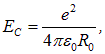
from this we find the expression for the equilibrium distance:
|
|
|
(8.2) |
Let us apply the formula obtained to estimate the size of the molecule  . We take the experimental data:
  so that the Coulomb energy will be

From this we easily find the size of the molecule
|
|
|
(8.3) |
The resulting value is approximately five times greater than the Bohr radius and gives a quite acceptable estimate of the size of the molecule. Note that for the equilibrium internuclear distance in the molecule  experiment gives
  .
.
Let us also estimate the size of the molecule of another compound —  , for which
 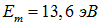 and
and 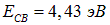 . To avoid repeating similar calculations, we use the result already obtained. In this case we have:

which is

times greater than the Coulomb energy for the molecule  . Accordingly, the size of the molecule will be smaller by the same factor:

(experiment gives the value  for the equilibrium internuclear distance).
The removal of an electron from one ion by another (ionic bonding) is found in most inorganic compounds, especially in molecules composed of atoms from distant groups. Besides compounds of alkali metals and halogens, other examples can be given. However, the classical considerations presented do not make it possible to independently calculate the binding energy of a molecule (or its size). The very emergence of an equilibrium distance lies outside the competence of such a theory. The forces of electrostatic attraction between ions must be balanced in the equilibrium state by some repulsive forces. The nature of these forces is rather complex and is related to the overlap of the electron shells of the ions. As atoms approach each other, the shells begin to deform strongly, which prevents further approach. The quantity  — is the equilibrium distance between the ions, at which the forces of electric attraction are balanced by the quantum-mechanical repulsion of the atoms at short distances.
Covalent bond. The second type of bonding is observed in molecules where the electrons carrying out the bond spend a significant part of their time in the space between the atoms and are, in a sense, «common» to both nuclei. A homeopolar (covalent) bond is characteristic of most molecules with two identical atoms ( and so on). A homeopolar bond does not lend itself to classical description and requires quantum treatment.
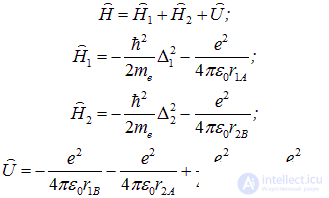
Let us consider the simplest homeopolar molecule — the hydrogen molecule. This was first done in 1927 by W. Heitler and F. London. We shall limit ourselves to an analysis of principle, omitting the calculations, since our task is to clarify the physical nature of the covalent (homeopolar) bond. The scheme of interactions in such a molecule, consisting of two protons (nuclei of the hydrogen atom) A and B and two electrons 1 and 2, is shown in Fig. 8.1.
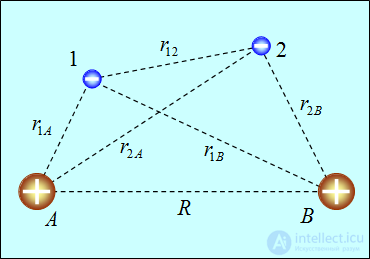
Fig. 8.1. Scheme of interaction in the hydrogen molecule
The Schrödinger equation for the system has the form
|
|
|
(8.4) |
where  and
and  denote the radius vectors of the first and second electrons, and
  is the Hamiltonian of the system:
|
|
|
(8.5) |
The Hamiltonian  contains the operator of the kinetic energy of electron 1 and the potential energy of that same electron in the Coulomb field of nucleus A. The Hamiltonian
  has an analogous structure. The operator U describes four interactions: electron 1 with nucleus B, electron 2 with nucleus A, the electrons with each other, and the nuclei — also with each other. The nuclei have a mass approximately 2 000 times greater than the mass of the electron, so they move much more slowly than the electrons, and to a first approximation they can be considered stationary (such an approximation is called adiabatic). Therefore the wave function

is regarded as a function of the coordinates of the electrons alone, while the distance R between the nuclei, which is important for the problem of the covalent bond, enters the wave function  as a parameter. The eigenvalues of the energy obtained from the Schrödinger equation will then depend on the distance R, that is

and in the cases of parallel and antiparallel orientation of the electron spins, the character of this dependence turns out to be different.
The total wave function depends not only on the spatial coordinates of the electrons, but also on their spins. Due to the Pauli exclusion principle (according to which a given set of quantum numbers can be possessed by only one particle), such a total wave function must be antisymmetric under the interchange of electrons. Since the spin state does not depend on the orbital one, the spatial and spin variables separate, and the total wave function of the electrons in the hydrogen molecule can be represented as a product of coordinate and spin functions:
|
|
|
(8.6) |
From the Pauli principle, the following properties of the wave functions follow:
|
A symmetric spin wave function corresponds to a parallel arrangement of the electron spin vectors, that is, to a total electron spin of S = 1. Such a state is called triplet after the number (2S + 1) = 3 of possible projections of the total spin. In the second case, an antisymmetric spin function is associated with oppositely oriented spins, which sum to S = 0, and consequently only one value of the projection of the total spin is possible, and the state is called singlet.
The interaction between neutral atoms, when the distance between the nuclei R is much greater than the characteristic size of the electron shells, that is, the Bohr radius,
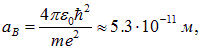
is practically absent, and the energy of the system equals twice the binding energy of the hydrogen atom  , where
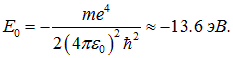
As R decreases to zero, this energy will increase without bound because of the Coulomb repulsion of the nuclei.
The results of the calculations can be described as follows. If the electron spins are parallel, then as the hydrogen atoms approach each other, the energy of the system increases monotonically, and no bound state arises (curve  in Fig. 8.2).
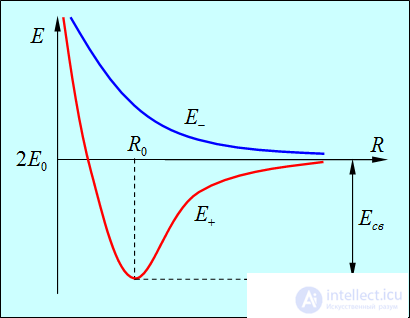
Fig. 8.2. Dependence of the energy E of the hydrogen molecule on the distance R between the atoms:
at large distances there exist two neutral hydrogen atoms with total energy  ;
;
curve E– corresponds to the triplet state of the electrons and lies above the asymptotic value
 — no bound state of the molecule exists in this case; curve
  corresponds to the singlet
state of the electrons; it has a minimum at  (the finite size of the molecule),
the distance of which from the asymptotic value is the binding energy  of the hydrogen molecule
In this case, the two atoms, left to themselves, will again move apart, tending toward the state of lowest possible energy. The condition for the existence of a bound state — the presence of a minimum in the energy of the system at some value  — is satisfied only for the singlet state of the electrons, when their spins are antiparallel (curve
  in Fig. 8.2).
This behavior of the energy can be understood at a qualitative level by considering two hydrogen atoms located at a large distance

from each other. Then the interaction operator U in the Hamiltonian (8.5) can be neglected, and we have two independent atoms, described by the sum of the Hamiltonians  and
and  . We already know the solutions of the Schrödinger equation corresponding to each of them. Let us introduce notation for the resulting wave functions:
  and
and  . Then the solution for the sum of the Hamiltonians
  will be represented as a product of the wave functions
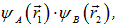
and the energy — as a sum of energies, that is, it will equal  . The physical meaning of the product of the wave functions is obvious: electron 1 is located in the field of nucleus A1, while electron 2 is in the field of nucleus B2. But the electrons are indistinguishable, and this physical situation is in no way different from the case where electron 2 is located in the field of nucleus 1A, while electron 1 is in the field of nucleus B2. This corresponds to a different product of wave functions:
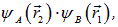
which is also a solution of the Schrödinger equation with the same energy  . According to the superposition principle, any linear combination of these products is likewise a solution with this same energy. Since the Pauli principle requires that the total wave function be either symmetric or antisymmetric with respect to the spatial coordinates of the electron, it must have the form
|
|
|
(8.7) |
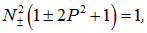
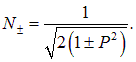
where  — are calculated normalization coefficients, ensuring that the total probability equals one:
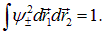
Substituting the expressions (8.7) here and taking into account that  and
and  are already normalized to unity, we obtain
|
|
|
(8.8) |
from which
|
|
|
(8.9) |
The quantity P, called the overlap integral, equals
|
|
|
(8.10) |
It characterizes the degree of overlap of the wave functions  and
and  , that is, the degree of independence of the spatial distribution of the electrons from each other, and it plays an important role in the theoretical calculation of the properties of molecules.
If we now take into account the interaction operator U, then, depending on the symmetry of the wave function  , corrections to the energy of different signs are obtained. In the case of the antisymmetric state
  (total electron spin S = 1) the correction turns out to be positive (repulsion of the atoms), and no bound state arises. In the case of the symmetric state
  (total electron spin S = 0) the correction for large R is negative (attraction of the atoms), which leads to the formation of the hydrogen molecule.
A graph of the wave function helps to make sense of this behavior of the energy correction. Let us direct the axis z along the line joining the nuclei of the hydrogen atoms, and choose the origin at the midpoint between the nuclei, so that the coordinates of nucleus A are (0, 0, –R/2), and of nucleus B — (0, 0, R/2). For simplicity we consider the wave functions on this axis, for the case of a symmetric arrangement of the electrons relative to the origin:
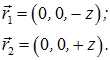
Then
|
|
|
(8.11) |
Graphs of these functions are shown in Fig. 8.3.
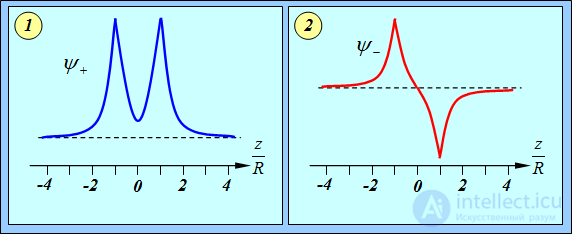
Fig. 8.3. Wave functions of the electrons in the hydrogen molecule on the axis joining the nuclei of the atoms,
for the singlet  and triplet
  states
We see that in both cases the greatest probability of finding the electrons is near the nuclei — the wave functions have extrema at the points

However, as the atoms approach each other, the electron density in the space between the nuclei is redistributed; its behavior differs depending on the type of symmetry of the spatial part of the wave function —  or
or  . In the state
  the electrons spend part of their time in the region between the protons (the wave function is noticeably different from zero in this region). An electron cloud forms in the center between the atoms, attracting the protons toward itself — a contracting action arises and a molecule is formed. In the state
  , however, the electron density between the protons decreases (the wave function passes through zero), the repulsion of the protons is not screened, which leads to an increase in the energy of the system in this state (see Fig. 8.2). The position of the minimum is thus determined by solving the Schrödinger equation, taking into account the potential energy of the electrical interaction of the electrons and protons in the molecule.
The numerical results  , obtained by this approach for the curve
  , should be compared with the experimental data:
 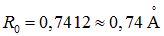 ,
,  . The difference in binding energy is 31 %, and in the size of the molecule — 17 %.
Combinations of different types of bonding. We have become acquainted with two types of bonding — ionic and covalent. In the first, the main role is played by the "jump" of electrons from one atom to another; in the second, by additional attractive forces between atoms arising from a pair of electrons with opposite spins. In fact, it turns out that such a sharp division is not an intrinsic property of the system, but rather a shortcoming of our calculation methods. Thus, to improve agreement with experiment, the Heitler — London approximation used above can be refined. Namely, the starting point earlier was the wave functions of the electrons — of electron 1 in the field of nucleus A and of electron 2 — in the field of nucleus B. But electron 1 is also present in the field of nucleus B, and electron 2 — in the field of nucleus A. These interactions were taken into account in the correction terms entering the operator U. One can, however, try to include these interactions in the treatment from the very start. For this, let us represent the wave function of the first electron in the form

where c, d — are certain numerical coefficients. They are not independent: the normalization condition of the wave function y1 leads to a relation between them
|
|
|
(8.12) |
where P — is the same overlap integral (8.10). The wave function of the second electron has an analogous form:

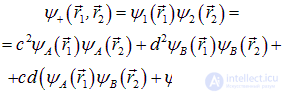
We construct the wave function of the singlet two-electron state as the product
|
|
|
(8.13) |
We see that this contains the Heitler–London wave function — this is the last term in (8.13). However, the formulas given also contain a description of another case: these are the terms
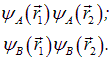
The physical meaning of the first of these is fairly obvious: both electrons are concentrated around nucleus A, forming the hydrogen ion H –, while nucleus B, having lost its electron, forms the ion H +. We see that this case describes ionic bonding. The second term describes an analogous situation, only with nuclei A and B exchanging roles. For a symmetric molecule, nothing changes when the nuclei are exchanged, from which the equality of the coefficients follows
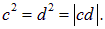
Thus, the wave function (8.13) describes a certain combination of ionic and covalent bonding, with the relative weights of these two types of bonding being equal. Physically, however, this is not the case, since we have already seen that the Heitler–London method gives a fairly good description of the hydrogen molecule. But we have found a way forward. It is clear that the shortcoming of the Heitler–London method lies in neglecting the ionic terms, while the shortcoming of the approach just described (called the molecular orbital method) lies in overestimating the influence of these terms.
Both of these methods can be taken as two different starting approximations, and a natural generalization would be to improve the numerical values of the coefficients in the wave function that determine the statistical weight of the ionic and covalent bonds. Let us represent, for example, the symmetric wave function as a superposition of individual two-electron states with arbitrary coefficients  :
:
|
|
|
(8.14) |
Using such a wave function noticeably improves agreement with experiment. In actual calculations, the coefficients  are determined from the condition of minimum average energy, and their numerical values are obtained automatically, depending on the properties of the system. If it turns out that the numerical value of one of them greatly exceeds the other two in absolute magnitude, then one can speak of the predominance of a particular type of bonding.
Thus, if

then this is ionic bonding  (the electron "jumped" from nucleus B to nucleus A).
If

then this is the case of ionic bonding  (the electron transferred from nucleus A to nucleus B).
If, finally,

then we are dealing with covalent bonding.
This approach is applicable both to molecules composed of two different atoms and to compounds of identical atoms, and it makes it possible to take into account the contribution of covalent bonding in ionic molecules and the contribution of ionic bonding in covalent molecules. When applied to symmetric molecules, the following equality must hold

but the third coefficient  remains independent, unlike in the molecular orbital method. Comparison of experiments with calculations using the wave function (8.14) showed that the fraction of ionic bonding in the covalent molecule of the hydrogen atom is 20 %.
In the hydrogen molecule, the chemical bond between the two atoms is realized, as we have seen, through the influence of the electron clouds between the atoms. In unexcited atoms these electrons are in s-states, and their wave functions are spherically symmetric. The shape of the overlap of these clouds is shown in Fig. 8.4-1.
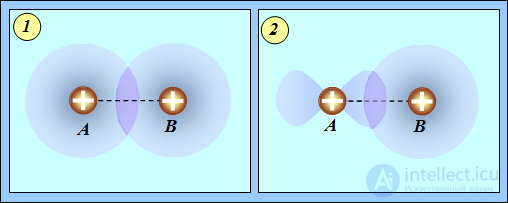
Fig. 8.4. Shape of the overlap of the electron shells: 1 — both electrons are in the s-state;
2 — one of the electrons is in the p-state
But often the valence electrons are in a p-state with angular momentum equal to unity. In this state, the wave function corresponding to zero projection of the momentum onto some axis is proportional to the cosine of the angle q between this axis and the radius vector. Consequently, the electron cloud has a density proportional to  . If such a cloud were drawn in a figure, it would have the shape of a figure eight (more precisely, a solid formed by rotating a figure eight about its longitudinal axis). If such a p-electron "pairs up" with an s-electron of another atom, the latter tends to "position itself" in such a way that the overlap of the wave functions is maximal. Obviously, such a bond is realized in the direction of elongation of the p-electron cloud (Fig. 8.4-2).
The electron cloud in the state m = 0 "envelops" the axis z, while in the two other states with projections  similar clouds are elongated along the axes x and y. This helps to clarify the spatial structure of molecules of various substances. Below we give some characteristic examples.
Water H20. The oxygen atom has two filled shells: 1s and 2s, on which four electrons are placed. The remaining four valence electrons are found on the 2p. shell. Their electron clouds repel each other and tend to move as far apart as possible: three clouds stretch out along the axes  and the fourth has nowhere to go. Let us say it is located along the axis z, with the electron having a spin opposite to that of the other electron, whose cloud is also located along this axis. This produces paired electrons that do not participate in the chemical bond. Two electrons remain free for chemical bonding — clouds along the axes x and y. The hydrogen atoms, joining as described, form a triangular molecule (Fig. 8.5), with the angle
  between the directions to the hydrogen atoms required to equal 90°.
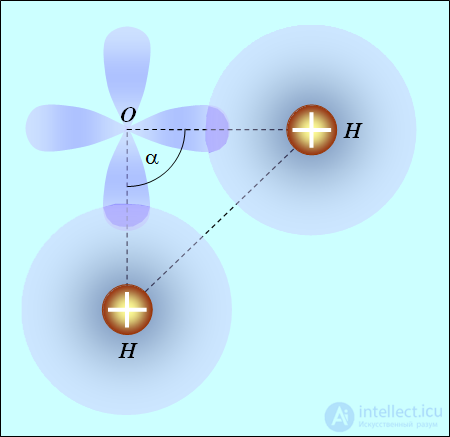
Fig. 8.5. Arrangement of atoms in the water molecule
But the partially "bare" protons also repel each other, and this angle increases somewhat: its experimental value is  . This increase is smaller the larger the atom. Thus, in the analogous compound
  the sulfur atom is larger than the oxygen atom, the repulsion of the protons is weaker, and the angle decreases to
  . The selenium atom is even larger, and in the molecule
  the hydrogen atoms are located at an angle of
  .
.
Ammonia NH3. The nitrogen atom has the configuration  . As in oxygen, the four electrons in the 1s and 2s states are paired and do not participate in the chemical bond. Three p-electrons remain, and all three bonds are located along the axes
  . When three hydrogen atoms attach, a regular triangular pyramid is formed with the nitrogen atom at the apex (see Fig. 8.6).
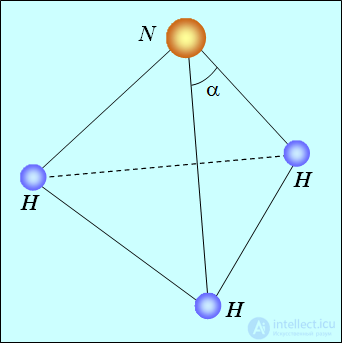
Fig. 8.6. Arrangement of atoms in the ammonia molecule
Because of the repulsion of the protons, the angles  at the apex are slightly greater than
  . For a similar compound, phosphine
  , the angle is closer to a right angle, and for
 . The three-dimensional shape of the ammonia molecule implies the existence of two degenerate states, differing in the position of the nitrogen atom on one side or the other of the base of the pyramid. However, the degeneracy is lifted owing to quantum-mechanical tunneling, which leads to a splitting of the degenerate levels. Transitions between them give rise to radiation, which made possible the creation of the ammonia maser.
Hydrogen peroxide  . In the case where two p-electrons pair up, maximum overlap is obtained when their "figure eights" are oriented along a single axis. In this way, two oxygen atoms are joined in the hydrogen peroxide molecule (Fig. 8.7).
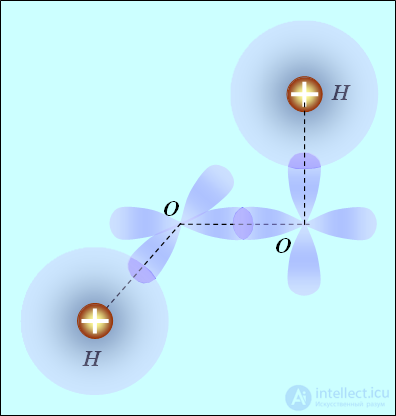
Fig. 8.7. Shape and arrangement of the electron clouds in the hydrogen peroxide molecule
Hydrogen atoms attach to them in the usual way, and owing to repulsion the hydrogen atoms attach to the oxygen clouds along different axes, so that the line OO and the two lines HO in Fig. 8.7 are all mutually orthogonal (in fact, the valence angle between OO and OH increases to  ).
).
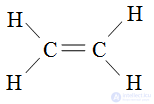
In some molecules, the bonds between atoms are formed not by one but by two or three pairs of electrons (double or triple bonds). An example of a triple bond: the molecule  , which chemists write in the form

(the dash corresponds to a pair of electrons). A triple bond of the carbon atom occurs in the acetylene molecule:

A double bond of the carbon atom in the ethylene molecule:
Quantum mechanics explains these and more complex types of bonds.
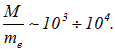
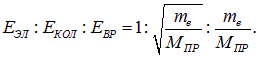
Compared with the line atomic spectra, molecular spectra have a more complex structure. They consist of a set of bands which, in turn, break up into a series of closely spaced lines. The reason for this complexity of the spectra is that, alongside the motion of the electrons around the nuclei, the molecule also exhibits oscillation of the nuclei themselves about the equilibrium position and rotation of the molecule as a whole. These three types of motion correspond to three types of quantized energy levels: electronic, vibrational, and rotational. To a first approximation, the motions can be considered independent. In studying molecular spectra, it is extremely important that the mass of the nucleus exceeds the electron mass by more than three orders of magnitude:
Therefore, the speeds of motion of the nuclei in the molecule are small compared with the speeds of the electrons. The motion of the electrons instantly adapts to changes in the arrangement of the nuclei. Thus, the configuration of the nuclei can be regarded as a parameter in determining the energy levels  . The total energy of the molecule E is accordingly composed of three quantized energy values
|
|
|
(8.15) |
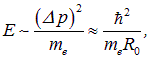
Electronic energy levels. A molecule, like an atom, possesses a series of excited states differing in the structure of the electron shell. Transitions of an electron from one state to another are associated with the absorption or emission of light quanta. The order of magnitude of the energy of the electronic levels of a molecule can be estimated from the Heisenberg uncertainty relation, in a manner analogous to how the ground-state energy of the hydrogen atom was obtained. If the linear dimensions of the hydrogen molecule are  , then the energy of the level
|
|
|
(8.16) |
which, for typical values,

amounts to several electron-volts and corresponds to transitions with the emission of quanta in the visible and ultraviolet regions of the spectrum.
Energy of the vibrational motion of the nuclei. The motion of the nuclei in a molecule can be considered for a given electronic state. Studying the relative motion of the nuclei with masses  and
and  in the molecule reduces to solving the problem of the behavior of a particle with reduced mass
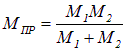
in a potential field external to it. For a given bound electronic state of the molecule, the energy E(R) has a minimum when the nuclei are located at a distance  . Let us expand E(R) in a Taylor series near the minimum point in powers of
( ):
):
|
|
|
(8.17) |
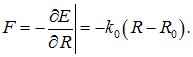
To within an additive constant  the energy of motion of the nuclei is proportional to the square of the distance from the equilibrium position. Consequently, these atoms oscillate under the action of a quasi-elastic force
|
|
|
(8.18) |
Quantum mechanics (see Section 3.3) makes it possible to determine the energy states of such an oscillatory system (a harmonic oscillator), which form a set of equidistant (equally spaced) levels (3.15):
|
|
|
(8.19) |
where  — is the vibrational quantum number, and the frequency

coincides with the frequency of the classical oscillator. Transitions between vibrational levels obey the selection rule

that is, the vibrational number can change by only one unit in a transition.
To estimate the order of magnitude of the energy of vibrational motion, note that when the amplitude of oscillation is of the order of the distance  between the nuclei, the molecule dissociates (falls apart). The energy of such oscillations is of the order of

On the other hand, the change in energy for an oscillation amplitude  is close to the value of the electronic energy
  . Indeed, a change in the internuclear distance by an amount
  must cause substantial distortions of the electronic wave function
  , that is, excitation of the electrons with a change in their energy of order
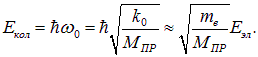
  . Thus, we obtain an estimate of the "stiffness coefficient" of the molecular oscillator:
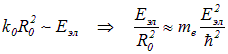
(see relation (8.11)), as well as of the energy of the vibrational motion
|
|
|
(8.20) |
This is a quantity of the order of tenths or hundredths of an electron-volt and corresponds to radiation in the infrared region of the spectrum. Thus, the vibrational energy is much smaller than the energy of the electronic level.
Energy of the rotational motion of molecules. Let us consider the rotation of molecules under the assumption of a rigid bond between the nuclei, that is, neglecting vibrations. For a diatomic molecule, the moment of inertia about an axis perpendicular to the axis of the molecule and passing through the center of inertia is equal to

According to the laws of mechanics, the energy of rotational motion is related to the rotational angular momentum L of the molecule by the expression

The rotational angular momentum is quantized:
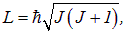
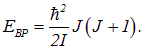
where J = 0, 1, 2, ... — is the rotational quantum number. This makes it possible to determine the rotational energy levels:
|
|
|
(8.21) |
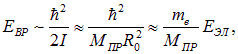
From this follows an estimate of the magnitude of the rotational energy:
|
|
|
(8.22) |
that is, a quantity of the order of
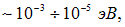
corresponding to radiation in the far-infrared and microwave (SHF) regions of the spectrum. For the rotational spectrum, transitions are allowed with

Molecular spectra. The estimates made of the magnitude of the three types of levels in a molecule show that
|
|
|
(8.23) |
In accordance with these ratios, the system of levels of a molecule consists of relatively widely spaced electronic levels, which undergo splitting under the influence of the vibrations of the nuclei. These split levels, in turn, undergo an even finer splitting in connection with the rotation of the molecules (Fig. 8.8).
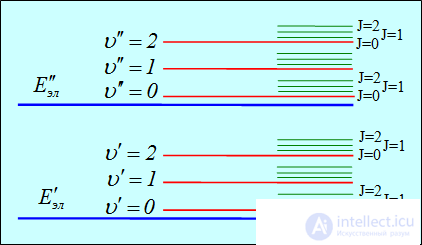
Fig. 8.8. Diagram of the arrangement of the electronic, rotational, and vibrational energy levels of a molecule
A change in the electronic state of a molecule is usually accompanied by a whole series of changes: the vibrational motion undergoes changes, since the new state corresponds to a changed equilibrium distance between the nuclei; at the same time, the moment of inertia of the molecule also changes and, consequently, so does the position of the rotational levels. These changes give rise to a whole series of absorbed or emitted quanta, whose energies correspond to the difference in energies of whichever levels the transition occurs between.
Whereas atomic spectra consist of individual lines, molecular spectra, when observed at low resolution, appear to consist of bands. When instruments with high resolving power are used, it is found that the bands consist of a large number of closely spaced lines. Because of their character, molecular spectra are called band spectra. Depending on which types of energy (electronic, vibrational, or rotational) change to cause the molecule to emit a photon, the following types of bands are distinguished: 1) rotational; 2) vibrational-rotational; 3) electronic-vibrational.
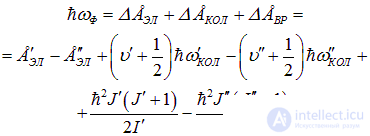
In the ground state of the molecule, all three types of energy have their minimum values. When a sufficient amount of energy is imparted to the molecule, it goes over into an excited state and then, undergoing a transition allowed by the selection rules into one of the lower energy states, emits a photon with energy
|
|
|
(8.24) |
It should be noted that the values of the frequency  and the moment of inertia I depend on the electronic configurations of the molecule, and are therefore denoted with one and two primes.
Taking into account the relations between the energies

we come to the conclusion that for weak excitations only  changes, for stronger excitations —
  , and only for even stronger excitations does the electronic configuration of the molecule change, that is
  . Accordingly, the photons with the lowest energy are those associated with rotational transitions (the electronic configuration and the vibrational energy do not change). Taking into account that
  , we find
|
|
|
(8.25) |
Measuring the energy of such photons makes it possible to determine the moment of inertia of the molecule and, consequently, its size  . For example, for HCl it was found that
  , which corresponds to
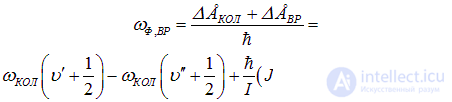
For transitions accompanied by changes in both the vibrational and rotational states of the molecule, the frequency of the emitted photon can be written in the form
|
|
|
(8.26) |
where it was taken into account that 
In 1928, the Soviet scientists G.S. Landsberg and L.I. Mandelstam, and simultaneously the Indian physicists C.V. Raman and K.S. Krishnan, discovered that in the scattering spectrum arising when light passes through gases, liquids, or transparent crystalline bodies, in addition to the unshifted line with the frequency of the incident light, new lines may appear whose frequencies represent combinations of the frequency of the incident light  and the frequency
  of the vibrational or rotational transitions of the scattering molecules:

This phenomenon came to be known as Raman (combination) scattering of light, and for its discovery Raman was awarded the Nobel Prize in 1930.
From Fig. 8.9 it is evident that the Raman scattering spectrum consists of the unshifted line  , around which a series of satellites is symmetrically arranged. Each "red" satellite (that is, a satellite shifted toward longer wavelengths) with frequency
  (Stokes lines) corresponds to a "violet" satellite with frequency
  (anti-Stokes lines).
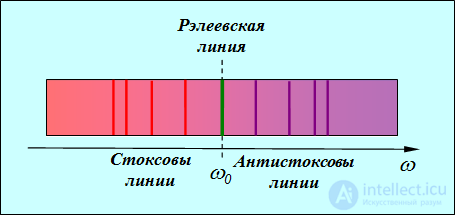
Fig. 8.9. Raman scattering spectrum
At ordinary temperatures, the intensity of the violet satellites is significantly lower than that of the red ones. As the temperature increases, the intensity of the violet satellites increases rapidly.
The process of light scattering can be regarded, within the framework of quantum theory, as a collision of photons with molecules (elastic and inelastic). In a collision, a photon can give to a molecule, or receive from it, only such amounts of energy as are equal to the differences between two of its energy levels. Scattering of a photon with energy  may be accompanied by transitions of the molecule between various rotational or vibrational levels
  and so on. If, upon colliding with a photon, the molecule goes from a state with energy
  to a state with energy
  (with
(with  ), then the energy of the photon after scattering decreases:
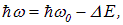
where
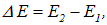
that is, a red satellite arises in the spectrum.
If, however, the molecule was initially in an excited state with energy  , it may, as a result of interaction with the photon, go over into a state with energy
  , giving up the excess energy to the photon. As a result, the energy of the photon increases:
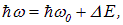
that is, a violet satellite arises. In this way, a series of symmetrically arranged satellites can appear.
At ordinary temperatures, the number of molecules in the ground state greatly exceeds the number of molecules in excited states. Therefore, collisions accompanied by an increase in the energy of the molecule occur more often than transitions accompanied by a decrease in energy. This explains the greater intensity of the red satellites compared with the violet ones. As the temperature increases, the number of molecules in excited energy states grows rapidly, which causes an increase in the intensity of the violet satellites.
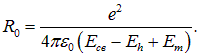
It should be noted that Raman scattering is one of the nonlinear effects of the quantum theory of radiation. It has become an effective method for studying the structure of molecules and their interaction with a medium. Methods of Raman scattering are used to study quasiparticles in solids. The use of lasers as light sources has significantly expanded the range of objects (gases, powders) accessible to study by methods of Raman light scattering.

 .
.











Comments