Work of an electric current
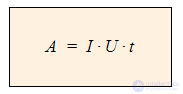
When studying the applications of electric current, one needs to be able to calculate the amount of electrical energy expended on a particular action of the current. For example, raising an elevator, heating a kettle, and so on. Therefore let us derive a formula for calculating the work of a current.
In the previous section we learned the formula:
P = I · U However, from 7th grade we know another formula for power:
N = A / t
On the left-hand sides of these equalities stand different symbols, but they denote one and the same physical quantity – power. Consequently, the right-hand sides of the formulas can be equated: I · U = A / t . Let us express the work:
A – work of the electric current, J
I – strength of the electric current, A
U – electric voltage, V
t – observation time, s
This formula is used to calculate the work of the current or, what is the same thing, the electrical energy consumed. Let us clarify that the terms we have highlighted are synonyms.
Work of the current – a physical quantity characterizing the amount of electrical energy converted into other forms of energy.
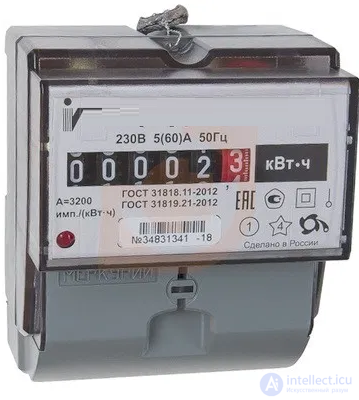
The unit is 1 joule (1 J). The measuring instrument is an electricity meter, which uses the unit 1 kilowatt-hour (1 kWh).
At the moment the circuit is closed, the electric field of the energy source sets the charged particles in the conductor (electrons and/or ions) in motion, and their energy increases. The sum of the energies of all the particles of a body is the internal energy of the body (see § 7-e), which means the internal energy of the conductor increases at the moment a current arises in it. According to the first law of thermodynamics, internal energy can be expended on heat transfer or on doing work (see § 6-h). But, as it is expended, it is continuously replenished from the energy source.
Let us recall that the passage of current through a conductor is always accompanied by actions of the current (see § 8-h). In this process, a conversion of electrical energy into other forms of energy necessarily occurs. For example, into internal energy (an iron or a kettle), mechanical energy (a vacuum cleaner or a fan), and so on. Therefore, by the expression «the current does work» we will understand the conversion of electrical energy into other forms of energy. In this sense, the work of the current and the electrical energy consumed are synonymous expressions.
Self-check questions
- The power of a current is calculated by the formula: ...
- Any power is calculated by the formula: ...
- These formulas can be equated because, as applied to a current, they ...
- The product on the right-hand side of the boxed equality is ...
- The work of a current is a synonym for the expression ...
- Including a source of electrical energy in a closed circuit ...
- As a result of the motion that arises ...
- Since the energy of a body is made up of the energies of its particles, then ...
- According to the formula ΔU = Q + A, U itself ...
- During any action of a current, there is always ...
Electricity meters
Special measuring instruments – electricity meters – are used to measure consumed electrical energy.
For accounting electrical energy, a larger unit than the joule is used – the kilowatt-hour (notation: 1 kWh). For example, the meter in the figure shows a reading of 254.7 kWh. This can mean that, over the whole accounting period, a load of power 254.7 kW operated for 1 hour, or that a load of power 2547 W operated for 100 hours (and so on, keeping the proportion).
Let us find the relationship between the kilowatt-hour and the joule, the unit more familiar to us for measuring work.
1 kW · h = 1000 W · 60 min = 1000 J/s · 3600 s = 3,600,000 (J/s)·s = = 3,600,000 J = 3.6 MJ
Thus, 1 kWh = 3.6 MJ.
Note. The formula for the work of a current A = I·U·t will help clarify the physical meaning of electric voltage. Let us express it:

Consequently,
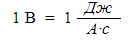
From this it can be seen that 1 volt is the voltage at which a current of strength 1 ampere is able to do 1 joule of work in 1 second. In other words, electric voltage shows the work that the forces of the electric field perform each second to maintain a current of strength 1 ampere in the circuit.
Moreover, from the formula I = q / t (see § 9-b) it follows that: q = I · t. Then:
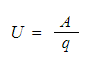
Consequently,
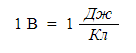
Based on this formula, 1 volt can also be regarded as the voltage at which the work of the electric field forces in moving a charge of 1 C is equal to 1 J. In general terms we will say: electric voltage is one of the characteristics of the electric field that moves charges along a conductor.
- An electricity meter is used ...
- Compared to the joule, the kilowatt-hour is ...
- Values of energy in kilowatt-hours should be understood as ...
- The notation 1 kWh = 3.6 MJ expresses the relationship of the kilowatt-hour ...
- What is the essence of the note we made?
- From the formula A = I·U·t, substituting the units of the quantities, it follows that: ...
- Extending this to any voltages, we arrive at the generalization: ...
- Next we will need the formula for current strength: ...
- Substituting the units of the quantities into I=q/t, we obtain a new consequence: ...
- Extending this to any voltages, we arrive at a new generalization: ...
Interesting facts
. in the 19th century, a small trough with a solution of copper sulfate (blue vitriol) or another water-soluble salt was used as an electricity meter? The current passing through it caused copper to deposit on one of the electrodes. From the increase in its mass, one could judge the amount of electricity that had flowed (that is, the electrical energy consumed).


Comments