
Lecture
We are completing our introduction to statistical physics. Classical statistics, mathematically expressed by the Maxwell-Boltzmann distribution, counted the number of particles located in a small volume dV around some point  and having momenta in a small interval
  around some value
  . Having become acquainted with the laws of quantum mechanics, we now understand that this approach is inapplicable to quantum systems: microparticles cannot simultaneously have definite values of coordinate and momentum, so the Heisenberg uncertainty relation must be taken into account. In addition, we are already familiar with the Pauli principle, according to which electrons «interfere» with one another and cannot occupy one and the same state. Obviously, this too must be reflected in quantum statistics, to the study of which the present chapter is devoted. Quantum statistics found its first and almost obvious application in the theory of the heat capacity of solids. We will also touch upon some of the most interesting macroscopic quantum phenomena — superfluidity and superconductivity.
The simplest model of a crystal is a geometrically regular crystal lattice, at whose sites atoms, considered as material points, are placed. Atoms undergo thermal oscillations about equilibrium positions. If the oscillations are small, they can be regarded as harmonic. The energy of each atom consists of kinetic and potential energy. Each degree of freedom accounts for, on average, a kinetic energy of

and the same amount of average potential energy. Thus, the average value of the total energy per one vibrational degree of freedom is equal to:
 .
.
Let us now recall the classical results for the heat capacity of a crystal lattice, discussed earlier. Assume for simplicity that all atoms are identical and each has three vibrational degrees of freedom, so that the average energy per atom is  . Multiplying this quantity by Avogadro's constant
  , we can obtain the internal energy of one mole of a crystalline solid:
|
|
|
(7.1) |
where R is the universal gas constant. From this, for the molar heat capacity of a solid we have
|
|
|
(7.2) |
This law was established in 1819 by P. Dulong and A. Petit as an empirical rule, according to which the product of the specific heat capacity of a chemical element in the solid state and its atomic mass (molar heat capacity) is approximately the same for all elements and equals
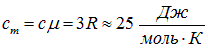 .
.
If the substance of the crystal consists of molecules having  atoms, then the Dulong-Petit law is modified in an obvious way:

(thus, for example, for molecules of table salt NaCl  ).
).
Shortcomings of the classical theory of heat capacity
1. The classical theory gives no explanation for the dependence of the heat capacity of bodies on temperature. It has been experimentally established that as absolute zero is approached, the heat capacities  and
and  of all bodies, including crystals, tend to zero.
2. According to the theorem of equipartition of energy, all degrees of freedom are equivalent. However, experiment leads to the conclusion that at low temperatures not all of them contribute to the heat capacity: as the temperature decreases, certain degrees of freedom become ineffective (said to be «frozen out»). Thus, at a temperature
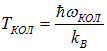
the vibrational degrees of freedom «freeze out» (here  is the oscillator frequency). Quite similarly, due to the quantization of rotational energy, the rotational degrees of freedom «freeze out»: this occurs at
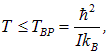
where I is the moment of inertia of the molecule.
3. The Dulong-Petit law was formulated for any solid: metal and dielectric alike. However, a metal consists of positively charged ions undergoing thermal oscillations about the sites of the crystal lattice. Between them move so-called «free» electrons, which behave like an electron gas. The presence of free electrons explains the high electrical conductivity of metals. The classical theory of heat capacity does not take into account the presence of an electron gas in metals. It accounts only for the thermal oscillations of the ions and leads to the Dulong-Petit result. Unlike dielectrics, in metals one should take into account the contribution to the heat capacity made by the electrons. Each free electron accounts for an average kinetic energy of
 .
.
Therefore, according to the classical theory, the heat capacity of the electron gas should be comparable to the heat capacity of the crystal lattice. Experiment shows that free electrons make practically no contribution to the heat capacity of metals.
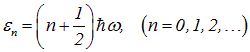
Quantum theory removed the difficulties encountered by the classical theory regarding the heat capacity of solids. Let us represent a body as a system of N oscillators that do not interact with one another. Let us apply Boltzmann's distribution law to this system, taking into account that the energy of a harmonic oscillator is quantized:
|
|
|
(7.3) |
If we denote by  the number of oscillators with quantum number n, where

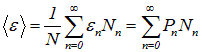
then the average energy per molecule in a state of thermodynamic equilibrium is determined by the expression
|
|
|
(7.4) |
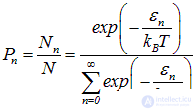
According to the Boltzmann distribution, the probability  of finding an oscillator in a state with quantum number
  is equal to
|
|
|
(7.5) |
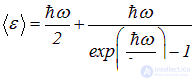
Substituting relations (7.5) and (7.3) for  and
and  into formula (7.4) and carrying out the summation, we arrive at the expression for the average energy of a harmonic oscillator:
|
|
|
(7.6) |
Formula (7.6) differs from the expression obtained earlier by the presence of an additional first term.
This term

is the energy of the «zero-point oscillations» of the harmonic oscillator, which does not depend on temperature and therefore does not contribute to the heat capacity of the system.
Expression (7.6) was used by Einstein as the basis for the quantum theory of the heat capacity of solids. Einstein identified the crystal lattice of N molecules with a system of  independent harmonic oscillators with the same natural frequency w. Then the internal energy of one mole is determined by the expression
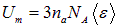 .
.
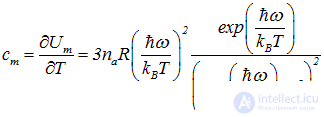
Differentiating it with respect to temperature, we obtain the molar heat capacity of the crystal lattice of solids
|
|
|
(7.7) |
This is the Einstein formula for the heat capacity of crystals. At high temperatures, when

it reduces to the classical formula
 .
.
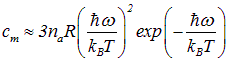
In the other limiting case of low temperatures, when

one can neglect the unity in the denominator and obtain
|
|
|
(7.8) |
As T, tends to 0, the resulting expression tends to zero, as required by Nernst's heat theorem (see Sec. 5.7).
Let us explain the physical meaning of this result. Because of quantum discreteness, there is a finite energy gap  (the energy gap) between the ground and excited levels of the system of oscillators. The oscillator simply cannot absorb a smaller amount of energy. At zero temperature there are no excitations in the system — all oscillators are in the ground state. With a slight increase in temperature, the thermal energy is insufficient to overcome this gap, and only a small number of oscillators, proportional to

according to the Boltzmann law, make the transition to the first excited level. It is they that are responsible for the absorption of thermal energy and, correspondingly, for the small heat capacity of the crystal at low temperatures. At high temperatures there is enough thermal energy to excite many higher-lying vibrational levels, so that the discreteness of energy no longer plays a special role — we return to the classical Dulong-Petit result.
However, the agreement of Einstein's theory with experiment is only qualitative. In the expression for  at low temperatures, the exponential factor decreases faster than the factor
  increases. Therefore, as absolute zero is approached, the heat capacity tends to zero practically according to an exponential law. Experiment, however, shows that the heat capacity of crystals at low temperatures changes not exponentially, but according to a power law
 .
.
As it turned out, these discrepancies between Einstein's theory and experiment are related not to the essence of quantum theory, but to a simplification in the calculation, in which it was assumed that all harmonic oscillators vibrate at one and the same frequency. In fact, the crystal lattice should be considered as a coupled system of interacting particles. In calculating the heat capacity, the body can indeed be regarded as a system of harmonic oscillators, but with different frequencies. The problem reduces to finding the frequency spectrum.
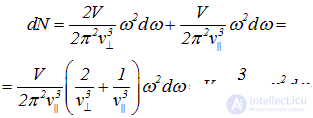
P. Debye took into account that the oscillations of atoms in the crystal lattice are not independent. The displacement of one atom from its equilibrium position entails the displacement of atoms neighboring it. Thus, a crystal represents a system of N elastically coupled atoms possessing 3N degrees of freedom. Each degree of freedom (normal mode) can be represented as a harmonic oscillator, whose average energy  we have already calculated (see (7.6)). Because of the coupling between atoms, the frequencies of the normal modes no longer coincide with one another. The interaction of atoms leads to the fact that an oscillation arising at some point in the crystal is transmitted from one atom to another, as a result of which an elastic wave arises. This wave, upon reaching the boundary of the crystal, is reflected. When the direct and reflected waves are superimposed, a standing wave is formed, corresponding to a certain normal mode of the crystal lattice. The number dN of normal modes, that is, standing waves, in the frequency interval from
  to
to  is large, so the summation in the expression for the internal energy of the system can be replaced by integration:
|
|
|
(7.9) |
Number of oscillations per unit volume. In this section we will take up counting the number of standing waves with close frequencies  . In essence, we already carried out this calculation earlier for electromagnetic radiation, but we will repeat it again with small modifications for application also to elastic vibrations in a crystal.
Let us first consider a one-dimensional potential box of length  . We have already been able to convince ourselves that the standing wave in it (whether electromagnetic, acoustic, or a de Broglie wave) is described by the function sin(kx), which must vanish at the boundaries of the box. From this
|
|
|
(7.10) |
The number  numbers the different standing waves along the x, axis, and therefore the number of modes falling within a small interval of the wave vector
  is
is
|
|
|
(7.11) |
We put a factor of two in the denominator in order to avoid double counting: replacing  with
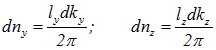
with  leads to the same standing wave. In a three-dimensional box, for waves propagating along the other axes, we obtain analogous formulas
|
|
|
(7.12) |
Multiplying (7.11) and (7.12), we find for the total number of standing waves in a box of volume 
|
|
|
(7.13) |
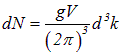
Finally, let us take into account that g polarizations may correspond to each standing wave (for example, for de Broglie waves corresponding to particles with spin s, we have g = 2s + 1 — the number of different spin projections). Finally we have
|
|
|
(7.14) |
Formula (7.14) gives the number of different standing waves (differing in the number of nodes and directions of polarization) in volume V, corresponding to a volume element  in the space of the wave vector
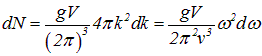
  . Next, in order to go over to wave frequencies, let us recall the relation

where v is the phase velocity of the wave. From this
 .
.
and finally we obtain
|
|
|
(7.15) |
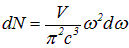
We derived formula (7.15) for a rectangular volume, but it can be shown that the shape of the volume does not affect the result. Nor does the physical nature of the oscillations, whose number we have counted, matter much. For example, for photons v = c and g = 2 (light can have right and left circular polarizations). As a result we obtain the formula, already known to us, for the number of photon types in volume V with frequency  in the interval
  :
:
|
|
|
(7.16) |
To apply (7.15) to sound waves in a crystal, let us take into account that there one longitudinal wave, propagating with speed  , and two transverse waves with different polarizations, as for photons, propagating with speed
  . are possible. Now it is obvious how to generalize formula (7.15) to this case:
|
|
|
(7.17) |
Here we have introduced the quantity v, playing the role of a certain average between the speeds of longitudinal and transverse waves; it is calculated from the relation
|
|
|
(7.18) |
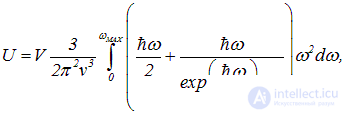
Characteristic temperature of Debye. Substituting (7.17) and (7.6) into expression (7.9) for the internal energy, we obtain
|
|
|
(7.19) |
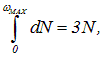
 is the maximum frequency of the normal modes, which is determined from the normalization relation
|
|
|
(7.20) |
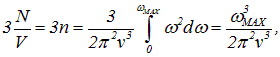
since the total number of normal modes equals the number of degrees of freedom. Using (7.17), we find
|
|
|
(7.21) |
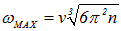
where n — the concentration of atoms (their number per unit volume of the crystal). Thus, the maximum frequency of normal vibrations, called the Debye frequency, equals
|
|
|
(7.22) |
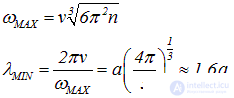
It should be noted that the smallest wavelength of an elastic wave in the crystal, corresponding to the maximum frequency  , equals
|
|
|
(7.23) |
where
 .
.
— is the distance between neighboring atoms in the crystal lattice. This result agrees with the fact that waves whose lengths are less than twice the interatomic distance cannot exist in a crystal.
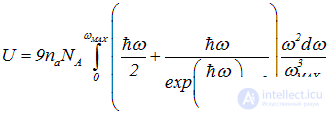
Using definition (7.22) and taking into account that for one mole of a crystal the concentration of atoms equals

where  — is the number of atoms in a molecule of the crystal substance, we can write the internal energy of one mole in the form
|
|
|
(7.24) |
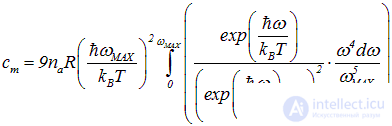
Differentiating the internal energy U with respect to temperature, we can obtain the molar heat capacity of the crystal:
|
|
|
(7.25) |
Let us introduce a new parameter — the Debye characteristic temperature
|
|
|
(7.26) |
and perform a change of variables in the integral (7.25)
 .
.
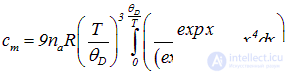
Then the molar heat capacity of the crystal can be written in the form
|
|
|
(7.27) |
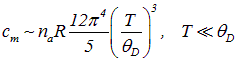
At low temperatures  the upper limit of the integral will be very large, so it can be approximately set equal to infinity. Then the integral will represent the number
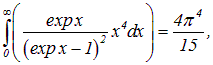
and the heat capacity turns out to be proportional to the cube of the temperature:
|
|
|
(7.28) |
This approximate dependence is known as the Debye law and agrees well with experiment at sufficiently low temperatures  .
.
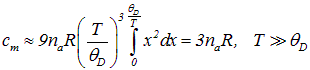
At high temperatures  the exponential in the numerator is approximately equal to unity, and the exponential in the denominator can be expanded in a Taylor series:
 .
.
Then for the molar heat capacity we obtain the value
|
|
|
(7.29) |
that is, the Dulong–Petit law.
The agreement of Debye's theory with experiment can be judged from the graph in Fig. 7.1, which shows experimental points for several substances.
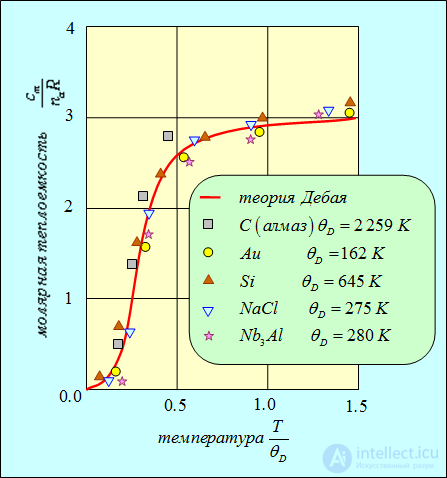
Fig. 7.1. Comparison of the Debye heat capacity theory with experimental data: substances with markedly different values of the Debye temperature and different molecular compositions are shown ( for NaCl and
  for
for  ), but all points lie fairly close to the theoretical curve
Example. Using the data given in the graph in Fig. 7.1, let us find the maximum vibration frequency  in a gold crystal according to Debye's theory.
The Debye temperature for gold, as indicated on the graph, equals  . Using (7.26), we find

As inside molecules, atoms in a crystal perform small vibrations about fixed equilibrium positions. The vibrations of atoms propagate through the crystal in the form of weakly interacting waves with wave vectors  and frequencies
  . Physically, normal vibrations in crystals give rise to deformation waves of the crystal lattice (that is, elastic waves). Thus, the motion of atoms in a crystal can be described as a superposition of plane waves of various frequencies
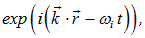
each of which corresponds to a harmonic oscillator with frequency  .
.
Following de Broglie's ideas, such an elastic wave in a crystal can be associated with a quasiparticle with energy

and momentum
 .
.
It is called a phonon.
|
A phonon — is an elementary quantum of sound energy, just as a photon is an elementary quantum of light (electromagnetic) energy. |
Our correspondence can be depicted schematically as follows:
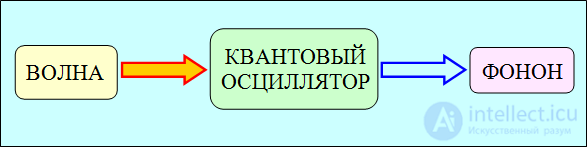
The index i denotes the type of the corresponding wave (longitudinal, transverse, characterized by a definite dispersion law

and so on), or, as it is said, a phonon mode. In a quantum-mechanical treatment, the harmonic oscillator of a given phonon mode, as we already know, can have energy
 .
.
At  we have zero-point vibrations with energy

— there is no phonon of this mode in the solid. At  we have a new state with excitation energy
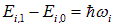
— this is exactly the quasiparticle phonon. At an arbitrary quantum number ni the excitation energy equals
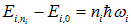 .
.
In this case we say that i phonons of a given mode i are propagating in the solid.
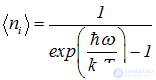
Using the results obtained above, in the case of thermodynamic (thermal) equilibrium we can find the average number of phonons  with frequency
  . Indeed, we have already found the average energy
  of a quantum oscillator (see (7.6), where the frequency
  must now be replaced by the frequency of the elastic wave
  ). On the other hand, this same energy can be represented in the form (7.6)
 .
.
Equating these expressions, we obtain
|
|
|
(7.30) |
At low temperatures

the average number of phonons decreases exponentially as T tends to 0: no excitations arise in the system. Conversely, at high temperatures

the exponential in the denominator can be expanded in a Taylor series, giving the result
 .
.
It follows, therefore, from the relation obtained that at a sufficiently high temperature an unlimited number of identical phonons can be excited simultaneously in the crystal, that is, the Pauli principle does not apply to phonons. Recall that quanta of the electromagnetic field — photons in equilibrium with the walls of a cavity — also obey this distribution.
The concept of phonons is widely used in solid-state physics. Phonons are called quasiparticles, because, although quite real, they exist only within crystals: outside the medium they do not exist. The idea of the existence of quasiparticles was first put forward by L.D. Landau in the 1940s. Besides phonons there are other types of quasiparticles as well. The thermal vibrations of the lattice can be regarded as a phonon gas, ideal at low temperatures. At very high temperatures the lattice melts and the model of non-interacting phonons becomes inapplicable: they cease to be free. The advantage of the phonon concept is that within its framework the properties of a solid are treated as the properties of an ensemble of a large number of independent quasiparticles — a phonon gas. All the notions of this model can be used to describe the behavior of the crystal lattice.
One can also consider the interaction of ordinary particles (electrons, photons) with phonons. Thus, electrons, by exchanging phonons, experience attraction. Despite Coulomb repulsion, a bound state of a pair of electrons can even form. This mechanism leads to the phenomenon of superconductivity (to be considered later).
Earlier we discussed the Raman (combination) scattering of light by crystals. This process can be interpreted as a process of interaction of a photon with a gas of phonons. A photon flying through the crystal lattice can excite in it a phonon of one of the frequencies of the crystal's optical mode. In this case the photon is completely absorbed by the crystal lattice, and then a new photon is emitted, but now with lower energy, since part of the energy remains in the crystal lattice in the form of the phonon created there — a red satellite arises: a photon with lower energy. If a phonon had already been excited in the crystal, the reverse exchange of energy is also possible: a flying photon, as a result of absorption and re-emission, can increase its energy at the expense of the phonon's energy; in that case a violet satellite arises: a photon with higher energy.
We have already seen that the number of phonons in a solid is not constant. The more intense the thermal motion of the atoms, that is, the higher the temperature, the greater the number of phonons. At high temperatures the number of phonons is proportional to the temperature, while as absolute zero is approached their number tends to zero exponentially.
Two particles are identical if all their physical properties coincide exactly, which excludes the possibility of experimentally distinguishing them. In classical theory it is always assumed that we can, in principle, trace the motion of particles and say which one went where. Therefore, in classical theory even identical particles are in principle distinguishable. In quantum mechanics this is not so: the uncertainty principle does not allow trajectories to be traced, and hence the indistinguishability of particles has a fundamental character and affects the result of calculations.
Suppose, for example, that a system of two particles is described by a Hamiltonian (energy operator)

and suppose the system is in a state with wave function
 .
.
Let us introduce the operator

which interchanges the particles, that is, exchanges their position vectors:
|
|
|
(7.31) |
Mathematically, the identity of particles is expressed by the invariance (unchangeability) of the Hamiltonian under the permutation operation

of these particles, which in quantum mechanics is written as the condition that the operators commute

that is
|
|
|
(7.32) |
This condition ensures the physical indistinguishability of the particles, since then the wave function  will also be a solution of the Schrödinger equation with the same energy value. Indeed, if

and we act on both sides of this equation with the commutation operator

then we obtain
 .
.
Because of the commutation condition we can carry the commutation operator through the Hamiltonian:

and our equation takes the form
 .
.
But we recall that commutation of operators with the Hamiltonian means conservation of their eigenvalues. Let us find the eigenvalues p of the commutation operator. For this we must solve the equation
|
|
|
(7.33) |
Taking into account definition (7.31) of the commutation operator, we write this equation in the form
|
|
|
(7.34) |
Let us again act on both sides of (7.34) with the particle permutation operator:
|
|
|
(7.35) |
From (7.34) and (7.35) we obtain that
|
|
|
(7.36) |
that is  . Thus, the commutation operator can have only two eigenvalues. For p = 1 the wave function is symmetric with respect to the particle permutation operation:
 .
.
For p = –1 we have an antisymmetric wave function:
 .
.
Thus, we have obtained an important result:
|
The wave functions of a system of two identical particles can be either even or odd with respect to the operation of interchanging the particles. |
A generalization of this result holds:
|
The states of a system of identical particles are either symmetric or antisymmetric with respect to the permutation of any two of them. |
Which state is realized — depends on the nature of the particles under consideration.
|
Particles with symmetric states are called bosons, and those with antisymmetric states — fermions. |
Earlier we used these names for particles with integer and half-integer spin, respectively. In the relativistic Dirac equation, unlike the Schrödinger equation, the spin of particles arises automatically. There exists a fundamental Pauli theorem:
|
Particles with half-integer spin (s = 1/2, 3/2, etc.) are described by antisymmetric wave functions, while those with integer spin (s = 0, 1, 2, etc.) — by symmetric ones. |
This theorem on the connection between spin and statistics is a consequence of combining quantum mechanics with the theory of relativity.
Let us turn, as an example, to the state of two atomic electrons. Neglecting the interaction between them, the wave function factorizes into the product of the wave functions of each electron separately:
 .
.
The indices i, j here denote the complete set of quantum numbers (n, l, m, s), by which one state differs from another. Interchanging the electrons, we arrive at a state with the same energy, described by the wave function
 .
.
Therefore, by virtue of the superposition principle, states described by any linear combination of these two functions are possible, and all of them will have the same energy. However, we now know that for electrons with spin s = 1/2 only the antisymmetric combination has physical meaning
|
|
|
|
If the states of the electrons are identical (i = j, that is, all quantum numbers coincide), then
 .
.
We have again arrived at the Pauli principle:
|
There cannot be two electrons in the same state.
|
Bosons and fermions have completely different statistical properties, that is, they behave differently in a collective of their own kind. Besides the direct force interaction between particles, there is a specifically quantum, exchange interaction: these are not some additional forces or fields — some particles influence the behavior of others simply by their presence. These effects are felt by particles if they are located at distances from each other smaller than or of the order of the de Broglie wavelength  . At high temperatures the energies of the particles are large and
  is small — this is the domain of classical physics. At low temperatures
  increases and quantum effects dominate.
Let us consider a system of identical fermions with energies  in state i (where i denotes a set of quantum numbers, including spin). Let us denote by
  the number of particles in state i. The basic principle of statistical physics (classical and quantum) is formulated as follows:
|
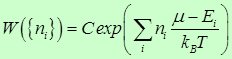
The probability of finding the system in state i equals
|
Here C is the normalization constant, and  is the chemical potential. This parameter always appears when the number of particles in the system is fixed, which equals

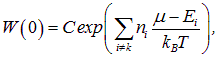
where the sum is taken over all states. In essence, equation (7.38) is a generalization of the well-known Boltzmann distribution. From the Pauli principle it follows that for fermions  can take only the values 0 and 1 — a given state i can contain either one particle or none at all.
Out of the entire set of possible states of the system, let us follow some particular state k with energy  . With some probability
|
|
|
продолжение следует...
Часть 1 7. Heat capacity of crystals. Quantum statistics
Часть 2 7.7. Bose—Einstein statistics - 7. Heat capacity of crystals. Quantum

 .
. .
. .
. .
. .
. .
. .
. .
. .
. .
. .
. .
. .
. .
. .
. .
. .
.
 .
. .
. .
. .
.
 .
. .
.
 .
. .
. .
. .
. .
. .
.
 .
. .
.

Comments