Electric heating appliances have become very widespread in our lives. For example, electric stoves and kettles, irons, fireplaces, hair dryers, and others have long since become familiar «residents» of our homes.
The resistance of a conductor is directly proportional to its length and inversely proportional to the area of its cross-section. The coefficient of proportionality is the resistivity of the substance. Its unit is 1 ohm-meter (1 Ω·m).
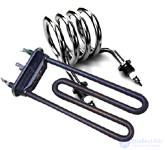
The main part of any electric heating appliance is the heating element. Since the second half of the 20th century and to this day, so-called tubular heaters (TENs) – tubular electric heating elements – have been widely used (see photo). They consist of nichrome wire wound into a coil and placed inside a metal tube filled with an electrically insulating, heat-conducting powder. TENs are used in most water-heating appliances, in irons, electric stoves, electric fireplaces, and so on. Such TENs can be up to several decimeters in size and up to several thousand watts in power.
Recently, electric «warm floors» have begun to spread widely. To lay them, TENs are used that are housed not in metal tubes but in plastic ones, so they bend easily. This is important for laying them in a «snake» pattern, evenly covering the whole floor area and going around obstacles such as wall bends and projections. Such heaters are tens of meters long and have a power of up to several hundred watts, which is enough to heat one room.
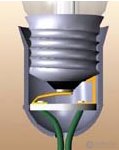
In ordinary incandescent lamps, less than 10% of the electricity consumed is converted into light energy, while the remaining 90% is converted into heat. That is why incandescent lamps can also be considered electric heating appliances. And although they are most often used for lighting, there are not infrequent cases when they are used for heating as well, for example, greenhouses. To connect lamps to the electrical network, a special socket is used (shown in cross-section in the figure). It has a lower contact in the form of a springy plate and a ring contact that touches the base of the lamp.
Self-check questions
- Give examples of electric heating appliances used at home.
- The heating element in all cases serves as ...
- Tubular electric heaters are made from nichrome wire by inserting it ...
- Tubular electric heaters are used ...
- Typical characteristics of such heaters are as follows: ...
- Flexibility of elements for warm floors is necessary so that they can be ...
- To acceptably heat one room, flexible electric heaters ...
- Incandescent lamps can be considered heating appliances because in them ...
- Incandescent lamps can be used not only for lighting, but also ...
- The socket for connecting an incandescent lamp to the electrical network has ...
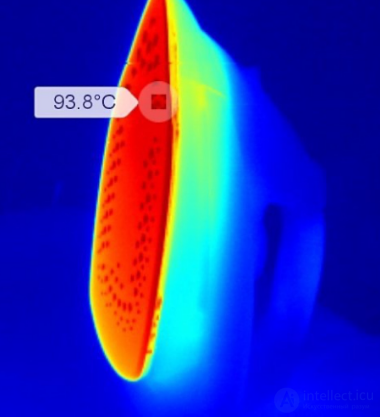
Fig. thermogram of an iron taken with a thermal imager
Important: heat is released not only in the heating element, but also in the wires. However, per unit length of the heating element, much more heat is released than per unit length of the wire. In other words, on every centimeter of the coil far more heat is released than on every centimeter of the wire that carries the current to the coil. What is the reason for this?
First, the heating element and the lead-in wires are made of different metals: nichrome and copper. Meanwhile, if you take conductors of the same size made of nichrome and copper, the nichrome conductor will have 50 times greater resistance than the copper one. This can also be said differently: the resistivity of nichrome is 50 times greater than the resistivity of copper. Let us find out how this affects the release of heat.
The heating element and the lead-in wires are conductors connected in series. In § 9-b we learned that in such conductors the current is the same. Consequently, according to the Joule–Lenz law, the amounts of heat released in these conductors are directly proportional to their resistances (since the currents and the times of its flow are the same). Therefore, each unit of length of nichrome wire releases 50 times more heat than a unit of length of copper wire, if their cross-sectional areas are the same.
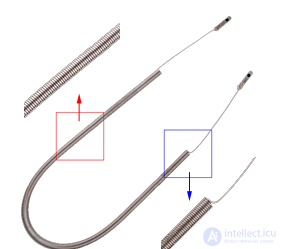
Second, the nichrome wire is wound into a coil whose length is 10-20 times shorter than the length of the wire itself (see figure). Therefore, per unit length of the coil, 10-20 times more heat is released than per unit length of a straight section of nichrome wire.
So, two causes – the use of a substance with high resistivity (nichrome or similar) and its dense placement (a coil with closely spaced turns) – result in most of the heat being released precisely in the heating element of the appliance, and not in the wires.
Self-check questions
- What fact do we intend to justify in the remaining part of the section?
- What general formulation will we consider?
- From it follows a particular consequence: ...
- The first cause of the difference in heat-release power consists in the fact that ...
- Since the resistivity of nichrome is 50 times greater than that of copper, ...
- The lead-in wires are connected to the heating element in series, therefore ...
- Since the current and the time it flows are the same, then ...
- Given equal diameters of the nichrome wire and the copper wire ...
- The second cause of the greater heat-release power precisely in the TEN is that ...
- In heating appliances, the location of the main heat release is influenced by
See also
[[b9316]]
See also


Comments