
Lecture
Vacuum – that is how the word "vacuum" translates from Latin, meaning emptiness. Vacuum is the name given to a space containing gas whose pressure is hundreds, or perhaps even thousands, of times lower than atmospheric pressure. On our planet, a vacuum is created artificially, since such a state is impossible under natural conditions.
So how does electric current behave in a vacuum? Like any current, current in a vacuum appears when there is a source with free charged particles.
What particles create the electric current in a vacuum? To create a vacuum in some closed vessel, the gas must be pumped out of it. This is most often done using a vacuum pump. This is a device needed to pump out gas or vapor down to the pressure required for the experiment.
There are four types of vacuum: low vacuum, medium vacuum, high vacuum, and ultra-high vacuum.
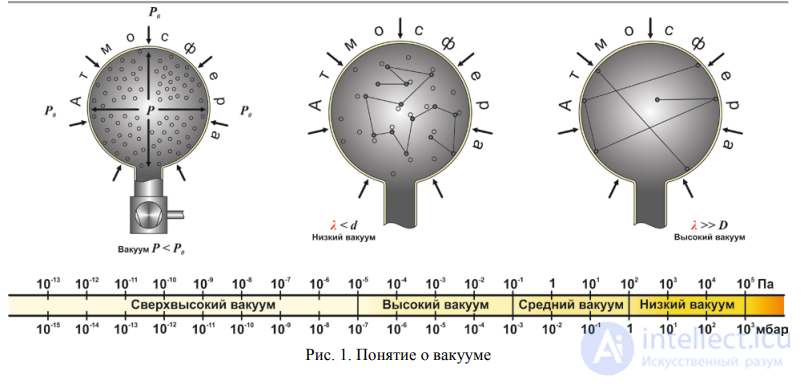
Fig. 1. Characteristics of vacuum
Current in a vacuum cannot exist by itself, since a vacuum is a dielectric. In this case, current can be created using thermionic emission. Thermionic emission is a phenomenon in which electrons leave metals when heated. Such electrons are called thermoelectrons, and the whole body is called the emitter.
The American scientist Thomas Edison was the first to draw attention to this phenomenon in 1879.
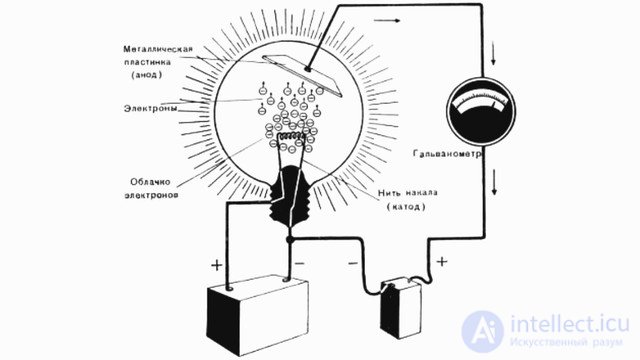
Fig. 2. Thermionic emission
Emission is divided into:
Electrons will be able to fly out of a metal if they possess sufficient kinetic energy. It must be greater than the work function of electrons for the given metal. Electrons flying out of the cathode form an electron cloud. Half of them return to their original position. In the equilibrium state, the number of electrons that have flown out equals the number that have returned. The density of the electron cloud is directly proportional to the temperature (that is, as the temperature rises, the density of the cloud becomes greater).
When the electrodes are connected to a source, an electric field arises between them. If the positive pole of the current source is connected to the anode (the cold electrode), and the negative pole to the cathode (the heated electrode), then the electric field strength will be directed toward the heated electrode.
Electric current in a vacuum is used in various electronic devices. One such device is the vacuum diode
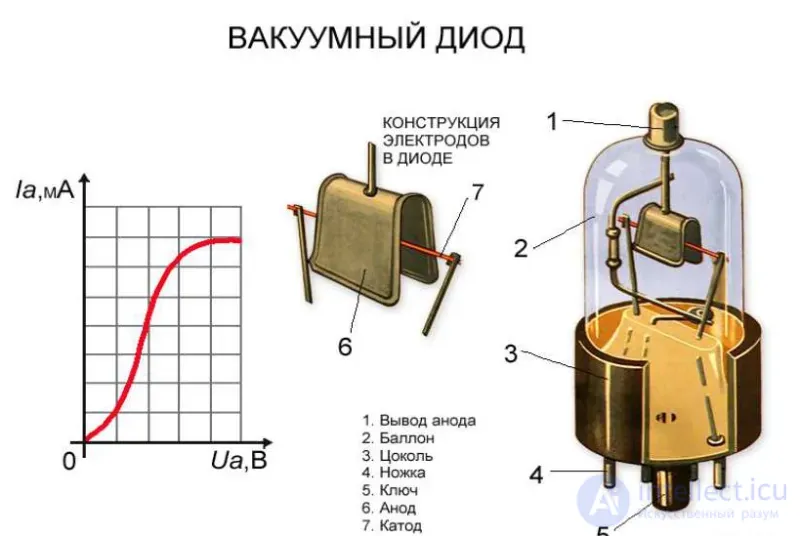
Fig. 3. Vacuum diode
It consists of a bulb, which contains 2 electrodes – a cathode and an anode.
In engineering, the use of so-called electron beams is of very great importance.
Definition. An electron beam is a stream of electrons whose length is much greater than its width. It is fairly simple to obtain. It is enough to take a vacuum tube through which current flows, and make a hole in the anode toward which the accelerated electrons travel (the so-called electron gun) (Fig. 3).
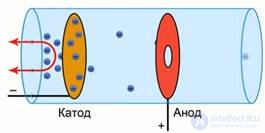
Fig. 3. Electron gun
Electron beams possess a number of key properties:
Owing to their large kinetic energy, they have a thermal effect on the material into which they strike. This property is used in electron-beam welding. Electron-beam welding is necessary in cases where it is important to preserve the purity of the materials, for example, when welding semiconductors.
- When colliding with metals, electron beams, as they slow down, emit X-ray radiation, which is used in medicine and engineering (Fig. 4).

Fig. 4. An image taken using X-ray radiation
- When an electron beam strikes certain substances, called phosphors, a glow occurs, which makes it possible to create screens that help track the movement of the beam, which is, of course, invisible to the naked eye.
- The ability to control the motion of beams by means of electric and magnetic fields.
It should be noted that the temperature at which thermionic emission can be achieved cannot exceed the temperature at which the structure of the metal begins to break down.
At first, Edison used the following design to obtain current in a vacuum. In a vacuum tube, a conductor connected to a circuit was placed on one side, and a positively charged electrode on the other side (see Fig. 5):
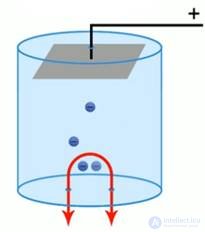
Fig. 5
As a result of current passing through the conductor, it begins to heat up, emitting electrons that are attracted to the positive electrode. Eventually, a directed motion of electrons arises, which is, in fact, the electric current. However, the number of electrons emitted in this way is too small, which gives too small a current for any practical use. This problem can be overcome by adding another electrode. Such an electrode of negative potential is called an indirectly heated electrode. With its use, the number of moving electrons increases many times over (Fig. 6).
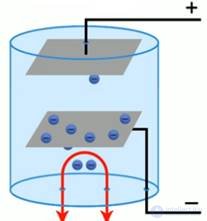
Fig. 6. Use of an indirectly heated electrode
It is worth noting that the conductivity of current in a vacuum is the same as in metals – electronic. Although the mechanism by which these free electrons arise is quite different.
As already mentioned above, based on the properties of current propagation in a vacuum, such an important device as the cathode-ray tube was constructed. In its operation it makes use of the properties of electron beams. Let us examine the structure of this device. A cathode-ray tube consists of a vacuum bulb with a widened section, an electron gun, two cathodes, and two mutually perpendicular pairs of electrodes (Fig. 10).
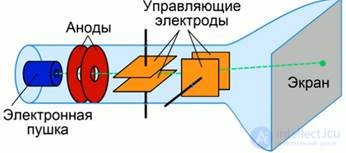
Fig. 10. Structure of the cathode-ray tube
The principle of operation is as follows: electrons emitted from the gun as a result of thermionic emission are accelerated owing to the positive potential on the anodes. Then, by applying the desired voltage to the pairs of control electrodes, we can deflect the electron beam as we wish, horizontally and vertically. After that, the directed beam strikes the phosphor screen, which allows us to see the image of the beam's trajectory on it.
The cathode-ray tube is used in a device called an oscilloscope (Fig. 11), intended for studying electrical signals, and in picture-tube televisions, with the sole exception that there the electron beams are controlled by magnetic fields.
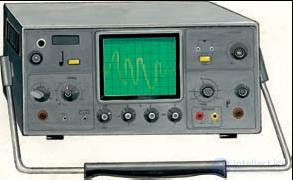
Fig. 11. Oscilloscope
We have learned briefly about electric current in a vacuum from this article. For it to exist in a vacuum, the presence of free charged particles is required first of all. The types of vacuum and their characteristics were also examined. The concept of thermionic emission is essential to study. This information can be used to prepare a report or presentation for a physics lesson.

Comments