
Lecture
|
Magnetics are substances that change their state in an external magnetic field in such a way that they themselves become sources of a magnetic field. |
In essence, all substances in nature are magnetics. In other words, while in an external magnetic field, every substance becomes magnetized, itself becoming a source of a magnetic field. In some cases the magnetization is retained even after the external magnetic field is switched off — the so-called permanent magnets. The intensity of the «response» of different substances to the action of an external magnetic field differs by many orders of magnitude. Therefore, despite what was said above, some substances (aluminum, copper, wood, etc.) are called nonmagnetic. Our next task is to understand the mechanisms by which a magnetic field acts on a substance (magnetics).
In the presence of a magnetic, the magnetic flux density vector  equals the sum of the magnetic flux density vector of the external magnetic field
  , created by currents independent of the magnetic, and the magnetic flux density of the magnetic's own field
|
|
(7.1) |
The field  , created by the magnetized magnetic, of course depends on how the magnetic is magnetized, and it is magnetized by the total field
  , so is itself a function of :
  . An exception in this sense may be a permanent magnet, whose magnetization does not depend, or practically does not depend, on the presence or absence of an external magnetic field, in particular, a substance that can remain magnetized even in the absence of an external — magnetizing — field.
It will be shown below that if the magnetic field outside the magnetic is parallel to its surface, then the field  is related to the magnetic flux density
  in vacuum (that is, in the absence of the magnetic) by the relation

The dimensionless quantity m is called the magnetic permeability.
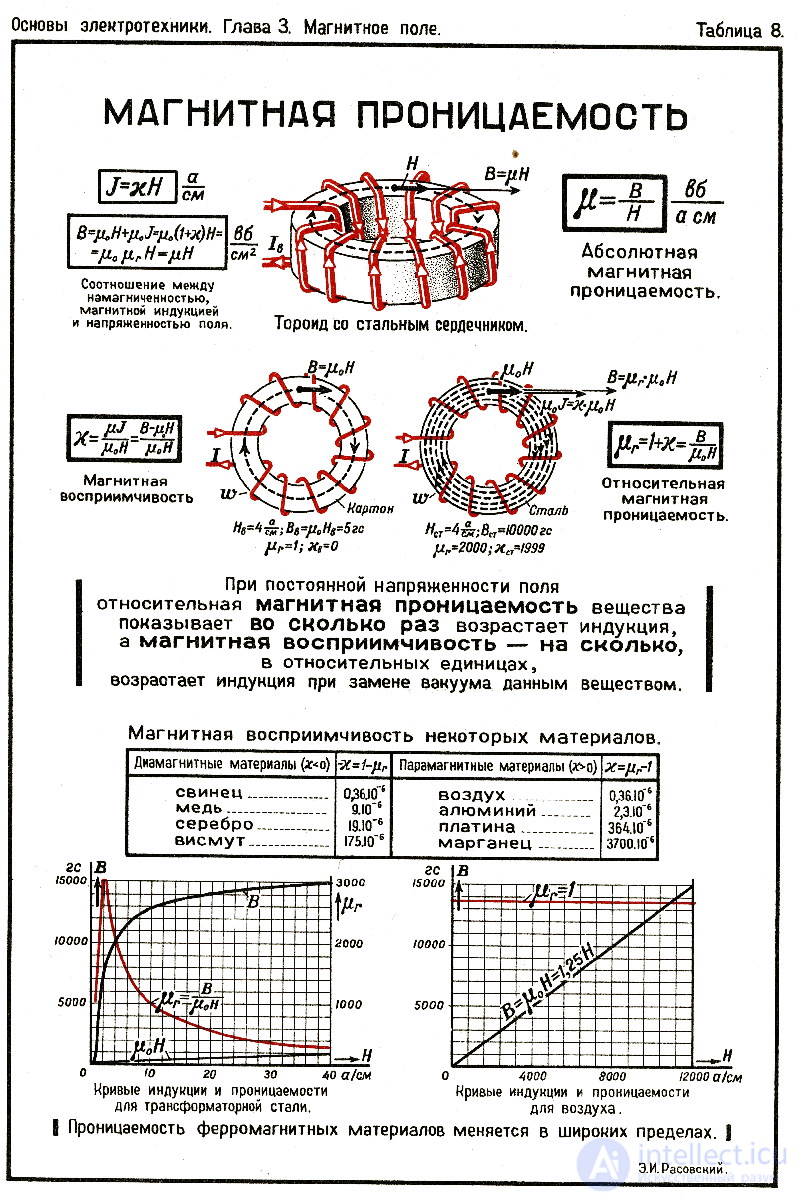
Magnetic permeability — a physical quantity, a coefficient (depending on the properties of the medium), characterizing the relation between the magnetic flux density B and the magnetic field strength H in a substance.
For different media this coefficient is different, so one speaks of the magnetic permeability of a specific medium (implying its composition, state, temperature, etc.).
Usually denoted by the Greek letter μ. It may be either a scalar (for isotropic substances) or a tensor (for anisotropic ones).
This term first appears in the work of Werner Siemens «Beiträge zur Theorie des Elektromagnetismus» («Contribution to the Theory of Electromagnetism») published in 1881.
The relation between the magnetic flux density and the magnetic field strength through the magnetic permeability is introduced as:
 ,
,
and μ in the general case here should be understood as a tensor, which in component notation has the form :
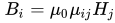 .
.
For isotropic substances the notation means multiplying a vector by a scalar (the magnetic permeability reduces in this case to a scalar).
By μ0 the magnetic constant is denoted. In the Gaussian system this constant is dimensionless and equal to 1, while in the International System of Units (SI)
  H/m (N/A2). The magnetic permeability μ in both systems of units is a dimensionless quantity. Sometimes, when using SI, the product μ0μ
 is called absolute, and the coefficient μ — relative magnetic permeability.
The value of the magnetic permeability reflects how massively the magnetic moments of individual atoms or molecules of a given medium orient themselves parallel to an applied external magnetic field of some standard strength, and how large these moments are. Values of μ close to 1 correspond to weak orientation of the moments (almost chaos in their directions, as without a field) and to their smallness, while values far from 1, on the contrary, correspond to high orderliness and large magnitudes or a large number of individual magnetic moments.
There is an analogy with the content of the concept of «permittivity» as a measure of how the electric dipole moments of molecules respond to an electric field.
In SI, the magnetic permeability is related to the magnetic susceptibility χ by the relation:
μ=1+χ ,
while in the Gaussian system the analogous relation reads
μ=1+4πχ .
Generally speaking, the magnetic permeability depends both on the properties of the substance and on the magnitude and direction of the magnetic field for anisotropic substances (and, in addition, on temperature, pressure, etc.).
It also depends on the rate of change of the field over time, in particular, for sinusoidal variation of the field, it depends on the frequency of this oscillation (in this case, to describe the magnetization, a complex magnetic permeability is introduced, in order to describe the effect of the substance on the phase shift of B relative to H). At sufficiently low frequencies — a low rate of change of the field — it can usually be considered, in this sense, independent of frequency.
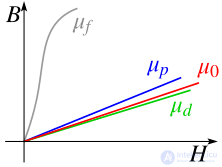
Schematic graph of the dependence of 'B' on 'H' (magnetization curve) for ferromagnets, paramagnets and diamagnets, as well as for vacuum, illustrating the difference in magnetic permeability (represented by the slope of the graph) for: ferromagnets (μf), paramagnets (μp), vacuum (μ0) and diamagnets (μd)
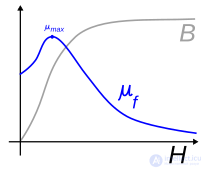
Magnetization curve for ferromagnets (and ferrimagnets) and the corresponding graph of magnetic permeability
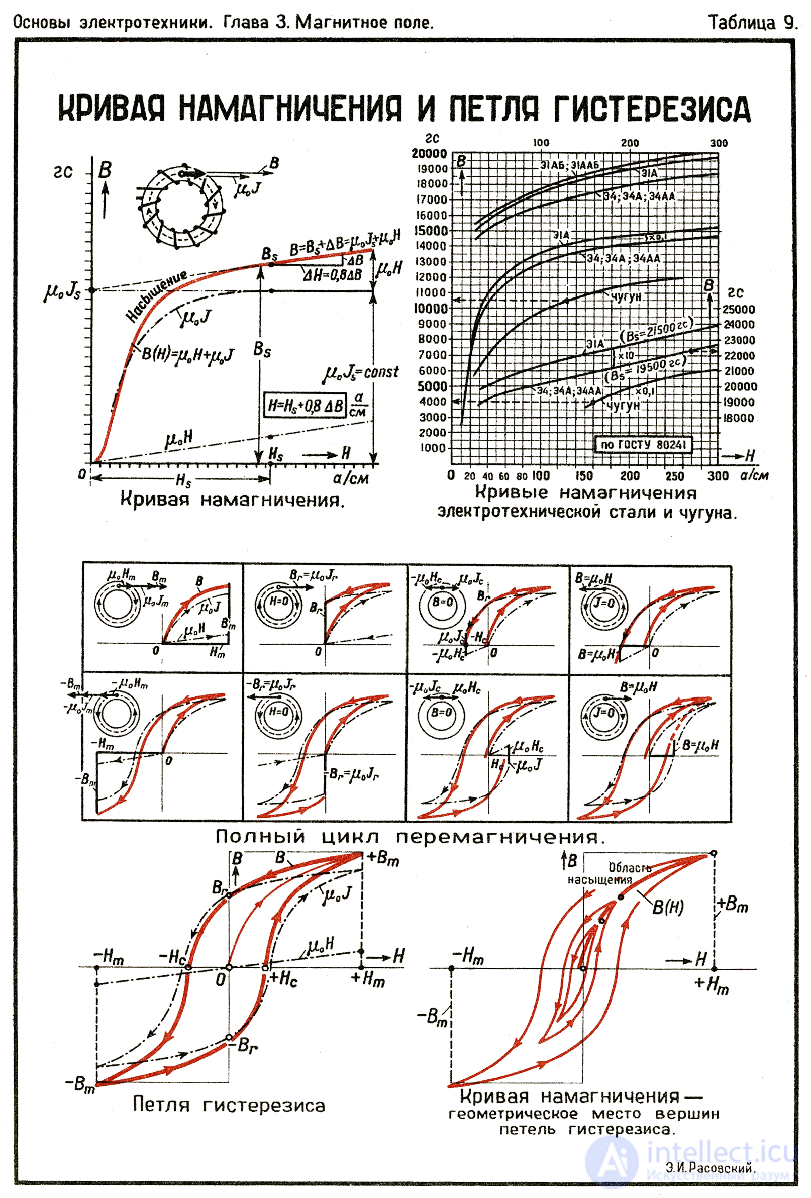
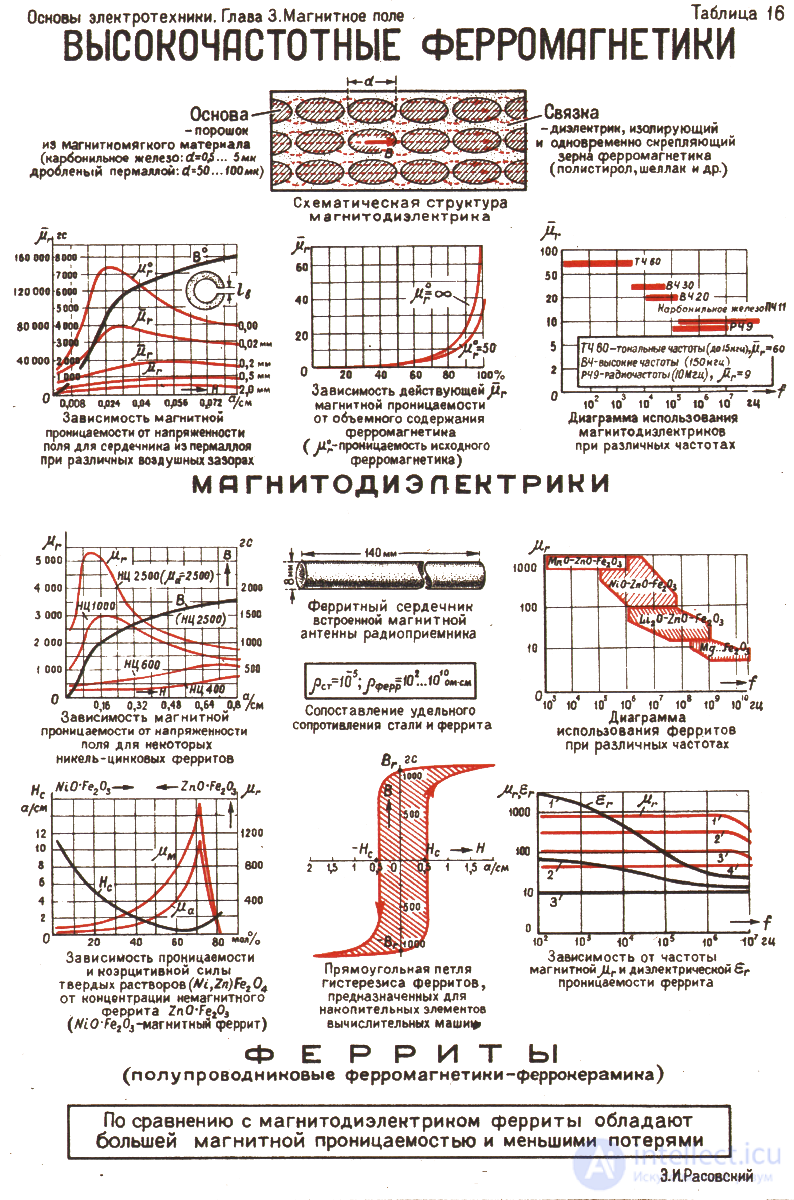
The magnetic permeability strongly depends on the magnitude of the field for media that are nonlinear with respect to magnetic susceptibility (a typical example — ferromagnets, which are characterized by magnetic hysteresis). For such media, the magnetic permeability, as a number independent of the field, can be given approximately, in the linear approximation.
For nonferromagnetic media the linear approximation μ= const holds fairly well over a wide range of variation of the field magnitude.
All magnetics, depending on the nature of the influence of their own field on the total magnetic field, can be divided into three groups:
 is directed in the same direction as the vector of the external magnetic field
  ;
; and are directed in opposite directions;
In paramagnetic bodies the own field  increases the magnetic flux and, consequently, paramagnetic bodies are attracted to a magnet. In contrast to paramagnetic bodies, diamagnetic bodies reduce the magnetic flux. This means, as already stated, that in a diamagnetic body an own magnetic field arises under the action of the external field, directed opposite to the direction of the external magnetic field. Consequently, diamagnetic bodies are repelled from a magnet by their own magnetic field.
As experiment shows, the magnetic flux density vector of the own field of a para- or diamagnet is proportional to the magnetic flux density vector of the external field B0
|
|
(7.2) |
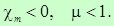
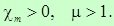
The dimensionless proportionality coefficient cm is called the magnetic susceptibility of the substance and is a dimensionless quantity. For diamagnetic substances the magnetic susceptibility is a negative quantity (cm < 0), for paramagnetic substances it is positive (cm > 0). For ferromagnets the magnetic susceptibility cm depends on the magnitude of the magnetic flux density of the external field B0, so in the general case the dependence of a ferromagnet's own field on the external one cannot be considered linear.
The resulting magnetic field in the presence of a magnetic equals:
|
|
(7.3) |
Comparing (7.3) with (7.1), we obtain
|
|
(7.4) |
From this we find the relation between the own field and the external one
|
|
(7.5) |
analogous to the corresponding expressions for dielectrics.
To explain the magnetization of bodies, Ampere assumed that in the atoms and molecules of a substance there circulate special circular currents — molecular currents. Each such current creates a magnetic field in the surrounding space. Owing to the chaotic orientation of the magnetic moments of the individual molecular currents, the total magnetic moment of the body equals zero. Under the action of an external magnetic field, the magnetic moments of the molecular currents acquire a preferential orientation in one direction, as a result of which the substance becomes magnetized — its total magnetic moment becomes nonzero, and an additional field  arises (Fig. 7.1).
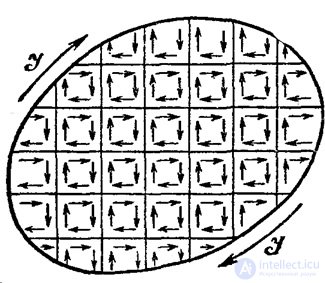
Fig. 7.1. Molecular currents in a magnetic
Without going for now into a discussion of the nature of molecular currents, let us obtain relations analogous to those derived for dielectrics. Each molecular current has a magnetic moment  . The magnetization (degree of magnetization) of a magnetic is naturally characterized by the magnetic moment per unit volume, called the magnetization vector (or magnetization).
|
The magnetization vector (or magnetization)
|
Here dV is an elementary (physically infinitesimal) volume of the magnetic, taken in the vicinity of a certain point,  are the magnetic moments of the individual molecular currents. In formula (7.6) the magnetic moments of all molecular currents located inside the volume dV are summed.
|
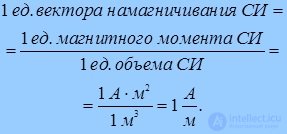
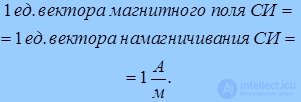
In SI the unit of the magnetization vector is the ampere per meter (A/m):
|
The polarizability of a dielectric (the density of the electric dipole moment) was associated with the appearance of surface charges, which changed the electric field in the medium. Similarly, the magnetization of a magnetic leads to the appearance of surface currents, which changes the magnetic field. Fig. 7.2 shows a sample of a magnetic placed in an external magnetic field  .
.
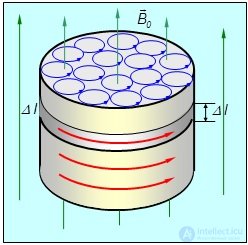
Fig. 7.2. Molecular currents in a magnetic placed in a magnetic field,
create their own field similar to the field of a solenoid carrying current I
The molecular currents shown on the end face of the sample are oriented so that their magnetic moments line up parallel to the vector  . It can be seen that the currents in the bulk of the magnetic cancel each other out. Only the currents near the surface of the sample turn out to be uncompensated. Adding up, they give rise to surface currents (shown by red arrows in Fig. 7.2 and by black arrows in Fig. 7.3).
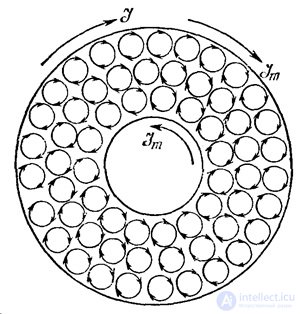
Fig. 7.3. Formation of molecular currents on the surfaces of a magnetic
Such a system is equivalent to a solenoid. In the formula for the magnetic flux density of the field of a solenoid
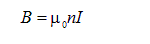
the quantity n is the number of turns per unit length

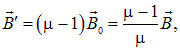
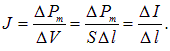
On the other hand, the product  is the total current through an element of length Δl. Therefore the formula for the solenoid applies to our magnetic if we replace the product nI with the linear density of the surface current ΔI/Δl. We then obtain the following expression for the magnitude of the magnetic flux density of the field B ', created by the molecular currents
|
|
(7.7) |
On the other hand, the magnetic moment of an element of surface current flowing along a section of the solenoid of length Δl, equals
|
|
(7.8) |
where S is the cross-sectional area of the sample. By definition of the magnetization vector
|
|
(7.9) |
Comparing (7.7) and (7.9), we find the relation between the magnetization vector and the field created by the molecular currents
|
|
(7.10) |
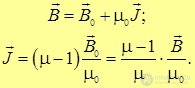
Taking (7.1) and (7.5) into account, we can write
|
|
(7.11) |
In dielectrics, in addition to the force characteristic of the electric field E, we also introduced an auxiliary quantity — the electric displacement vector

In the most common case of a linear dependence of the polarization of an isotropic dielectric on the strength of the polarizing field, the relation held

For magnetics, an auxiliary quantity is similarly introduced — the magnetic field strength H
|
|
(7.12) |
note the different signs with which P for dielectrics and the vector J for magnetics enter). Taking into account the relations obtained above, we have
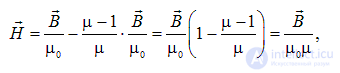
so that
|
|
(7.13) |
|
In SI the unit of the magnetic field strength is the ampere per meter (A/m):
|
Let us emphasize that the analogue of the electric field strength vector  is precisely the magnetic flux density vector
  , while the vectors
  and
and  play an auxiliary role. One should avoid the false impressions caused by the historically established name «strength» of the magnetic field for the vector
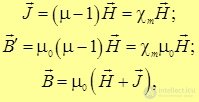
  . In terms of , the relations obtained take the form
|
|
(7.14) |
where  is the magnetic susceptibility of the magnetic.
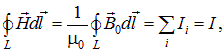
We have seen that the circulation of the magnetic flux density in vacuum was determined by the current threading the chosen contour L
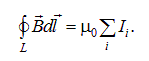
An analogous expression, naturally, also holds for the circulation of the vector  in a substance, but the circulation of the own field of the magnetic

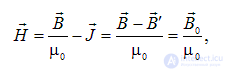
would lead to the appearance on the right-hand side of a sum of molecular currents, which are unknown to us. This is extremely inconvenient. The situation is saved by the introduced magnetic field strength vector H. From definition (7.12) and relation (7.10) it follows
|
|
(7.15) |
so that the circulation of the magnetic field strength vector is determined only by the macroscopic currents in the system
|
|
(7.16) |
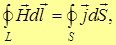
where I is the total macroscopic current through the contour L. It can be expressed through the current density  through any surface S stretched over the contour L
|
|
(7.17) |
where dS = ndS, and the vector  is the unit normal vector to an elementary area element of area dS.
To illustrate the application of the formulas obtained, let us calculate the magnetic flux density in a solenoid with a linear turn density n and current I, if the turns are wound on a core with permeability m. Let us find the circulation of the magnetic field strength vector H around the same contour as before (see Fig. 6.18). The answer is, in essence, already known to us
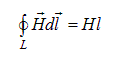
(cf. (6.34)). The contour encloses the same total current nlI, and (7.16) leads to the equality
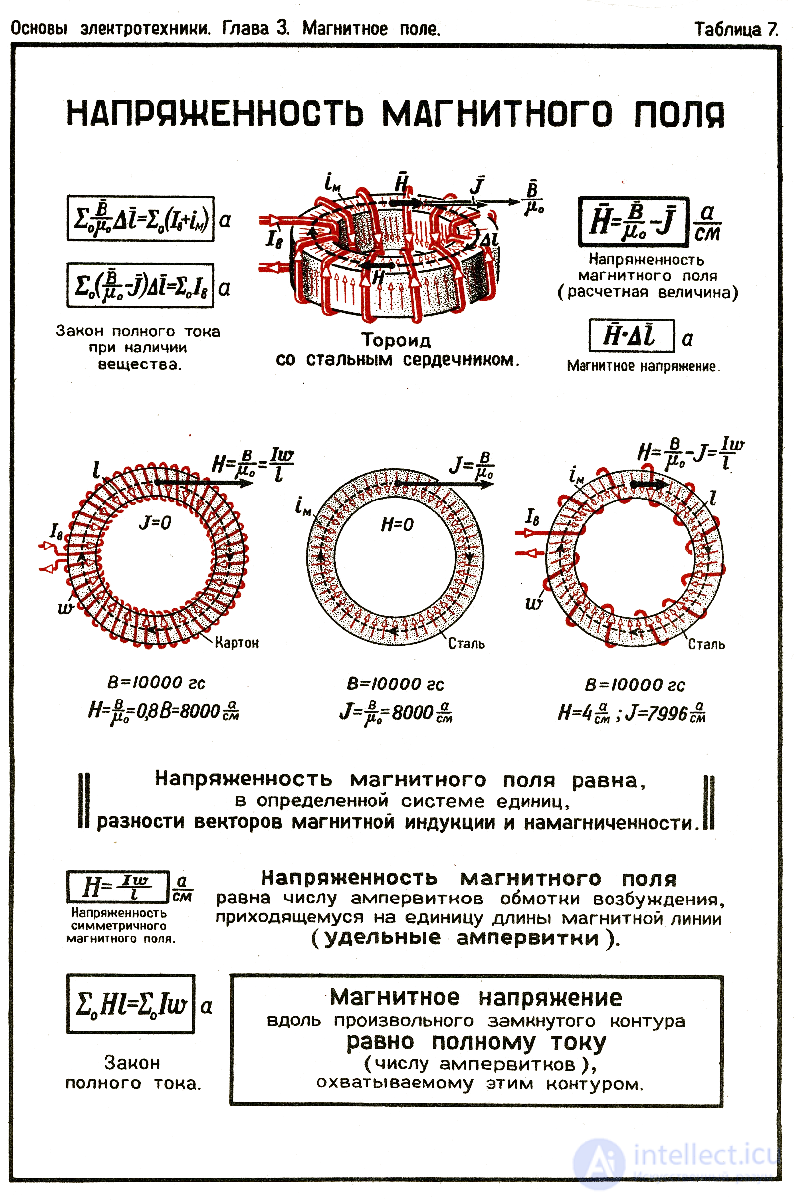
H=nl
Now using the relation B = m0mH, we obtain the expression for the magnetic flux density of the field of a solenoid filled with a magnetic material
|
|
(7.18) |
Compared with expression (6.35) for a solenoid without a core, an additional factor μ now appears.
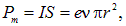
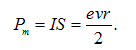
An electron moving in an atom along a circular orbit can conventionally be likened to a current loop, and it can be considered that the electron forms a circular current whose strength is I = en, where (–e) is the electron's charge, and n is the number of revolutions of the electron per second. Consequently, the magnetic moment of such a loop is equal to
|
|
(7.19) |
where r is the radius of the electron orbit.
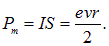
Since the product of the circumference 2πr and the rotation frequency n is the linear speed of the electron's motion in its orbit

then

and
|
|
(7.20) |
This quantity is called the electron's orbital magnetic moment. The direction of the vector  forms a right-hand system with the direction of the current (that is, with the direction of motion of positive charges). An electron moving along its orbit possesses angular momentum

where me is the electron's mass. The vector L is called the electron's orbital angular momentum. It also forms a right-hand system with the direction of the electron's motion. Consequently, for a negatively charged electron, the directions of the vectors  and
and  are opposite.
The ratio of an elementary particle's magnetic moment to its angular momentum is called the gyromagnetic (magnetomechanical) ratio. For an electron it is equal to
|
|
(7.21) |
In addition to its orbital angular momentum, an electron possesses an intrinsic angular momentum  and a corresponding intrinsic magnetic moment
  , for which the gyromagnetic (magnetomechanical) ratio is twice as large
|
|
(7.22) |
The intrinsic mechanical moment (spin) and the associated intrinsic (spin) magnetic moment are inherent properties of the electron, just like its mass and charge. A similar picture holds for other elementary particles as well. The nature of spin will be discussed when studying the foundations of quantum mechanics. We note only that, in a very crude approximation, it can be associated with the rotation of the particle about its own axis (from the English spin — rotation).
The spin of elementary particles is proportional to a fundamental constant — the so-called Planck constant

and is expressed through it as follows
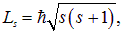
where  is the so-called «spin quantum number», which takes the values
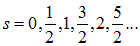 .
.
For electrons, protons, neutrons, and a number of other elementary particles, the quantum number determining the spin is s=1/2. For mesons  , for the photon
  , and for the hypothetical quantum of the gravitational field, the «graviton», this quantum number should be equal to
  . The quantum number determining the spin, like the spin itself, is one of the characteristics of elementary particles, along with mass and charge.
Thus, the intrinsic angular momentum — the spin — of electrons, protons, and neutrons is equal to

Because of the unambiguous relationship between the quantum number s and the spin 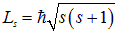 , it has become common practice to say «spin» while actually referring to the corresponding quantum number, without causing any misunderstanding; that is, it is common to say that the electron's spin equals one half, or 1/2. According to (7.22), the electron's intrinsic magnetic moment is equal to
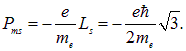
The quantity
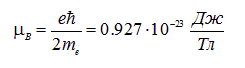
is called the Bohr magneton.
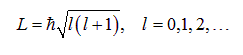
As shown in quantum mechanics, the orbital angular momentum is expressed through the corresponding quantum number in the same way as the intrinsic angular momentum (spin)
|
|
(7.23) |
It is important that the orbital quantum number  can take on only integer values.
As can be seen from (7.21) and (7.23), the smallest nonzero orbital magnetic moment is equal to the Bohr magneton:
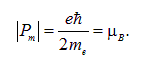
The resultant magnetic moment of an atom is formed as a result of the vector addition (according to the rules of quantum mechanics!) of the magnetic moments of all the elementary particles contained in the atom. The picture becomes even more complicated when considering aggregates of molecules and atoms.
In diamagnetic materials placed in an external magnetic field B0, an internal field arises, directed against the magnetizing field.
This is because the total magnetic moment of a diamagnetic atom is equal to zero. When a diamagnetic substance is placed in an external magnetic field, the action of this field gives rise to a precession of the electron orbits.
Since an electron in an atom can be likened to a circular current characterized by the magnetic moment Pm , in an external magnetic field a torque begins to act on the magnetic moment  of this circular current
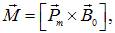
under the action of this moment M, the vector of the electron's orbital moment Pm begins to precess about the direction of the magnetic flux density vector B0, that is, it acquires an additional uniform rotation, in which the vector Pm traces out a cone about the direction of B0 (Fig. 7.4).
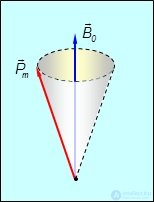
Fig. 7.4. Precession of the electron's orbital magnetic moment Pm
about the magnetic flux density vector B0 of the external field
Thus, the vector Pm , perpendicular to the plane of the electron orbit, retains a constant angle a of inclination to the external field and rotates about B0 with a certain angular velocity. This motion is akin to the precession of the axis of a spinning top in a gravitational field.
The frequency of this precession

called the Larmor frequency, does not depend on the angle of inclination of the electron's orbit to the vector B0, nor on the radius of the orbit or the speed of the electron, and is consequently the same for all electrons. The precession of the electron orbit creates an additional motion of the electron in the external magnetic field B0. This motion, like any motion of charges, leads to the appearance of an induced magnetic moment, directed in this case against the field (Fig. 7.5).
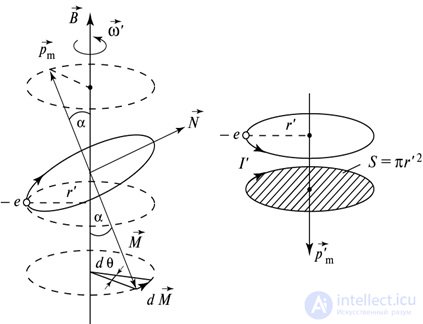
Fig. 7.5. Formation of an induced magnetic moment directed against the external magnetic field
Consequently,
|
In diamagnetic substances, in an external magnetic field B0, there arises, directed opposite to B0, an induced magnetic field B', which weakens the external field
that is, for diamagnetics
|
The molecules of a paramagnetic substance possess an intrinsic magnetic field, due to the fact that for paramagnetics the vector sum of the orbital and spin moments of the electrons is not equal to zero. In the absence of an external magnetic field, these magnetic micro-fields of the molecules are oriented randomly in space by thermal motion, and therefore the total macroscopic magnetic field of the paramagnetic material is equal to zero. When a paramagnetic substance is placed in an external magnetic field B0, the magnetic moments of the atoms acquire a preferential orientation along the field B0, which is greater the greater B0 is, and the effect decreases as the temperature increases. As a result, the total intrinsic magnetic field of the paramagnetic material B becomes nonzero and is directed along the external field B0.
Consequently,
|
A paramagnetic material, placed in an external magnetic field, reinforces this field
that is, for paramagnetics
|
It should be noted that the diamagnetic effect occurs in all substances without exception, including in paramagnetics as well, but the magnitude of the diamagnetic effect is substantially smaller than the paramagnetic one, and in this case it can be disregarded.
Whereas the diamagnetic effect does not depend on the temperature of the substance, the paramagnetic effect does, since the thermal motion of atoms and molecules disrupts the preferential orientation of their magnetic moments along the field in an external magnetic field (Fig. 7.6).
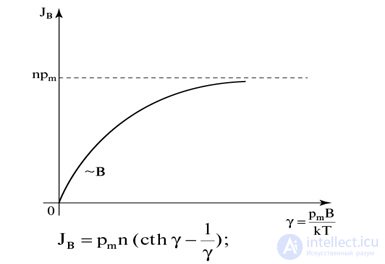
Fig. 7.6. Dependence of the magnetization of a paramagnetic material on inverse temperature
The dependence of the magnetic susceptibility  of paramagnetics on temperature was established by Curie and is expressed by the formula
|
|
(7.24) |
Diamagnetics are expelled from a magnetic field, while paramagnetics are drawn into a magnetic field. That is why thin rods of para- and diamagnetic materials, suspended on threads and placed between the poles of a magnet, behave differently. The magnetic field turns the diamagnetic rod so that it becomes oriented perpendicular to the field lines, while the paramagnetic rod aligns itself parallel to the field lines (see Fig. 7.7).
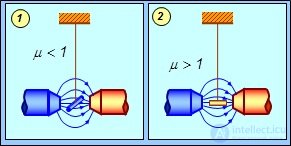
Fig. 7.7. Behavior of para- and diamagnetic materials in an external magnetic field:
1 — paramagnetic rod; 2 — diamagnetic rod
Fig. 7.8 shows an experiment in which a rod of bismuth, which is a diamagnetic material, is suspended in the field of a powerful electromagnet. When the field is switched on, the rod turns and aligns itself parallel to the surface of the magnet's poles, that is, perpendicular to the field.
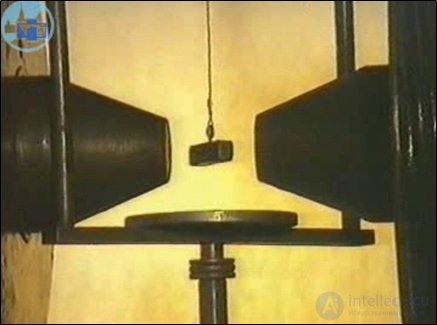
Fig. 7.8. Diamagnetics in a magnetic field
Fig. 7.9 presents an experiment demonstrating the orientation of a long metallic paramagnetic sample and a long ampoule with a solution of a paramagnetic salt along the magnetic field created by a magnet.
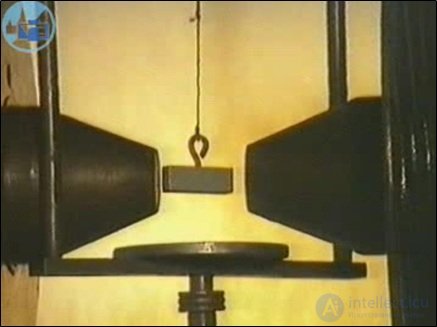
Fig 7.9. Paramagnetics in a magnetic field
In ferromagnetics, just as in paramagnetic materials, the intrinsic field upon magnetization reinforces the external field, that is, cm > 0 and reaches very large values (for iron, for example, cm = 5,000, but there are alloys with even larger values cm = 50,000).
Ferromagnetic substances possess a number of distinctive properties:
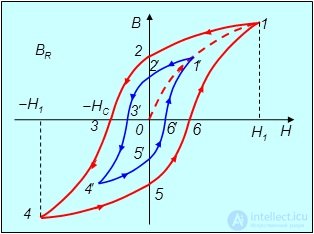
Fig. 7.10. Dependence of the magnetic flux density B on the magnetic field strength H
(main magnetization curve 01, as well as the minor loop 1'2'3'4'5'6' and the limiting hysteresis loop 123456)
The study of the structure of ferromagnetics has shown that a ferromagnetic material consists of a large number of spontaneously magnetized regions, with linear dimensions on the order of 10–3–10–4 cm, which are called domains. The cause of their formation is the strong interaction of the spin magnetic moments, which, tending to become parallel, orient themselves identically within a sufficiently large region, which then becomes a domain. Since within each domain the magnetic moments of all its molecules or atoms are directed the same way, their vector sum gives a nonzero magnetic moment for the whole domain.
If a ferromagnetic material is not magnetized (J = 0), the magnetic moments of the individual domains are distributed isotropically in direction, and the total moment of the ferromagnetic material is equal to zero. When an external magnetic field is switched on, the domains oriented along the external field grow at the expense of domains whose magnetic fields have a different direction. As the external field increases, the intrinsic magnetic field of the ferromagnetic material grows. In weak fields, this growth is reversible in character. In stronger fields, a reorientation of the magnetic moments within the entire domain occurs simultaneously. This process is irreversible, which explains hysteresis and residual magnetization. In a very strong external field, all domains have the same orientation along the external field. A state of magnetic saturation of the ferromagnetic material sets in.
A qualitative picture of the growth of domains oriented parallel to the external field, as the external field increases during the magnetization of a ferromagnetic material, is shown in Fig. 7.11.
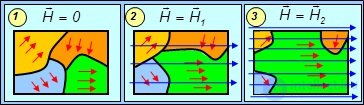
Fig. 7.11. Magnetization of a ferromagnetic material in an external field:
1 — H = 0; 2 — H = H1; 3 — H = H2, H2 > H1
In strong fields (field strength H on the order of 200 A/m or more) the magnetization reaches saturation (Fig. 7.12).
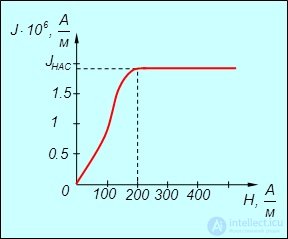
Fig. 7.12. Saturation of magnetization in strong external fields
Upon reaching saturation, the magnetic flux density of the field B continues to grow together with the external field according to a linear law

In the state of saturation, practically all the domains are aligned along the external field H. Therefore the induction B' stops growing and has no further effect on the increase of B, but B0 continues to increase as H grows. Therefore, in the state of saturation, the magnetic flux density inside the ferromagnetic material continues to increase slowly and linearly.
As the external field strength H changes, the dependence B = B(H) has the form shown in Fig. 7.10. At the initial moment, if the ferromagnetic material was not magnetized, then H = 0 and B = 0; then, as H increases to the value H1, the flux density rises along curve 01 to the value B1. As the strength of the external magnetic field is smoothly decreased, the flux density B will change along curve 12, rather than along the original curve 01. As a result, when the strength of the external field becomes equal to zero, the magnetization of the sample does not vanish and is characterized by the value Br, which is called the residual induction. The magnetization at this point has the value Jr, called the residual magnetization. This is a manifestation of the irreversibility of the magnetization process of the ferromagnetic material.
As already mentioned, domains are sufficiently large formations, and thermal motion is unable to destroy the residual induction. To do this, a reverse external field must be applied. The magnetic flux density becomes equal to zero (point 3 in Fig. 7.10) under the action of an oppositely directed field of magnitude Hc. The strength of the demagnetizing field Hc is called the coercive force.
When an alternating magnetic field with strength H < H1 acts on the ferromagnetic material, the flux density of the resulting field changes in accordance with curve 1'2'3'4'5'6'1', called the minor hysteresis loop. If the amplitude of the strength of the alternating magnetic field is H > H1, we obtain the limiting hysteresis loop 1234561, corresponding to saturation of the magnetization.
Fig. 7.13 shows an experiment in which the hysteresis loop is observed. A cathode-ray tube with vertical- and horizontal-deflection coils is used. When an equal alternating voltage is applied to both pairs of coils, an inclined straight line is seen on the screen. Ferromagnetic rods are then inserted into the horizontal coils that deflect the beam vertically, and the vertical deflection of the beam becomes proportional to the magnetic flux density in the ferromagnetic material. The oscilloscope screen then shows the hysteresis loop for the given ferromagnetic material.
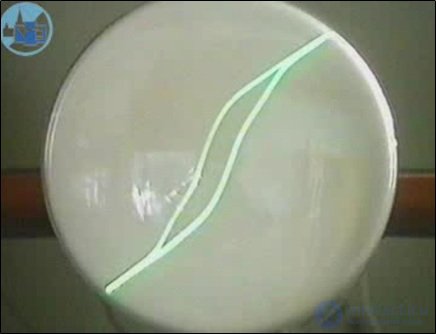
Fig. 7.13. Hysteresis loop
Since the magnetic flux density B in a ferromagnetic material is not a single-valued function of the field strength H, the permeability of ferromagnetics quoted in reference tables
 ,
,
is by convention defined only for the main magnetization curve.
At high temperatures, the substance of a ferromagnetic material turns into a paramagnetic material, since the domain structure of the substance is destroyed by thermal motion. The transformation occurs at a temperature TC that is well defined for each ferromagnetic material, called the Curie point; for iron TC = 1,043 K, for cobalt TC = 1,393 K, and for nickel TC = 631 K.
Fig. 7.14 demonstrates the disappearance of the attraction of a ferromagnetic plate to a permanent magnet when it is heated above the Curie point. The plate is suspended on a thin wire to the side of the magnet, so that the wire, stretched by attraction to the magnet, is tilted relative to the vertical. A gas burner is placed under the plate, and after heating above the Curie temperature the plate stops pulling the wire toward the magnet, moves away from it, and the suspension takes on a vertical position.
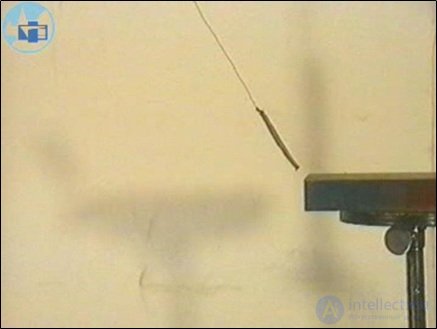
Fig. 7.14. Destruction of the ferromagnetic properties of a ferromagnetic material upon heating above the Curie point




 is the density of the magnetic moment, that is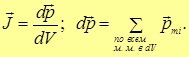











Comments