
Lecture
Supersymmetry, or Fermi–Bose symmetry, — is a hypothetical symmetry linking bosons and fermions in nature . The abstract supersymmetry transformation links bosonic and fermionic quantum fields, so that they can turn into each other. Figuratively speaking, the supersymmetry transformation can convert matter into interaction (or radiation), and vice versa.
Supersymmetry implies a doubling (at least) of the number of known elementary particles due to the existence of superpartners. For example, for the photon — the photino, for the quark — the squark, for the higgs — the higgsino, and so on. Superpartners must have a spin value differing from the spin value of the original particle by a half-integer .
Supersymmetry is a hypothetical symmetry of space and time, and a unique one at that. Among theoretical physicists this idea was very popular for several decades, for a number of reasons – it was a hit when I was a student, even before physics became a cool subject, and even earlier still.
An automatic consequence of the presence of such a symmetry in nature would be that every type of particle would have one or more superpartners – another type of particle possessing the same properties, but differing in a definite, and important, way. If a particle is a fermion, its superpartner is a boson. If a particle is a boson, its superpartner is a fermion
As of 2019, supersymmetry is a physical hypothesis not confirmed experimentally. It has been established with complete certainty that our world is not supersymmetric in the sense of exact symmetry, since in any supersymmetric model, fermions and bosons linked by a supersymmetric transformation must have the same mass, charge, and other quantum numbers (except spin). This requirement is not satisfied for particles known in nature. It is nevertheless assumed that there exists an energy limit beyond which fields obey supersymmetric transformations, while within the limit they do not. In that case the superpartner particles of ordinary particles turn out to be very heavy compared to ordinary particles .
The search for superpartners of ordinary particles is one of the main tasks of modern high-energy physics . It is expected that the Large Hadron Collider will be able to discover and study supersymmetric particles, if they exist, or cast great doubt on supersymmetric hypotheses, if nothing is found.
Supersymmetry was first proposed in 1973 by the Austrian physicist Julius Wess and the Italian physicist Bruno Zumino to describe nuclear particles . The mathematical apparatus of the theory had been discovered even earlier, in 1971—1972, by the Soviet physicists Yuri Golfand and Evgeny Likhtman of FIAN, as well as by Dmitri Volkov and Vladimir Akulov of KhFTI. Supersymmetry first arose in the context of a version of string theory proposed by Pierre Ramond, John Schwarz, and Andre Neveu, but the algebra of supersymmetry later came to be successfully used in other areas of physics as well.
The main physical model of modern high-energy physics — the Standard Model — is not supersymmetric, but it can be extended to a supersymmetric theory. The minimal supersymmetric extension of the Standard Model is called the «Minimal Supersymmetric Standard Model» (MSSM). In the MSSM, additional fields must be added so as to build a supersymmetric multiplet for every field of the Standard Model. For the material fermionic fields — quarks and leptons — scalar fields must be introduced — squarks and sleptons, two fields for each field of the Standard Model. For the vector boson fields — gluons, photons, W and Z bosons — fermionic fields are introduced: gluino, photino, zino, and wino, also two per degree of freedom of the Standard Model. To break electroweak symmetry, the MSSM requires the introduction of 2 Higgs doublets (in the ordinary Standard Model a single Higgs doublet is introduced), that is, in the MSSM 5 Higgs degrees of freedom arise — a charged Higgs boson (2 degrees of freedom), a light and a heavy scalar Higgs boson, and a pseudoscalar Higgs boson.
In any realistic supersymmetric theory there must be present a sector that breaks supersymmetry. The most natural way of breaking supersymmetry is to introduce so-called soft breaking terms into the model. Several options for breaking supersymmetry are currently being considered.
The first version of the MSSM was proposed in 1981 by the American physicists Howard Georgi and Savas Dimopoulos.
Theories incorporating supersymmetry make it possible to resolve several problems inherent in the Standard Model:
Regardless of whether supersymmetry exists in nature, the mathematical apparatus of supersymmetric theories turns out to be useful in a wide variety of areas of physics. In particular, supersymmetric quantum mechanics makes it possible to find exact solutions of rather nontrivial Schrödinger equations. Supersymmetry turns out to be useful in certain problems of statistical physics (for example, the supersymmetric sigma model).
In 2011, a series of experiments was carried out at the Large Hadron Collider (LHC) in which the fundamental conclusions of the theory of Supersymmetry were tested, as well as how correctly it describes the physical world. As Professor Tara Shears[en] of the University of Liverpool announced on 27 August 2011, the experiments did not confirm the main tenets of the theory. At the same time, Tara Shears clarified that no confirmation was found for the simplified version of the theory of supersymmetry either, although the results obtained do not disprove the more complex variant of the theory.
By the end of 2012, statistics on the decay of the strange B meson into two muons had been accumulated at the LHCb detector of the Large Hadron Collider. The preliminary results coincided with the prediction of the Standard Model: (3.66 ± 0.23)⋅10-9, whereas its supersymmetric extension predicts a higher probability of decay. In the spring of 2015, the LHCb and CMS collaborations combined their data on the decay of the strange B meson into a muon-antimuon pair and obtained a decay probability of 2.8+0.7
−0.6⋅10-9 with a statistical significance level of 6.2 σ. Thus, the probability of this extremely rare event is statistically reliable and agrees well with the prediction of the Standard Model..
The results of testing the electric dipole moment of the electron (2013) also did not confirm variants of supersymmetric theories.
Nevertheless, supersymmetric theories may be confirmed by other experiments, in particular by observations of the decay of the neutral B0-meson.. After the restart in the spring of 2015, the LHC plans to begin operating at a power of 13 TeV and will continue the search for deviations from the statistical predictions of the Standard Model..
The absence of experimental data confirming the theory of supersymmetry has led to the appearance of critics of this theory even among former enthusiasts of supersymmetry. Thus the theorist Mikhail Shifman published a critical article back in October 2012. In the article he stated directly that the theory of supersymmetry has no prospects, that it should be abandoned in favor of new ideas and for the sake of a new generation of theoretical physicists (so that they do not become a lost generation).
If supersymmetry were an exact symmetry of nature, we would already have found many superpartners.
Before going further, let us recall which elementary particles are known to us.
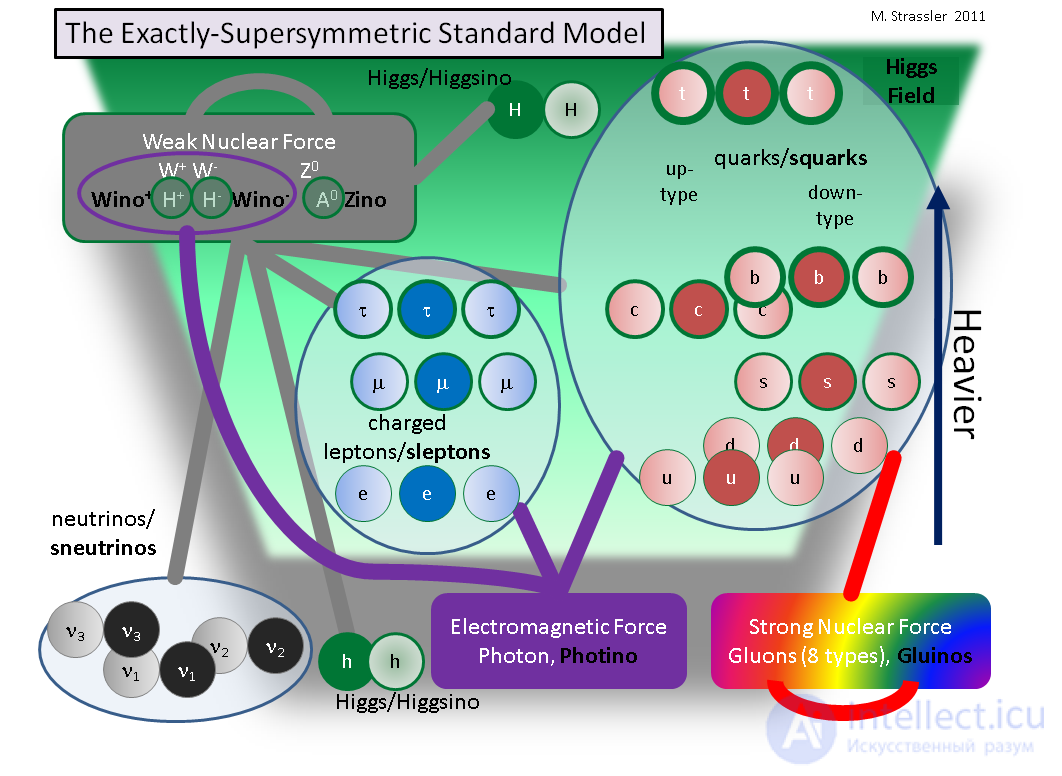
Fig. 1
Fig. 1 shows which particles would exist in the world if the Standard Model were extended with exact supersymmetry.
• For each fermion of matter, for example, the electron or the strange quark, there are two new particles – both bosons. Their names are rather ugly, selectron and strange squark, where «s» stands for supersymmetry. You might ask why there are two of them (and why there is only one for each neutrino). Turn to fig. 3 below, and everything should become clear to you.
• For the boson force carriers there are fermion partners. The photon has the photino, the gluons have the gluino, and so on. With the massive W bosons things are a bit more complicated. They have a partner called the wino, as well as a Higgs partner named H+ (Attention! This particle should not be confused with the particle H+ that appears in the article describing what would happen to the Standard Model if the Higgs field were zero. Unfortunately, in particle physics there is a constant problem with naming particles – there aren't enough letters). All these particles have exactly the same mass, in this imaginary supersymmetric world.
• In this model there are two Higgs particles, h0 and H0, and each has a higgsino partner. One is massless, the other massive. Why two? It turns out that in the supersymmetric world the presence of two particles is necessary so that the up and down quarks acquire mass in the ordinary way. A second argument – two higgsinos are needed for mathematical consistency.
But, obviously, this perfectly supersymmetric world is not ours. As shown in the figure, in such a world the particles and their superpartners:
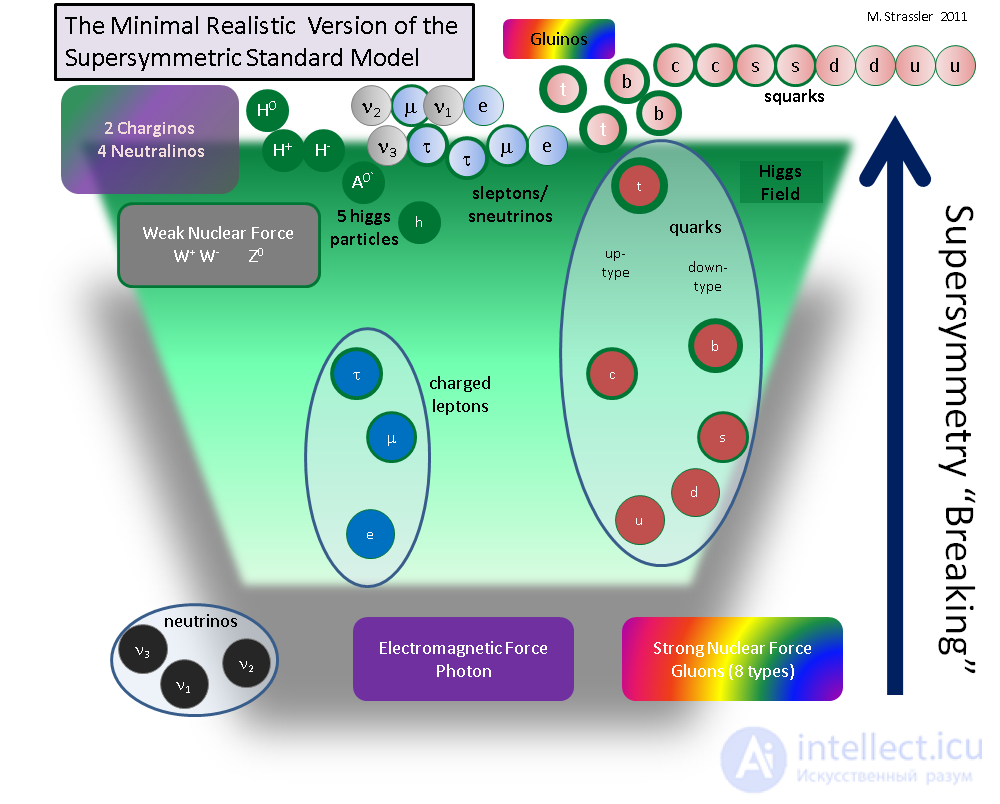
Fig. 3
A realistic possible world of this type – perhaps resembling ours – is shown in fig. 3. You can see that the breaking of supersymmetry (the fact that it is hidden and not easily detected) has increased the mass scale of all the superpartners so that the entire mass scale lies above the mass of the top quark. And this is not as artificial or foolish as it seems – mathematics readily accepts this effect. There are many precise examples of how this could occur – but there are too many of them for us to guess which one is most likely.
In this probable world, shown here for you, I made several arbitrary assumptions, but they occur fairly often in the detailed examples of supersymmetry breaking studied by theoretical physicists, myself included:
And this is not the only scheme that can arise from the breaking of supersymmetry! There is a large number of other possibilities, which I will call variants of supersymmetry. But the variant I have presented is the most popular among theorists and experimenters, especially in Europe (in the USA it is less popular, and I don't know about other places). There are good reasons for this popularity; it turns out that there are several independent ways of obtaining a scheme similar to this one. However, popularity always breeds bias, and we need to consider all the possibilities without making assumptions regarding these arguments.
But if the superpartners are very massive, might it not turn out that we will be unable to produce a single one of them in the coming decades or even centuries? Are we not counting the number of angels that can fit on the head of a pin? From everything said above it does indeed follow that such a risk exists. However, there is also a more subtle argument in favor of supersymmetry, thanks to which many physicists hope that all these superpartners are within reach of the Large Hadron Collider. This follows from the fact that supersymmetry would solve the hierarchy problem – one of the greatest mysteries of our world.

Comments