
Lecture
Extensive air shower (EAS) (air shower)— a «shower» of secondary subatomic particles (predominantly electrons) formed as a result of multiple cascade reactions in the Earth's atmosphere. The progenitor of the shower is a primary particle that has entered the atmosphere from space and enters into reactions with the nuclei of atoms of the gases making up the air. Extensive air showers are a normal phenomenon, imperceptible to humans, and are recorded using special particle detectors.
The width of the shower at the Earth's surface can reach hundreds and thousands of meters, and its area — tens of square kilometers. To obtain the characteristics of the primary particle (primarily its energy), which are encoded in the characteristics of the secondary particles, it is necessary to place detectors over as large an area as possible.
Studying extensive air showers makes it possible to investigate the parameters of particles that cannot be observed directly from the ground, since their energy is too high to pass through the Earth's atmosphere, for example high-energy gamma particles.
obtained in the atmosphere from primary cosmic rays (i.e., one of extraterrestrial origin) enters the atmosphere. When a particle, which may be a proton, a nucleus, an electron, a photon or (rarely) a positron, collides with an atomic nucleus in the air, it produces many energetic hadrons. Unstable hadrons quickly decay in the air into other particles and electromagnetic radiation, which are part of the shower's components. Secondary radiation is produced, including x-rays, muons, protons, antiprotons, alpha particles, pions, electrons, positrons and neutrons.
The dose from cosmic radiation depends largely on muons, neutrons and electrons, with a dose rate that varies in different parts of the world, and depends largely on the geomagnetic field, altitude and solar cycle. Airline crews receive more cosmic radiation if they typically work on flight routes that take them close to the north or south pole at high altitudes, where this type of radiation is at its maximum.
The air shower was discovered by Bruno Rossi in 1934. Observing cosmic rays with detectors placed apart from one another, Rossi found that many particles arrive at the detectors simultaneously. [1] This phenomenon is now called an air shower.
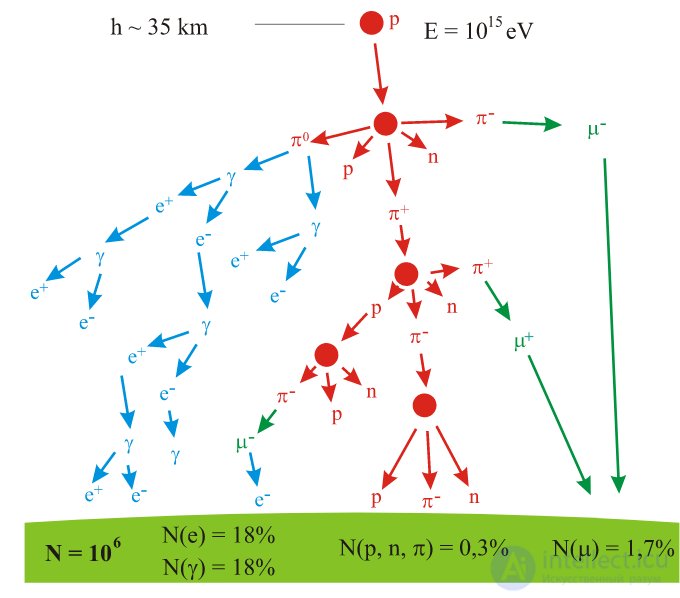
Formation of an air shower in the atmosphere. The first proton collides with a particle in the air, creating pions, protons and neutrons.
After the collision of a primary cosmic particle with an air molecule, pions make up the main part of the first interactions. Kaons and baryons can also be created. Pions and kaons are unstable, so they can decay into other particles.
Neutral pions  decay into photons
  in the process
  , The resulting photons form an electromagnetic cascade, creating more photons, protons, antiprotons, electrons and positrons. [2]
Charged pions  predominantly decay into muons and neutrinos in the processes
 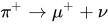 as well as {\ displaystyle \ pi ^ {-} \ rightarrow \ mu ^ {-} + \ nu}
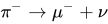 , So muons and neutrinos are formed in the air shower. [2]
In addition, a kaon can be a source of muons, which means the decay process  , On the other hand, kaons can also produce pions in a decay mode.
  , [2]
, [2]
The initial particle arrives with high energy and, consequently, with a speed close to the speed of light, so the products of the collisions also tend to move mostly in the same direction as the primary particle, spreading sideways to some extent. In addition, secondary particles produce a widely spread flash of light in the forward direction due to the Cherenkov effect, as well as fluorescent light, which is emitted isotropically when nitrogen molecules are excited. The cascade of particles and the light generated in the atmosphere can be detected using surface detector arrays and optical telescopes. Surface detectors typically use Cherenkov detectors or scintillation counters to detect charged secondary particles at ground level. Telescopes used to measure fluorescence and Cherenkov light use large mirrors to focus the light onto clusters of PMTs. Finally, air showers emit radio waves due to the deflection of electrons and positrons by the geomagnetic field. As an advantage over optical methods, radio detection is possible around the clock, not only on dark and clear nights. Thus, in several modern experiments, for example, TAIGA, LOFAR or the Pierre Auger Observatory, radio antennas are used in addition to particle detectors and optical methods.
The longitudinal profile of the number of charged particles can be parameterized by the Gaisser–Hillas function.
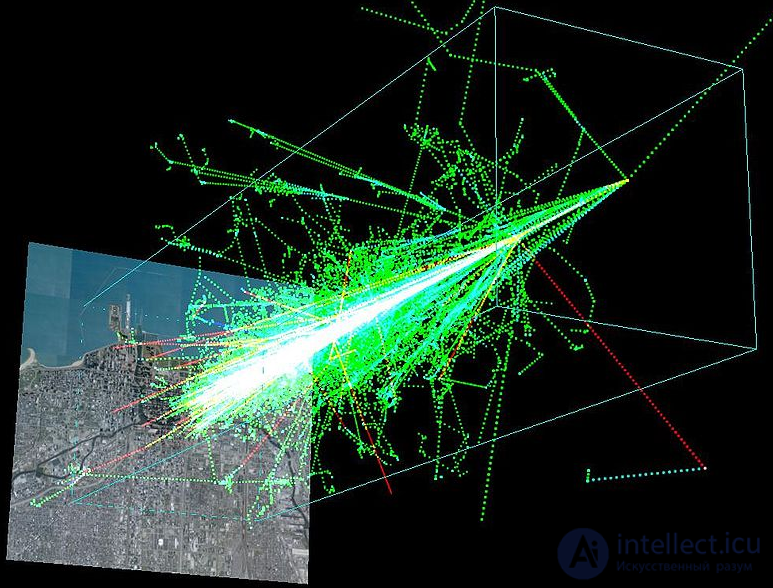
Computer model of a shower produced by a primary proton of 1 TeV energy hitting the atmosphere at an altitude of 20 km. The coastline is shown below to scale.

Comments