
Lecture
Oscillations — a process, repeating to one degree or another in time, of a system's states changing around a point of equilibrium. For example, in the oscillations of a pendulum all the angles of its deflection from the vertical are repeated; in the oscillations of an electrical oscillatory circuit the magnitude and direction of the current flowing through the coil are repeated.
Oscillations are almost always associated with the conversion of energy from one form into another and back again.
Oscillations of various physical natures have many common regularities and are closely connected with waves. That is why the study of these regularities is the subject of the theory of oscillations and waves. The fundamental difference of waves is that their propagation is accompanied by the transfer of energy.
The oscillations of strings, rods, and columns of air are objects of study in the fields of physics, acoustics, and mechanics. In each case, the oscillations occur around an equilibrium position and are characterized by the properties of the medium and the boundary conditions.
Oscillations of strings:
Oscillations of rods:
Oscillations of air columns:
Studying the oscillations of strings, rods, and air columns makes it possible to understand the basic laws of wave dynamics, resonance phenomena, acoustic properties, and their applications in various fields, such as music and engineering.
From the analysis of a standing wave in general, let us move on to the analysis of standing waves in specific situations.
Let's begin with the oscillations of a string, the oscillations of strings.
The oscillations of a string can be regarded as a particular case of standing waves: at both fixed ends of the string a reflection of the traveling wave occurs, leading to the formation of standing waves (Fig. 2.27). This stable pattern of standing waves will occur when either end of the string is fixed at any of the nodes. Consequently, along the length L of the string between the fixings there can fit a whole number m of half-waves 'λ/2

These oscillations correspond to the following wavelengths
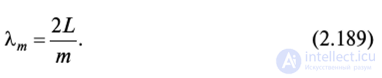
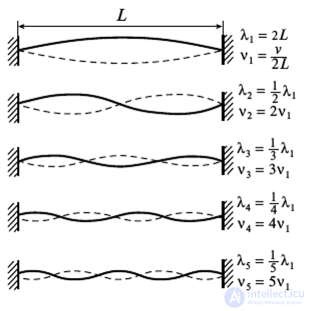
Fig. 2.27. Oscillations of a string
The frequencies of these oscillations are expressed as follows:
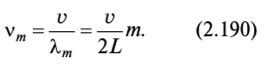
The oscillation of a string with the lowest (fundamental) frequency ν1, at which a single antinode fits on the string (that is, a half-wave λ/2), gives the fundamental tone in the sound of the string (Fig. 2.27, top). The remaining oscillations with multiple frequencies correspond to multiple frequencies (overtones) — see Fig. 2.27 from top to bottom.
The regularities considered govern not only the oscillations of a string in many musical instruments and the formation of standing waves in them (say, in the resonator of a guitar), but also manifest themselves in the model of the radiation of an absolutely black body, in quantum mechanics, in solid-state physics, and elsewhere. The reader will learn about all of this in the corresponding chapters.
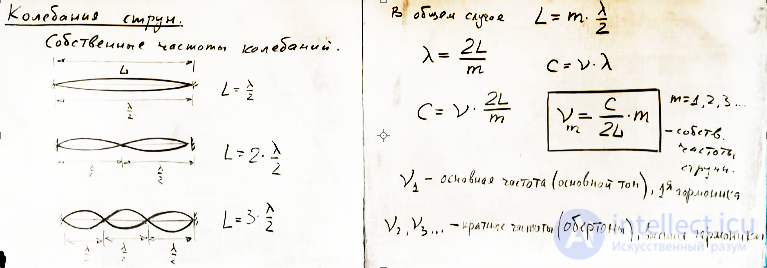
At the end of the last lecture we saw that if at the ends of a spring — well, a string is actually the same in its properties as a spring, just considerably more elastic. There are nodes, so the oscillations can occur at strictly defined frequencies; these frequencies are called the natural frequencies of oscillation — natural frequencies of oscillation — let's go ahead and find these natural frequencies now. We found that a string must have nodes at its ends, while in the middle there can be several antinodes — one antinode — that is, several types of standing waves are possible. Let's draw the first of them: the string has length L, and here is one of the types of standing wave in such a string — this is two nodes at the edges and one antinode in the middle. We already found that the distance between nodes is half a wavelength — half the wavelength — leave yourself some room below, the drawing will develop downward — so in this situation L equals half the wavelength. Another type of oscillation, which we obtained with the spring, can also be obtained on the string — I will demonstrate this to you a little later — this is when there is also a node in the middle, and there are 2 antinodes, like this: the length of the string is still L, but now here is half the wavelength and here is half the wavelength, that is, now the length of the string equals two half-wavelengths. And we can also arrange it so that not two but three antinodes and two nodes fit along the length of the string — in this way, the distance between nodes is half a wavelength, so this is half a wavelength, this is half a wavelength, and this is also half a wavelength — altogether we get that 3 half-waves fit along the length of the string, like this. Let's write in the general case that here there can stand one, two, three, or any natural number, that is, we can write in general — in the general case the length of the string contains a number of half-waves, from which the wavelength on the string equals 2L divided by m, but we need to find the oscillation frequencies. Frequency and wavelength are related through the speed — through the wave speed: c equals ν multiplied by lambda, hence we can write c equals ν multiplied by 2L divided by m; substituting lambda here, we get ν equals c divided by 2L, c divided by 2L multiplied by the whole number m. This number numbers the natural frequencies, that is, the frequency at which the string can oscillate is not just one but a whole set of them, and the number m is the index of that frequency, so we can write ν with the index m — this formula, where m equals 1, 2, 3, and so on, gives us the set of natural frequencies of the string. You don't need to memorize this formula, you just need to remember how it is derived, and then you can easily work out any problem yourself. The natural frequencies of a string, by the way — what we are dealing with right now — students will meet again when they study quantum mechanics: it turns out that in quantum mechanics exactly the same problems are solved, it's the same underlying nature; it's not for nothing that quantum mechanics, as one of the most modern areas of physics, is called wave mechanics. But we've drifted off topic — the first one is called the fundamental frequency, the first harmonic, or the fundamental tone — the fundamental frequency, or the fundamental tone, is also called the first harmonic; the frequencies ν2 and ν3 and so on are called overtones or multiple frequencies — multiple frequencies, overtones, or higher harmonics — higher harmonics, a familiar name, familiar terminology, multiple frequencies. Remember we studied the oscillations of multiple frequencies, and we found — so we studied the addition of oscillations of multiple frequencies, and we found that when oscillations of multiple frequencies are added together, the resulting oscillation will not be harmonic but will be a periodic process. Here let's ask ourselves a question: in a string such oscillations are possible, such oscillations are possible, such ones are possible — but is it possible for all such types of oscillation to exist at the same time? Why not — it's possible, but the result of adding these oscillations will be a periodic process, whose period is determined by the fundamental frequency, which is why it is called the fundamental tone. And what determines how many overtones there are and what their intensity is? Let's experiment with the string — well, it's best to experiment with the bass string. Now we will excite a standing wave in this string — in short, we'll just pluck it. Right now, standing waves of all these types coexist in this string; by plucking the string in different ways, we can excite the oscillations of individual components with different amplitudes. What this will look like, we probably won't see, but we can hear it — listen [music] — the sound has one and the same pitch, we'll talk about that in more detail tomorrow, but it has a different timbre. Why is that? Because the amplitudes of these natural frequencies are different. Moreover, those who are familiar with stringed instruments know that you can excite oscillations in a string in such a way that some of these natural frequencies will be absent — for example, right now I will do it so that this one is absent and only this one remains — this one absent, and only the 4th remains, and
all the even harmonics — for this you need to keep the middle of the string from vibrating, that is, at the point where there is an antinode; if you place a finger there, the oscillations whose antinode is located at this point will die out. For example, let's touch the middle of the string and excite oscillations, first without touching — such a sound — and now with a touch — I can let go of the finger, the oscillations continue anyway; I can press the finger down, the string does not die out, the oscillations continue, because here there is a node. So in this string such oscillations exist now, including oscillations number 4 and 6. We can press the string here or here, then oscillations like this become possible, and such ones will become impossible, because at this point I will damp the oscillations with my finger, and here too — I'll damp them at this point of the string. So, look — this very long bass string sounds a high tone, because these oscillations are damped out. This method of sound production is known to every musician — it's called a flageolet. A flageolet (Old French flageolet, «a small flute») — a technique of playing on bowed and plucked string instruments consisting in the extraction of an overtone. With a flageolet we can extract oscillations of different frequencies from a bass string like this one — although here it already gets difficult, and notice that this note E, and this one too, do not differ from each other by an octave; here there is a possibility of extracting the note E on the fourth string — that's how you can tune a guitar without any tuner at all. There is one more note E on the guitar — on which string, guitarists? On the first — and I can also get it on the bass string, like this. So, as you can see, a string is an extremely rich object, and it's interesting to play around with it.
There is a lot of physics and music happening here at once, and that's perhaps why physicists often love music very much. Let's move on to the oscillations of rods — all right, let's pretend nothing happened, this guitar has been through worse. Take a close look at its body. When considering the oscillations of rods, we will look not at longitudinal oscillations, although they are also possible, but at transverse oscillations; but the deformation of a rod, or here, the deformation of a plate, these are flexural waves. So we won't be able to say much about standing waves in rods, because the theory of flexural waves differs greatly from, for example, the theory of string oscillations — this is because it turns out that the speed of flexural waves depends on the frequency, which is called dispersion. But on a qualitative level we will get acquainted with some of it. So, this is not a rod, but something like a rod — let's try to create a standing wave in this rod, in this plate. To do this, we need to fix this rod at the nodes, because if we fix it not at the nodes, the oscillations will die out. Here is how it can be done: suppose here and here we allow there to be antinodes, and in the middle there is also an antinode, while between the antinodes, in the middle, there is a node — that is, at a quarter and at three-quarters of the length of this plate, this ruler, we fix it — we simply place it on two rubber bands, like this — and now we can make this ruler oscillate. This is the standing flexural wave in the rod, with 2 antinodes at the ends, an antinode in the middle, and two nodes — this is that type of oscillation. Here is the undeformed rod — let's even draw it with a dotted line. We divide it in half, in half again, and in half again, and here, at a quarter and at three-quarters of the length, we place the mounts, and then the standing wave will look like this — such a standing wave. Suppose this is the length of the rod, then this distance, the distance between nodes, is half a wavelength, half a wavelength, so L equals what — simply, here a quarter, here a half, here a quarter, that makes a full wavelength; hence the frequency equals the wave speed divided by, or the frequency ν equals the wave speed divided by the wavelength — that's the frequency for this type of oscillation. But what if we try to create a node in the middle, so that there are two antinodes at the edges — here is the undeformed rod — let's try to create a node right here, that is, let's fix it here, with 2 antinodes at the edges, like this. Then, on the one hand, this will be the length of the rod, but on the other hand, this will be half the wavelength in this rod, in this oscillating plate — half the wavelength. From this we get that half the wavelength equals L, or the wavelength equals 2L, so the frequency ν′ equals what — the speed divided by 2L. That is, if we forget about dispersion and assume that we have the same wave speed for any wavelength, any frequency, then it turns out that ν′ equals half of ν. Well, in any case, even if there is dispersion, that is, if the speed of the flexural wave depends on frequency — never mind that — in any case ν′ is less than ν, that is, such oscillations must be lower in frequency than those on the ruler. We will not verify this with the ruler — we'll take a pipe, a rod, a pipe, it doesn't matter. Let's now create oscillations of this type. For this, while preparing for the lesson, I already marked this pipe: here is the middle of the pipe, here a quarter, here three-quarters, like this. If you fix it and now strike the pipe, it will start to oscillate like this — you don't have to hold it by both ends. Just fix it right here — I'll now strike this pipe, and a standing wave will arise with two antinodes at the ends and also an antinode in the middle. If I hold it at the node, a quiet sound arises, so sit quietly, and here I'll bring it to the microphone — you may not be able to hear it — well, that won't do, heh-heh — a low sound, not quite like this. Now let's try — never mind that you can't hear it — let's now try holding the rod by the middle. We expect to get a tone that, if not exactly twice as low, is at least lower than the previous ones, so it shouldn't be audible at all, at least to you — well, the viewers might hear a very low sound. Let's strike the string — nothing of the sort: instead we hear two tones at once, a high one and a low one, one almost a squeak, and the other a ringing, musical sound. So where did this type of oscillation go? It turns out it is forbidden by the laws of nature. Look — when we go from this state to that one, this point moves down, this point moves up, that is, ultimately the rod turns, and in doing so it possesses some angular momentum; then it accelerates to a maximum, this angular momentum is maximal, then it slows down and stops in this position.
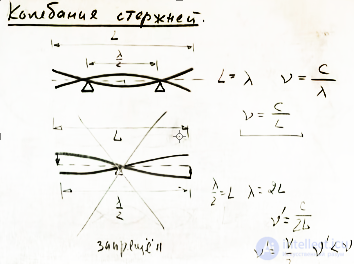
You haven't forgotten that points around a node oscillate in antiphase, that is, the rod would have to oscillate like this — but sorry, for that you need to apply some torque to it so that the angular momentum changes, but it is fixed in the middle, so no torque can arise here with this kind of mounting of the rod. That means the angular momentum itself cannot change, which means this type of oscillation is forbidden by the law of conservation of angular momentum — forbidden. In quantum mechanics there exist so-called selection rules, which forbid certain types of oscillation in atoms; they too are consequences of the law of conservation of angular momentum. We are dealing right now with some of the most interesting things, which you will later encounter again, only while studying modern physics. So, it's forbidden — but then what do we actually observe as sound? Let's try to investigate what these two simultaneous sounds are. To investigate these oscillations we need to look for more nodes. Look, there are two sounds here, but it turns out that if I grab this point, one of the sounds remains — listen, the high-frequency one dies out, and the low-frequency one remains, which means there is another node here. Here's a node, here's a node — I can even hold onto this node, and the low sound still exists, but not the high one. What kind of oscillation is this? Let's look: here a node, here a node, here an antinode, here an antinode — so the allowed type of oscillation has this configuration: node, node, node, with the middle hidden — hidden — and this is the shape that the rod's oscillations, which we hear, take: node, node, node — this point, for example, moves up, and this point moves down, this point moves up, this point moves down. The total angular momentum, which was 0, remains 0 — the law is not violated. This is the allowed type of oscillation in the rod. The high tone can also be investigated — let's listen once more — where are the antinodes of the high one? Here is one more node corresponding to this high tone, so here a node, here a node, and probably a node somewhere here too — I won't draw it anymore — antinode, node, antinode, somewhere here a node, and an antinode here, and a node here — let's look for it — a node here, a node here, and there must be a node in the middle too, so there must be a node somewhere here.
The factors responsible for the vibration of air columns are:
The air inside the tubes of a wind instrument vibrates. The tube in a wind instrument confines the movement of the air within it — the air particles must oscillate parallel to the walls of the tube. As a result, a longitudinal standing wave arises in the column of air inside the tube. The ends, whether open or closed, create nodes or antinodes.
Musical instruments such as the flute, clarinet, nadaswaram, and so on, are known as wind instruments. They operate on the principle of the oscillation of air columns. The simplest form of a wind instrument is the organ pipe. It consists of a wooden or metal tube that produces a musical sound. For example, the flute, the clarinet, and the nadaswaram belong to the class of organ-pipe wind instruments.
I can adjust it here and the sound is preserved — well, I need to tune it more precisely, like this. So the oscillation of rods is also a very complex process, and a curious physicist can learn a lot of useful things for himself just by playing around with a piece of aluminum tube — oscillations of air columns. By the way, physics is closely connected with music — which musical instrument works, falls, on this principle? The xylophone — the xylophone, where the source of sound is bars like these, and each bar is necessarily mounted in a certain way. By striking such bars with a small hammer, we excite flexural oscillations, standing waves; depending on the length of the bar the wavelength will be different, and correspondingly the frequency of the sound will be different, and hence the pitch of the tone. However, we'll talk about that in more detail tomorrow. Now, oscillations of air columns — wind instruments immediately come to mind — oscillations of air columns, but these columns oscillate in open air, in tubes, for example in organ pipes, and now we will look at the types of standing waves in organ pipes. It turns out there are two kinds of organ pipes: closed pipes and open pipes. They differ from each other only in that in a closed organ pipe there is a bottom on one side and none on the other, while in an open one both ends are free. So, a closed organ pipe — we don't have an organ pipe, so instead of it we will use a piece of drainpipe. So, a closed pipe — here it is, stopped at one end, open at the other. Where it is stopped, oscillations of the air particles are impossible, the bottom prevents it, but at the top oscillations are possible, air can go in and out. That means a standing wave can be excited here such that there will be an antinode here; further, as we move deeper into the tube, the amplitude of these oscillations will decrease, and here, at the point where the tube is closed, there will be a node. But it's inconvenient to show the oscillations this way, so I'll just show, as an illustration, what look like transverse oscillations, but remember that in reality they are longitudinal. Here is the configuration of a standing wave in a closed organ pipe: a node at the bottom, an antinode always at the open end. The length of the organ pipe is L, and we see that along the length of the organ pipe, in this variant of the standing wave, at this natural frequency, there fits the distance between a node and an antinode — we found that this equals a quarter of the wavelength, so here L equals lambda over 4. But you can also create this type of standing wave in a closed organ pipe, when there will still be a node at the bottom, but there will also be an intermediate node, like this — that is, here the particles will oscillate, here the air is stationary, here the particles oscillate, and at the bottom the air is stationary. This is a distance of half a wavelength, half a wavelength, and here, from the node to the antinode, there is another quarter wavelength. As a result it turns out that the length of the tube consists of half a wavelength plus a quarter wavelength — a quarter wavelength plus half a wavelength. There can also be this type of oscillation, when there are two nodes in the middle: here we get half a wavelength, here also half a wavelength — this is the distance between the nodes — and here we are given a quarter. Then, along the length of the organ pipe, there will be a quarter wavelength plus twice half a wavelength, or, in the general case, along the length of the tube there fits a quarter wavelength plus m half-wavelengths, and from this we can find the possible wavelengths, as in a closed organ pipe, and find the natural frequencies. We won't do that right now — we'll only be interested in the first, fundamental frequency. For it, m equals 1, and here is such a standing wave, so L equals lambda over 4, L equals lambda over 4, from which lambda equals 4L, or, if we want to find the frequency, then c equals ν1 multiplied by lambda, or c equals ν1 multiplied by 4L, from which ν1 equals c divided by 4L — so this is the fundamental tone of a closed organ pipe. Now let's consider an open organ pipe — I can erase this, all right. An open organ pipe is open at both ends; in that case there will be antinodes both here and here, with a node in the middle, that is, here air oscillations are possible, here air oscillations are possible, while in the middle the air stays in place; let's not forget that
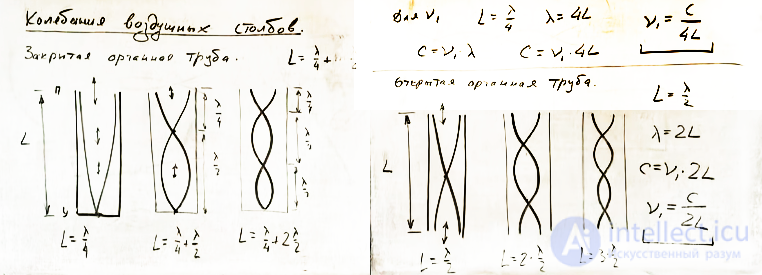
on the sides, on opposite sides of a node, the oscillations are in antiphase, that is, when the air particles here move down, over there they move up — the air compresses, expands, compresses, expands. The pattern of the standing wave is like this: antinodes at the ends, a node in the middle. The length of the tube — and along the length of the tube there fits the distance between two antinodes, which is also equal to half a wavelength: L equals half the wavelength. But more complex oscillations of higher natural frequencies are also possible; let's show them: here there is one node, but there can also be two nodes — such oscillations. Here we will have half a wavelength plus two quarter-wavelengths, that is, a whole wavelength, so L equals twice half a wavelength. Such oscillations are possible.
Here we have two nodes, but there can also be three nodes [music]. Here we have L equals once half a wavelength, twice half a wavelength, and a third time half a wavelength — three times half a wavelength. Notice that we have already encountered this same set of ratios for the string — exactly the same, so the set of natural frequencies of an open organ pipe is exactly the same as the set of natural frequencies of a string. But here's the difference — look, let's find the first frequency, the fundamental tone of the open organ pipe. For the fundamental tone, half a wavelength equals L, half a wavelength equals L, then the wavelength equals 2L, or c equals ν1 times 2L, or ν1 equals c divided by 2L, just as for strings. And compare: for a closed organ pipe the frequency is two times lower than for an open organ pipe; musicians call a ratio of frequencies of two to one the interval of an octave, which means a closed organ pipe should sound an octave lower than an open organ pipe. Let's check — let's take this organ pipe and tap it, it resonates at a certain frequency, do you hear the pitch of the tone? Now let's close it at one end and listen — since there's no one there — you can hear the sound is an octave lower, and — come here, I need someone with a strong palm — close the tube tightly, we listen, open, close — it works. Now what we have just learned tells us that the oscillations of air columns can be used in musical instruments, in organs, and moreover, organs have both open and closed organ pipes. It turns out that the set of natural frequencies of a closed organ pipe are related not as whole numbers but as odd numbers — the next harmonic will already be 3 times greater in frequency than the first, that is, there will be no even harmonics there, unlike the spectrum in an open organ pipe.
Recall that this word is the same as for a string — and so in organs both kinds of pipes are used, and by combining them one can create sounds very rich in timbre. You can change, emulate, the length of the tube, and thereby change the frequency of oscillation; this is done in instruments such as trombones — you know, there's a thing there, and when you slide it up or in one direction or the other, the pitch of the tone changes. In flutes, in saxophones, there is a hole; by closing and opening the hole you can change the length of the tube simply by opening it at one place or another. Finally, there exists a musical instrument called the pan flute; the pan flute in general consists of separate closed tubes, and there are many of them, each of these tubes being tuned to its own wavelength, and hence to its own frequency. Here, yesterday I made such a flute — this is a completely empty test tube, and here is a test tube into which some water has been poured — so, you see, it produces a higher tone. Here a certain number of test tubes with a certain amount of liquid have been selected.
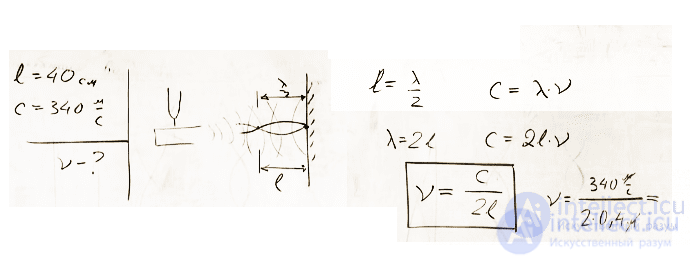
Here's a musical instrument you can play — please, do-re-mi — did you like that? Yes, you can try it at recess, although — no, you'll probably spill it on me. If I were more of a mathematician about it and there were more tubes, one could continue this melody. So as you can see, theory is grey, but the tree of life is forever green. But finally, let's, in conclusion, solve one little problem — a simple problem, just a pretext to introduce you to one more device. Problem number 365 from Irodov's problem book, number 365: the distance between the nodes of a standing wave produced by a tuning fork in air is 40 centimeters; determine the oscillation frequency of the tuning fork, taking the speed of sound to be 340 meters per second. The distance between the nodes of a standing wave produced by a tuning fork in air is 40 centimeters; determine the oscillation frequency of the tuning fork, the speed of sound c being 340 meters per second. We need to find the oscillation frequency of the tuning fork. What is a tuning fork? A tuning fork is a device which in English is called a «tuning fork» — a tuning fork. This fork, by the way — the very first forks in history consisted of two prongs, not three or four as now — and by striking it with a small hammer we can make the tuning fork sound. What is this box for? It's not hard to guess — it's a resonator. Look, I won't let the tuning fork sound by itself, I'll just tap on this box — do you hear? In its sound you can hear the same tone at which the tuning fork operates, that is, here we are dealing with acoustic resonance — this is a resonator for the oscillation of a column of air.
In this box they resonate, they are tuned to the same frequency as the oscillations of the tuning fork's prongs. So this tuning fork creates a standing wave, that is, here is the tuning fork, here is its resonator box; a wave leaves the resonator box, it probably reaches the wall there, is reflected, and here the incident and reflected waves are superimposed, and here we get a standing wave. And according to the conditions of the problem, the distance between the nodes of this standing wave is 40 centimeters. But here there will be a node, and here a second node — that is, here is roughly what the standing wave in the air looks like; this distance L, according to the conditions of the problem, is equal to 40 centimeters. But on the other hand, we know that the distance between the nodes of a standing wave is half a wavelength, so L equals half the wavelength. We are given the speed of sound; recalling that the wave speed is the product of the wavelength and the frequency, we can now substitute the wavelength here — lambda here equals 2L, so c equals ν times 2L, from which the oscillation frequency of the tuning fork that creates our standing wave equals c divided by 2L — this is our working formula. Let's calculate: ν equals c, the speed of sound, 340 meters per second, divided by two times 0.4 meters — the meters will cancel, the answer will come out in inverse seconds; we understand that if we're talking about frequency, at the end we need to write hertz. So, three hundred forty divided by 0.8 gives us — as someone, Dima, said — 425, 425 inverse seconds, but we write hertz — at this frequency the tuning fork oscillated. That's all.

Comments