
Lecture
Density of a substance — a scalar physical quantity defined as the ratio of a body's mass to the volume it occupies, or as the derivative of mass with respect to volume:
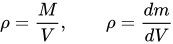 .
.
These expressions are not equivalent, and the choice depends on exactly which density is being considered. The following are distinguished:
 . In the homogeneous case it is simply called the density of the body;
 ) containing that point to the volume of that small part (
 ) as the volume tends to zero , or, in short,
 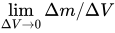 . Since at the atomic level any body is inhomogeneous, the limiting process must stop at a volume corresponding to the physical model being used.
For a point mass the density is infinite. Mathematically it can be defined either as a measure or as a Radon–Nikodym derivative with respect to some reference measure.
Density is usually denoted by the Greek letter  [rho] (the origin of the notation remains to be clarified); sometimes the Latin letters D and d are used (from Latin densitas, «density»). Based on the definition of density, its dimension is kg/m³ in SI and g/cm³ in the CGS system.
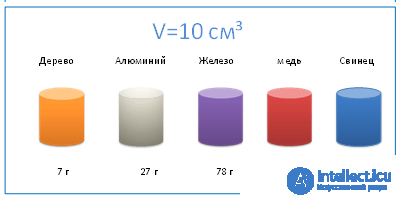
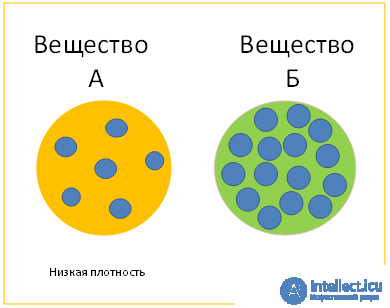
The concept of «density» in physics may have a broader interpretation. There are surface density (the ratio of mass to area) and linear density (the ratio of mass to length), applied respectively to flat (two-dimensional) and elongated (one-dimensional) objects. In addition, one speaks not only of the density of mass, but also of the density of other quantities, for example, energy or electric charge. In such cases, clarifying words are added to the term «density», say «linear charge density». «By default», density is understood to mean the above-mentioned (three-dimensional, kg/m3) mass density.
Here density plays a decisive role — the greater it is, the more the body will sink. Density and hardness are different concepts. Water and ice are a good example of this. Water has a higher density than ice, which is why ice floats on its surface rather than sinking.
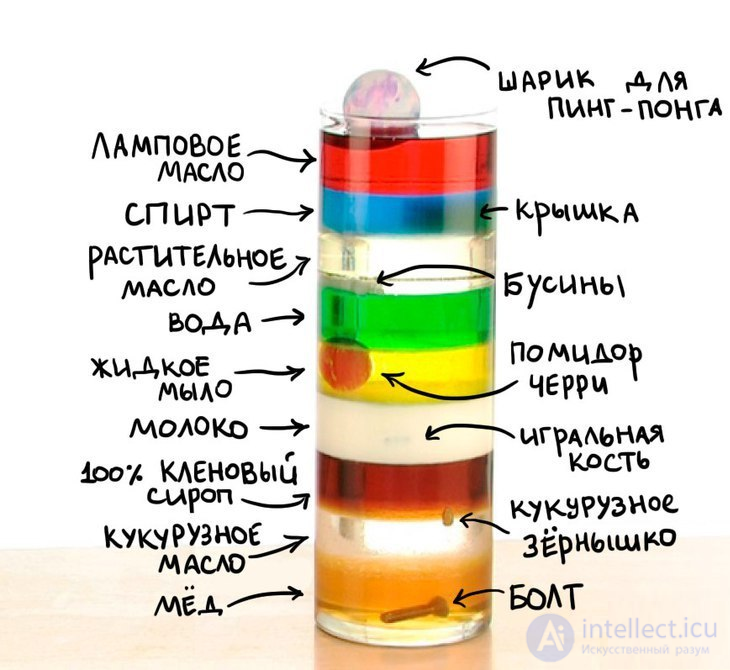
A vivid example of this is the simple «Density Tower» experiment. It can be carried out at home.
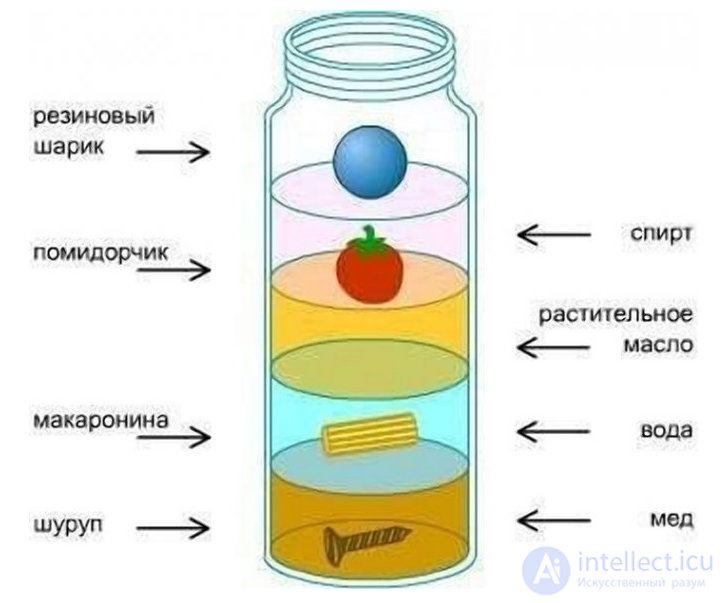
fig. Density Tower
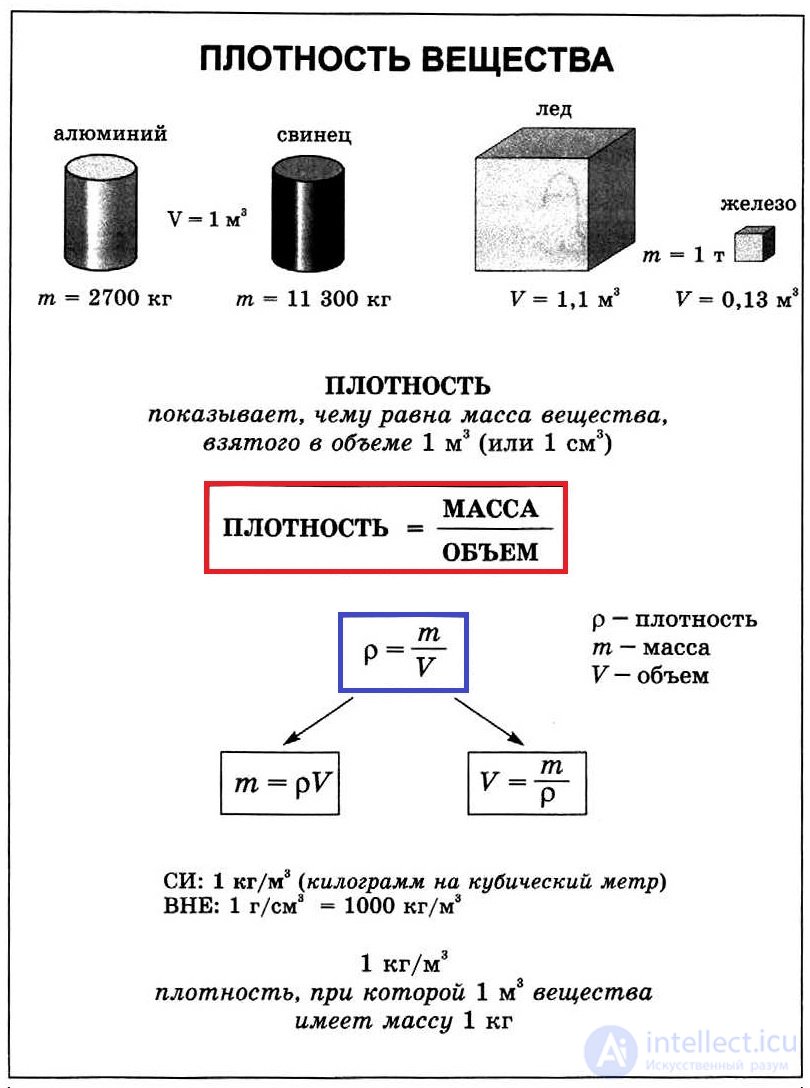
Density (the density of a homogeneous body or the average density of an inhomogeneous one) is found by the formula:

where M — the mass of the body, V — its volume; the formula is simply a mathematical statement of the definition of the term «density» given above.
When calculating the density of gases at standard conditions, this formula can also be written as:

where  — the molar mass of the gas,
  — the molar volume (at standard conditions approximately equal to 22.4 L/mol).
The density of a body at a point is written as

then the mass of an inhomogeneous body (a body whose density depends on coordinates) is calculated as

In the case of granular and porous bodies, a distinction is made between
True density is obtained from the bulk (apparent) density using the value of the porosity coefficient — the fraction of void volume in the occupied volume.
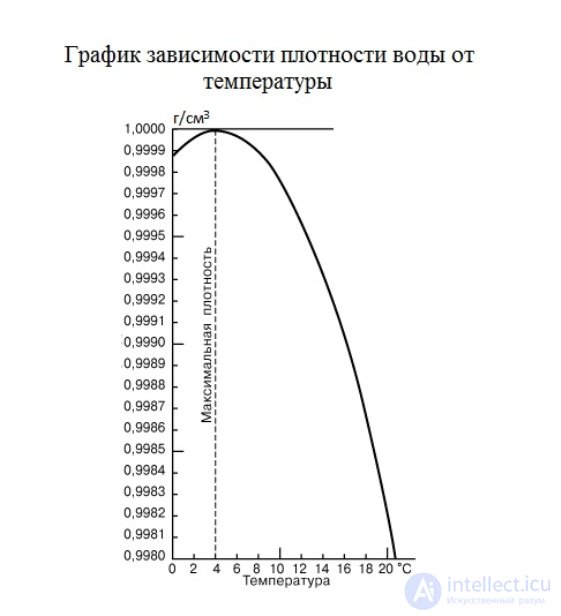
As a rule, when temperature decreases, density increases, although there are substances whose density in a certain temperature range behaves differently, for example, water, bronze and cast iron. Thus, the density of water has a maximum value at 4 °C and decreases both as the temperature rises and as it falls relative to this value.
When the state of aggregation changes, the density of a substance changes abruptly: density increases during the transition from the gaseous state to the liquid state and during solidification of a liquid. Water, silicon, bismuth and some other substances are exceptions to this rule, since their density decreases upon solidification.
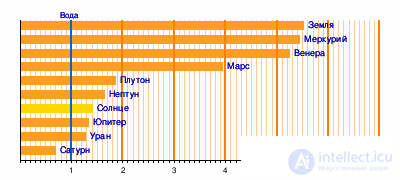
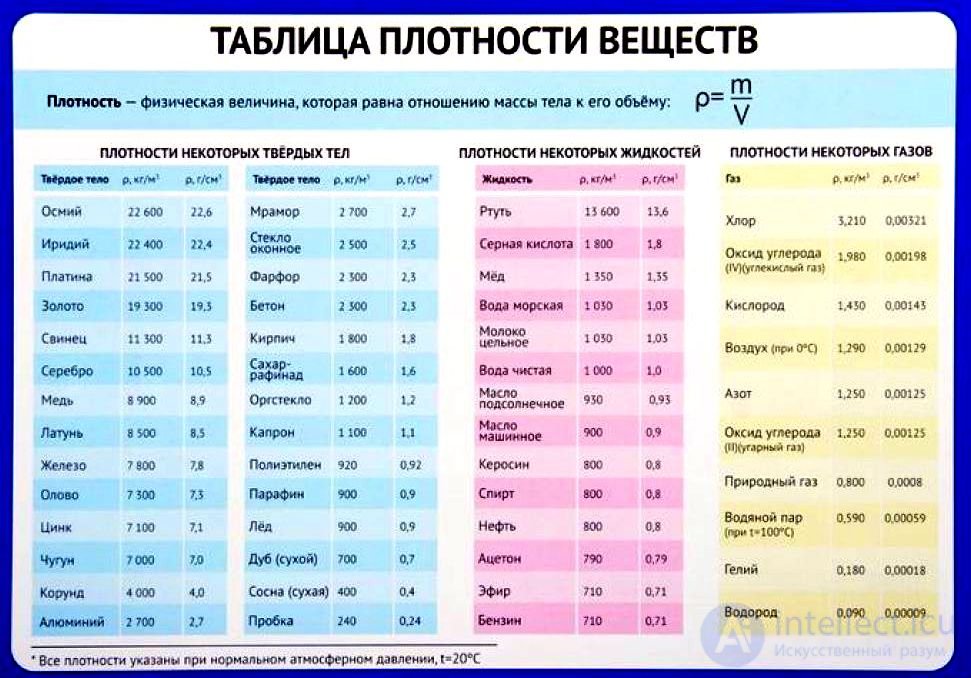
For various natural objects, density varies over a very wide range.
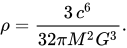
The average density falls off inversely proportional to the square of the black hole's mass (ρ~M−2). Thus, if a black hole with a mass on the order of the Sun's has a density of about 1019 kg/m³, exceeding nuclear density (2×10¹⁷ kg/m³), then a supermassive black hole with a mass of 109 solar masses (such black holes are assumed to exist in quasars) has an average density of about 20 kg/m³, which is significantly less than the density of water (1000 kg/m³).
| Nitrogen | 1.250 | Oxygen | 1.429 |
| Ammonia | 0.771 | Krypton | 3.743 |
| Argon | 1.784 | Xenon | 5.851 |
| Hydrogen | 0.090 | Methane | 0.717 |
| Water vapor (100 °C) | 0.598 | Neon | 0.900 |
| Air | 1.293 | Radon | 9.81 |
| Tungsten hexafluoride | 12.9 | Carbon dioxide | 1.977 |
| Helium | 0.178 | Chlorine | 3.164 |
| Cyanogen | 2.38 | Ethylene | 1.260 |
To calculate the density of an arbitrary ideal gas under arbitrary conditions, one can use a formula derived from the ideal gas equation of state:
 ,
,
where:
 — pressure, — molar mass,
 — the universal gas constant, equal to approximately 8.314 J/(mol·K)
 — thermodynamic temperature.
| Gasoline | 710 | Milk | 1040 |
| Water (4 °C) | 1000 | Mercury (0 °C) | 13600 |
| Kerosene | 820 | Diethyl ether | 714 |
| Glycerin | 1260 | Ethanol | 789 |
| Seawater | 1030 | Turpentine | 860 |
| Olive oil | 920 | Acetone | 792 |
| Motor oil | 910 | Sulfuric acid | 1835 |
| Petroleum | 550—1050 | Liquid hydrogen (−253 °C) | 70 |
| Balsa | 0.15 | Siberian fir | 0.39 |
| Coast redwood | 0.41 | Spruce | 0.45 |
| Willow | 0.46 | Alder | 0.49 |
| Aspen | 0.51 | Pine | 0.52 |
| Linden | 0.53 | Horse chestnut | 0.56 |
| Sweet chestnut | 0.59 | Cypress | 0.60 |
| Bird cherry | 0.61 | Hazel | 0.63 |
| Walnut | 0.64 | Birch | 0.65 |
| Cherry | 0.66 | Smooth-leaved elm | 0.66 |
| Larch | 0.66 | Field maple | 0.67 |
| Teak | 0.67 | Beech | 0.68 |
| Pear | 0.69 | Oak | 0.69 |
| Swietenia (Mahogany) | 0.70 | Plane tree | 0.70 |
| Buckthorn | 0.71 | Yew | 0.75 |
| Ash | 0.75 | Plum | 0.80 |
| Lilac | 0.80 | Hawthorn | 0.80 |
| Pecan (hickory) | 0.83 | Sandalwood | 0.90 |
| Boxwood | 0.96 | Ebony | 1.08 |
| Quebracho | 1.21 | Lignum vitae | 1.28 |
| Cork | 0.20 |
The density values of metals can vary within very wide limits: from the smallest value for lithium, which is lighter than water, to the largest value for osmium, which is heavier than gold and platinum.
| Osmium | 22610 | Rhodium | 12410 | Chromium | 7190 |
| Iridium | 22560[10] | Palladium | 12020[11] | Germanium | 5320[12] |
| Plutonium | 19840[13] | Lead | 11350[14] | Aluminum | 2700[15] |
| Platinum | 19590[16] | Silver | 10500[17] | Beryllium | 1850[18] |
| Gold | 19300[14] | Nickel | 8910[19] | Rubidium | 1530[20] |
| Uranium | 19050[21] | Cobalt | 8860[22] | Sodium | 970[23] |
| Tantalum | 16650[24] | Copper | 8940[25] | Cesium | 1840[26] |
| Mercury | 13530[27] | Iron | 7870[28] | Potassium | 860[29] |
| Ruthenium | 12450[30] | Manganese | 7440[31] | Lithium | 530[32] |
The following are used to measure density:

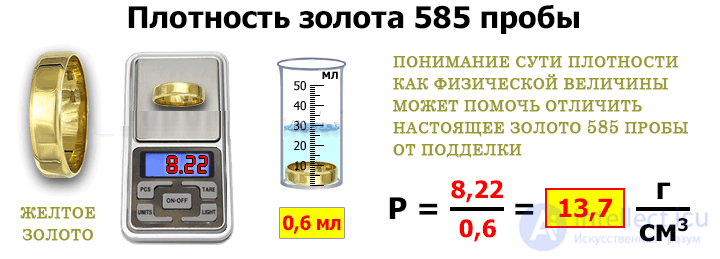
determining a substance by mass and volume
1. Over time, oil stops being squeezed out of the rock formation by the weight of the overlying strata. Then the reservoir pressure maintenance (RPM) system comes into play. Injection wells are drilled, and water is pumped into them under high pressure. Naturally, the injected or formation water will sooner or later reach the production wells and rise to the surface together with the oil.
2. Cream makes up the greater part of the fat contained in milk. When milk settles, the light fats rise to the surface; in the past they could simply be skimmed off fresh milk after it had settled for some time. Under industrial conditions this product is obtained by separation.
3. In countries where malaria-carrying mosquitoes are common, their larvae are combated by pouring liquid oils over the places where they live. The larvae need air. But they cannot pierce even a thin layer of oil with their spiracles. As a result – a sharp decrease in their numbers

Comments