We are finishing our study of the topic «Direct electric current». Nevertheless, in this section we will also consider alternating current. Why is that? The reason lies in the terms «direct current» and «alternating current» themselves, whose names are not entirely fortunate, since they can be interpreted differently in physics and in electrical engineering: this is how it developed historically. Let us turn to the definitions.
In physics, direct current is the name given to an electric current that does not change in magnitude or direction over time. The graph of such a «truly constant» current should be a straight line parallel to the time axis (see fig. «a»). Nevertheless, in electrical engineering, direct current is considered to be a current that is constant only in direction, but may vary in magnitude. Such a current can be obtained by «rectifying» a sinusoidal alternating current, for example, the one that exists in a household lighting network (see fig. «b»). The result is a pulsating unidirectional current (see fig. «c»).

In physics, alternating current is the name given to an electric current that changes over time: in magnitude and/or direction. From the point of view of physics, the «pulsating» current in figure «c» is alternating, since it changes in magnitude (while remaining constant in direction). Such a unidirectional current is considered «direct» in electrical engineering, since in its effects it resembles true direct current. For example, it is suitable for charging batteries, running electric motors, and carrying out electrolysis. A current alternating in direction is unsuitable for these purposes.
[[s|as]]
Note. Why the current in electrical networks is precisely sinusoidal and changes its direction 100 times per second, we will explain later (see § 10-zh). For now, let us consider how a unidirectional pulsating current – «direct» from the point of view of electrical engineering – can be obtained from it. In other words, how can we «flip» the lower parts of the sine wave upward, that is, transform the shape of the current without losing its power? Various devices serve this purpose, one of which is the semiconductor diode, which passes current through itself in only one direction (see § 09-i).
Self-check questions
- At the beginning of the section we justified why ...
- Unlike in electrical engineering, in physics direct current is considered to be ...
- Direct current in the coordinates (I, t) is ...
- It developed historically that, allowing an evident contradiction with the physical definition, ...
- A current that is constant in direction but periodically changes in magnitude ...
- It is known that sinusoidal alternating current ...
- Alternating current in physics includes ...
- Graph «c» shows a pulsating ...
- In graph «c» the current is constant only ...
- A semiconductor diode is an electrical device ...
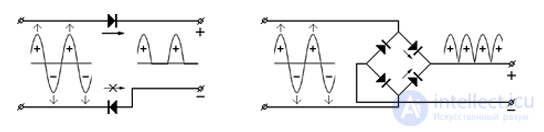
Below, the left-hand diagram shows two diodes connected into an alternating-current circuit. Here the upper parts of the sine wave pass through the upper diode (in the direction of its «arrow»), while the lower parts of the sine wave do not pass through the lower diode (against its «arrow»). This produces a pulsating unidirectional current, and exactly half of the original power does not reach the consumer, since «plateaus» with zero current appear. For those especially interested in physics, we note that exactly the same result would occur if only one diode were left, and it could be either one.
The right-hand diagram shows four diodes connected in the so-called bridge circuit. It is more advantageous than the previous one: the diodes pass both the upper and the lower parts of the sine wave in pairs, to the «+» and «–» terminals respectively. As a result, whereas the graph of the original alternating current can be said to show «hills and valleys», the graph of the resulting unidirectional current shows not «hills and plains» but «doubled hills». This means that now the entire power of the original current reaches the consumer.
Finally, let us consider how the Joule-Lenz law Q=I²Rt, which describes the thermal effect of a current, can be applied to a non-constant current. What should be done if the current is constantly changing? It must be replaced by a conventionally constant current that produces the same thermal effect. Such a conventionally constant value of the current is called, in physics, the equivalent (effective, rms) value of the non-constant current.
Definition: the equivalent value of a non-constant current equals the value of such a direct current which, flowing through the same resistance, releases in it the same amount of heat over the same time. It is precisely the equivalent value of the current that all ammeters show us. The same applies to voltage and voltmeters. Thus, calorimetric measurements (see § 06-v) make it possible to determine the equivalent values of non-constant currents.
Self-check questions
- A semiconductor diode is an electrical device ...
- On the left halves of both circuits there is ...
- When a sinusoidal current is applied to the «input» of the two-diode circuit on the left, the following occurs: ...
- The diodes separating the sinusoidal-current circuit from the right-hand part of the circuit ultimately lead to ...
- Pairwise passage of both parts of the sine wave is realized in ...
- The use of exactly four diodes ultimately leads to ...
- The law of Joule-Lenz can also be applied to alternating currents ...
- To apply the Joule-Lenz law in the case of a non-constant current strength it is necessary ...
- The conventionally constant value of current that produces the same thermal effect is called ...
- Remember: the equivalent value of a non-constant current is such a value ...
- To experimentally compare the equivalent values of any two currents ...
See also
- direct current
- alternating current
- electric current


Comments