
Lecture
Matter (from Lat. māteria «substance») — one of the fundamental concepts of physics, a general term defined by the totality of the contents of space-time and affecting its properties.
It is an object of study in physics, where it is regarded as an objective reality independent of the mind.
The definition of matter has expanded with the development of various fields of science. Earlier these were objects that could be described by classical properties (mass, temperature, divisibility, etc.), and in Newton's conception of the absoluteness of space and time, considered independently; with the development of optics, and after it special and general relativity, this concept was supplemented by its connections with gravity and waves; and modern quantum physics, astrophysics and high-energy physics have established this concept in its modern sense and are actively engaged in the search for new forms of matter.
A field, unlike matter, has no internal voids and possesses absolute density.
These objects were introduced into scientific use to explain a number of astrophysical and cosmological phenomena.
Substance — one of the forms of matter, consisting of fermions or containing fermions alongside bosons; it possesses rest mass, unlike certain types of fields, such as the electromagnetic field.
Usually (at relatively low temperatures and densities) substance consists of particles, among which electrons, protons and neutrons are most common. The latter two form atomic nuclei, and all together — atoms (atomic matter), from which — molecules, crystals, and so on. Under certain conditions, such as in neutron stars, rather unusual forms of matter can exist.
The concept of substance is sometimes also used in philosophy as an equivalent of the Latin term substantia .
Classical matter can exist in one of several states of aggregation: gaseous, liquid, solid crystalline, solid amorphous, or in the form of a liquid crystal. In addition, a highly ionized state of matter (usually gaseous, but, in a broad sense, of any state of aggregation) is distinguished, called plasma. States of matter known as Bose–Einstein condensate and quark-gluon plasma are also known.
Field in physics — a physical object, classically described by a mathematical scalar, vector, tensor, or spinor field (or some set of such mathematical fields), subject to dynamical equations (equations of motion, called in this case equations of the field or field equations — usually these are partial differential equations). In other words, a physical field is represented by a certain dynamical physical quantity (called the field variable ), defined at all points of space (and, generally speaking, taking different values at different points of space, and moreover changing with time ).
In quantum field theory, the field variable can be treated formally similarly to how the spatial coordinate is treated in ordinary quantum mechanics, and the field variable is associated with a quantum operator of the corresponding name.
The field paradigm, representing all physical reality at the fundamental level as reducible to a small number of interacting (quantized) fields, is not only one of the most important in modern physics, but, perhaps, unconditionally the dominant one .
The simplest way to visualize a field (when we are talking, for example, about fundamental fields that have no obvious direct mechanical nature ) is as a disturbance (deviation from equilibrium, motion) of some (hypothetical or simply imagined) continuous medium filling all of space. For example, as the deformation of an elastic medium whose equations of motion coincide with, or are close to, the field equations of the more abstract field that we wish to visualize. Historically such a medium was called the ether, but subsequently the term almost completely fell out of use , and its implied physically meaningful part merged with the concept of the field itself. Nevertheless, for a basic visual understanding of the concept of a physical field in general terms, such a representation is useful, bearing in mind that within the framework of modern physics such an approach is usually accepted, by and large, only as an illustration .
A physical field can thus be characterized as a distributed dynamical system possessing an infinite number of degrees of freedom.
The role of the field variable for fundamental fields is often played by a potential (scalar, vector, tensor), and sometimes by a quantity called the field strength. (For quantized fields, in a certain sense the corresponding operator is also a generalization of the classical concept of the field variable.)
Also, a field in physics refers to a physical quantity considered as depending on location: as the complete set, generally speaking, of different values of this quantity for all points of some extended continuous body — a continuous medium, describing in its totality the state or motion of this extended body . Examples of such fields can be:
The dynamics of such fields is also described by partial differential equations, and historically it was precisely such fields that were first considered in physics, beginning in the 18th century.
The modern concept of a physical field grew out of the idea of the electromagnetic field, first conceived in a physically concrete form relatively close to the modern one by Faraday, and consistently realized mathematically by Maxwell — initially using a mechanical model of a hypothetical continuous medium, the ether, but later going beyond the use of a mechanical model.
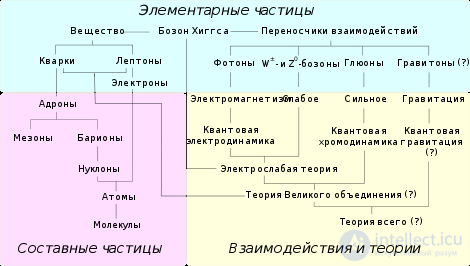
Among the elementary particles making up substances and fields, fermions and bosons are distinguished, as well as particles that do and do not possess rest mass (massless particles); they may also differ in electric and other charges. In addition, virtual particles are distinguished separately, which can be regarded as particles arising in the intermediate states of the interaction of «real» elementary particles, differing in that the latter can be observed in a long-lived state as the outcome of an experiment (in principle, particles of one and the same kind, for example, photons or electrons, may participate as virtual in some situations, and as real in others). The difference of virtual particles is that they are created and destroyed (absorbed) in the process of interaction and are not present in the experiment in the initial and final states. Virtual particles determine the properties of the physical vacuum, which, thus, in modern physics also acquires the attributes of a material medium.
Matter and radiation, according to the special theory of relativity, are only special forms of energy distributed in space; thus, ponderable mass loses its special position and is merely a special form of energy.
— Albert Einstein, 1920
According to established terminology, all fields except the gravitational one are called material fields in general relativity.

Comments