
Lecture
Two centuries of struggle between the corpuscular and wave theories of light ended in victory for the latter. Maxwell's equations became the crowning achievement of nineteenth-century theoretical physics. On the horizon of science only two small dark spots were visible — the problems with thermal radiation and the result of the Michelson experiment. It seemed that just a little more, and physicists would be left without work: the laws of nature seemed to be, for the most part, understood. Fortunately, this did not happen. From one spot grew quantum theory, from the other — the theory of relativity. We became acquainted with the theory of relativity in the first part of the course. The time has come to open the doors to the quantum world a little.
|
Thermal radiation — is electromagnetic radiation emitted by a substance at the expense of its store of internal (thermal) energy. |
Therefore, the characteristics of thermal radiation (intensity, spectral composition) depend on the temperature of the radiating substance. All other types of electromagnetic radiation exist at the expense of other, non-thermal, forms of energy. Thermal radiation — is the only type of radiation that can be in thermodynamic equilibrium with a substance while itself being in a state of thermodynamic equilibrium. Below we will mainly consider thermodynamically equilibrium thermal radiation.
Suppose a heated body is placed in a cavity whose walls are maintained at some constant temperature  If there is no medium (gas) in the cavity, then energy exchange between the shell and the body occurs only through the processes of absorption, emission, and reflection of thermal radiation by the substance of the cavity wall. Over time, the temperature of the body will become equal to the temperature of the shell and dynamic equilibrium will set in — in a unit of time the body will absorb exactly as much energy as it emits. Obviously, in this case the radiation filling the cavity will also be in equilibrium, both with the body and with the walls of the cavity. Suppose the equilibrium between the body and the radiation is disturbed and the body emits more energy than it absorbs. Then the temperature of the body and its internal energy will begin to decrease, which will lead to a decrease in the energy emitted by the body. The temperature of the body will decrease until the amount of energy emitted by the body becomes equal to the amount of energy absorbed. If the equilibrium is disturbed in the other direction, that is, the body emits less energy than it absorbs, then the temperature of the body will increase until equilibrium is again established. Thus, a disturbance of the equilibrium between the body and thermal radiation causes processes directed toward the restoration of equilibrium.
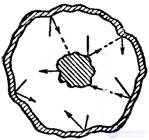
Fig. 1.1. A heated body in a cavity with ideally reflecting walls
Let us now imagine the same body, placed inside another shell, differing in size, shape, or the material from which it is made. Let us maintain the same temperature of the shell. Similar equilibrium-establishing processes will take place in the system, as a result of which the body inside the shell will heat up to the same temperature T. For the body inside the shell nothing has changed: it is at the same temperature as before, and, consequently, will emit the same energy. Since the body is in equilibrium with the radiation inside the shell, we come to the conclusion that the characteristics of this radiation do not depend on the properties of the shell, but only on its temperature. This «standard», thermodynamically equilibrium radiation is called the radiation of a blackbody. Where this name comes from and what a blackbody is will be explained below. Equilibrium radiation can be characterized by its energy density  , which depends only on temperature.
|
Energy density |
Thermal radiation consists of electromagnetic waves of different frequencies. The total energy density is made up of the energy densities of these waves. For a more detailed characterization of the radiation, a differential quantity is introduced — the spectral energy density of radiation  .
.
|
Spectral energy density of radiation — is the radiation energy per unit volume, per unit interval of frequency. |
In other words, if we denote by  the radiation energy per unit volume, contained in waves with frequencies from
  to
to  , then

|
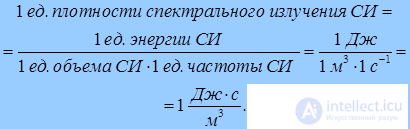
In the SI system, the spectral energy density is measured in the following units:
|
The energy density is the sum of the spectral energy densities over all possible frequencies, that is, it is expressed by the integral
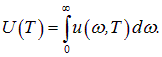
So, in the cavity there exists standard radiation with energy density . Let us now consider a body that is in equilibrium with it.
|
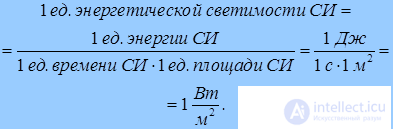
Radiant exitance R (the integral density of the energy flux of radiation) — is equal to the energy emitted per unit time by a unit surface of the radiating body in all directions. |
|
In the SI system, radiant exitance is measured in
|
The radiant exitance depends on the temperature of the body. Thermal radiation consists of waves of various frequencies. To characterize thermal radiation it is important to know how much energy is radiated by the body, and in which range of frequencies. Therefore a differential characteristic  is introduced, called the emissive power of the body, which is the spectral density of the energy flux of radiation.
|
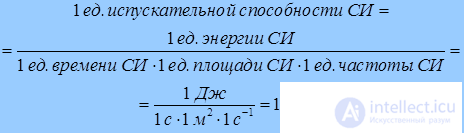
Emissive power of a body (spectral density of the energy flux of radiation) — is the amount of energy emitted per unit time by a unit surface of the body, in a unit interval of frequency, in all directions. |
To obtain the radiant exitance of a body, one must integrate the emissive power over all frequencies:

|
In the SI system, the emissive power of a body (spectral density of the energy flux of radiation) is measured in J/m2:
|
A heated body not only emits energy, but also absorbs it. To describe a body's ability to absorb the energy of radiation incident on its surface, a quantity is introduced which is called exactly that: absorptive power.
|
Absorptive power |
The absorptive power is equal to the fraction that — in a given spectral interval  — the absorbed radiation energy
  makes up of the incident
  radiation energy. In other words:
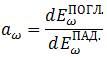
Obviously, the absorptive power of a body is a dimensionless quantity, not exceeding unity.
|
A blackbody — is a body capable of absorbing, at any temperature, all radiation of all frequencies incident on it. |
For a blackbody

Bodies with such properties do not occur in nature; this is yet another physical idealization.
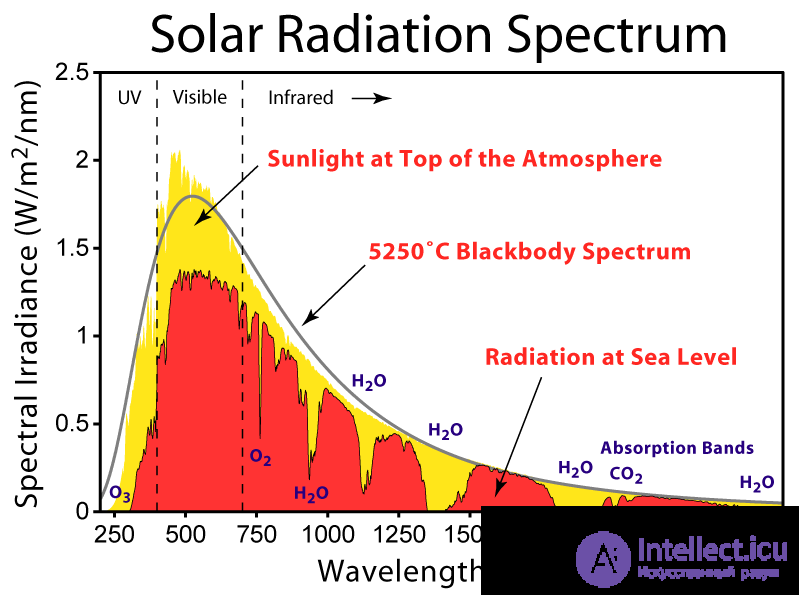
Fig. 1.2. The blackbody radiation spectrum (black line) at a temperature of 5250 °C provides a good model for solar radiation. Red shows measurement results at sea level, yellow — in the upper atmosphere.
Let us place different bodies in the cavity one after another. All of them are under the same conditions, surrounded by the same radiation. Let us denote by  the energy incident per unit time on unit surface area of the body in a unit frequency interval. According to the definition of absorptivity, the body absorbs energy
  In the equilibrium state, this energy must equal the energy emitted by the body:
|
|
|
(1.1) |
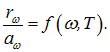
Different bodies in the cavity have different absorptivity, and consequently different emissivity, so that the ratio rw /aw does not depend on which particular body is placed in the cavity:
|
|
|
(1.2) |
On the other hand, the emissivity of a body does not depend on the cavity into which it is placed, but only on the properties of the body itself. Thus the function is a universal function of frequency and temperature, independent of the properties of the cavity or of the characteristics of the body in it. Relation (1.2) expresses Kirchhoff's law.
|
The ratio of the emissivity and absorptivity of a body does not depend on the nature of the body. For all bodies the function |
Strictly speaking, the statement formulated above is valid under conditions of thermodynamic equilibrium, whose presence is always assumed here and below.
For an absolutely black body

from which follows the physical interpretation of Kirchhoff's universal function : it represents the emissivity of an absolutely black body, that is
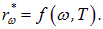
(We shall mark the characteristics of an absolutely black body with an asterisk, and often call the body itself simply «black» rather than absolutely black).
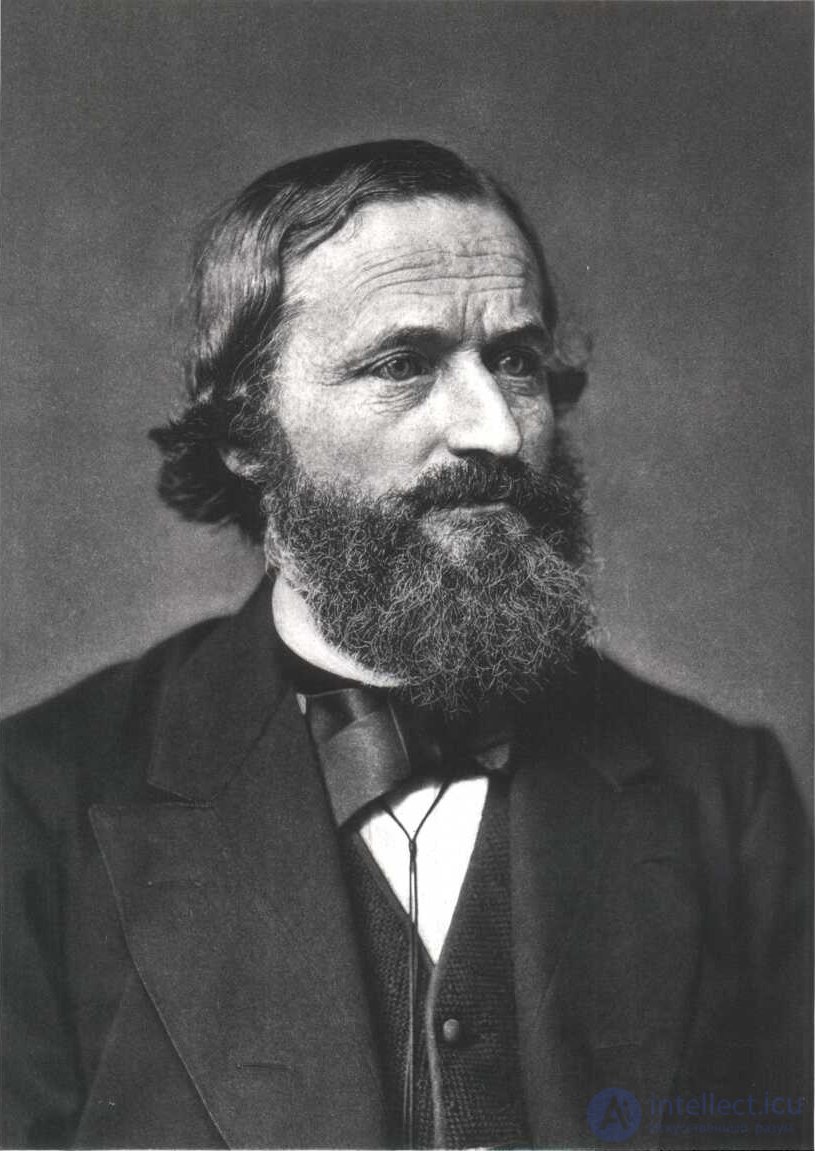
Fig. 1.3. Gustav Robert Kirchhoff (1824–1887)
Let us now establish the relation between the emissivity of a black body and the spectral density  of the standard radiation in the cavity (above we called it blackbody radiation). Comparing the dimensions of these quantities, we see that the ratio
  has the dimension of velocity. The only quantity with the dimension of velocity that is associated with electromagnetic waves in vacuum — is the speed of light
  . Therefore the sought relation must have the form

Let us find the dimensionless proportionality coefficient  in this formula. As a model of an absolutely black body we take a closed cavity with a small opening s (Fig. 1.4).
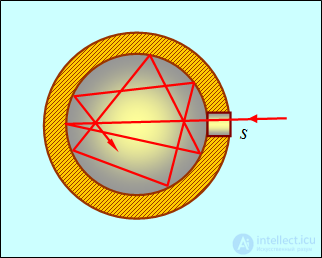
Fig. 1.4. A cavity with a small opening — a realization of a black body
A ray of light entering this cavity through the opening s, undergoes multiple reflections. At each reflection the cavity walls absorb part of the energy. Therefore the intensity of the light ray leaving the opening is many times smaller than the intensity of the incoming ray. The larger the ratio of the cavity area to the opening area, the closer such a body is to an absolutely black body. Hence the opening in the cavity radiates as an abstract black body.
On the other hand, inside the cavity there exists equilibrium thermal radiation with spectral density U. Let us calculate the energy dW0 , leaving through the opening of area s within the solid angle  in the direction defined by the angle
  . First, in this direction, in time
  only the energy contained in the oblique cylinder with base area s and slant length c (Fig. 1.5-1) can leave.
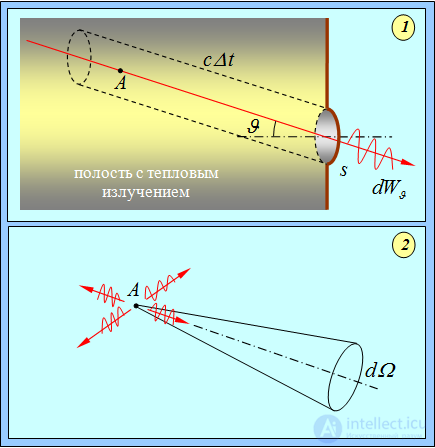
Fig. 1.5. Thermal radiation from an opening in a cavity
The volume of such a cylinder is equal to

The thermal radiation energy contained in it is equal to

But not all of it propagates at the angle  . Thermal radiation propagates in all directions with equal probability (Fig. 1.5-2). Therefore only a fraction of the energy falls within the solid angle
  , (we denote this fraction as
  ), proportional to the magnitude of the solid angle

Since the total solid angle is equal to  , we have
|
|
|
(1.3) |
Now it remains to integrate  over the angles
  and
and  , to obtain the total energy
  , leaving the cavity opening. Note: radiation falls on the opening only from the left half-space, so that the polar angle varies within the limits from zero to
  (the angle varies as usual from 0 to
  ). Integration over gives a factor
  , and integrating over , we finally obtain:
|
|
|
(1.4) |
Dividing  by the time
  and the opening area s, we obtain the radiant emittance of a black body R*, as well as the sought proportionality coefficient

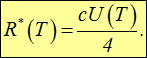
Thus, the radiant emittance of a black body  is related to the energy density in the cavity by the relation
|
|
|
(1.5) |
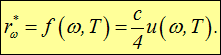
An analogous relation holds for the spectral characteristics of blackbody radiation:
|
|
|
(1.6) |
Thus, the universal function  in Kirchhoff's law, which represents the emissivity of a black body, also coincides, up to the factor c/4 , with the spectral density of equilibrium thermal radiation.
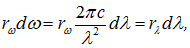
Up to now we have referred the spectral characteristics of thermal radiation to a unit frequency interval. One can define analogous characteristics referred to a unit wavelength interval. Thus a black body emits, in the frequency interval  , the energy
  . This same energy can be written as
  . To the frequency interval
  there corresponds the wavelength interval
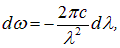
  . Taking into account the relations

we find
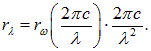
|
|
|
(1.7) |
where the minus sign indicates that as the frequency  increases, the wavelength
  decreases. Therefore in what follows, in relations connecting the lengths of intervals, we shall omit the minus sign. Thus,
|
|
|
(1.8) |
or
|
|
|
(1.9) |
Similar expressions can be written for the spectral energy density.
The study of the energy distribution in the thermal radiation spectrum of an absolutely black body at various temperatures led to the experimental establishment of the following regularities.
|
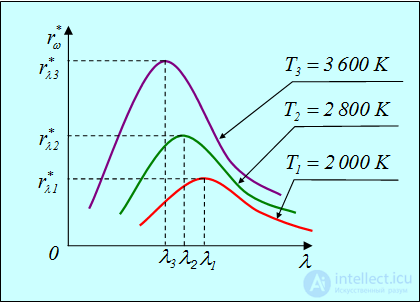
Fig. 1.6. Emissivity of a black body at different temperatures
If any body is heated, it first turns red, and as the temperature rises the glow of the body becomes ever whiter. This indicates that the maximum of thermal radiation intensity shifts toward the violet end of the spectrum, that is toward its short-wavelength part, as the temperature of the body rises. The wavelength  in the blackbody radiation spectrum, at which the maximum of the spectral radiant emittance density falls, is determined by Wien's displacement law:
|
|
|
(1.10) |
where Wien's constant 
Video 1.3. Wien's displacement law.
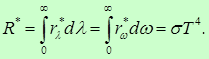
The Austrian physicist J. Stefan, who analyzed the experimental data, and L. Boltzmann, who proceeded from general thermodynamic considerations, established the dependence of the radiant emittance of an absolutely black body on temperature. According to the Stefan — Boltzmann law,
|
The radiant emittance of an absolutely black body is proportional to the fourth power of its thermodynamic temperature
|
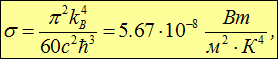
The experimentally found proportionality coefficient — the Stefan — Boltzmann constant — turned out to be equal to 
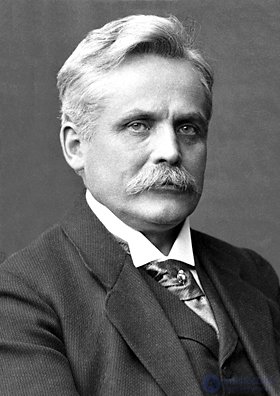
Fig. 1.7. Wilhelm Wien (1864–1928)
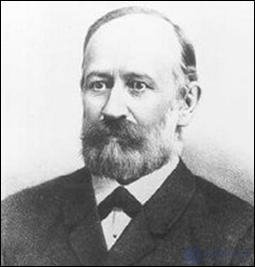
Fig. 1.8. Josef Stefan (1835–1893)
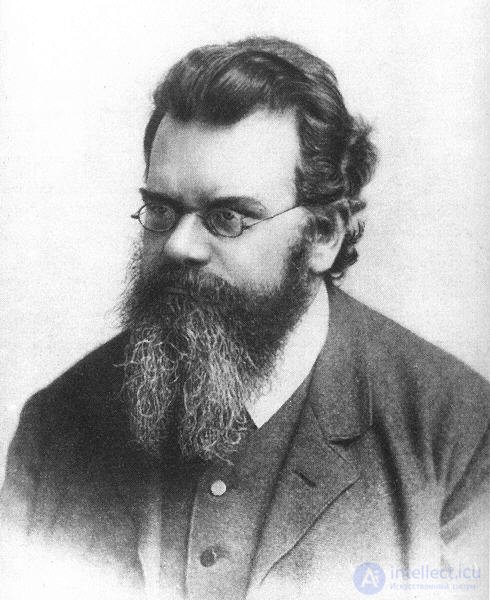
Fig. 1.9. Ludwig Boltzmann (1844–1906)
Despite detailed study of the characteristics of thermal radiation, the mathematical form of the functions  and
and  remained a puzzle for physicists for a long time.
An attempt at a rigorous theoretical derivation of the dependence  belongs to the English scientists J. Rayleigh and J. Jeans. Let us reproduce their arguments. Let the cavity be a rectangular box with linear dimensions Lx, Ly, Lz along the corresponding coordinate axes. Consider standing electromagnetic waves along the x axis. These waves are equivalent to standing waves arising on a string. Their wavelengths
  must satisfy the relation

from which for the projection of the wave vector we find

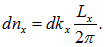
The number  numbers the different types of waves existing on a string of length Lx. Therefore the number of types of standing electromagnetic waves with wave-vector projections in the interval from kx to kx + dkx is equal to
|
|
|
(1.12) |
We reduced the result by half, because standing waves with wave numbers kx and –kx — are one and the same oscillation (there is no direction of propagation for standing waves).
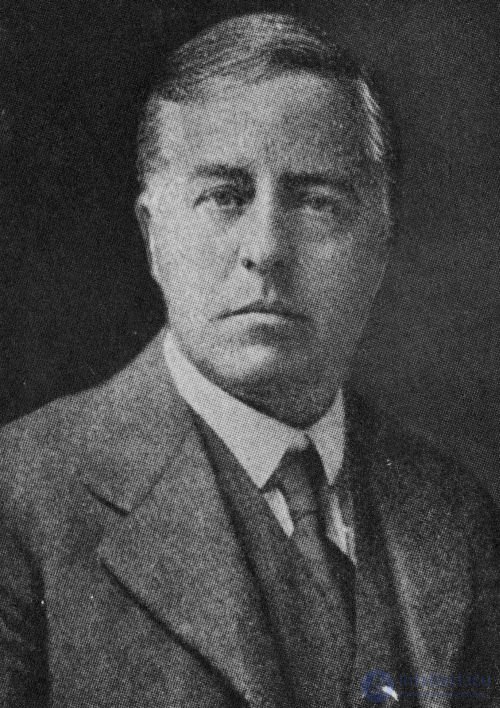
Fig. 1.10. James Hopwood Jeans (1877–1946)
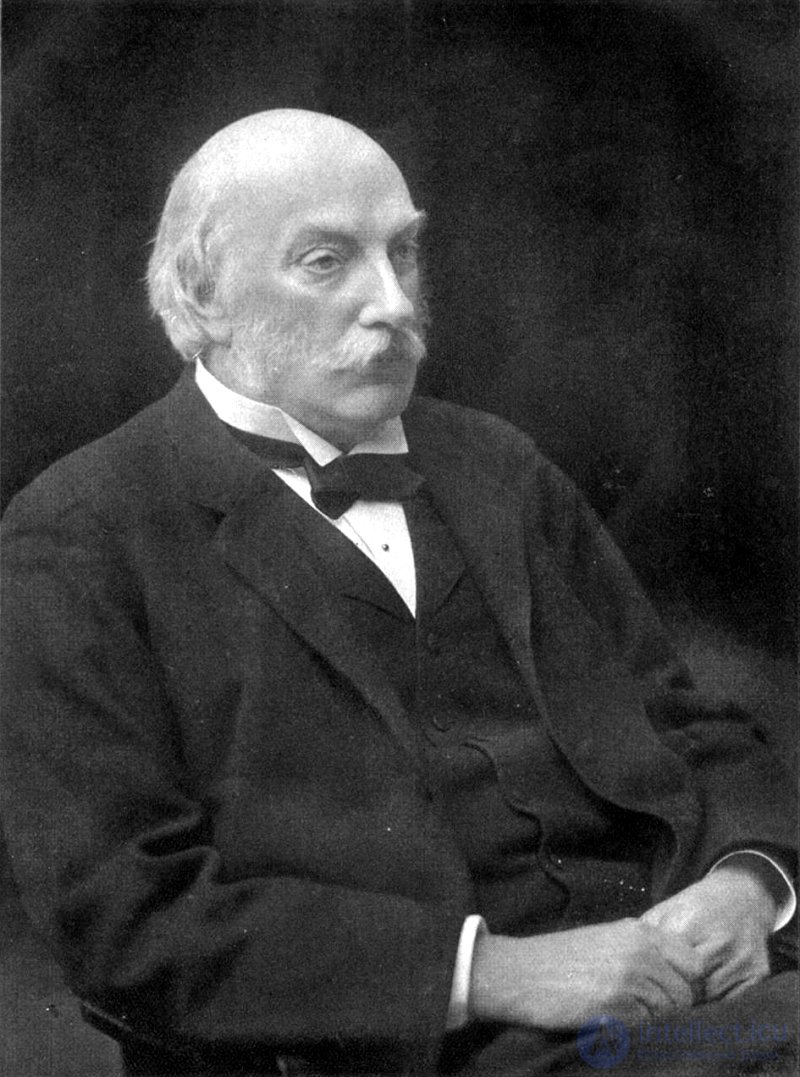
Fig. 1.11. John William Rayleigh (1842–1919)
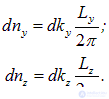
Analogous formulas can be written for standing electromagnetic waves along the y and z axes:
|
|
|
(1.13) |
Multiplying these relations, we find the total number of types of oscillations in the rectangular cavity, whose wave vectors lie in the interval from  to
to 
|
|
|
(1.14) |
Here we increased the result by a factor of two to account for the transverse nature of electromagnetic waves: for a given wavelength, oscillations can occur in two mutually orthogonal directions.
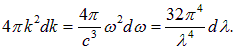
Taking into account that the frequency is determined only by the modulus of the wave vector and does not depend on its direction, let us pass to spherical coordinates and integrate over the angles (taking into account all directions), that is, let us make the substitution
|
|
|
(1.15) |
Then expression (1.14) for  takes the form:

Taking into account that

we obtain (omitting the «minus» sign)
|
|
|
(1.16) |
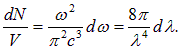
The product

is the volume of the cavity. We then find, for the number of oscillation types per unit volume:
|
|
|
(1.17) |
Next, Rayleigh and Jeans applied the classical theorem of equipartition of energy over degrees of freedom, according to which each degree of freedom in a classical statistical system carries an energy

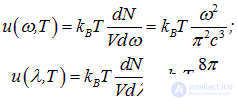
(here kB — is Boltzmann's constant). For a harmonic oscillator the average kinetic energy equals the average potential energy, and therefore its average energy equals kBT. Similarly, in an electromagnetic wave the electric and magnetic field strength vectors oscillate, giving equal contributions to the average energy flux. Therefore, for the spectral energy density of the radiation, Rayleigh and Jeans found the expressions:
|
|
|
(1.18) |
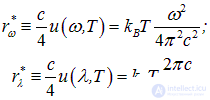
Correspondingly, for the emissivity of an absolutely black body the following relations were obtained:
|
|
|
(1.19) |
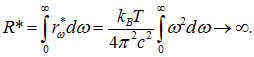
For long wavelengths the Rayleigh — Jeans formula gives good agreement with experimental data, but for short wavelengths, that is in the region of high frequencies, the calculated values of the spectral density  cease to agree with experiment (the curve goes to infinity). Moreover, the radiant emittance of a black body also turns out to be infinite:
|
|
|
(1.20) |
This situation was called the «ultraviolet catastrophe». Thus, classical physics turned out to be unable to explain important experimental data.
M. Planck pointed out a way out of the situation that had arisen, putting forward the hypothesis that electromagnetic energy is emitted and absorbed not continuously, but in separate portions (quanta)

The proportionality coefficient in the relation between the energy  and the frequency of light
  is measured in SI in J∙s and is now called Planck's constant. Its numerical value was subsequently established:

In accordance with Planck's hypothesis, the energy of the standing wave in the resonator considered above can take only a discrete set of values

that are multiples of the wave frequency.
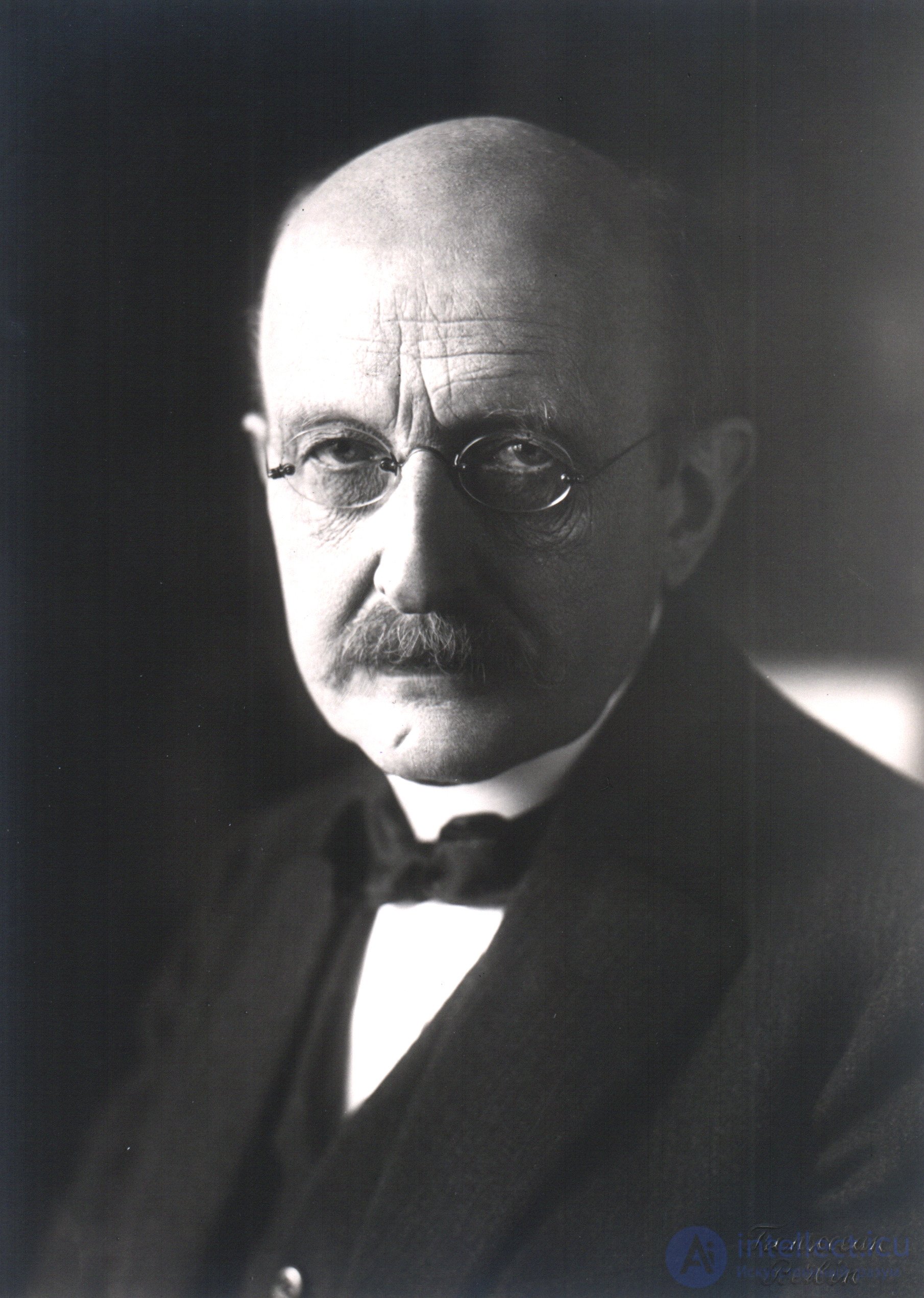
Fig. 1.12. Max Karl Ernst Ludwig Planck (1858–1947)
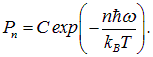
Using this relation, Planck obtained an analytical expression for the emissivity of a black body. For radiation in a state of thermodynamic equilibrium, the Boltzmann distribution is still valid. Correspondingly, the probability Pn that the energy of a standing wave with frequency  equals

is given by the formula
|
|
|
(1.21) |
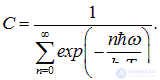
The sum of all probabilities equals unity, from which we find the normalization coefficient C:
|
|
|
(1.22) |
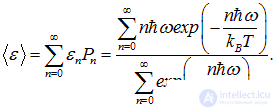
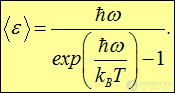
The average energy of an oscillation with frequency w equals
|
|
|
(1.23) |
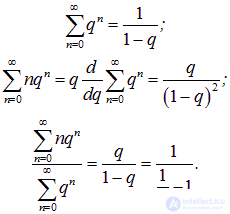
The method for calculating such sums is based on the expression for the sum of terms of a geometric progression and the formula obtained from it by differentiation:
|
|
|
(1.24) |
Substituting here

we find the expression for the average energy of a standing wave
|
|
|
(1.25) |
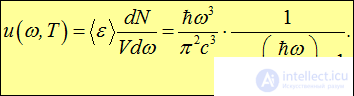
Multiplying the number of standing waves per unit volume with frequency in the interval  by their average energy (1.25), we obtain Planck's formula for the spectral energy density of thermal radiation
|
|
|
(1.26) |
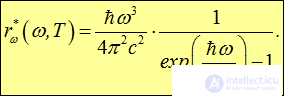
The emissivity of an absolutely black body, taking into account formula (1.6), is described by Planck's law
|
|
|
(1.27) |
At high temperatures (low frequencies)
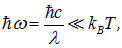
the exponential in the denominator of formulas (1.25) and (1.27) can be expanded in a series:
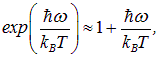
from which we obtain the classical expression for the average energy of an oscillator

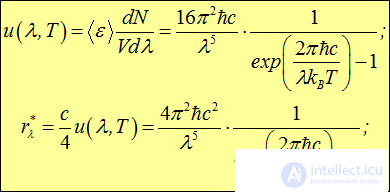
and the Rayleigh — Jeans formula (1.19). For the spectral energy density and the emissivity of an absolutely black body as functions of the wavelength  we have
|
|
|
(1.28) |
It turned out that Planck's law agrees exactly with experimental data over the entire range of wavelengths, whereas the Rayleigh — Jeans formula, as already noted, corresponds to experimental data only at large wavelengths (Fig. 1.13).
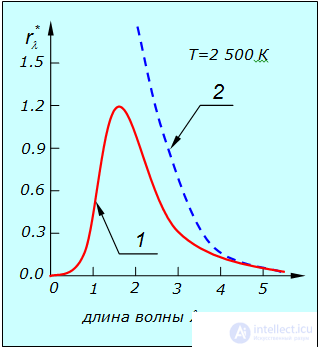
Fig. 1.13. Comparison of the emissivity of a black body  ,
,
according to Planck's law and experiment (1) and the Rayleigh — Jeans formula (2)
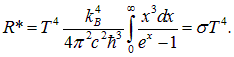
Moreover, the Stefan — Boltzmann law follows directly from Planck's law:
|
|
|
(1.29) |
Let us introduce a dimensionless integration variable
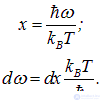
As a result of this we obtain
|
|
|
(1.30) |
Using the value of the integral
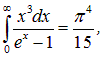
we find the analytical expression for the Stefan — Boltzmann constant:
|
|
|
(1.31) |
whose value agrees with the experimental data cited.
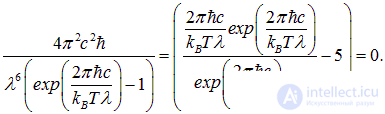
Wien's displacement law also follows from Planck's law. If we differentiate Planck's function (1.28) with respect to  , and set the derivative equal to zero, we can find the position of the maximum of the function
  . Indeed, setting the function
  equal to zero, we obtain
|
|
|
(1.32) |
Introducing the dimensionless variable

we arrive at the equation
|
|
|
(1.33) |
The root of this equation

allows us to obtain Wien's displacement law:
|
|
|
(1.34) |
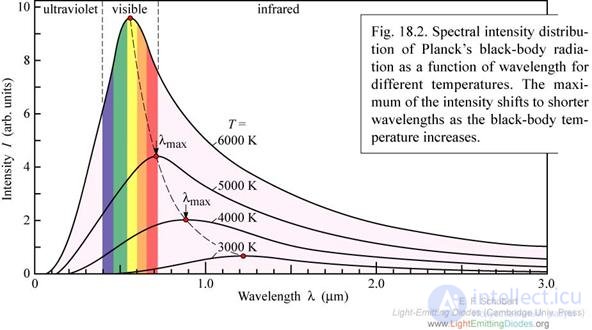
Fig. 1.14. Planck's distribution for the emissivity of an absolutely black body at different temperatures. As the temperature rises, the maximum of the spectra shifts along the dashed line toward short wavelengths, in accordance with Wien's law
Thus, Planck's formula not only agrees well with experimental data, but also contains within itself all the empirical laws of thermal radiation, and moreover makes it possible to calculate the constants in these laws.
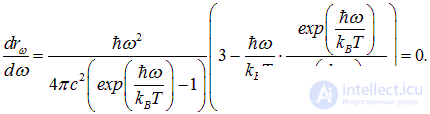
We sought the maximum of the function  with respect to wavelength. But blackbody radiation can also be characterized by the distribution (1.27)
  with respect to frequency. Let us find, for comparison, the maximum of this distribution. For this we need to find the extremum of function (1.27):
|
|
|
(1.35) |
Introducing the dimensionless variable

we obtain the equation for the maximum point of the distribution  :
:
|
|
|
(1.36) |
which has the root

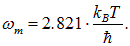
It follows that the maximum of the intensity  falls on the frequency
|
|
|
(1.37) |
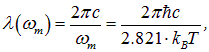
This frequency corresponds to the wavelength
|
|
|
(1.38) |
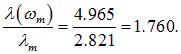
which, of course, does not determine the maximum of function (1.28) and therefore does not coincide with expression (1.34) for  from Wien's displacement law:
|
|
|
(1.39) |
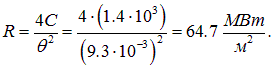
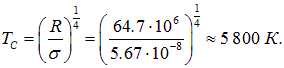
Example 1. Assuming that the Sun radiates as an absolutely black body, let us calculate its radiant emittance and surface temperature. The solar disk is seen from Earth at an angle  rad. The flux of solar energy at Earth's orbit (the so-called solar constant) is equal to C = 1.4 kW/m2.
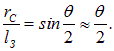
Let the radius of the Sun be rS , and the distance to Earth be lE . Their ratio is related to the angular diameter of the Sun:
|
|
|
(1.40) |
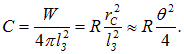
If the radiant emittance of the Sun is R, then the total energy radiated by the Sun per unit time is equal to the product of R and the surface area of the Sun:
|
|
|
(1.41) |
This energy reaches Earth's orbit, where it is distributed over a larger area  . From this we find the solar constant
|
|
|
(1.42) |
As a result we obtain
|
|
|
(1.43) |
Using the Stefan — Boltzmann formula we find the temperature of the Sun's upper layers
|
|
|
(1.44) |
Example 2. In the prophecy of Isaiah (Isa. 30:26) it is said:
«Moreover the light of the moon shall be as the light of the sun, and the light of the sun shall be sevenfold, as the light of seven days, in the day that the Lord bindeth up the breach of his people, and healeth the stroke of their wound».
Let us estimate the temperature of the environment on that day.
The flux of solar radiation falling on Earth is compensated by the energy radiated by Earth. From the condition of the problem it follows that on the specified day the energy flux (taking into account the light of the Moon) will exceed the present solar radiation flux eightfold. In a state of thermal equilibrium, the flux of thermal energy from Earth must increase by the same factor. From the Stefan — Boltzmann law it follows that the temperature on Earth must increase by
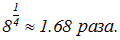
If the present average temperature is 17° C = 290 K, then with the energy flux increased by a factor of 8, it will become T = 1.68 ·290 = 487 K = 214 °C. It will be hot!
Example 3. Based on the data of Example 1, let us find the wavelength at which the maximum of the solar radiation energy falls.
Above we found the temperature of the Sun's upper layers. By Wien's displacement law we obtain
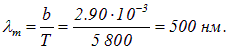
 :
:
 (spectral absorption coefficient) — is equal to the ratio of the energy absorbed by the surface of the body to the energy incident on the surface of the body. Both energies (incident and absorbed) are taken per unit area, per unit time, and per unit interval of frequency.
 is a universal function of frequency and temperature (Kirchhoff's function).

 increases, reaches a clearly pronounced maximum at some wavelength λm , and then decreases.








Comments