
Lecture
Chemical light source, chemiluminescent light source (CLS) — devices that generate light through the course of a chemical reaction: for example, the catalytic reaction of certain oxalic acid esters with hydrogen peroxide in the presence of a phosphor. The outer tube contains part of the chemical mixture. The inner tube, containing the rest of the mixture, is made of glass or another fragile material. If the light stick is bent, the inner tube breaks, and the chemicals mix. This causes a reaction that produces light but not necessarily heat. This phenomenon is called chemiluminescence.
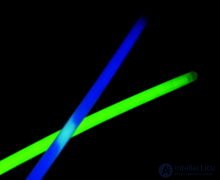
They are widely used as autonomous (up to 12 hours of glow ) light sources for various emergency rescue, road, and street works, in emergency situations, in tourism and speleology, scuba diving, for signaling, and generally as various kinds of backup illuminators, in decorative lighting, and for entertainment. Being fully autonomous, durable, fireproof, and waterproof, and suitable for long-term storage, these sources can be used in a wide range of applications. They are typically produced in the form of plastic sticks or bracelets that begin to glow with a pale light when bent.
The color of the sources can have fluorescent shades of various colors, typically green, blue, or orange .
Typically, household chemical light sources provide illuminance of about 100 lux immediately after activation, decreasing in output to 20−40 lux after 10−15 minutes .
Glow sticks are waterproof, do not use batteries, emit negligible heat, are inexpensive, and are essentially disposable. They can withstand high pressure, for example, underwater. They are used as light sources and light markers by the military, tourists, and divers. [12]
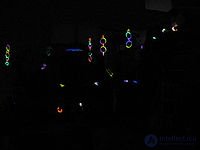
Glowsticking is the use of glow sticks in dance. [13] They are often used for entertainment at parties (in particular, raves), concerts, and dance clubs. They are used by orchestra conductors for evening performances; glow sticks are also used at festivals and holidays around the world. Glow sticks also serve several functions as toys, as clearly visible night warnings for motorists, and as light markers that allow parents to keep track of their children. Another use is for light effects carried by balloons. Glow sticks are also used to create special effects in photography and film under low-light conditions. [14]
The Guinness World Records book recorded that the world's largest glow stick cracked at a height of 150 meters (492 feet 2 inches). It was created by the Chemistry Department of the University of Wisconsin-Whitewater to commemorate the school's sesquicentennial, or 150th anniversary, in Whitewater, Wisconsin, and was cracked on September 9, 2018. [15]
Glow sticks are used for outdoor recreation, often used at night for marking. Scuba divers use glow sticks for diving to mark themselves during night dives, and can then turn off their bright dive lights. This is done to allow visibility of bioluminescent marine organisms, which cannot be seen while a bright dive light is on. Similarly, glow sticks are used on backpacks, tent hangers, and jackets during night hikes. Glow sticks are often recommended as an addition to survival kits.
There are certain industrial applications for glow sticks, which are often used as a light source in conditions where electric lighting and LEDs are unsuitable. For example, in the mining industry, glow sticks are required for emergency evacuation in the event of a gas leak. Using an electric light source in this case could cause an unintended explosion. Chemiluminescence, the type of light used in glow sticks, is a "cold light," does not use electricity, and does not cause ignition of a gas leak.
Glow sticks are also used worldwide in the maritime industry, often used as fishing lures in longline, recreational, and commercial fishing, as well as to ensure personnel safety.
Glow sticks are used by the military, and sometimes by tactical police units, to mark cleared rooms or notable objects during building clearing operations in close combat. They are also used to identify friendly soldiers during night operations. [16]
Glow sticks are used by emergency services as backup light sources. For example, glow sticks are included in UN emergency relief kits for people affected by natural disasters and humanitarian crises. Rescue teams often distribute glow sticks to keep track of people at night who may not have access to their own lighting. Glow sticks are sometimes attached to life jackets and lifeboats on passenger and commercial vessels to ensure nighttime visibility.
On public transport, such as the subway, emergency lighting stations with backlighting are sometimes available for emergency illumination to ensure passenger safety in the event of an emergency.
Regenerable "chemical light sources"
Until the end of the 1990s, products capable of continuing to work after fully fading and the completion of the chemical reaction were commercially available. After brief mechanical action lasting 1−2 minutes, the product would emit light for 1−3 hours; over 4−5 cycles of such "recharging," the glow intensity gradually decreased until it faded away completely. In the 2000s, production was discontinued due to the use of expensive materials and their high toxicity.
It is believed that glow sticks can be placed in a freezer to slow down the chemical reactions, allowing the sticks to be stored for two to three nights. Cold promotes the transition of the mixture to a solid state and slows the release of photons. Conversely, exposure to microwave radiation or hot water accelerates the release of photons and increases the brightness of the glow, but reduces its duration. This, however, generally depends on the specific composition of the chemicals in a particular glow stick.
The liquids contained in some chemical light sources (up to tens of milliliters) can pose a hazard if the source's shell is compromised and the liquid comes into contact with skin.
In glow sticks, phenol is formed as a byproduct. It is advisable to keep the mixture away from skin and to prevent accidental ingestion if the glow stick casing cracks or breaks. Upon contact with skin, the chemicals can cause mild skin irritation, swelling, or, in extreme cases, vomiting and nausea. Some of the chemicals used in older glow sticks were considered potential carcinogens. [24] Polynuclear aromatic hydrocarbons, a class of compounds known for their carcinogenic properties, are used as sensitizers.
Dibutyl phthalate, an ingredient sometimes used in glow sticks, causes certain health concerns. It was added to California's list of suspected teratogens in 2006. [25].
Glow sticks contain ingredients that act as plasticizers. This means that if a glow stick comes into contact with plastic, the plastic can become liquid. [26]
Diphenyl oxalate can cause eye burns, irritate the skin, and cause burns in the mouth and throat if ingested.
In addition, used glow sticks that remain in the environment cause long-term pollution. This Nature paper describes the many secondary reactions that continue to occur in used glow sticks and chemical lights used in the maritime industry (and are similar for all types of glow sticks). [27] "Loss of viability, cell cycle changes, and DNA fragmentation were observed in the HepG2 cell line and skin fibroblasts. A non-cytotoxic concentration of LS (Light Stick) increased the occurrence of the mutagenic lesion 1, N6-εdAdo in HepG2 DNA threefold. Furthermore, incubation of used LS contents with DNA in vitro led to the formation of dGuo-LS adducts, structural elucidation of which revealed the presence of a reactive chlorinated product. In conclusion, it was found that LS content is highly cyto- and genotoxic. Our data indicate an urgent need for guidelines on LS waste handling and for adequate information on the toxic consequences that may result from human exposure."
Glow sticks also contribute to the problem of plastic waste, since glow sticks are disposable and made of plastic. Additionally, since the inner vial is often made of glass, and the chemicals inside are hazardous if mishandled, the plastic used for glow sticks cannot be processed by recycling services, so glow sticks are classified as non-recyclable waste.
As of 2021, work is underway to create safer alternative glow sticks. The Canadian company Nyoka Design Labs [28] is developing alternatives to glow sticks. Light Wand is biodegradable and glows via bioluminescence rather than chemiluminescence. LUMI is a non-toxic, reusable alternative that glows via phosphorescence and is chemically and biologically inert.
A phosphor (from Latin lumen — light, and Ancient Greek φορός — bearing) — a substance capable of converting absorbed energy into light emission (luminescing).
The emission of light by molecules – luminescence – can occur when energy is transferred to them through various processes: – exposure to an electron flow (cathode rays) – cathodoluminescence; – thermal heating – thermoluminescence; – chemical reactions – chemiluminescence; – exposure to electric current – electroluminescence; – ultrasonic exposure – sonoluminescence; – exposure to mechanical friction – triboluminescence; – irradiation with ionizing radiation – radioluminescence; – irradiation with ultraviolet and visible light – photoluminescence or fluorescence.
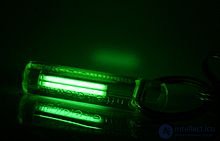
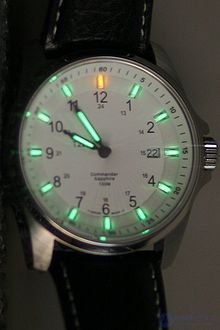

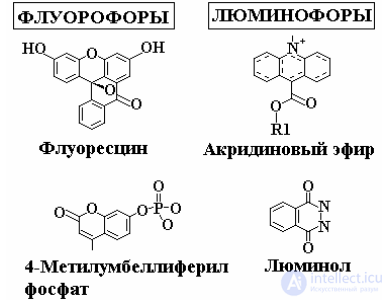
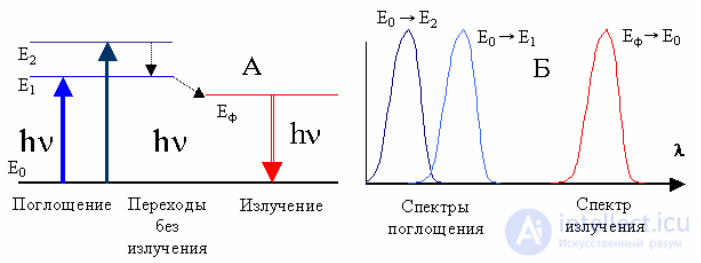
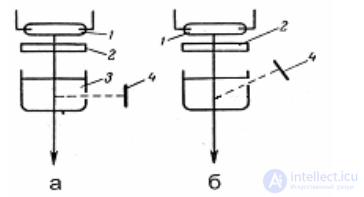
By chemical nature, phosphors are divided into inorganic (phosphors in the narrow sense), most of which belong to crystallophosphors, and organic (organoluminophores). The glow of inorganic phosphors (crystallophosphors) is caused in most cases by the presence of foreign cations contained in small amounts (from 0.0001% to 2%).
Such impurities (activators) are usually ions of transition metals; for example, the luminescence of zinc sulfide is activated by an admixture of copper ions.
Luminescence — non-thermal glow of a substance occurring after it absorbs excitation energy. Luminescence was first described in the 18th century.
One type of luminescence, chemiluminescence (glow resulting from a chemical reaction), was first observed in 1669 by Hennig Brand, who discovered phosphorus.
Until the 20th century, theoretical concepts of the nature of chemiluminescence converged on the idea that part of the energy released during a chemical reaction is not converted into heat; the atoms of the reacting substances then transition into an excited state, manifested as a glow.
In the 20th century, Kautsky and Zocher, working on unsaturated silicon compounds, discovered that under the action of light on them a very bright phenomenon of chemi-, cathodo-, and photoluminescence (phosphorescence and fluorescence) occurs. The scientists found that luminescence intensified upon cooling, which led them to the idea that the source of chemiluminescence could be the same objects that cause fluorescence, that is, atoms of the substance that do not take direct part in the chemical reaction but receive energy for glowing from the reacted particles.
In the 1920s, on the initiative of S. I. Vavilov, research began aimed at creating fluorescent lamps, light sources new for that time. At the same time, O. V. Losev discovered electroluminescence, which was subsequently used in the production of LEDs.
Since the early 1990s, in addition to traditional luminescence phenomena (gas discharge, photoluminescence, injection and field electroluminescence, low- and high-voltage cathodoluminescence), research began into cathodoluminescence in the medium energy range of the electron beam.
At present, the phenomenon of luminescence is actively used in the production of fluorescent lamps and LEDs, in phosphor screens for medical equipment, in color screens of televisions and other electronic devices, in design, as well as in safety and evacuation systems.
Every year the manufacturing technologies for luminescent substances improve, which helps create phosphors with enhanced light-emitting qualities.
The list of substances capable of producing luminescence under one or another type of excitation is quite extensive, and therefore several classification schemes exist for these compounds. Classification by excitation method is the most convenient, which is why it is the one used in most books on phosphors.
| Method of luminescence excitation | Type of phosphor |
|---|---|
| UV radiation | Photophosphor |
| Electron beam | Cathodophosphor |
| Electric field | Electrophosphor |
| α-, β- radiation from radioactive waves | Radiophosphors |
| X-ray or γ- radiation | X-ray phosphor |
| Type of luminescence | Type of absorbed energy |
|---|---|
| Photoluminescence | Electromagnetic radiation (UV, visible) |
| X-ray luminescence | Electromagnetic radiation (X-ray) |
| Cathodoluminescence | Kinetic energy of electrons |
| Electroluminescence | Energy of the electric field |
| Radioluminescence | Energy of α-, β-, γ- rays, ions |
| Chemiluminescence | Energy of a chemical reaction |
| Bioluminescence | Energy of a biochemical reaction |
| Triboluminescence | Mechanical energy of friction |
| Thermoluminescence | Thermal energy |
| Nature | Phosphor |
|---|---|
| Intracenter | A non-conducting phosphor is used, or a phosphor with discrete centers |
| Recombination | A photoconductive phosphor is used |
| Type of luminescence | Temporal characteristic |
|---|---|
| Fluorescence | Rapidly decaying |
| Phosphorescence | Long-lasting |
An important characteristic of phosphors — the absorption spectra, which reflect the dependence of the amount of absorbed energy on the wavelength of the light incident on the phosphor. The emission spectrum of a phosphor depends on the chemical nature of the activator and the phosphor host, their interaction, and, in the case of phosphors with several activators, on the interaction between the activators themselves. Emission spectra may depend on the intensity and wavelength of the exciting light, as well as on temperature.
The dependence of emission spectra on the wavelength of the exciting light can be clearly traced in the characteristic phosphors (Ca, Mg)3(PO4)2·Sn and (Ca, Zn)3(PO4)2·Sn. Their emission spectra consist of broad bands located in the red and green regions of the spectrum.
The number of substances that can be used to synthesize phosphors is quite large; however, in practice the following classes of compounds are used: chalcogenides and phosphates of group II metals, silicates, oxides, tungstates, and compounds of rare-earth elements.
Phosphor manufacturing technology belongs to the field of high-temperature fine inorganic synthesis. Phosphors are used in the form of polycrystalline powders, less often as single crystals and thin films. Phosphor synthesis is carried out at 900—1200ºC.
To obtain a phosphor with specified properties, it is necessary to strictly maintain the batch composition and calcination conditions, avoid the introduction of random impurities, and ensure thorough drying of the phosphor. It is also necessary to maintain material purity at all stages of synthesis.
Chalcogenides of group II elements
Almost all chalcogenides are photosemiconductor compounds with n-type conductivity (the impurity has a higher valence than the pure semiconductor, resulting in free electrons). Zinc telluride is characterized by hole conductivity (the impurity has a lower valence than the pure semiconductor, resulting in broken bonds — holes), while cadmium telluride exhibits both hole and electron conductivity.
Zinc and cadmium chalcogenides exhibit "self-activated" luminescence, caused by intrinsic defects or associates with halogen impurities or trivalent cations. Chalcogenides are also characterized by luminescence associated with the introduction of activating impurities.
Phosphors based on alkaline-earth metal sulfides are synthesized by calcining mixtures of the corresponding carbonates with an activator, sulfur, fluxes, and a reducing agent. The main reaction that occurs during phosphor synthesis can be represented by the equation:

Zinc sulfide can be obtained by the hydrogen sulfide method via the reaction:

The thiosulfate method for obtaining sulfides should also be mentioned, based on reactions that can be written in simplified form as:


In the synthesis of chalcogenide phosphors, the starting sulfides are prepared in advance. The synthesis takes place in 3 stages:
Preparation of the batch
The required amount of chalcogenide (powder) is weighed on a technical balance, and a specified amount of flux solution (a substance added to ore during smelting to increase the fusibility of the impurities present in it and to form slags) and activator (a substance that intensifies physical and chemical processes) is added to it. The batch (the initial mixture used in pyrometallurgical or other high-temperature processes) is thoroughly mixed.
Drying
The batch is dried at 100—120ºC in a drying oven until it becomes powdery, for a time depending on the amount of batch (approximately 0.5-1 hour).
Calcination
Calcination is carried out in a muffle furnace at a specified temperature of 900—1200ºC for a time depending on the amount of batch (about 0.5-1 hour). During the calcination stage, the phosphor formation process takes place, that is, crystallization of the base material, diffusion of the activating impurities introduced into the batch, and heterogeneous chemical and intercrystalline reactions that form various defects in the lattice.
Zinc and cadmium selenides are obtained from sulfides by a reaction that, in simplified form, looks as follows:

Phosphates of group II metals
Among phosphates, calcium phosphate finds the widest application in phosphor production and is used for fluorescent light sources. The diversity of the luminescent properties of phosphates lies in the large number of polymorphic modifications they possess and the relative looseness of their lattices, which create favorable conditions for phosphor formation. Zinc phosphate is also used for phosphor synthesis and serves as a base for synthesizing red-emitting cathodophosphors. Double phosphates of calcium and magnesium are used for synthesizing phosphors, which are subsequently used in ultraviolet lamps.
Phosphates in the solid phase can be synthesized in various ways. For example, calcium and strontium phosphates are obtained by one of the following methods:


Silicates
The most widely used silicate phosphor in production is zinc silicate, which is used as a base for green-emitting cathodophosphors. Owing to its high chemical and thermal stability and its resistance to electron bombardment, silicate phosphors are used in cathode-ray devices. Zinc silicate is prepared by calcining a mixture of ZnO and SiO2 at 1200º.
Calcium silicate activated with Pb and Mn can be obtained by calcining a mixture of the carbonates or oxides of the corresponding metals with SiO2. This requires a temperature of 1150º and a water-vapor atmosphere, which has a mineralizing effect (conversion to the solid state).
Oxide systems
Many metals of groups II, III, and IV of the periodic system exhibit luminescence under photo-, cathode, and X-ray excitation, but few have practical application. The most widely used is zinc oxide, which is employed as a cathodophosphor with a very short afterglow, as well as in low-voltage cathodoluminescent indicators.
Oxides and oxysulfides of rare-earth elements (REE) are finding increasingly wide application as a base for synthesizing cathodophosphors. Their significant advantage is greater color saturation and high stability under electron bombardment.
Tungstates
Tungstate phosphors mostly belong to the self-activated type, meaning they luminesce without the introduction of an activator.
Compounds of rare-earth elements
REE compounds successfully serve both as the host material and as the activator. Such compounds are used in the synthesis of cathodophosphors operating at high current densities of electron excitation.
The use of phosphors in engineering allows us to save on electricity, since the development of semiconductor technology has stimulated work on creating injection electroluminescent light sources. The ability to watch television is made possible by phosphors, since screens of receiving television tubes commonly use mixtures of phosphors to achieve high-brightness glow close to white. The use of phosphors in the medical field makes X-ray imaging and fluorography possible. Additionally, the ability of phosphors to glow without an electrical energy source has found application in evacuation and fire safety systems.
Inorganic phosphors are used in fluorescent lamps and cathode-ray tubes, for making X-ray screens, and serve as radiation indicators, among other uses.
Organic phosphors (sometimes called "lumogens") are used to produce bright fluorescent dyes for coloring textiles, plastics, jewelry, in printing inks, for pigmenting polymer clay, wallpaper paints, tattoo pigments, cosmetics, and luminescent materials; they are used for detecting cracks in parts, and in sensitive luminescent analysis in chemistry, biology, medicine, and forensic science.

Comments