
Lecture
Electrolytes are conducting media in which the flow of electric current is accompanied by the transport of matter. The carriers of free charges in electrolytes are positively and negatively charged ions.
The main representatives of electrolytes, widely used in engineering, are aqueous solutions of inorganic acids, salts, and bases. The passage of electric current through an electrolyte is accompanied by the release of substances at the electrodes. This phenomenon is called electrolysis (Fig.9.10).
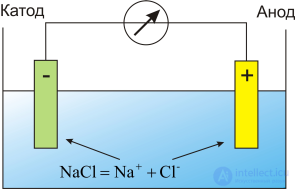
Fig.9.10
Electric current in electrolytes represents the movement of ions of both signs in opposite directions. Positive ions move toward the negative electrode (cathode), while negative ions move toward the positive electrode (anode). Ions of both signs appear in aqueous solutions of salts, acids, and alkalis as a result of the splitting of part of the neutral molecules. This phenomenon is called electrolytic dissociation.
The law of electrolysis was established experimentally by the English physicist M. Faraday in 1833.
Faraday's first law determines the amounts of primary products released at the electrodes during electrolysis: the mass m of a substance released at an electrode is directly proportional to the charge q that has passed through the electrolyte:
m = kq = kIt,
where k – the electrochemical equivalent of the substance:

F = eNA = 96485 C / mol. – Faraday's constant.
Faraday's second law the electrochemical equivalents of different substances are related to their chemical equivalents  :
:
 .
.
The combined Faraday law for electrolysis:
 .
.
Electrolytic processes are classified as follows:
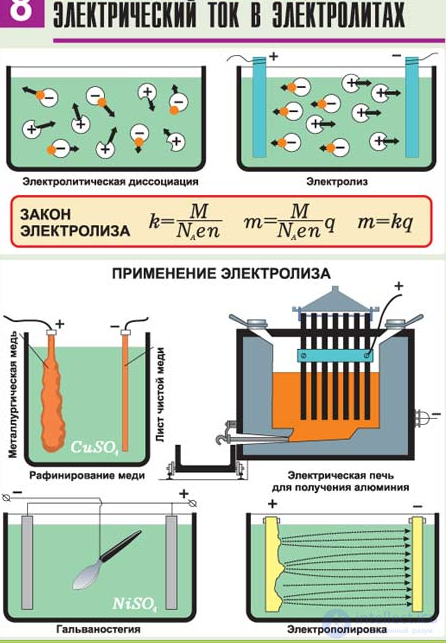
Electrochemical processes are widely used in various fields of modern engineering, in analytical chemistry, biochemistry, and so on. In the chemical industry, electrolysis is used to obtain chlorine and fluorine, alkalis, chlorates and perchlorates, persulfuric acid and persulfates, chemically pure hydrogen and oxygen, and so on. In doing so, some substances are obtained by reduction at the cathode (aldehydes, para-aminophenol, etc.), others by electrooxidation at the anode (chlorates, perchlorates, potassium permanganate, etc.).
Electrolysis in hydrometallurgy is one of the stages of processing metal-bearing raw materials, providing marketable metals. Electrolysis can be carried out with soluble anodes – the electrorefining process – or with insoluble ones – the electrowinning process. The main task in the electrorefining of metals is to ensure the required purity of the cathode metal at acceptable energy costs. In non-ferrous metallurgy, electrolysis is used to extract metals from ores and to purify them.
Aluminum, magnesium, titanium, zirconium, uranium, beryllium, and others are obtained by electrolysis of molten media. For refining (purifying) a metal by electrolysis, plates are cast from it and placed as anodes 1 in an electrolyzer 3 (Fig.9.11). When current is passed, the metal to be purified 1 undergoes anodic dissolution, that is, it passes into solution in the form of cations. These metal cations are then discharged at the cathode 2, as a result of which a compact deposit of already pure metal is formed. Impurities present in the anode either remain undissolved 4, or pass into the electrolyte and are removed.
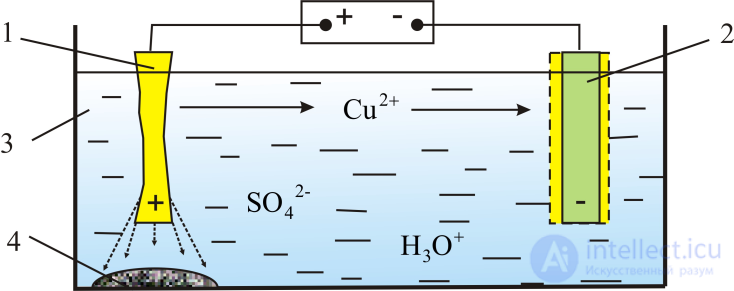
Fig. 9.11
Figure 9.11 shows a diagram of the electrolytic refining of copper.
Electroplating technology – a field of applied electrochemistry dealing with the processes of depositing metal coatings on the surface of both metallic and non-metallic articles by passing a direct electric current through solutions of their salts. Electroplating technology is divided into electroplating and electroforming.
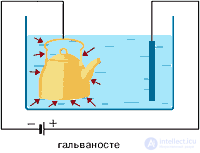
Electroplating (from the Greek for "to cover") – is the electrodeposition onto the surface of a metal of another metal, which bonds firmly (adheres) to the metal (object) being coated, which serves as the cathode of the electrolyzer (Fig. 9.12).
By the method of electroplating, a part can be coated with a thin layer of gold or silver, chromium or nickel. By means of electrolysis, the thinnest metal coatings can be deposited on various metal surfaces. In this method of applying coatings, the part is used as the cathode, placed in a solution of the salt of the metal from which the coating is to be obtained. A plate of the same metal is used as the anode.
 |
 |
||
| Fig. 9.12 | Fig. 9.13 |
We recommend watching the demonstration "Electroforming".
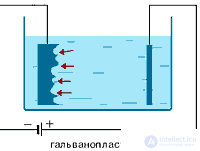
Electroforming – the production, by electrolysis, of precise, easily separable metal copies of considerable thickness from various non-metallic as well as metallic objects, called molds (Fig. 9.13).
Busts, statues, and so on are made using electroforming. Electroforming is used to apply relatively thick metal coatings onto other metals (for example, forming an "applied" layer of nickel, silver, gold, and so on).

Comments