In this topic we have already studied many regularities: in § 9-c we found out how current strengths are distributed in series and parallel connections of conductors. In § 9-d we learned how voltages are distributed in these same connections. Relying on this knowledge, as well as on Ohm's law for a section of a circuit (see § 9-e), let us derive formulas for calculating the resistances of connections of conductors.
| Series connection of conductors |
Parallel connection of conductors |
| Since |
| U = U1 + U2 |
I = I1 + I2 |
| and by Ohm's law |
| U = I · R |
I = U / R |
| we obtain: |
| I · R = I1 · R1 + I2 · R2 |
U / R = U1 / R1 + U2 / R1 |
| Taking into account that |
| I = I1 = I2 |
U = U1 = U2 |
| substituting, we obtain: |
| I · R = I · R1 + I · R2 |
U / R = U / R1 + U / R2 |
| Let us cancel the common factor: |
| 1 · R = 1 · R1 + 1 · R1 |
1 / R = 1 / R1 + 1 / R2 |
| Generalizing, we obtain: |
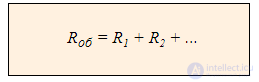 |
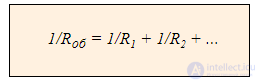 |
|
The total resistance of a series connection
of conductors is equal to the sum
of the resistances of its individual sections.
|
The quantity that is the reciprocal of the total resistance
of a parallel connection of conductors
is equal to the sum of the quantities
that are the reciprocals of the resistances of its sections.
|
Self-check questions
- Taking into account the regularities studied earlier, we ...
- In the left-hand column at the beginning of the section, we will consider ...
- In the right-hand column, by analogy, let us consider ...
- In a series connection, the total voltage ...
- In a parallel connection, the total current strength ...
- Expressing the voltage from Ohm's law, we obtain: ...
- Expressing the current strength from Ohm's law, we obtain: ...
- We obtain the formulas in the two boxes by ...
- The total is made up of the resistances of the individual sections, ...
- The sum of the quantities that are the reciprocals of the resistances of the sections is equal to ...
Let us consider the formula in the left-hand box: the total resistance is made up (summed) of the individual resistances. Since a sum is always greater than any of its terms, in a series connection of conductors the total resistance of the connection is always greater than the resistance of any of its sections. For example, suppose a connection is made up of resistors with resistances 4 Ω and 5 Ω, then the total resistance will equal 9 Ω (the total resistance is greater than the larger one).
Let us turn to the formula in the right-hand box: in a parallel connection of conductors, the total resistance of the connection is always less than the resistance of any of its sections. Let us check this using the example with the same resistances: 4 Ω and 5 Ω. Performing the calculation using the formula, we find that the total resistance of these same two resistors, connected in parallel, ≈ 2.2 Ω (the total resistance is less than the smaller one).
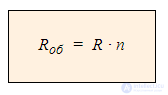
Let us continue to study physical regularities using mathematical methods. Now let us derive two additional formulas describing the total resistance of identical conductors.
Imagine, for example, that five identical resistors are connected in series. Then their total resistance will be as follows:
Rtot = R + R + R + R + R = 5·R .
Generalizing this to the case of n conductors, we obtain that their total resistance increases n-fold.
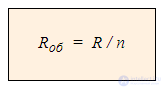
Now imagine that the same five identical resistors are connected in parallel. Then their total resistance is calculated as follows:
1 / Rtot = 1/R + 1/R + 1/R + 1/R + 1/R = 5/R .
Generalizing this to the case of n conductors, we obtain that their total resistance decreases n-fold.
Note. In deriving the last formula, we made use of a rule from algebra: if two quantities are equal to each other, then the quantities that are their reciprocals are also equal.
Self-check questions
The formula Rtot = R1 + R2 + ... shows that ...
The total resistance of a series connection is always greater than the resistance of any of its sections, ...
If conductors are connected in series, then their ...
The formula 1/Rtot = 1/R1 + 1/R2 + ... has the consequence: ...
If conductors are connected in parallel, then their ...
In the remaining part of the section, we intend to obtain the regularities, ...
The total resistance equals R·5, if ...
In a series connection of n fully identical conductors ...
The total resistance equals R/5, if ...
In a parallel connection of n fully identical conductors ...
Conclusions
For a series connection of conductors, the following laws hold:
1) the current strength is the same in all the conductors;
2) the voltage across the whole connection is equal to the sum of the voltages across the individual conductors;
3) the resistance of the whole connection is equal to the sum of the resistances of the individual conductors.
For a parallel connection of conductors, the following laws hold:
1) the voltage is the same across all the conductors;
2) the current strength at the point where the conductors join is equal to the sum of the currents in the individual conductors;
3) the quantity that is the reciprocal of the resistance of the whole connection is equal to the sum of the quantities that are the reciprocals of the resistances of the individual conductors.
See also
- series connection of conductors
- parallel connection of conductors
- mixed connection of conductors


Comments