
Lecture
In physics it always happens this way: say «A» in one place — and you have to say «B» in another, even if you don't much want to. Planck made his report on December 14, 1900, so the 20th century began with the birth of quantum theory. Planck's basic idea: any resonator radiating waves with frequency  can emit radiant energy only in portions that are multiples of a minimal «quantum of energy»

But physicists could not have imagined at the time that the successful resolution of the problems of thermal radiation would lead to the breakdown of many notions that had seemed unshakable. And the first to «suffer» was the Faraday – Maxwell electrodynamics, that «sacred cow» of classical physics, its highest achievement.
Thanks to Planck, a new fundamental constant ħ entered physics. The quantity

which appears in the formula for the energy of a quantum when not the angular frequency  but the frequency

is used, is also frequently encountered. In this case

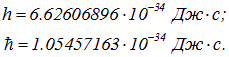
The modern numerical values of the constants h and ħ are given below:
|
|
|
(2.1) |
Planck's constant has the dimension of angular momentum L. In everyday life, values of L much larger than h are encountered. Let us give an example of the slow rotation of a light body:

This example shows why quantum discreteness is not observed in everyday life: for the same reason that a staircase with extremely low steps is perceived as a smooth slope. This suggests a way of formally passing from quantum results to classical ones: in all formulas one must let h tend to zero. This restores classical continuity. From a physical point of view, this purely mathematical device means that quantum effects are important for processes in which Planck's constant cannot be regarded as small.
Planck called the constant h the elementary quantum of action. He harbored no illusions about the problems arising in connection with his hypothesis. Indeed, ever since the time of Newton and Leibniz, who discovered differential calculus, all of physics had been based on the continuity of causal relations. Planck therefore noted that the constant h:
«is either a fictitious quantity, in which case the entire derivation of the radiation law was merely an empty game with formulas, or else h signifies something completely new and unheard of, which must bring about a revolution in our physical thinking».
In 1905, A. Einstein diverged still further from classical physics, suggesting that energy is not only emitted in portions, but also continues to exist thereafter (propagating, being absorbed) in the form of individual quanta (later, in 1926, they were aptly named photons):
«We must assume that homogeneous light consists of grains of energy of light quanta (Lichtquan-teri), that is, of small portions of energy rushing through empty space at the speed of light».
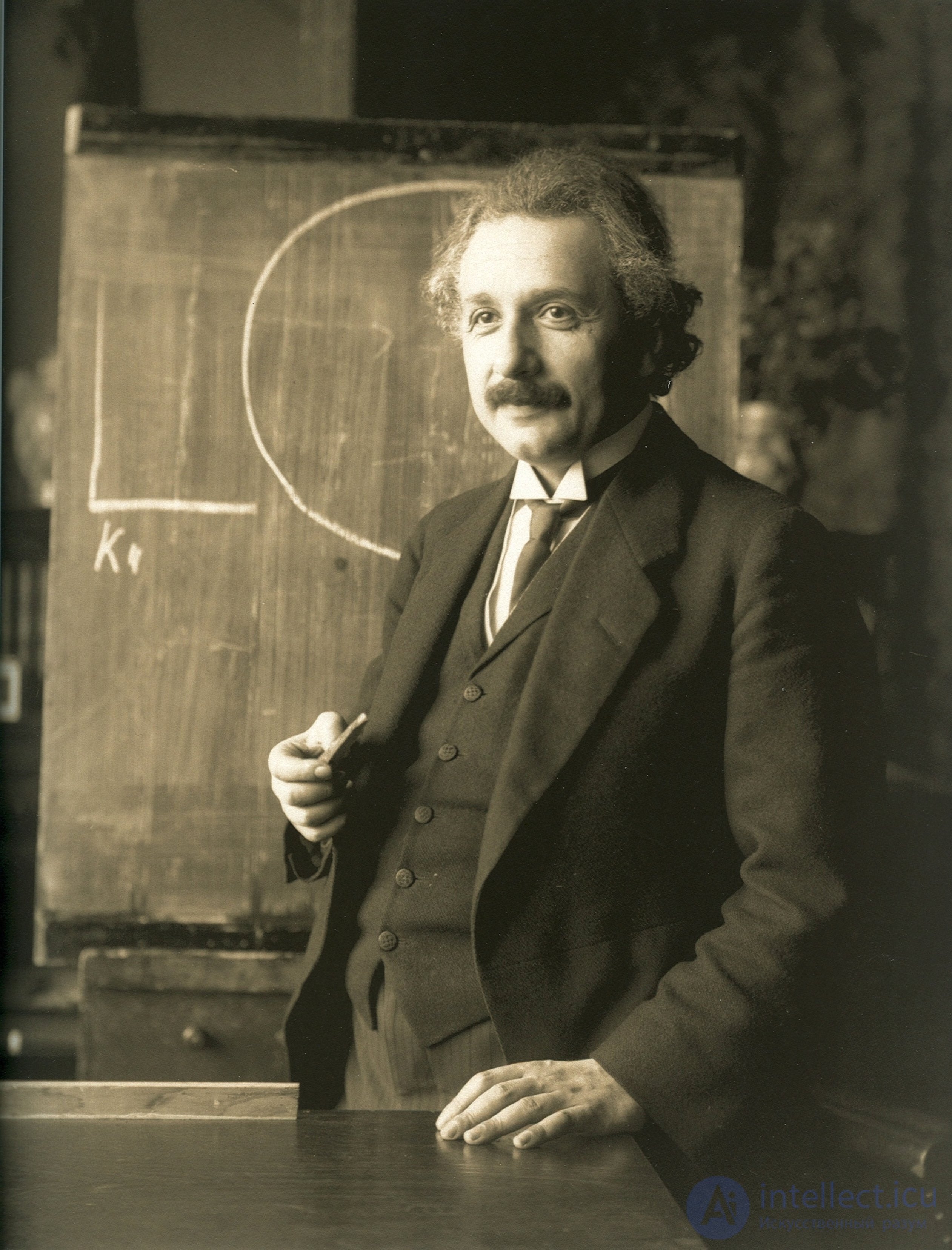
Fig. 2.1. Albert Einstein (1879–1955)
According to Einstein, the energy and momentum of light quanta are related to the corresponding wave characteristics by the relations
|
|
|
(2.2) |
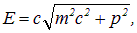
It is useful to picture for oneself the classical (non-quantum) sources of these formulas. In the theory of relativity, the relation between the energy E of a particle and its momentum p has the form
|
|
|
(2.3) |
where c — is the speed of light 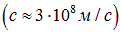 , that is, the speed of any photons. Only particles of zero mass can move at such a limiting speed. Setting
  in (2.3), we obtain, for photons, the relation between energy and momentum in the form:
|
|
|
(2.4) |
If we now apply Planck's relation to (2.4)

then for the momentum of a photon we obtain
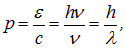
since

On the basis of formulas (2.2) the laws of the photoelectric effect were explained (see the next section).
And yet the new ideas were quite unfamiliar. The situation was discussed in 1911 at a congress attended by all the world's leading physicists. Planck said:
«When one thinks of the complete experimental confirmation that Maxwell's electrodynamics has received in the study of even the most complex phenomena of interference, when one thinks of the extraordinary difficulties that all theories would face in explaining electrical and magnetic phenomena if they were to abandon this electrodynamics, one instinctively feels an aversion to attempts to shake its foundation. For this reason we shall continue to set aside the hypothesis of «light quanta», all the more so since this hypothesis is still in an embryonic state. We shall consider that all phenomena occurring in a vacuum correspond exactly to Maxwell's equations and have no relation whatsoever to the constant h».
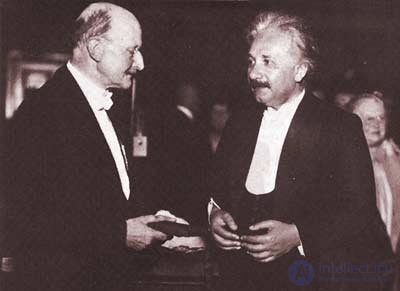
Fig. 2.2. Albert Einstein and Max Planck
A. Sommerfeld summed up the discussion:
«I think that the hypothesis of emission quanta, like the initial hypothesis of energy quanta, should be regarded rather as a form of explanation than as physical reality».
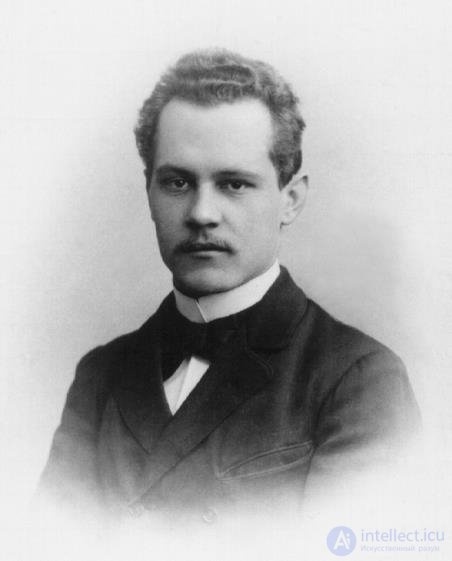
Fig. 2.3. Arnold Johannes Wilhelm Sommerfeld (1868–1951)
Thus, by 1911 the quantum hypothesis was met with instinctive rejection. But the question was settled by experimenters.
One of the phenomena confirming the photon hypothesis is the photoelectric effect.
|
The external photoelectric effect or photoelectron emission — is the emission of electrons by a substance under the action of electromagnetic radiation. |
The main influence on the character of the photoelectric effect is exerted by the properties of the irradiated material (conductor, semiconductor, dielectric), as well as by the photon energy, since for each material there exists a minimum value of photon energy below which the photoelectric effect ceases.
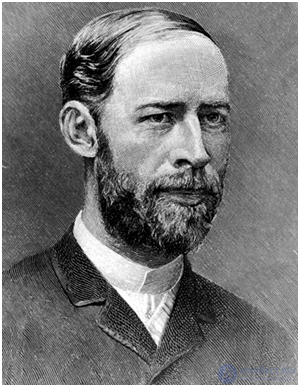
Fig. 2.4. Heinrich Rudolf Hertz (1857–1894)
The photoelectric effect was first observed by H. Hertz in 1887. The essence of the phenomenon is that when illuminated by ultraviolet rays, a metal body loses electrons. The photoelectric effect can be observed, for example, when a zinc plate connected to an electrometer is illuminated by the light of an electric arc (see Fig. 2.5).
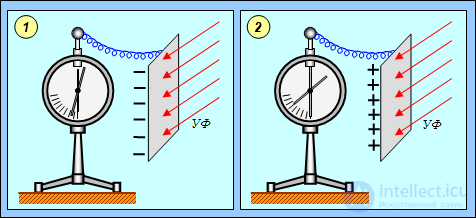
Fig. 2.5. Illumination of a charged zinc plate by the light of an electric arc:
1 — negatively charged plate; 2 — positively charged plate
If the zinc plate is charged negatively, then upon irradiation the electrometer discharges quickly. If, however, the plate is charged positively, then upon irradiation its charge does not change.
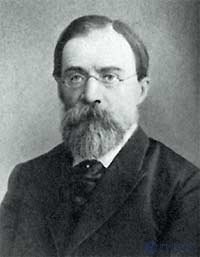
Fig. 2.6. Alexander Grigoryevich Stoletov (1839–1896)
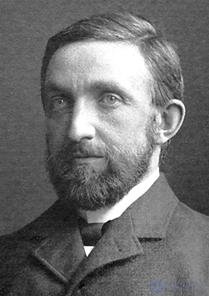
Fig. 2.7. Philipp Eduard Anton von Lenard (1862–1947)
The first quantitative studies of the photoelectric effect belong to the Russian physicist A.G. Stoletov, who established the basic laws of the photoelectric effect.
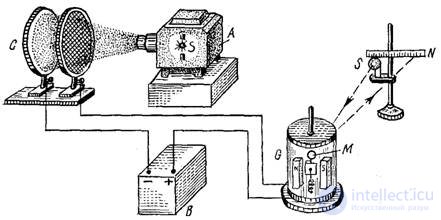
Fig. 2.8. Description of the experiment by A. G. Stoletov. «Two metal disks («mountings», «electrodes»), 22 cm in diameter, were mounted vertically and parallel to one another in front of a Duboscq electric lamp with all the glass removed. The lamp contained a voltaic-arc lamp A. One of the disks, the one nearer the lamp, was made of a fine metal mesh — brass or iron, sometimes electroplated with another metal — stretched over a circular ring; the other disk was solid (a metal plate)» [Stoletov A. G. Selected Works / Ed. A. K. Timiryazev.— Moscow; Leningrad: State Publishing House of Technical and Theoretical Literature, 1950. — 660 p.]. Measurements were taken with a mirror galvanometer G; the current source B consisted of galvanic batteries made up of varying numbers of cells.
Later, Stoletov's apparatus was improved by P. E. A. Lenard (Nobel Prize in 1905 for research on cathode rays) and by other researchers (Fig. 2.2).
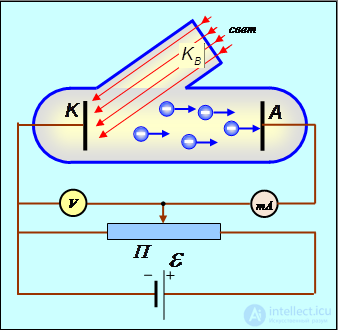
Fig. 2.9. Diagram of experiments studying the external photoelectric effect
Light passing through the quartz window KW (quartz transmits ultraviolet rays) illuminates the cathode K, made of the material under study. Electrons emitted as a result of the photoelectric effect move under the action of the electric field toward the anode A. A photocurrent, measured by a milliammeter, arises in the circuit. Using the potentiometer P, the voltage between the cathode and anode can be varied; it is displayed by the voltmeter V.
These studies led to the establishment of the following basic laws of the photoelectric effect:
|
1. The charges emitted under the action of light are negative. 2. The magnitude of the charge emitted by a body is proportional to the light energy it has absorbed. 3. Ultraviolet rays have the greatest effect. The maximum kinetic energy of photoelectrons does not depend on the intensity of the incident light, but, other conditions being equal, is determined solely by the frequency of the incident monochromatic light and increases with increasing frequency. 4. The photoelectric effect is inertialess, that is, the photocurrent appears practically simultaneously with the illumination of the cathode (delay |
Let us analyze the current-voltage characteristic (that is, the dependence of the photocurrent I on the voltage between the electrodes U), obtained as a result of the photoelectric effect. From the curve in Fig. 2.10 it can be seen that at a certain voltage  the photocurrent reaches saturation — all the electrons emitted by the cathode reach the anode.
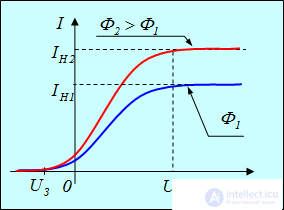
Fig. 2.10. Current-voltage characteristic of the photoelectric effect
Consequently, the saturation current  is determined by the number of electrons emitted by the cathode per unit time under the action of light. Therefore the saturation photocurrent is directly proportional to the luminous flux
|
|
|
(2.5) |
where k — is the proportionality coefficient characterizing the «sensitivity» of a given substance to light.
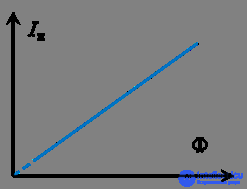
Fig. 2.11. Dependence of the saturation photocurrent on the luminous flux
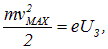
Analysis of the curve shows that electrons leave the cathode with various speeds. Some electrons have sufficient speed to reach the anode «on their own» at U =0 and produce a photocurrent without the help of an accelerating field. To reduce the photocurrent to zero, a certain retarding voltage  must be applied. From the magnitude of the retarding potential difference , at which the photocurrent becomes zero, the speed of the fastest photoelectrons can be determined:
|
|
|
(2.6) |
where  — are the mass, the magnitude of the charge (e>0), and the maximum speed of these electrons. It was established experimentally that the maximum speed of photoelectrons does not depend on the intensity of the light, but depends only on the frequency of the radiation
  . The growing linear dependence
  in Fig. 2.4 indicates that an increase in frequency leads to an increase in the maximum speed of the photoelectrons.
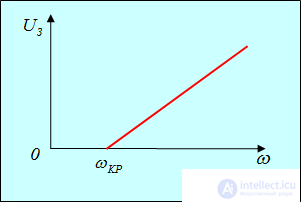
Fig. 2.4. Dependence of the retarding voltage on frequency
This experimental dependence does not fit within the framework of classical electrodynamics, since, by classical concepts, the speed of photoelectrons should depend on the intensity of the electromagnetic wave, not on its frequency.
In 1905, A. Einstein showed that all the laws of the photoelectric effect are readily explained if one assumes that light propagates and is absorbed in the same discrete portions (quanta)  , in which, according to Planck's hypothesis, it is emitted. When interacting with an electron of a substance, a photon can exchange energy and momentum with it. The photoelectric effect arises from an inelastic collision of a photon with an electron. In such a collision the photon is absorbed and its energy is transferred to the electron. Thus, the electron acquires kinetic energy not gradually, but instantaneously — as a result of a single collision event. This explains the inertialess nature of the photoelectric effect.
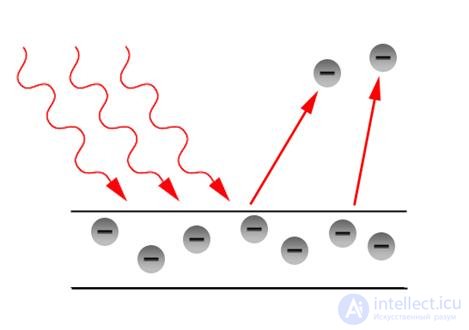
Fig. 2.13. Diagram of the occurrence of the photoelectric effect in a metal under the action of incident photons
The energy received by the electron is delivered to it in the form of a quantum . Part of this energy is spent by the electron on «escaping» from the metal. Each material has its own work function Aout
|
Work function — is the smallest energy that must be imparted to an electron in order to remove it from a substance into vacuum. |
The remainder of the photon energy  is converted into the kinetic energy K
  of the electron. The kinetic energy is maximal if the electron is formed near the surface of the substance and does not lose energy in random collisions within the substance. In this case Einstein's relation for the photoelectric effect (2.7) will hold.
|
|
|
(2.7) |
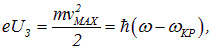
The 1921 Nobel Prize in Physics was awarded to Einstein for his «important contributions to theoretical physics, and especially for the discovery of the law of the photoelectric effect». (The famous theory of relativity is not even mentioned in this formulation). Einstein's equation makes it possible to explain the laws of the photoelectric effect. Indeed, it follows directly from Einstein's relation that the maximum kinetic energy of a photoelectron increases linearly with increasing frequency of the incident radiation and does not depend on its intensity. Since the kinetic energy of the photoelectrons decreases as the frequency of the incident light decreases (for a given cathode material Aout is constant), then on reaching a certain critical frequency  the kinetic energy of the photoelectrons becomes zero and the photoelectric effect ceases.
According to Einstein, the frequency
|
|
|
(2.8) |
represents the red limit of the photoelectric effect for a given substance. It depends only on the work function of the electrons, that is, on the chemical nature of the substance and the state of its surface.
Using expression (2.8) for the red limit and relation (2.6), let us rewrite Einstein's equation in the form
|
|
|
(2.9) |
which explains the experimentally observed linear dependence (see Fig. 2.4) of the retarding potential on the frequency of the incident electromagnetic radiation.
Thus, according to Einstein, light of frequency w is not only emitted, as Planck had assumed, but also propagates through space and is absorbed by matter in separate portions (quanta), whose energy is

In 1914, modified experiments on the photoelectric effect were carried out:  rays were directed onto metallic dust placed in a capacitor. The photoelectric effect is practically instantaneous: when a dust particle collides with photons, electrons are knocked out of it, the particle acquires a charge and begins to move in the field of the capacitor. Motion of the dust particles was observed immediately after the source of radiation was switched on. If the radiation were a classical electromagnetic wave, the wave would need a clearly noticeable amount of time, observable in the experiment, to shake up the electrons, impart to them an energy equal to the work function, and thereby knock them out of the particle. The absence of such a delay clearly demonstrated the corpuscular nature of the photoelectric effect.
The operation of devices called photocells is based on the photoelectric effect. Fig. 2.14 shows the design of a vacuum photocell.
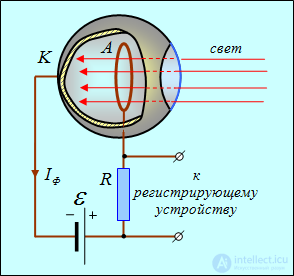
Fig. 2.14. Design of a vacuum photocell
A light-sensitive layer, serving as the cathode, is deposited on the inner surface of the metal bulb. It is connected to the negative terminal of the current source. A wire ring, serving as the anode, is placed at the center of the bulb. The anode is connected to the positive terminal of the current source. Through a transparent window in the front wall of the bulb, light enters and, passing through the wire ring, knocks photoelectrons out of the cathode. Under the action of the electric field, the photoelectrons move toward the anode, the circuit closes, and a current Iph begins to flow through it. If an opaque obstacle appears in the path of the light rays, light stops reaching the cathode, photoelectron emission ceases, and the current in the circuit is interrupted. This triggers some relay connected to a recording device.
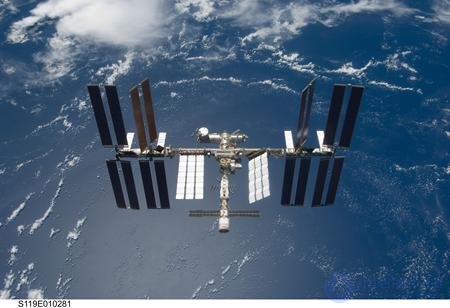
Fig. 2.15. Solar panels on the International Space Station. When the contact region of different semiconductors is illuminated, a photo-emf arises, which makes it possible to convert light energy into electrical energy.
Photocells are the main part of all kinds of photorelays, which have found wide application in industry. Photorelays make it possible to control various devices and installations, switching them on and off automatically when the photocell is illuminated by light, or, conversely, when the light is switched off.
Example 1. Monochromatic light with wavelength  is incident on the surface of lithium. To stop the emission of electrons, a retarding potential difference
  of no less than
  must be applied. Let us determine the work function
  .
.
The photon energy equals
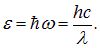
The maximum kinetic energy of the electrons equals the product  . From this we find the work function
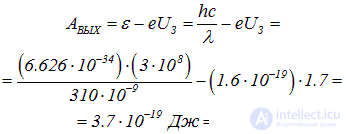
Later we will discuss in more detail the already-mentioned non-SI unit of energy — the electron-volt 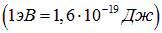 .
.
Example 2. Determine the maximum speed of electrons ejected from a metal under the action of quanta with wavelength 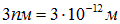 .
.
The energy of quanta
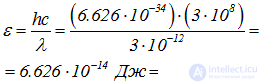
substantially exceeds the work function of electrons for any metal (no more than a few eVeV). Therefore, in Einstein's equation (2.7), the work function Aout can be neglected. Taking into account that the rest energy of an electron is approximately  , that is, close to its kinetic energy
  , relativistic formulas must be used to calculate the electron speed in this case, namely: the kinetic energy K equals
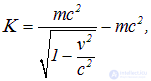
where  — is the maximum speed of the electrons, c - the speed of light in vacuum.
Then Einstein's equation takes the form
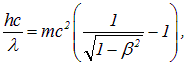
where

Solving it, we find the electron speed

which indeed turns out to be close to the speed of light in vacuum 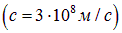 .
.
The existence of photons received direct confirmation in the experiment of W. Bothe. A thin metal foil F was placed between two symmetrically arranged counters 1 and 2 (Fig. 2.16).
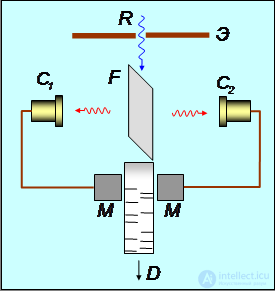
Fig. 2.16. Diagram of Bothe's experiment
The foil was illuminated by a weak beam of X-rays R, under whose action it itself became a source of X-rays (this phenomenon is called X-ray fluorescence). Because of the low intensity of the primary beam, the number of quanta emitted by the foil was quite small. The arrival of X-rays at each of the counters causes it to trigger immediately (in less than  s) and sets in motion a special mechanism, which makes a mark on a moving tape D. If the radiated energy propagated uniformly in all directions, as follows from wave concepts, both counters 1 and 2 would have to trigger simultaneously, and the marks on the tape would fall symmetrically opposite one another. In reality, however, a completely random arrangement of marks was observed. This can be explained only by the fact that, in individual acts of emission, the foil F emits light quanta flying now in one direction, now in another. Thus, the existence of special light particles — photons possessing energy and momentum — was experimentally proven.
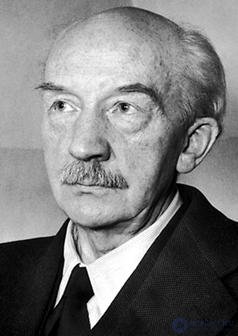
Fig. 2.17. Walther Wilhelm Georg Bothe (1891–1957)
The corpuscular properties of light are most vividly and fully manifested in the Compton effect. The American physicist A. Compton, while studying the scattering of monochromatic X-rays by substances with not very large atomic numbers (for example, boron or graphite), discovered that, along with radiation of the original wavelength  , the scattered radiation also contains radiation of longer wavelengths
  . From the standpoint of wave optics this looked just as strange as if a man in a blue sweater, looking in a mirror, saw himself dressed in red. But it is precisely in this «reddening» that the essence of the observed effect lies, and it received a simple explanation within the framework of the photon concept: because of the conservation law, part of the photon momentum is transferred to the electron, the photon energy decreases and, consequently, its frequency decreases, that is, the photon «reddens».
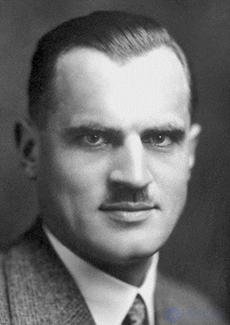
Fig. 2.18. Arthur Holly Compton (1892–1962)
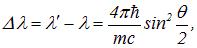
Experiments showed that the difference

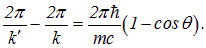
does not depend on the wavelength  of the incident radiation or on the nature of the scattering substance, but is determined only by the scattering angle
  between the directions of the scattered radiation and the primary beam:
|
|
|
(2.10) |
where  — is the wavelength of the scattered radiation, m — the rest mass of the electron,
  — Planck's constant, c — the speed of light in vacuum.
In light substances, with which Compton's experiments were carried out, the binding energy of an electron with an atom and the kinetic energy of the electron's motion around the nucleus are small compared to the energy transferred to it by the X-ray quantum during the collision, that is, in light atoms the binding energy of the electron within the atom can be neglected and all electrons can be regarded as free and at rest.
Let us consider the collision of a photon with a free electron at rest, applying the laws of conservation of energy and momentum, as in the collision of elastic balls (Fig. 2.19).
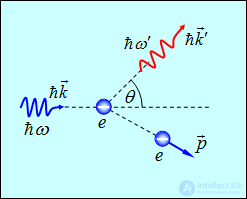
Fig. 2.19. The Compton effect as an elastic collision of a photon with an electron
A photon with energy  and momentum
 is incident on an initially resting free electron
  . The energy of the electron before the collision equals
  (
( — the mass of the electron). After the collision, the electron, as a result of recoil, will possess momentum p and energy
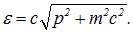
The energy and momentum of the photon after scattering will change and become equal to  and
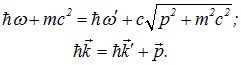
and  . Let us write the laws of conservation of energy and momentum:
|
|
|
(2.11) |
Taking into account that  , let us rewrite the law of conservation of energy in the form
|
|
|
(2.12) |
or
|
|
|
(2.13) |
Squaring the equation of the law of conservation of momentum gives
|
|
|
(2.14) |
Equating the right-hand sides of the resulting relations (2.13) and (2.14), we find
|
|
|
(2.15) |
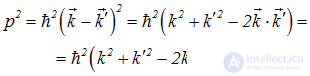
After dividing (2.15) by the product  and multiplying it by
  we obtain
|
|
|
(2.16) |
The wavelength of the photon is related to the wave number by  , therefore
|
|
|
(2.17) |
where the quantity
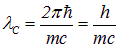
is called the Compton wavelength of a particle of mass m (in this case — the electron). The quantity

is also called the Compton wavelength of the electron, so we will distinguish between their notations:  and
and  .
.
Experiments show that the scattered radiation contains an unshifted line (radiation of the original wavelength), which can be explained as follows. The magnitude of the shift  , as we established when we considered the scattering of a photon by a free electron, is inversely proportional to its mass. However, a photon can exchange energy and momentum with the atom as a whole. Since the mass of the atom is large compared to the mass of the electron, a negligibly small fraction of the photon's energy is transferred to the atom. Therefore, in this case the wavelength
  of the scattered radiation will practically not differ from the wavelength of the incident radiation.
When electromagnetic waves fall on some surface, they exert pressure on that surface. Light pressure can be explained both from the electromagnetic point of view and within the framework of quantum theory.
Suppose a plane electromagnetic wave falls normally on the surface of a metal; then the electric and magnetic field vectors of such a wave are parallel to the surface. Under the action of the electric field E the electrons begin to move parallel to the surface. In this case, on each electron moving with speed  , the magnetic field of the light wave, with flux density
  exerts a Lorentz force

directed into the metal, perpendicular to its surface. Thus, the light wave must produce pressure on the surface of the metal.
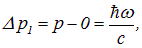
Within the framework of the quantum photon theory, light pressure arises because each photon not only carries energy  , but also possesses momentum
  . Each absorbed photon transfers its momentum to the surface
|
|
|
(2.18) |
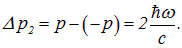
and each reflected photon — twice its momentum
|
|
|
(2.19) |
Suppose a flux of photons Nph falls normally on the surface of some body (Nph — the number of photons falling on a unit area per unit time). If the surface of the body has a reflection coefficient  , then per unit time
  photons will be reflected from it, while
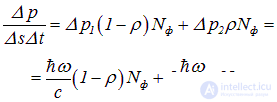
  photons will be absorbed by the surface. The momentum received by a unit area of the body's surface per unit time equals
|
|
|
(2.20) |
According to Newton's second law,  is the force
  normal to the surface (in this case
  is the force of pressure), and the quantity
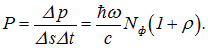
  — is the pressure. Thus, the light pressure equals
|
|
|
(2.21) |
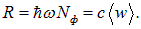
The quantity equal to the product of the photon energy ħw and the number of photons Nph falling on a unit area of the body per unit time is the density of the light energy flux R. The same quantity can be obtained by multiplying the average energy density in the wave by the speed of light:
|
|
|
(2.22) |
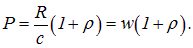
Therefore
|
|
|
(2.23) |
We have already discussed this formula for  and
and  earlier, when we considered the pressure of electromagnetic waves.
Example. Let us determine the pressure P of sunlight on a blackened plate positioned perpendicular to the sun's rays and located outside the Earth's atmosphere near the Earth.
The solar constant, that is, the flux density of the energy of solar electromagnetic radiation near the Earth outside its atmosphere, is approximately equal to  . A blackened plate absorbs practically everything, that is, for an estimate we can take . From this, the pressure

Light pressure plays an enormous role in orienting comet tails relative to the Sun. Dust particles and gas molecules present in comets experience light pressure from the sun's rays, as a result of which the characteristic shapes of comet tails are formed, oriented in the direction opposite the Sun. (At present it is assumed that the formation of comet tails is partly determined by a «proton» wind emanating from the Sun.)
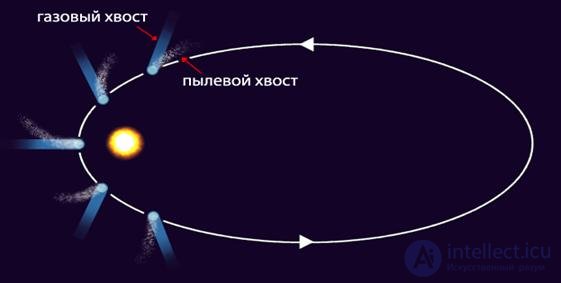
Fig. 2.20. Light pressure deflects a comet's tail away from the Sun
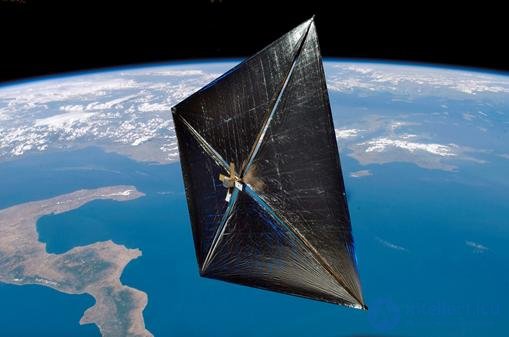
Fig. 2.21. Project of a solar sail in Earth orbit, propelled by light pressure
Thus, both the electromagnetic (wave) and photon (quantum) theories account equally successfully for the mechanism and laws of light pressure.
Let us sum up:
|
1. In the phenomena of propagation and reflection of light (diffraction and interference), light behaves as a wave with such typically wave characteristics as frequency 2. In the phenomena of emission and transfer of energy, light behaves as a particle, characterized by energy 3. Planck's constant numerically relates the corpuscular characteristics to the wave characteristics. |
Therefore, one is forced to acknowledge the dual nature of the photon. So far in our course this unusual property — wave-particle duality — has been established only for light.
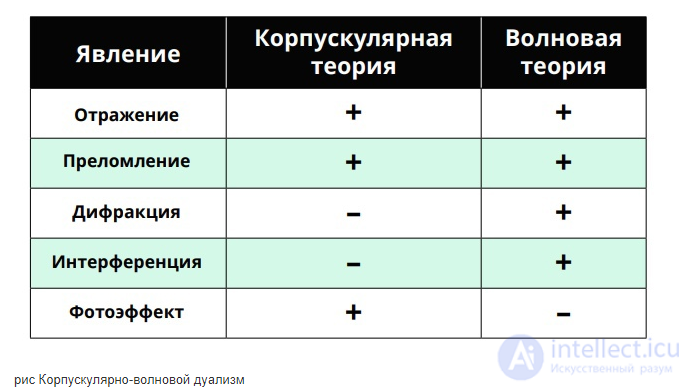
fig. Wave-particle duality


 ).
).






 and wavelength
  .
. and momentum
  .
.
Comments