
Lecture
General requirements placed on a theory of development.
1. Consistency
2. Coherence
3. Simplicity
4. Generality
5. Empirical grounding
6. Reliability
7. Logicality
8. Confirmability
9. Effectiveness
Criteria for evaluating a theory of development
1. Image of the human being
2. Scope of description
3. Age periods
4. Direction of development
5. Kind of change
6. Processes of development
7. Driving forces of development
8. Possibility of external influence
9. Pedagogical significance
10. Clinical significance
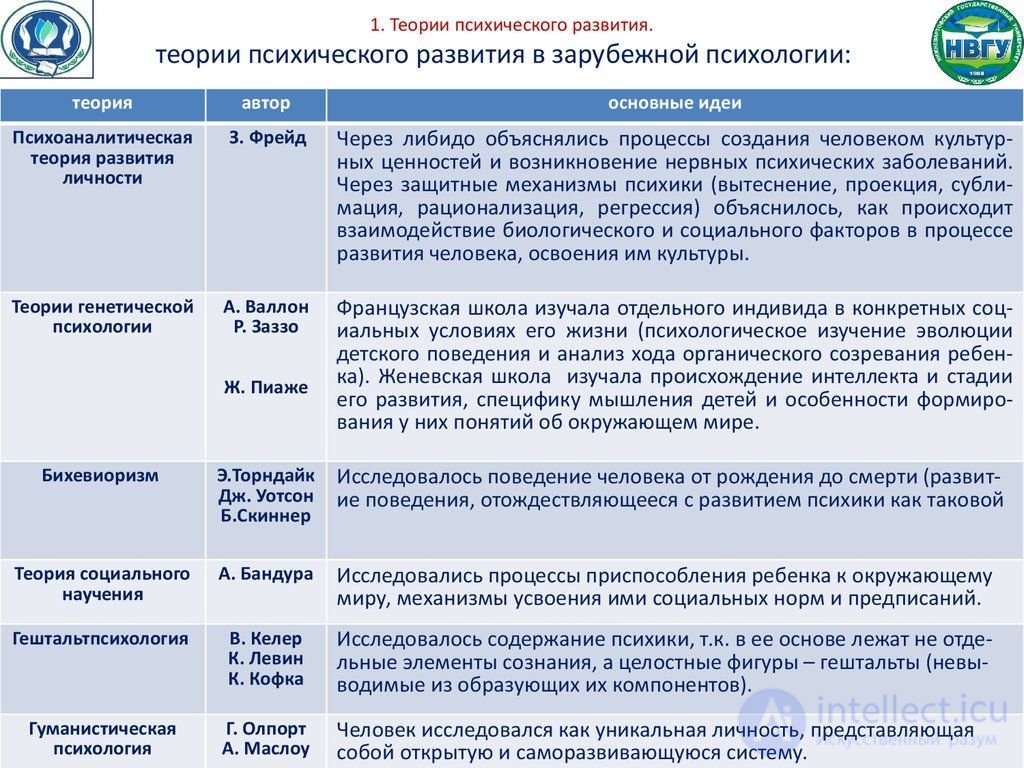
The endogenous direction.
Early theories of maturation. The ideas of Aristotle on development, J.-J. Rousseau,
and J.A. Comenius
A. Gesell's theory of maturation.
He developed a practical system for diagnosing the psychic
development of a child from birth to youth. For the objectivity of
his observations he was the first to use semi-transparent glass
(the famous «Gesell dome»).
A. Gesell introduced into psychology the longitudinal method of studying
the psychic development of the same children from birth through
adolescence. He was one of the first to use the twin method to analyze
the relationship between maturation and learning. In the last years of his life, A.
Gesell used the comparative-genetic method; he studied
the psychic development of a blind child in order to more deeply understand
the features of normal development. Widely used in clinical practice
is A. Gesell's «Atlas of Infant Behavior»,
containing 3200 photographs recording the motor activity and
social behavior of a child from birth to two years of age.
In his research A. Gesell confined himself to the quantitative
study of comparative cross-sections of child development, reducing development to a
simple increase, a «growth of behavior», without analyzing the qualitative
transformations in the transition from one developmental stage to another,
and emphasized the dependence of development solely on the organism's maturation. A. Gesell
drew attention to the slowing of the pace of development with age: the younger
the child, the faster the changes in his behavior occur.
The theories of H. Werner and A. Busemann.
The exogenous direction.
I.P. Pavlov and classical conditioning.
Behaviorism. There are various conceptions of learning. In
classical conditioning of the Pavlovian type, subjects begin
to give the same response to different stimuli
E. Thorndike and operant conditioning. In the earliest
research on learning, the idea of pairing a
stimulus and a response, conditioned and unconditioned stimuli, came to the fore: the
temporal parameter of this link was identified.
B. Skinner's theory. In operant learning, according to Skinner,
a behavioral act is formed through the presence or absence
of reinforcement of one of a set of possible responses.
A. Bandura believed that reward and punishment are not sufficient to
teach new behavior. Children acquire new behavior through
imitation of a model. Learning through observation, imitation and identification
– a third form of learning. One manifestation of imitation is identification.
This is a process in which the personality borrows thoughts, feelings or actions from
another personality acting as a model. Imitation leads to
the child being able to imagine himself in the model's place and to experience
sympathy and affection for that person.
Social learning theory examines not only how
socialization occurs, but also why it occurs. It examines
the satisfaction of the child's biological needs by the mother,
reinforcement of social behavior, imitation of the behavior of strong
personalities, and other influences of the external environment.
The developmental theories of S. Bijou and D. Baer. R. Sears's theory.
The psychoanalytic direction.
S. Freud's classical psychoanalysis.
In psychic life S. Freud distinguished three levels: consciousness;
the preconscious; the unconscious. He considered them in unity. In the early
1920s S. Freud described three basic structures of personality: the Id, the Ego,
and the Superego.
The Id is the original system of personality. It includes everything psychic that
is innate and present at birth, including the instincts.
The Ego – the organized part of the Id – emerges in order to follow
the Id's aims without frustrating them. Its main function – is to mediate
between the instinctive demands of the organism and the conditions of the environment. The Superego
– is the moral force of the personality; it represents an ideal. Its main
task – is to assess the rightness or wrongness of something, based on
the moral standards sanctioned by society. The Superego stands
in opposition to both the Id and the Ego and tries to build the world in its own image.
Features of development according to S. Freud:
• The determining factor in human development is the sexual instinct,
progressing from one erogenous zone to another over the course of a person's
life.
• Development – is a biologically determined sequence,
unfolding in a fixed order.
• Social experience is reflected in the form of acquired attitudes, traits,
and values.
E. Erikson's theory of psychosocial development.
E. Erikson – a follower of S. Freud, he expanded the Freudian
concept, going beyond its bounds. Following S. Freud he accepts
unconscious motivation, but devotes his research mainly
to the process of socialization, the child's inclusion into society.
The humanistic direction
C. Rogers's humanistic theory of development.
The phenomenological direction in personality theory emphasizes the idea
that:
• a person's behavior can be understood only in terms of his
subjective perception and cognition of reality.
• people are capable of determining their own destiny; they are responsible for what
they are.
• people are at their core good and possess a striving toward perfection.
People naturally and inevitably move in the direction of greater
differentiation, autonomy and maturity.
The basic concepts in C. R. Rogers's theory:
•self-actualization,
•the «self-concept»,
•congruence/incongruence.
•acceptance.
The main tendencies of personality development:
•the individual possesses an innate tendency toward actualization (the basic
striving of a living organism – to preserve and enhance itself);
•in accordance with the striving toward actualization, the individual's behavior
represents a purposeful attempt to satisfy the need
for actualization within the reality that he experiences;
•the individual takes part in the process of evaluating his own experience or behavior
in accordance with the tendency toward actualization;
•experience that promotes the enhancement and preservation of the organism
is subjectively evaluated positively, while what is perceived as an obstacle
to such preservation – is evaluated as negative;
•the individual's behavior is characterized by approach toward positively
evaluated experiential data and avoidance of data that have received
a negative evaluation.
A. Maslow's humanistic theory
A. Maslow believed that people are motivated to seek personal goals, and
this makes their lives significant and meaningful. A. Maslow proposed
that all human needs are innate and that they are organized into
a hierarchical system of priority or dominance. The dominant
needs, located at the bottom, must be more or less
satisfied before a person can become aware of and be
motivated by the needs located above them. Satisfaction of the
needs located lower in the hierarchy makes possible awareness of
the needs located higher in the hierarchy, and their involvement in motivation.
A. Maslow proceeded from the assumption that the hierarchy of needs extends to
all people, and the higher a person is able to climb in this hierarchy, the
greater the individuality, human qualities and psychological health
he will demonstrate.
The hierarchy of needs:
• Physiological needs
• Needs for safety and security
• The need for belonging and love
• Needs for self-esteem
• Needs for self-actualization
Self-actualization as the highest motive is not accessible to everyone, but only
to a small proportion of people.
The cognitive direction.
J. Piaget's structural-genetic theory.
For J. Piaget, the basis of periodization is the characteristics of intelligence.
According to J. Piaget:
• intelligence represents a particular form of the organism's adaptation,
• the interaction between the individual and the environment is characterized by the unity
of the processes of assimilation and accommodation and is dictated by the search for an equilibrium
between the realities of the external world and the
«forms» the intellect develops for mastering and understanding them,
•as development proceeds, thinking gradually undergoes ever more
complex systemic and structural changes.
The task of the genetic study of intelligence is to determine
the various stages that characterize this constant search for equilibrium.
In J. Piaget's account of cognitive development, four stages were identified:
• the sensorimotor stage (from 0 to 2 years);
• the intuitive, or preoperational, stage (from 2 to 7–8 years);
• the concrete-operational stage (from 7–8 years to 11–12 years);
• the formal-operational stage (from 11–12 to 14–15 years).
The stage of formal operations represents the final stage in
the development of intelligence.
At the heart of J. Piaget's theory is the idea that in the process of development
the child acts actively, rather than simply reacting to the influences of the external
environment.
The basic unit of study for J. Piaget is the schema, that is,
a flexible structure that, as the child grows, can change both
quantitatively and qualitatively. Initially schemas have a
sensorimotor character, but later become cognitive.
J. Piaget believed that intelligence is a concrete instance of
biological adaptation. He postulated that all people possess two
functional invariants – organization and adaptation. Adaptation
encompasses two mutually complementary processes:
assimilation, by which the individual incorporates information into already
existing structures, and accommodation, by which
existing structures change to meet the demands
of the changing external environment. Cognitive development – is
a sequential progression through four qualitatively distinct stages:
sensorimotor, preoperational, concrete-operational and formal-
operational.
L. Kohlberg's theory of moral development.
In his research Kohlberg identified 3 levels and 6 stages
of moral development.
Level I: Fear of punishment (up to age 7).
1. Fear of the power of authority.
2. Fear of being deceived and missing out on benefits.
Level II: Shame before others (age 13).
3. Shame before peers and one's immediate circle.
4. Shame of public condemnation, of the negative judgment of large
social groups.
Level III: Conscience (after age 16).
5. The desire to live up to one's own moral principles.
6. The desire to live up to one's own system of moral values.
K. Fischer's theory of readiness development. R. Case's theory of development.
The direction of socialization.
L.S. Vygotsky's cultural-historical theory of development.
The core of this theory is the analysis of the structures of interaction between
the personality and the surrounding environment, and the development of the personality.
The essence of the cultural-historical theory can be formulated
as follows:
•The basis of a person's psychic development is a qualitative
change in his social situation (or in his activity).
•The driving force of a person's psychic development is instruction.
•The initial form of activity is its expanded performance
by the person on the external (social) plane.
•Psychic neoformations arise in a person in the process of
internalizing the initial form of his activity.
•An essential role in the process of internalization belongs to
various sign systems.
•Of great importance in a person's activity and consciousness are his
intellect and emotions, which exist in inner unity.
A.N. Leontiev's activity theory of ontogeny.
According to A.N. Leontiev, a person's psychological development is the process
of the development of his activity, consciousness, and personality. The development of personality, according to
A.N. Leontiev, occurs through her inclusion in various kinds of
activity.
The category of activity in A.N. Leontiev – is foundational for
the analysis of personality development. Needs act as the initial
point of any activity, becoming objectified in motives.
D.B. Elkonin's periodization of psychic development.
M.I. Lisina's model of development.
L.I. Bozhovich's model of personality development.
The ecological direction
U. Bronfenbrenner's ecopsychological theory of development.
A.V. Petrovsky's theory of personalization.
Personality is regarded by A.V. Petrovsky as a person
who defines himself through the group, through society. The need for
personification is the starting point for the analysis of personality development.
This is precisely why A.V. Petrovsky calls his theory the concept of
personalization.
He identifies three main processes of personality development:
•adaptation – as the individual's appropriation of social norms and values,
that is, the formation of what is socially typical;
•individualization – as the discovery of one's own inclinations and abilities,
character traits, the formation of individuality;
•integration – as a change in the life activity of the people around one,
the making of contributions and their acceptance by others, and thereby
the assertion of oneself.

Comments