
Lecture
Это окончание невероятной информации про мемристор.
...
of the simplest cyborg robot. For one of the studies on the mold, its authors even received the Ig Nobel Prize in cognitive science.
Slime mold is able to remember what it has been taught, forget the lessons, and recover the memory of them when reminded. Japanese scientists not only observed this in an experiment but also built a model of it. Tetsu Saigusa and Toshiyuki Nakagaki of Hokkaido University in Japan described, in the pages of Physical Review Letters, how they discovered the mold's capacity for learning. If, three times in a row, the temperature and humidity are lowered for 10 minutes every hour, then an hour later the cell will freeze for 10 minutes in anticipation of unfavorable conditions — even if, in reality, the humidity and temperature remain optimal. Over time, the mold forgets what it was taught. But if it is reminded of the trouble by lowering the humidity and temperature again, the memory returns: an hour later, the mold once again freezes in anticipation of the worst, like a seasoned lawyer who always prepares for the worst.
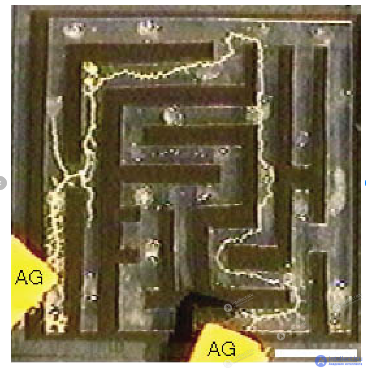
Physarum Polycephalum experimental maze solving (from Nakagaki et al. [17])

The presence of memory in the mold was not entirely unexpected. Previous maze experiments had shown that at each new fork, the mold remembers which way its tendrils turned at previous ones. What surprised the scientists was specifically the ability to learn, forget, and recover memory upon a reminder. The Japanese researchers put forward a hypothesis to explain what was happening. According to it, the giant cell of Physarum polycephalum contains a huge number of diverse biochemical "alarm clocks" with a wide variety of periods. Some of these clocks speed up the mold's movement, while others slow it down. But because they all run out of sync with each other, the cell crawls at a more or less constant speed.
But when external conditions change, the processes that were speeding up movement shut down, since they consume too many resources in cold, dry conditions. Only the clocks that slow things down remain active in the organism. This state persists for a while, and the mold's movement stays slow regardless of whether fate deals it further blows. Then another round of the unfavorable conditions follows, and after a while the mold forgets the set rhythm. This hypothesis has one significant drawback: it does not explain how the mold recovers a forgotten rhythm when it is reminded by a change in conditions.
A fundamentally new simulation model of the mold takes the form of an electrical circuit that you could even solder together yourself, given one exotic component — a memristor. Your only problem would be finding this memristor. Otherwise, this circuit is a series oscillating circuit with losses. Why an oscillating circuit specifically? The point is that the circuit needed a source of oscillations. There's no getting away from a resistor, since in the real world every element has some resistance. The memristor was connected in parallel with the capacitor, since any other connection either produced nothing or made the model inadequate to the real behavior of the mold. The circuit's parameters were optimized and tuned to match the behavior of real mold.
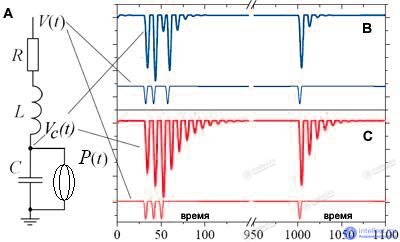 Fig. Electrical circuit model of the intelligence of the slime mold Physarum polycephalum (A) and its behavior in the case of irregular (B) and regular (C) changes in external conditions (Pershin et al, 2008, arxiv.org)
The memristor has two main states — one of high conductivity and one of low conductivity. An applied voltage can switch it from one state to the other, which is equivalent to a change in the external conditions for the mold's development — temperature and humidity. A positive voltage represents favorable conditions, a negative one represents unfavorable conditions. The system's response — the speed at which the slime crawls in the model — is the voltage across the memristor. If a single negative pulse is applied to the input of the circuit — placing the mold in unfavorable conditions — the circuit responds with rapidly decaying oscillations whose period is determined by the parameters of the LC circuit. In this state, the memristor's conductivity is at its highest. But when a series of pulses arrives at the input, with a period roughly equal to the period of the circuit's free oscillations, at some point the voltage across the memristor reaches a threshold value, and it quickly switches to a higher-resistance state. This is how the mold "remembers" a series of unfavorable experiences. Oscillations in a circuit that has "remembered" a charge decay much more slowly.
All it takes is to "remind" the circuit with one more negative pulse, and it immediately responds with a series of slowly decaying oscillations — it "recalls" what it was taught. Moreover, the memory turns out to be very long-lasting — it is recovered even after a hundred periods of the LC circuit's oscillations. The mold's memory is shorter.
Of course, this is only a model. Exactly how the memory of a real mold works is still unknown. It is not clear what sets the rhythm in this cell, how it remembers signals, or what makes it forget them. However, general knowledge of the mold's physiology suggests that the role of the memristor is played by a system of channels that transport cellular fluid within an elastic shell. The movement of the myxamoeba is essentially a constant back-and-forth flow of intracellular fluid, with a slight net bias forward. Continuous vibrations of actin-myosin protein fibers create a pressure gradient that pushes the fluid. These fibers are in turn connected to the cell's shell, which is subject to friction against the surface the myxamoeba crawls on. As a result, the frictional force partially counterbalances the fibers' response to the fluid's motion, and the cell as a whole moves forward. The fluid in the cell exists as ectoplasm and endoplasm. The former is more viscous than the latter, and the endoplasm makes its way through channels in the ectoplasm, much like mercury moving through glass. But when the pressure on the ectoplasm at some point exceeds a threshold value, its viscosity drops sharply — one could say that another channel opens up in the ectoplasm. Clearly, the more channels that are open, the faster the myxamoeba can move. And the number of open channels is, in the end, determined by the history of movement — in exactly the same way that the memristor's resistance is determined by the history of the voltage across its terminals. Incidentally, if you get a feel for the physics of how a memristor works, you can notice a deep similarity between the two models.
Часть 1 The Memristor: The Fourth Fundamental Passive Circuit Element
Часть 2 - The Memristor: The Fourth Fundamental Passive Circuit Element

Comments