
Lecture
Это окончание невероятной информации про волновые процессы.
...
theory" >
(2.105)
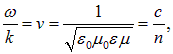
This yields the usual relation between the wave vector, frequency, and velocity:
|
|
|
(2.106) |
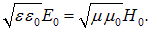
as well as the relation between the amplitudes of the field oscillations:
|
|
|
(2.107) |
Note that relation (2.107) holds not only for the maximum values (amplitudes) of the magnitudes of the electric and magnetic field strength vectors of the wave, but also for the instantaneous values — at any moment in time.
Thus, it follows from Maxwell's equations that electromagnetic waves propagate in vacuum at the speed of light. At the time, this conclusion made an enormous impression. It became clear that not only are electricity and magnetism different manifestations of the same interaction — all optical phenomena also became a subject of the theory of electromagnetism. The differences in human perception of electromagnetic waves are related to their frequency or wavelength.
The electromagnetic spectrum is a continuous sequence of frequencies (and wavelengths) of electromagnetic radiation. Maxwell's theory of electromagnetic waves makes it possible to establish that electromagnetic waves of various lengths exist in nature, produced by different vibrators (sources). Depending on the methods of generating electromagnetic waves, they are divided into several frequency (or wavelength) ranges.
Figure 2.28 shows the electromagnetic spectrum.
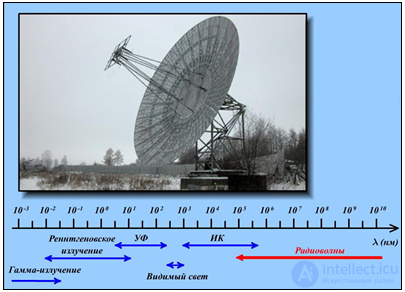
Fig. 2.28. The electromagnetic spectrum
It can be seen that the ranges of waves of different types overlap one another. Consequently, waves of such lengths can be obtained by various methods. There are no fundamental differences between them, since all of them are electromagnetic waves generated by oscillating charged particles.
Maxwell's equations also lead to the conclusion that electromagnetic waves in vacuum (and in an isotropic medium) are transverse: the electric and magnetic field strength vectors are orthogonal to each other and to the direction of wave propagation.
The Doppler effect for electromagnetic waves
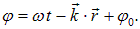
Suppose a plane electromagnetic wave propagates in some inertial reference frame K. The phase of the wave has the form:
|
|
|
(2.108) |
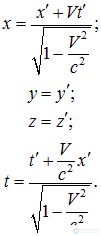
An observer in another inertial reference frame K', moving relative to the first at velocity V along the x axis, also observes this wave, but uses different coordinates and time: t', r'. The relation between the reference frames is given by the Lorentz transformations:
|
|
|
(2.109) |
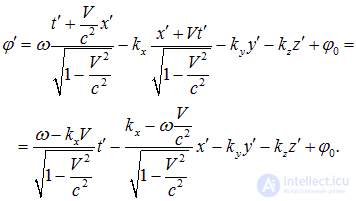
Substitute these expressions into the expression for the phase  , to obtain the phase
  of the wave in the moving reference frame:
|
|
|
(2.110) |
This expression can be written as
|
|
|
(2.111) |
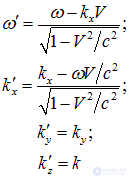
where  and
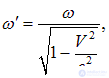
and  — are the angular frequency and wave vector relative to the moving reference frame. Comparing with (2.110), we find the Lorentz transformations for the frequency and wave vector:
|
|
|
(2.112) |
For an electromagnetic wave in vacuum

Suppose the direction of wave propagation makes an angle  with the axis x:
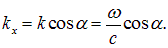
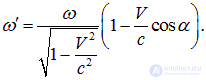
Then the expression for the frequency of the wave in the moving reference frame takes the form:
|
|
|
(2.113) |
This is the Doppler formula for electromagnetic waves.
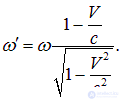
If  , then the observer is moving away from the source of radiation and the frequency of the wave they perceive decreases:
|
|
|
(2.114) |
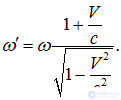
If  , then the observer is approaching the source and the frequency of the radiation increases for them:
|
|
|
(2.115) |
At velocities V << c one can neglect the deviation of the square root in the denominators from unity, and we arrive at formulas analogous to formulas (2.85) for the Doppler effect in a sound wave.
Let us note an essential feature of the Doppler effect for an electromagnetic wave. The velocity of the moving reference frame here plays the role of the relative velocity of the observer and the source. The formulas obtained automatically satisfy Einstein's principle of relativity, and it is impossible to establish by experiment which of the two is actually moving — the source or the observer. This is because, for electromagnetic waves, there is no medium (ether) that would play the same role as air does for a sound wave.
Let us also note that for electromagnetic waves there is a transverse Doppler effect. At  the frequency of the radiation changes:
|
|
|
(2.116) |
whereas for sound waves, motion in a direction orthogonal to the wave propagation did not lead to a frequency shift. This effect is directly related to relativistic time dilation in the moving reference frame: an observer on a rocket sees an increase in the frequency of the radiation or, in general, an acceleration of all processes occurring on Earth.
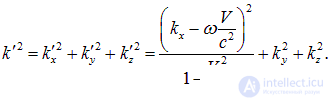
Let us now find the phase velocity of the wave

in the moving reference frame. From the Lorentz transformations for the wave vector we have:
|
|
|
(2.117) |
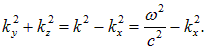
Let us substitute here the relation:
|
|
|
(2.118) |
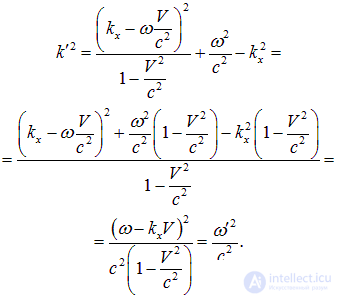
We obtain:
|
|
|
(2.119) |
From this we find the velocity of the wave in the moving reference frame:
|
|
|
(3.120) |
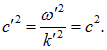
We have found that the velocity of the wave in the moving reference frame has not changed and is still equal to the speed of light c. Let us note, however, that with a correct derivation, this could not have turned out otherwise, since the invariance of the speed of light (electromagnetic waves) in vacuum is the fundamental postulate of relativity theory already «built into» the Lorentz transformations for coordinates and time (3.109) that we used.
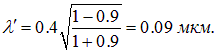
Example 1. A photon rocket moves at a velocity V = 0.9 c, heading toward a star observed from Earth in the optical range (wavelength  μm). Let us find the wavelength of the radiation that the astronauts will observe.
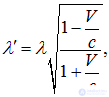
The wavelength is inversely proportional to the oscillation frequency. From formula (2.115) for the Doppler effect in the case of the light source and the observer approaching each other, we find the law of transformation of wavelengths:
|
|
|
(2.121) |
from which the result follows:
|
|
|
(2.122) |
From Fig. 2.28 we determine that for the astronauts the star's radiation has shifted into the ultraviolet range.
Energy and momentum of the electromagnetic field
The volume energy density w of an electromagnetic wave is made up of the volume densities  of the electric and
  of the magnetic fields:
|
|
|
(2.123) |
Taking into account the relation between the vectors E and H, we obtain that the energy densities of the electric and magnetic fields are equal to each other at every instant, that is,  . Hence w can be represented in the form:
|
|
|
(2.124) |
If we multiply the energy density w by the velocity of the electromagnetic wave in the medium

we obtain the magnitude of the energy flux density:
|
|
|
(2.125) |
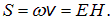
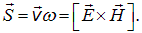
Since the vectors E and H are mutually perpendicular and form a right-handed system with the direction of wave propagation, the direction of the vector

coincides with the direction of wave propagation, that is, with the direction of energy transport, and the magnitude of this vector is equal to EH. Hence the vector of the electromagnetic energy flux density, called the Umov–Poynting vector, has the form:
|
|
|
(2.126) |
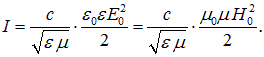
As with elastic waves, the intensity of an electromagnetic wave is the average value of the energy flux density:

Taking (2.107) into account for the relation between E0 and H0, we obtain
|
|
|
(2.127) |
As with an elastic (sound) wave,
|
the intensity is proportional to the square of the oscillation amplitude. |
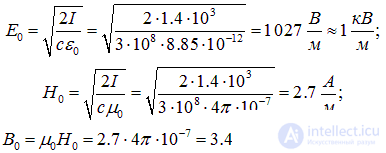
Example 2. The intensity of solar radiation incident on Earth is I = 1.4 kW/m2 (the solar constant). Let us find the average amplitude of oscillation E0 of the electric field strength vector in solar radiation. We compute the amplitudes of oscillation of the magnetic field strength H0 and of the magnetic flux density vector B0 in the wave.
We find the answer directly from equations (3.127), where we set  :
:
Electromagnetic waves are absorbed and reflected by bodies, and therefore must exert pressure on them. Consider a plane electromagnetic wave incident normally on a flat conducting surface. In this case the electric field of the wave induces a current in the body proportional to E. The magnetic field of the wave, by Ampère's law, will act on the current with a force whose direction coincides with the direction of wave propagation. In 1899, in exceptionally delicate experiments, P.N. Lebedev proved the existence of light pressure. It can be shown that a wave carrying energy W also possesses momentum:
|
|
|
(2.128) |
Suppose an electromagnetic wave falls in vacuum along the normal onto an area A and is completely absorbed by it. Assume that in time  the surface receives energy
  from the wave. Then the momentum transferred to the surface is equal to

The force acting on the surface from the wave is
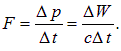
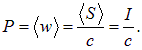
The pressure P exerted by the wave is equal to
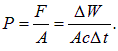
If the average energy density in the wave is equal to , then onto the area A in time  there arrives energy from the volume
  and
and

From this we find the pressure of an electromagnetic wave (light):
|
|
|
(2.129) |
If the surface reflects all of the incident energy perfectly, the pressure will be twice as great, which is explained very simply: in this case both the incident and the reflected waves make an equal contribution to the pressure, whereas in the case of a fully absorbing surface there is simply no reflected wave.
Example 3. Let us find the pressure P of sunlight on Earth. We use the value of the solar constant from the previous example. The desired pressure is equal to:

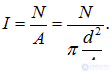
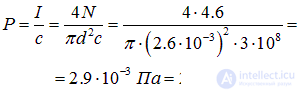
Example 4. Let us find the pressure P of a laser beam on an absorbing target. The output power of the laser is N = 4.6 W, the beam diameter is d = 2.6 mm.
The cross-sectional area of the laser beam

the radiation intensity
From this we find:
Часть 1 2. Wave processes and elements of music theory
Часть 2 2.4. Standing waves - 2. Wave processes and elements of
Часть 3 2.5. Spherical waves - 2. Wave processes and elements of
Часть 4 - 2. Wave processes and elements of music theory





Comments