
Lecture
Это окончание невероятной информации про теплоемкость кристаллов.
...
>
(7.39)
it may turn out to contain no particle at all ( ). With probability
|
|
|
(7.40) |
it will contain one particle ( ). In writing formulas (7.39), (7.40) we used the general expression (7.38) for the probability
 .
.
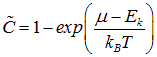
Since there is no third option, the normalization condition must hold
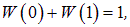
from which it follows that
|
|
|
(7.41) |
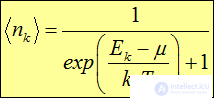
Hence, the average number of particles

in state k turns out to equal
|
|
|
(7.42) |
Formula (7.42) is the basis of quantum Fermi — Dirac statistics. At high temperatures we obtain

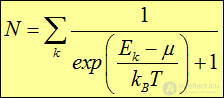
that is, a uniform distribution of particles over the states. If the number of particles N in the system is fixed, then the chemical potential  is determined from the condition
|
|
|
(7.43) |
Let us also emphasize that, according to (7.42), the average number of particles in a given state never exceeds unity. This is a direct consequence of the Pauli principle.
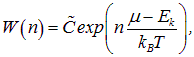
Let us now consider a system of identical bosons. In this case the number  of particles in state i can take any value from 0 to infinity (or from 0 to N for a fixed number of particles). Let us consider some particular state k of the system with energy
  . Then for the probability that this state will contain n particles, we obtain from the basic relation (7.38)
|
|
|
(7.44) |
where
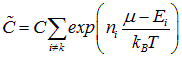 .
.
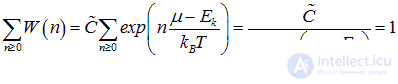
The sum of W(n) over all values of n (including zero) equals the probability that state k will contain some number of particles or none at all. Obviously, this sum must equal unity:
|
|
|
(7.45) |
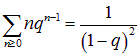
Here we used the formula
|
|
|
(7.46) |
for the sum of an infinitely decreasing geometric progression at
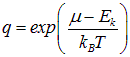 .
.
Now it is easy to find the normalization constant:
|
|
|
(7.47) |
and the complete expression for the probability W(n). We are primarily interested in the average number of particles in state k, which, by the meaning of probabilities, is expressed as
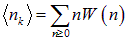 .
.
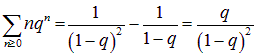
The sum of a series of the form

is easy to compute by differentiating expression (7.46) with respect to q :
|
|
|
(7.48) |
The left-hand side of (7.48) can be written in the form
|
|
|
(7.49) |
Together with (7.48) this leads to the result:
|
|
|
(7.50) |
Substituting
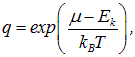
we find

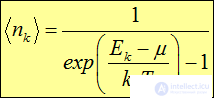
from which follows the basic relation of quantum Bose — Einstein statistics:
|
|
|
(7.51) |
The difference compared with the corresponding formula (7.42) for fermions lies only in the sign in front of the unity in the denominator. Because of this, one can no longer assert that the average number of particles in a given state is always less than unity: the Pauli principle does not apply to bosons. Physically, all  , and hence
  , where
  is the minimum energy of the system (that is, the energy of the ground level). For free particles the quantity
  equals zero. It follows that for free bosons the chemical potential is negative. As before, there is a relation linking
  and N for a fixed number of particles:
|
|
|
(7.52) |
At high temperatures

that is, as the temperature rises, the number of bosons in each state grows.
If the number of particles in the system is not fixed but is determined by equilibrium conditions (for example, the equilibrium of radiation with matter, when photons are absorbed and emitted), then  . Applying (7.51) to a system of photons and taking into account that for photons

we arrive at formula (7.15) and its analogue for phonons (7.30).
Note that when
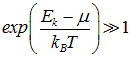
both formulas (7.42) and (7.51) go over into the classical Boltzmann distribution. In this case
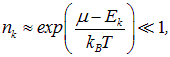
which can be interpreted as the condition of low particle density, that is, as the quantum analogue of a rarefied gas: in each quantum state there is in fact no more than one particle. This means that not only the direct interaction of particles is unimportant, but also their quantum influence on one another, the so-called exchange effects.
One should not think that the laws of quantum mechanics are important only when considering phenomena on the scale of atoms and molecules. At low temperatures near absolute zero, macroscopic manifestations of these laws also exist. We shall become acquainted with them in this section.
Bose–Einstein condensation. Let us consider an ideal gas of free bosons that do not interact either with each other or with an external field. The state of a particle is specified by its momentum p and the spin projection (there are a total of g = 2s + 1 possibilities, since for bosons s — is an integer). The average number of bosons in a given state k is described by formula (7.51). Since the Pauli exclusion principle does not apply to bosons, they can accumulate in a single state. At zero temperature all the particles of the system must occupy the lowest energy level with E = 0. The question arises as to what happens at  ?
?
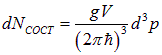
Let us again recall formula (7.14) for the number of types of vibrations, but replace the wave vector in it with the particle momentum:
 .
.
We then obtain
|
|
|
(1) |
By the subscript «st» we wish to emphasize that, dealing with quantum particles, we have started calling things by their proper names: the number of vibrations here becomes the number of states in which the particle can be found. The volume element of momentum space can be written in the form
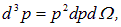
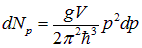
where  is the solid angle. Integrating relation (1) over the angles, we obtain the number of states
  , in which the magnitude of the particle's momentum lies between the values p and p + dp:
|
|
|
(2) |
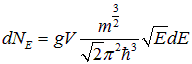
Taking into account that the energy of a free nonrelativistic particle

so that
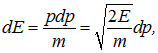
we find from (1) the number of states  with energies between E and E + dE:
|
|
|
(3) |
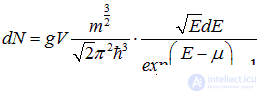
Multiplying (3) by the average number of particles in one state, we find the number of particles falling within the same energy interval:
|
|
|
(4) |
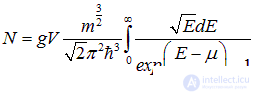
To obtain the total number of particles in the system, let us integrate (4) over all values of the energy:
|
|
|
(5) |
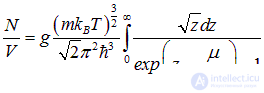
Introducing a new variable of integration

we rewrite (5) in the form
|
|
|
(6) |
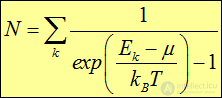
This is an equation for computing the chemical potential  . In essence, we have rewritten formula (7.52) in a form convenient for practical application: the summation over all possible states has been replaced by summation (an integral) over the particle's energy, and the number of states has already been accounted for through the use of formula (3).
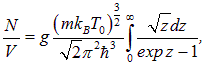
If, at a given particle concentration N/V, the temperature of the gas is lowered, the chemical potential will increase (that is, decrease in magnitude), as follows from (6). It reaches its limiting value  at the temperature
  , determined by the equation
|
|
|
(7) |
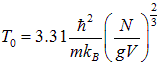
from which follows the expression for  :
:
|
|
|
(8) |
Let us understand the physical meaning of the combinations of parameters entering formula (8). If we denote by l the average distance between particles, then a sphere of radius l/2 will contain one particle, that is, the particle density will be
 .
.
Therefore formula (8) can be rewritten in the form
 .
.
Since the thermal energy of the particles' motion

we obtain from this

or

where  — is the de Broglie wavelength (we have omitted inessential numerical factors in this argument). Thus, we again arrive at the conclusion that quantum effects become noticeable when the de Broglie wavelength is of the order of the distance between particles. Formula (8) — is a general expression for the «quantum» temperature: we shall encounter it again, and only the numerical factor may change.
Thus, for  there exists a physically acceptable (
 ) solution of equation (6). For
  the chemical potential remains equal to its limiting value 0, since it has nowhere further to change, and the right-hand side of the equation becomes smaller than N/V. This result is surprising, since the number of particles in the system is fixed, and the particle density would seem to have to remain unchanged. Hence, some fraction of these particles must go somewhere, drop out of the system, and cease to participate in thermal motion. This means that the right-hand side of (6) will, for
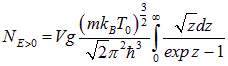
 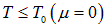 , describe those particles that do participate in thermal motion, that is, whose energy is greater than zero:
|
|
|
(9) |
If we multiply and divide the right-hand side of (9) by

we can single out the factor

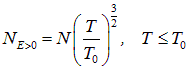
while the remaining factor, in accordance with (7), will equal the total number N of particles in the system:
|
|
|
(10) |
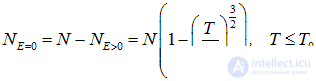
The remaining particles have zero energy; their number  is determined as the difference
  :
:
|
|
|
(11) |
Thus, at a temperature below the critical temperature  so-called Bose–Einstein condensation — the accumulation of particles in the state with
  — takes place. This effect is — macroscopic, since the number of particles in the condensate is enormous, of the order of the total number of particles N. When the temperature is lowered below the critical value, the condensate appears suddenly — the system undergoes an abrupt change of properties (as is said, a phase transition occurs).
At absolute zero temperature all the particles of the system are in the condensate. As the temperature rises, some of them leave the condensate and begin to participate in thermal motion. At  the Bose–Einstein condensate disappears: no particles remain in it. The dependence of the fraction of particles in the condensate on temperature is shown in Fig. 1.
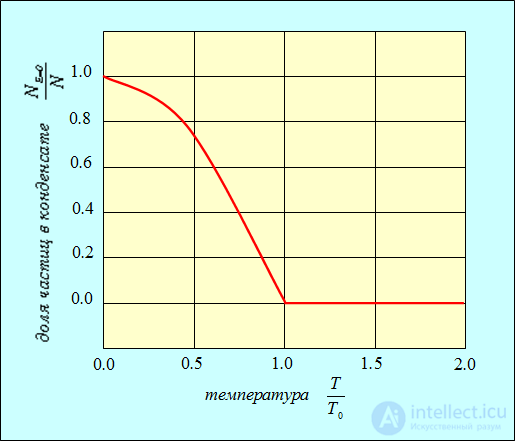
Fig. 1. Fraction of particles in the Bose–Einstein condensate as a function of temperature
It is important to note that condensation does not occur in ordinary space, as when, for example, dew forms, but in momentum space. From the point of view of our ordinary space, both the condensate and the normal component of the Bose gas are «mixed together», and the system remains spatially homogeneous. But there is also a similarity with ordinary saturated vapor: for example, at  the pressure does not depend on the volume of the system, which is unusual for an ideal gas.
The phenomenon, predicted by Einstein and the Indian physicist Bose many years earlier, was first observed experimentally in 1995 in the USA. A «gas» of 2,000 rubidium atoms, cooled almost to absolute zero (20 nK), «condensed» into a «superatom», which then behaved not as a gas of particles but as a single whole. Thus, a new state of matter was created, one that had never before existed in nature anywhere in the Universe, as was stated in the report on this work. In 2001 the authors of these experimental works were awarded the Nobel Prize.
The phenomenon of superfluidity. Superfluidity is the property of liquid helium to flow without friction through thin capillaries at low temperatures  . The phenomenon was discovered by P.L. Kapitsa in 1938 (the Nobel Prize for it was awarded in 1978). Further research showed that liquid helium appears to contain two components: normal and superfluid. Because of the absence of viscosity, superfluid helium exerts no resistance on immersed bodies. In the superfluid state, liquid helium displays so many unusual properties that we are entitled to regard the superfluid component as a special state of matter, conventionally denoted
  (as opposed to the ordinary
  ). Let us mention just the so-called fountain effect: when the lower end of a capillary immersed in liquid helium is illuminated with a flashlight, it heats up and the fraction of the superfluid component drops. The resulting excess pressure forces the superfluid component to flow into the capillary, producing a small fountain up to 30–40 cm high. Such a flow of helium from a cold place to a hot one is unusual: in normal liquids everything happens the other way around.
The phase diagram for helium is shown in Fig. 2.
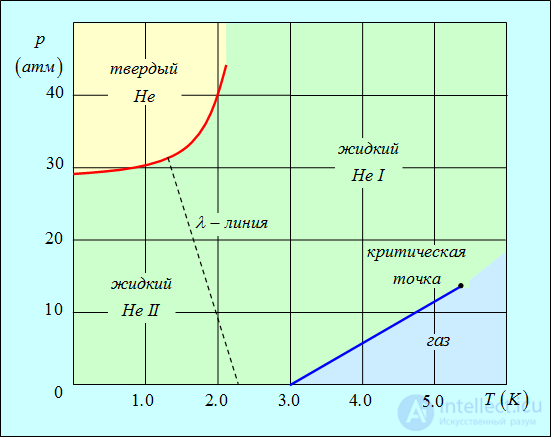
Fig. 2. Phase diagram for  (pressure and temperature are plotted along the axes).
The dashed curve shows the  —line separating the normal (He I) and superfluid (He II) states
The phase transition  occurs on the so-called
  -line, with the transition temperature decreasing as pressure increases. The superfluid state was observed for the isotope
  (superfluidity in the other isotope
  was observed much later and with much greater difficulty, but that is another story). Since the proton and neutron making up the helium nucleus have spin 1/2, the nuclear spin of
  is integer, while that of
  is half-integer. This is where the difference between bosons and fermions arises. The particles of liquid
  are bosons, and they can undergo Bose-Einstein condensation. Moreover, at a typical particle concentration in the liquid of
  , a helium nucleus mass of
 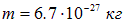 , and g = 1 (the total nuclear spin is zero), formula (8) gives a Bose-Einstein condensation temperature of
  , which is not so far from the temperature of the -transition. It is very tempting to relate the two unusual states of matter — the Bose-Einstein condensate and the superfluid component. But it is not all as simple as it seems.
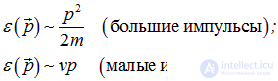
Elements of the microscopic theory of superfluidity. The point is that a liquid — is not an ideal gas; there is strong interaction between the particles there. But we considered the condensate in a system of an ideal Bose gas. And we still need to understand why the condensate should exhibit superfluidity. According to the microscopic theory of N.N. Bogoliubov (1947), one cannot speak of the state of individual helium atoms, but only of the state of the entire system. Here we meet for the first time a quantum liquid — a macroscopic quantum effect. At T = 0 the system is in the ground state; as the temperature rises, thermal excitations arise, transitions to low-lying excited energy levels. Collective excitations of the atoms are quantized in a way analogous to the vibrations of atoms in a crystal lattice in Debye's theory. There, phonons arose upon quantization; here — quasiparticles, individual quanta with energy  . It turned out that the decisive role is played by the law relating energy to momentum
  — the dispersion law. In a quantum Bose-liquid the «excitations» (quasiparticles) — are also bosons with zero spin. At low temperatures the number of quasiparticles is small, and they can be regarded as non-interacting. In this case we have an ideal gas of quasiparticles, which undergoes condensation at some critical temperature.
But everything, let us repeat, depends on the dispersion law, whose complete calculation is very complex and has still not been carried out. Bogoliubov calculated the dispersion of weakly excited states. In the limiting cases his formula gives
|
|
|
(12) |
where v — is a certain constant with the dimension of velocity. The energy in the first case is nothing other than the energy of a helium atom. The energy in the second limiting case, in turn, is analogous to the energy of an acoustic quantum (a phonon). The shape of the curve is shown in Fig. 3.
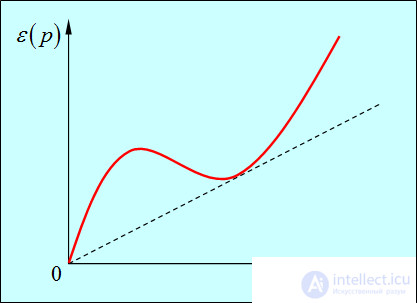
Fig. 3. Dependence of the quasiparticle energy in He II on their momentum (dispersion law)
Thus, at T > 0 liquid helium consists of a condensate of quasiparticles and an ideal gas of quasiparticles with energy  . Helium atoms cannot be divided into those «forming the condensate» and those «generating free quasiparticles»: all of them take part in forming both the ground condensate state and the ideal gas. The gas of quasiparticles can be regarded as the normal component of liquid helium, and the condensate — as the superfluid one. A similar phenomenological theory of a two-component liquid was developed by Landau (1941).
Superfluidity of the condensate. We have understood why an ideal gas can appear in the liquid: the free particles of the gas — are not the helium atoms themselves, but excitations of the ground state (the condensate). Now we need to understand the origin of the superfluidity of the condensate.
First, let us recall the results of classical mechanics concerning the transition to moving reference frames. Let there be a system K, in which the radius-vectors of particles with masses  are denoted
  . The momentum of such a system is

and the kinetic energy

where
 .
.
Let there also be given a system  , the origin of whose coordinates is given by the vector
  , the velocity of the system
  relative to K is
 .
.
In the moving coordinate system the radius-vectors of the particles are
 .
.
From this immediately follow the expressions for the total momentum and energy of the particles in the moving coordinate system ( — the total mass of all the particles):
|
|
|
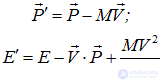
(13) |
These are the non-relativistic Galilean transformations known from classical mechanics. Following Landau's reasoning, let us now apply these formulas to an unexcited condensate flowing through a tube with velocity  . In the laboratory frame of reference K the energy and momentum of the condensate are given by the obvious formulas
|
|
|
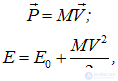
(14) |
where  — is the energy of the condensate at rest in the ground state. Let us take a system
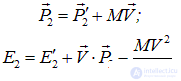
  , moving with the velocity of the condensate V, so that in it the condensate is at rest. The Galilean transformations (12) then give
|
|
|
(15) |
These results are obvious, and we will only recall that all this refers to the condensate in the ground state. In the system  it is at rest, while the tube moves past it with velocity
  . If there is viscosity, it will manifest itself in the dissipation of energy. This cannot happen at once throughout the entire liquid: first, individual internal motions will be excited, and quasiparticles of the phonon type will appear. Suppose an excitation arises with momentum
  and energy
  . For the excited condensate in
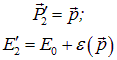
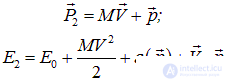
  we have quite obvious relations
|
|
|
(16) |
How will these formulas look in the laboratory frame of reference? To go back to K, we use the inverse Galilean transformations:
|
|
|
(17) |
from which we find
|
|
|
(18) |
Comparing formulas (14) and (18), we find the change in the energy of the moving condensate in the laboratory frame  upon transition from the ground state to the excited state:
|
|
|
(19) |
The formation of a quasiparticle is energetically favorable if  . In the most favorable case for this, the momentum
  is antiparallel to the velocity
  , and the change in the condensate energy equals
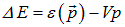 .
.
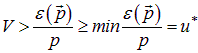
From this it follows that for the liquid to be decelerated, the condition must be satisfied
|
|
|
(20) |
Here we have introduced the notation  for a parameter with the dimension of velocity — the ratio of the minimum excitation energy to the momentum. This parameter equals the angular coefficient of the dashed line in Fig. 3. If the excitation spectrum is such that
  , as is shown here, then the deceleration condition is not satisfied for weak excitations: as it is said, the excitation spectrum has an energy gap — a certain difference between the excitation energy and the ground-state energy. This means that at small velocities
  friction is impossible. In other words, we have obtained the phenomenon of superfluidity (at small momenta the velocity
  equals the speed of sound). The meaning of this result is that the condensate is a collective formation, which reacts to the loss of one of its members by an increase in energy, whereas friction should lower the energy. The dispersion law shown in Fig. 3 is such that the condition of superfluidity is satisfied. For ordinary bose-particles with

we have
 .
.
and the condition of superfluidity is not satisfied.
Conclusion: ordinary particles, even in the condensate state, do not possess superfluidity; the condensate does not form a bound collective and does not react to the deceleration of individual particles.
Let us emphasize once more:  — is not a mixture of different substances, and its components cannot be separated individually. It would be better to speak not of components coexisting simultaneously in helium, but of two kinds of motion — normal and superfluid.
Superconductivity. In 1911 the Dutch physicist H. Kamerlingh — Onnes discovered a remarkable phenomenon. At a temperature of about 4K the electrical resistance of mercury dropped abruptly to zero. Subsequently, the phenomenon of superconductivity was also found by him in tin, lead, thallium, and other substances. Numerous experiments were carried out to reveal the properties of the superconducting state of matter.
The most important properties of the superconducting state of matter are:
 , at which the superconducting state arises;
For most substances known earlier, the critical temperatures are of order 1–15 K. In 1986, ceramic compounds were discovered that pass into the superconducting state at temperatures of order 125 K, that is, above the boiling point of liquid nitrogen at normal pressure. Since previously superconductors could only be obtained by cooling the material with liquid helium, and liquid nitrogen is much cheaper to produce, the discovery of high-temperature superconductivity promises the development of numerous technical applications.
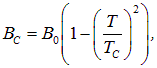
The critical value of the magnetic flux density  , at which the superconducting state is destroyed, depends on the temperature of the superconductor. A characteristic graph of this dependence is shown in Fig. 4; it is well described by the formula
|
|
|
(21) |
where  — is the critical field value at absolute zero temperature.
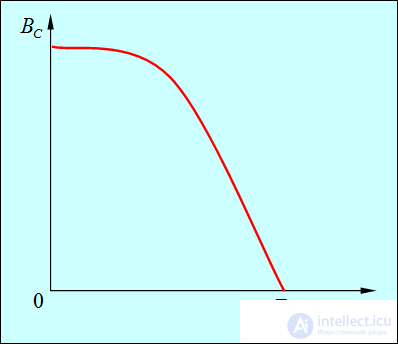
Fig. 4. The value of the critical magnetic field as a function of the temperature of the superconductor
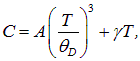
As we shall see further in our course, the heat capacity of a normal metal at low temperatures has the form
|
|
|
(22) |
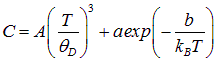
where the first term — is the already familiar contribution of the crystal lattice, described by Debye's theory, and the second term — is the contribution of the electron gas studied in the next part of the course. In a superconductor, the heat capacity at very low temperatures is determined, as experiments show, by an expression of the type
|
|
|
(23) |
The first term has not changed: the crystal lattice is still there as before. The dramatic change in the second term (an exponential instead of a linear function) shows that superconductivity is associated with some fundamental changes in the behavior of the conduction electrons.
The microscopic theory of superconductivity was created by J. Bardeen, L. Cooper, and J. Schrieffer, and improved by N.N. Bogoliubov. It is too complex to present in this textbook. It is enough to point out that there is a deep analogy between superfluidity and superconductivity. Because of the interaction of electrons with phonons, an attraction arises between electrons, and under certain conditions a peculiar bound state can form — a Cooper pair of electrons with opposite spins. Such a formation is already a boson and can undergo Bose–Einstein condensation, which is the prerequisite for the transition of the material to the superconducting state.
At absolute zero temperature, the electron gas in a superconductor passes into a ground state possessing the properties of a condensate. What is very important is that this state is separated by an energy gap  from the next, excited, state. In other words, to remove an electron from the ground state, it must be given some minimum energy
  , and smaller portions of energy simply will not be absorbed. We have already seen something similar for the superfluid state, and even earlier — for heat capacity (the "freezing out" of rotational and vibrational degrees of freedom, Einstein's theory of heat capacity). The theory predicts a simple relation between the energy gap and the critical temperature:
 .
.
The presence of the energy gap immediately explains the behavior of the heat capacity of the electron gas. Indeed, the energy  — is the minimum energy that breaks a Cooper pair, and imparting such energy produces a pair of free electrons. Then each electron accounts for half the energy
  . From statistical considerations one can assert that the number of electrons outside the ground state is proportional to the quantity
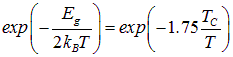 .
.
The thermal energy absorbed upon excitation is proportional to
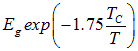 .
.
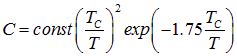
The derivative of this quantity with respect to temperature gives the heat capacity of the electron gas in the superconducting state:
|
|
|
(24) |
At low temperatures the pre-exponential factor  changes much more slowly than the exponential, so that this law practically does not differ from the phenomenological relation (23). As the temperature changes, the value of the gap changes according to a law similar to that shown in Fig. 4. At the critical temperature the gap disappears, and the superconducting properties disappear along with it. Note that expression (24) is analogous to the formula for heat capacity (7.8) in Einstein's theory, where a gap between the ground and excited energy levels is likewise present.
From what has been said, it is clear how important a role the energy gap plays. In a system of bosons it is responsible for the phenomena of superfluidity and superconductivity. In a system of fermions, as we shall see later, it is responsible for the difference in the properties of metals, dielectrics, and semiconductors.
Research into the phenomena of superfluidity and superconductivity has always attracted great interest, both from scientists and from society as a whole. The "reason" for this — is the broad prospects for their practical application. They acquire particular significance in the modern world, where scientists have learned to create entirely new materials with unusual characteristics, exhibiting, for example, superconducting properties at relatively high temperatures and in sufficiently strong magnetic fields. It is no coincidence that more than one Nobel Prize has been awarded for research in this area, starting with Kamerlingh Onnes (1913 prize) and ending, for now, with the 2003 prize, which was received by A.A. Abrikosov (Russia and the USA), V.L. Ginzburg (Russia), and A. Leggett (Great Britain and the USA).
Часть 1 7. Heat capacity of crystals. Quantum statistics
Часть 2 7.7. Bose—Einstein statistics - 7. Heat capacity of crystals. Quantum
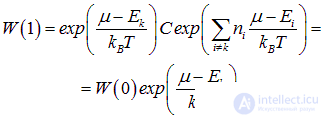
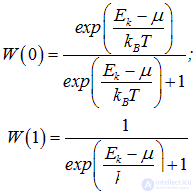 .
. .
. .
.
 .
.
 .
. .
. .
. .
. .
. .
. .
. .
. .
. .
. .
.
 .
. .
. .
. .
.
 .
.
 .
. .
.
 .
. .
. .
.
 .
. .
.
Comments