
Lecture
Это продолжение увлекательной статьи про теория атома.
...
square of the spin
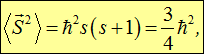
while the projection of the spin onto some axis (running through all values from the maximum to the minimum in steps of ħ ) is written as

where  takes only two values

The number  is called the magnetic spin quantum number.
Where, then, did the splitting of spectral lines come from? Let us try to understand this with the help of semiclassical reasoning. In classical physics any rotation of an electric charge creates a magnetic field. An electron moving classically in an orbit of radius R can be represented as a current loop with a current l, enclosing an area  , that is, as a magnetic dipole with a magnetic moment

(This formula was already known to C. Coulomb.)
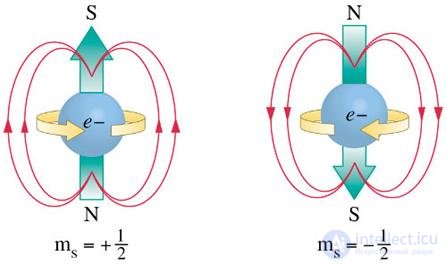
Fig. 5.13. Model of the spin and magnetic moment of the electron within classical physics
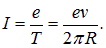
Classical estimate: an electron in an orbit of radius R with speed v has a period of revolution

Let us take some point on the orbit. In a time T the charge e passes through it, that is, by definition the current is equal to
In addition, the electron has an orbital momentum

so that the current can be expressed through the orbital momentum, eliminating the electron's speed:
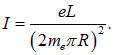
Then the orbital magnetic moment produced by the electron equals

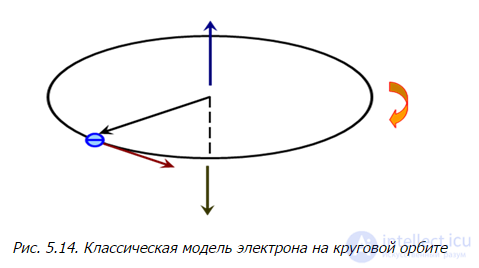
Fig. 5.14. Classical model of an electron in a circular orbit
Let us now substitute, in accordance with the quantization rules,
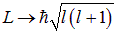
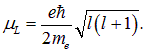
and obtain the expression for the orbital magnetic moment, which can also be derived more rigorously:
|
|
|
(5.11) |
From this the following conclusions follow:
|
· The natural unit for magnetic moments in the microworld is the so-called Bohr magneton
· The projection of the magnetic moment onto any axis must always be an integer multiple of the Bohr magneton:
(Now it is clear why the quantum number n was called magnetic.) · The ratio of the electron's orbital magnetic moment to its orbital angular momentum, called the gyromagnetic ratio, equals
|
Experiments showed that the electron's spin has a double magnetism: the electron's intrinsic magnetic moment associated with the spin equals
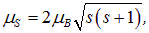
that is, the gyromagnetic ratio for it turned out to be twice as large  . This is further proof that the electron cannot be imagined as a charged little ball spinning about its own axis: in that case the ordinary gyromagnetic ratio would have to result. For the projection of the intrinsic magnetic moment we have

and since

then

As a result, for the projection of the spin magnetic moment we again get integer multiples of the Bohr magneton, just as for the orbital motion. For some reason nature prefers to deal with a whole Bohr magneton rather than with fractions of it. That is why it compensates the half-integer value of the intrinsic angular momentum with a double gyromagnetic ratio.
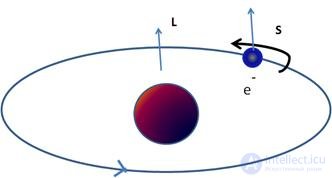
Fig. 5.15. Illustration of the orbital and spin moments of the electron
Now we can understand why the presence of the electron's own magnetic moment leads to the appearance of some interaction that has not yet been accounted for. For this let us again switch to semiclassical language. The electron's orbital motion creates a magnetic field, which acts on the electron's intrinsic magnetic moment. In a similar way, the Earth's magnetic field acts on a compass needle. The energy of this interaction shifts the atom's energy levels, the magnitude of the shift depending, generally speaking, on the spin and orbital angular momenta.
Important conclusion:
|
The interaction of the spin and orbital magnetic moments leads to the lifting of degeneracy and to the splitting of spectral lines. |
Example 1. Let us estimate the splitting of energy levels due to the interaction of the spin and orbital magnetic moments of the electron in the hydrogen atom.
A circular loop of radius R carrying a current I produces at its center a magnetic field

Earlier in this chapter it was shown that an electron moving in an orbit can be represented as a current loop
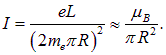
Here, for the estimate, we set

Then we obtain, for the magnetic field produced by the orbital motion of the electron in the atom, a value of the order

The energy of interaction of the electron's intrinsic magnetic moment with this magnetic field is, in order of magnitude, equal to
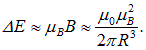
For the estimate let us set R equal to the Bohr radius of the first orbit  . Substituting here the expressions for
  and
and  and taking into account that

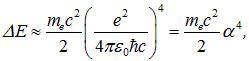
we obtain the estimate for the shift of the energy levels
|
|
|
(5.13) |
where  is the fine-structure constant introduced above (see (3.3)). The energy of the first level of the hydrogen atom, as is known, equals
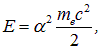
so that (3.13) can be rewritten as

Since

and E = 13.6 eV, then

and the relative shift of the levels
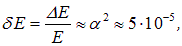
which agrees with experimental data.
This is an estimate (not a calculation) of the sought splitting of levels. In essence, the splitting of levels is a relativistic effect: according to Bohr, the electron's speed in the first orbit is

and

It is therefore not surprising that the properties of spin can be fully understood only within relativistic quantum theory. We do not set ourselves such a task, but will simply take into account that the electron possesses this remarkable property.
Experimental proof of the existence of electron spin was given by the Stern–Gerlach experiment in 1922. The idea of the experiment is that in a magnetic field inhomogeneous along the z axis, a displacing force acts on electrons, directed along the field. The origin of this force is easier to understand first using the example of an electric dipole placed in an electric field. An electric dipole is a pair of opposite charges  , located a small distance l apart. The magnitude of the electric dipole moment is defined as

where the vector l is taken to be directed from the negative charge to the positive one.
Let the positive charge be located at point r, and the negative one — at point  , so that

Let the dipole be placed in an electric field of strength  . Let us find the force acting on the dipole. On the positive charge acts a force

on the negative one —
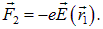
The resultant force will be

Since the distance between the charges is small, the field at the location of the negative charge can be approximately written as

Substituting this expansion into the expression for the force F, we find
|
|
|
(5.14) |
If the field is uniform (E does not depend on  ), then equal and oppositely directed forces act on the charges of the dipole and the resultant force is zero, as also follows from equation (5.14). As is known, such a pair of forces does not displace the dipole (which is electrically neutral as a whole), but only turns it along the field (the magnetic analogue — a compass needle). In a non-uniform field, however, the resultant force is nonzero. In the particular case where the field
  depends only on the coordinate z, in equation (5.14) only the derivative with respect to z is nonzero
|
|
|
(5.15) |
where  is the projection of the electric moment onto the axis z. A non-uniform field tends to draw the dipole into the region where it is stronger.
Magnetic charges do not exist, but a magnetic dipole is realized by a current loop, and its properties are analogous to those of an electric dipole. Therefore in formula (5.15) we must replace the electric field with the magnetic one, the electric moment with the magnetic one, and write an analogous expression for the force acting on the electron in the Stern–Gerlach experiment

Scheme of the experiment: a beam of atoms flies through a non-uniform magnetic field directed transversely to the atoms' velocity. The force acting on the atoms' magnetic moments deflects them. According to the possible values of the projection of the magnetic moment onto the field direction, the original beam splits into several beams. If the total magnetic moment of the atom is determined solely by the electron's spin, then the original beam splits into two. For multielectron atoms there can be more split beams. For their experiment Stern and Gerlach used silver, which was evaporated in an electric furnace. The numerical values of the splitting amounted to fractions of a millimeter. The authors emphasized in their conclusions that no undeflected atoms were registered. Below we shall see that this is specific to experiments with elements of the first group.
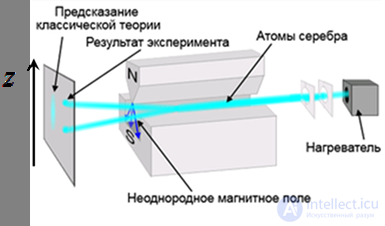
Fig. 5.16. Diagram of the Stern and Gerlach experiment
The main result of the Stern and Gerlach experiments — direct experimental proof of the quantization of the direction of the atoms' magnetic moment. According to classical physics, the original beam should not split, but should smear out, in accordance with the arbitrariness of the projection of the magnetic moment onto the direction of the magnetic field. Correspondingly, on the screen behind the apparatus, instead of two separate lines left by the silver atoms, a blurred band should have been observed.
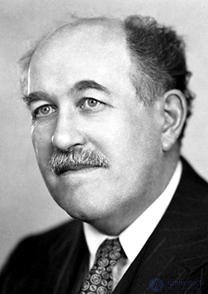
Fig. 5.17. Otto Stern, 1888–1969
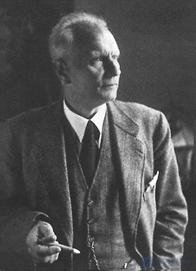
Fig. 5.18. Walther Gerlach, 1889–1979
Example 2. A narrow beam of atoms with speed  and mass n is passed through a transverse non-uniform magnetic field, in which a force
  acts on them (Fig. 5.19). The extent of the field region is
  , the distance from the magnet to the screen is
  . Let us determine the deflection angle
  of the atomic beam's trace on the screen from its position when the magnetic field is switched off.
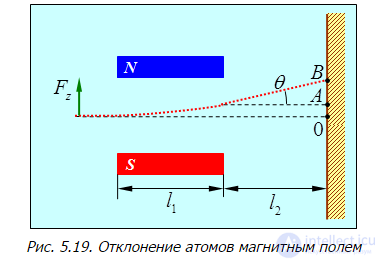
Fig. 5.19. Deflection of atoms by a magnetic field
Here we are dealing with a problem of classical mechanics, which allows us to prepare for a quantitative treatment of the Stern–Gerlach experiment. The time of flight of an atom through the magnet equals

For this whole time a transverse force  acts on the atom, giving it a transverse acceleration

Over the time of flight the atom deflects by a distance
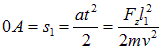
and acquires a transverse velocity
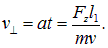
This means that the atom leaves the magnet at an angle  to the original direction of motion, where

Consequently, over the distance l2 to the screen the atom deflects by a further distance

Adding the deflections  and
and  , we obtain the sought deflection of the atom's trace on the screen
|
|
|
(5.16) |
Often the question in the problem concerns the deflection of the atomic beam upon leaving the magnet. In that case one must set  in the formula obtained (5.16).
Example 3. A narrow beam of silver atoms, when passing through a magnetic field with an inhomogeneity

of extent  cm split into two beams. The observation screen is set at a distance of
  cm, the speed of the atoms
  km/s. Let us determine the distance b between the components of the split beam on the screen.
Filled shells give a zero contribution to the magnetic moment of an atom. The silver atom has one valence electron (in the ground state l = 0) and therefore its magnetic moment equals the electron's own magnetic moment. In a non-uniform field a force acts on the atom
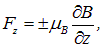
where  is the Bohr magneton. The signs
  correspond to the two possible directions of the electron's magnetic moment, and that is why the beam splits into two. On the screen two bands are observed, at a distance b from each other. If we substitute the expression for the force
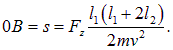
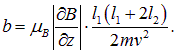
  into formula (5.16), we obtain two deflections s, differing in sign. Hence the sought splitting is b = 2s. As a result we arrive at the expression
|
|
|
(5.17) |
The mass of a silver atom is easily found from the periodic table: the molar (atomic) mass is M = 107.868 g/mol. To find the mass of an atom, one must divide the molar mass M by Avogadro's number:

Let us now substitute into (5.17) the numerical values:
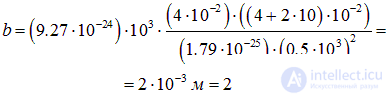
Such a splitting is quite observable in experiments.
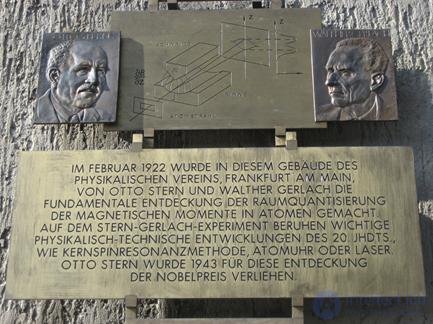
Fig. 5.20. Memorial plaque at the University of Frankfurt commemorating the Stern and Gerlach experiment
Let us discuss the qualitative changes that electron spin introduces into atomic theory. The total angular momentum J is now made up of the orbital L and spin S parts. A new quantum number j arises, taking, for a one-electron atom, two values

(at l = 0 the total angular momentum j = 1/2). These values correspond to the two cases in which the spin is parallel and antiparallel to the orbital angular momentum. New notations for the levels must be introduced: an index is added indicating the magnitude of the total angular momentum: levels are denoted  , where n is the principal quantum number, and x is the former spectroscopic symbol denoting the magnitude of the azimuthal quantum number l. The properties of the total momentum are the same as those of the orbital and spin momenta. As a consequence of this new type of interaction, a richer structure of atomic spectra arises, as observed experimentally. Let us illustrate this with the example of the first excited levels of the hydrogen atom (see the table).
Table
Scheme of the lower levels of the hydrogen atom
|
n = 1 |
l = 0 |
j = 1/2 |
1s1/2 |
|
n = 2 |
l = 0 |
j = 1/2 |
2s1/2 |
|
l = 1 |
j = 1/2 |
2p1/2 |
|
|
j = 3/2 |
2p3/2 |
||
|
n = 3 |
l = 0 |
j = 1/2 |
3s1/2 |
|
l = 1 |
j = 1/2 |
3p1/2 |
|
|
j = 3/2 |
3p3/2 |
||
|
l = 2 |
j = 3/2 |
3d3/2 |
|
|
j = 5/2 |
3d5/2 |
The energy of the levels is no longer given by Bohr's formula, but contains corrections whose relative magnitude is of order  . We shall not give this formula, but note its characteristic property: in the absence of external fields the energy still does not depend on the orbital momentum (the quantum number l ), but only on the total angular momentum (the quantum number j). This means that the levels
  and
and  are degenerate (their energies coincide). The level
  , as it turns out, lies a little higher.
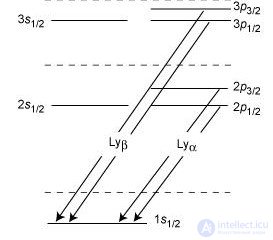
Fig. 5.21. Doublet structure of the Lyman series
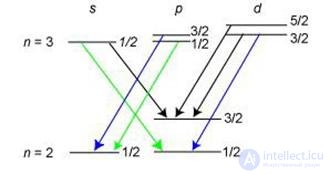
Fig. 5.22. Diagram of the transitions determining the fine structure of the  line of the Balmer series
States of multielectron atoms are classified in a similar way. If L is the total orbital momentum of all the electrons, and S — their total spin momentum, then the total momentum of the system is defined as

Correspondingly this state is denoted as  . By X is meant the same letter (spectroscopic) symbol denoting the value of the orbital angular momentum (only in this case a capital letter is used). The upper left index equals the number of spin states (for a single electron there was no need for it, since its spin always equals 1/2).
So, suppose we are given a state  . The question arises: what is the magnetic moment of the system
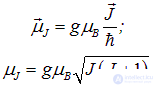
  ? It is clear that it is directed along the total angular momentum J, and its dimension and order of magnitude are determined by the Bohr magneton
  . Then
|
|
|
(5.18) |
For the gyromagnetic ratio (a generalization of the analogous quantity associated with the orbital and spin momenta) one can then write an expression of the form

The proportionality coefficient g is called the Landé factor or simply the g-factor. For the orbital magnetic moment g = 1, for the spin magnetic moment g = 2. The problem of the atom's magnetic moment reduces to finding the dependence of g on the quantum numbers J, L, S.
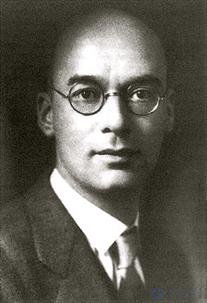
Fig. 5.23. Alfred Landé, 1888–1976.
The answer can be obtained with the help of a simple semiclassical model called the vector model of the atom. First let us square the equation relating J to L and S:

The squares of the momenta can be expressed through the corresponding quantum numbers by rules already known to us. We then find the expression for the scalar product
|
|
|
(5.19) |
The total magnetic moment of an atom is made up of the magnetic moment produced by the total orbital angular momentum, and the total spin magnetic moment. But spin, as already mentioned, has double magnetism. Therefore, taking equation (5.18) into account, we can write
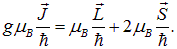
Cancelling the common factor  and multiplying both sides by

(on the right-hand side J is replaced by L + S), we obtain

If we substitute here expression (5.19) for the scalar product L·S, we obtain the final answer
|
|
|
(5.20) |
Let us verify that this formula reproduces already known results. If the total spin momentum is zero, then the total momentum coincides with the orbital one. Substituting into (5.20) the values S = 0, J = L, we obtain g = 1, as it should be for a magnetic moment produced by purely orbital motion of the electrons. In the other limiting case, the orbital momentum is zero, and the total angular momentum equals the spin momentum. Substituting into (5.20) the values L = 0, J = S, we find g = 2 in full agreement with the double magnetism of the spin momentum. It is precisely this case that is realized for elements of the first group in the Stern–Gerlach experiment. It was mentioned that for complex atoms (for example, sulfur) the splitting of beams would be more complicated. Now we can predict the result of the experiment quantitatively. The ground state of sulfur is  , that is, S = 1, L = 1, J = 2. From formula (5.20) for the Landé factor we readily obtain g = 3/2, so that the magnetic moment of the atom equals

The projection of the magnetic moment onto the z axis
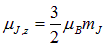
is determined by the quantum number  of the projection of the total angular momentum, which for J = 2 takes five different values in accordance with the rules of momentum quantization:
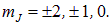
Now, using the solution of Example 3 in Section 5.4, we can calculate the splitting of the sulfur atom beam in the Stern–Gerlach experiment. It is clear that the beam will split into five components, one of which  will not be deflected by the magnetic field.
We have seen that orbital angular momentum is characterized by the azimuthal quantum number, which takes integer values. The electron's intrinsic spin angular momentum is characterized by the spin quantum number s, equal to 1/2. Spin is a fundamental quantum property of all elementary particles. According to the value of the spin quantum number s particles are divided into two classes: bosons (integer s) and fermions (half-integer s). Other values of s are not known to science. Examples of fermions: electron, muon, neutrino, quarks, particles made of three quarks (proton, neutron). Examples of bosons: photon, the recently discovered W± and Z particles, particles made of two quarks (π–mesons, etc.).
Bosons and fermions — are not proper names of specific particles, but names of entire families. Bosons and fermions obey Bose—Einstein and Fermi—Dirac quantum statistics, respectively, which we will consider later. Each microparticle belongs to one of these two families and can never change its affiliation. In the theory of elementary particles it has been noted that matter is built from fermions, while bosons are the carriers of fundamental interactions.
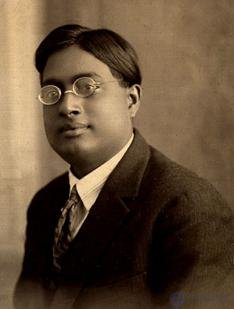
Fig. 5.24. Satyendra Nath Bose, 1894–1974
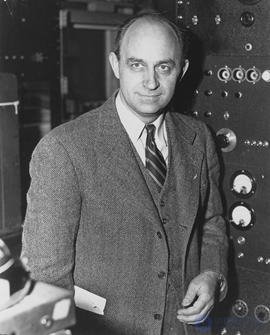
Fig. 5.25. Enrico Fermi, 1901–1954
If several bosons are brought together, nothing prevents them from occupying the lowest energy state, and, consequently, all of them end up there.
The behavior of a collection of fermions is governed by the Pauli exclusion principle:
|
Two identical fermions cannot occupy one and the same quantum state. |
Applied to an atom, the Pauli principle forbids two electrons from having the same set of quantum numbers: the states of the electrons must differ in at least one of them. If the Pauli principle did not exist, then in all atoms in the ground state all electrons would occupy the lowest energy level, and atoms of different elements would be dreadfully alike. Thus, the chemistry we know, all the diversity of elements and their properties (in particular, the range of taste sensations that distinguishes, say, wine from cheese) — are consequences of the Pauli principle.
So far we have mainly considered only an atom with a single electron. Let us start adding an extra electron and, correspondingly, increasing the nuclear charge by one. In other words, let us take a walk through the periodic table. Let us introduce the concept of a shell as a collection of levels with the same principal quantum numbers n and of a subshell (levels of a given shell with the same l). The traditional shell designations are as follows
|
n = |
1 |
2 |
3 |
4 |
… |
|
symbol |
K |
L |
M |
N |
… |
We have essentially already counted the number of levels in a shell: it equals the degeneracy multiplicity with respect to m and l, multiplied by 2, in accordance with the two possible directions of electron spin. Thus, according to the Pauli principle, a shell can hold  electrons, and a subshell — 2(2l + 1) electrons (the number of different values of n, doubled for the same reason). So, the states of electrons in an atom differ in the quantum numbers
  and
and  , and, by the Pauli principle, only one electron can have a given specific set of quantum numbers.
Recall: the three quantum numbers  reflect the three-dimensionality of space,
  — the intrinsic properties of the electron.
The order of filling of levels in multielectron atoms is determined by the level energies, taking into account the influence of already-filled shells. The inner shells partially screen the nuclear charge, which leads to a non-Coulomb field for the outer shells. This explains the dependence of level energy on the quantum number l. The larger l (for electrons of the same shell), the farther the electron is from the nucleus and the weaker its bond with the nucleus, that is, such a level lies higher. For large moments (states d, f, etc.), the energy levels of a given shell are close to, or even higher than, the s-sublevels of the next shell. Overall, the filling proceeds in the following order (with occasional small deviations):
||1s||2s, 2p||3s, 3p||4s, 3d, 4p||5s, 4d, 5p||6s, 4f, 5d, 6p|| etc.
In this sequence, the || sign separates the periods of the periodic table. In accordance with the formulas obtained for the number of levels as a function of n and l, the first period contains 2 elements, the second and third — 8 each, and the fourth and fifth — 18 elements each. Here the filling of the d-subshells «wedges in» (10 elements each — transition metals). In the sixth period the filling of the f-subshell is added (14 elements — lanthanides), and so on.
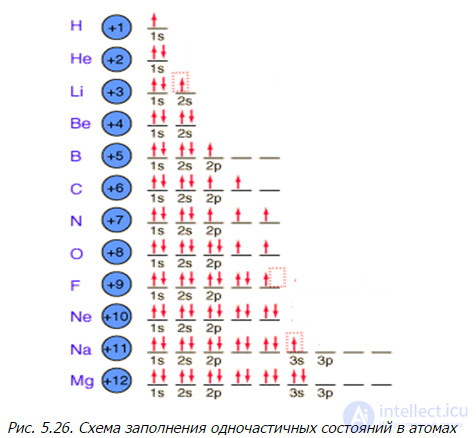
Fig. 5.26. Diagram of the filling of single-particle states in atoms
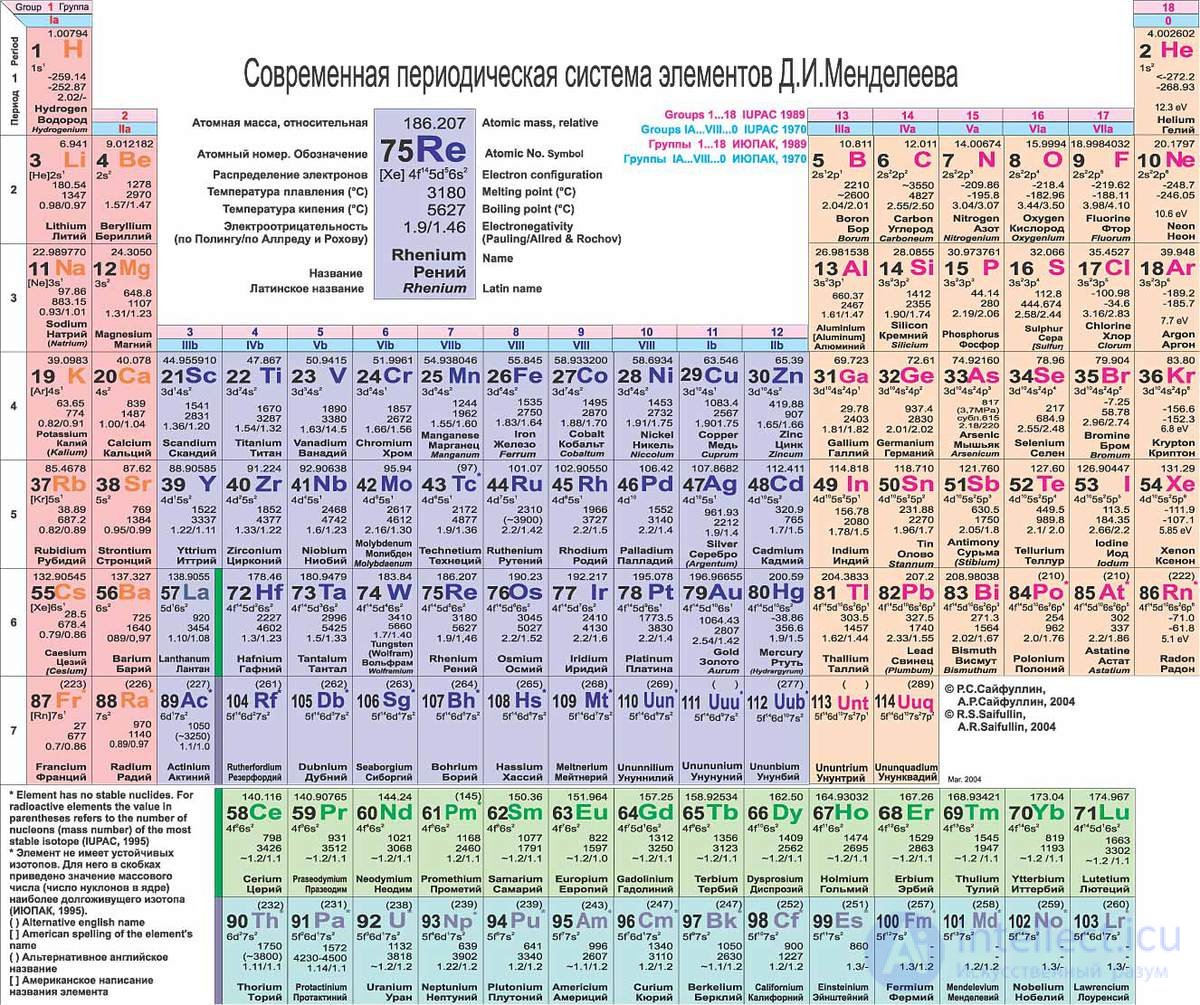
Fig. 5.27. The modern periodic table of elements of D.I. Mendeleev
Chemical properties depend mainly on the structure of the outer electron shell (valence electrons). This is what gives rise to the periodicity in the repetition of element properties. Thus, noble gases have their outer s- and p-subshells filled with 8 electrons. Elements of the first group (alkali metals) have only one electron in the outer shell, while halogens (group VII ) lack one electron to fill the outer p-subshell. All these arguments are well known from the chemistry course, but they are qualitative in nature. As is known, the valence of an element is determined not so much by the number of electrons as by the ease with which they can be pulled out of the atom. It is clear that outer electrons are easier to remove, but it would be good to have at least some quantitative criterion. Such a criterion can be the ionization potential, proportional to the energy that must be spent to remove an electron from the atom. Calculating complex atoms is not simple, but on the whole the periodic table is explained by quantum mechanics. We will limit ourselves to the simplest atoms and replace exact calculations with quantitative estimates. The experimental results are shown in Fig. 5.28.
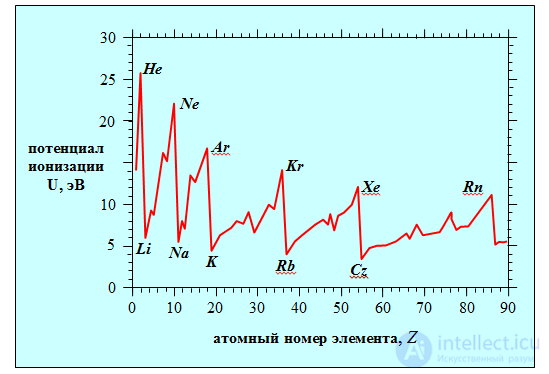
Fig. 5.28. The ionization potential for elements from hydrogen to uranium. The periodicity of the elements' properties is clearly visible:
peaks of the ionization potential occur for noble gases, minima — for alkali metals
Effective nuclear charge, estimates of the ionization potential, and Moseley's law
We have studied in detail the energy levels of hydrogen-like atoms, described by the Bohr formula
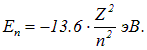
For more complex systems with many electrons this formula is not valid, but we will still use it, introducing a correction for the screening of the nucleus by electrons by replacing the nuclear charge Z with a certain effective charge  . This will not give great precision in comparison with experimental data, but we will be satisfied with agreement in order of magnitude.
Hydrogen. Nuclear charge Z = 1, no screening, in the ground state n = 1. The energy of the ground level is 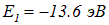 , and the minimum energy of an electron pulled out of the atom is zero. Consequently, the ionization potential U — is the absolute value of the ground-state energy, expressed in volts: U = 13.6 eV. This value will serve as a reference point that keeps us from getting lost on the energy scale of the microworld.
Positive helium ion. The ion  differs from hydrogen only by a doubled nuclear charge: Z = 2. Hence U = 13.6·4 = 54.4 eV.
Helium. A neutral helium atom in the ground state has two electrons on the lowest shell (n = 1), differing in their spin projections. Let us picture the following. When the second electron is farther from the nucleus than the first, the nuclear charge is screened from it and equals (from its «point of view») one. When the second electron is located closer to the nucleus than the first, the «visible» nuclear charge equals two. Both electrons are equivalent, so the described situations are equally probable. Therefore, to estimate the effective nuclear charge we take the arithmetic mean:
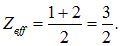
Of course, an electron cannot completely screen the nucleus from its partner. Of course, one must also take into account the energy of Coulomb repulsion between the electrons. And yet the resulting estimate is not so bad:

Experiment gives

The enormous value of the ionization potential of helium is striking (the largest in the periodic table). The inertness of helium is a direct consequence of this fact.
Doubly ionized lithium atom  . A hydrogen-like system with Z = 3. Therefore
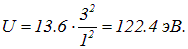
Lithium ion. The ion  is similar to a helium atom, but for it the effective nuclear charge is one unit greater:

Hence
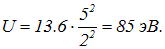
Experiment gives

Lithium. The third electron in a neutral lithium atom is located on the second shell — the level with n = 2. For this reason the two inner electrons almost completely screen two units of nuclear charge from it:

Hence
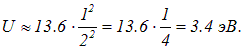
Experiment gives

These estimates are very telling: how much easier it is (compared with hydrogen) to pull one electron from lithium, and how hard it is to remove the subsequent ones. That is why lithium is monovalent.
Beryllium. The ions  and
and  are analogous to hydrogen and helium and have enormous ionization potentials. The ion
  is similar to lithium, but for it the effective nuclear charge «seen» by the third electron is one unit greater:

We obtain
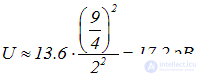
Experiment gives 18.2 eV. This value is not much greater than the ionization potential of the hydrogen atom, and is certainly much smaller than the ionization potential of the ion  . In a neutral Be atom, two electrons occupy the second shell. The system is similar to the ion
  , but the effective nuclear charge is one unit greater:

Hence
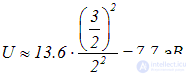
The experimental value is 10.4 eV. From this we conclude: since the first two electrons are much easier to pull from a beryllium atom than the subsequent ones, beryllium is divalent.
The concept of effective nuclear charge is also useful when considering the properties of so-called characteristic X-ray radiation, which arises when outer electrons transition to a vacant place in the inner shells. As we have found, for electrons in the KK shell

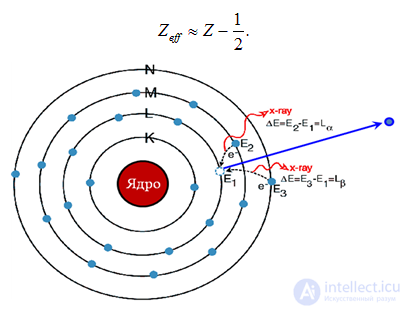
Fig. 5.29. The origin of characteristic radiation. When a collision with an electron occurs in a target atom, a vacancy is formed in an inner electron shell. This vacancy is filled by an electron from another shell. In the process, an X-ray quantum is emitted
Example. For copper Cu Z = 29 and

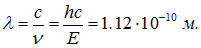
When an outer electron, far from the nucleus, with energy nearly equal to zero, makes the transition, a photon is emitted with energy

The wavelength of such a photon
In 1913, Moseley's law was established, relating the frequency n of the characteristic X-ray radiation of an element to its atomic number Z:
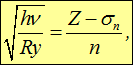
where  — the Rydberg constant, n — the principal quantum number of the shell to which the transition occurs, and
  — some constant. In this law it is now easy to see the manifestation of nuclear screening, that is, the influence on a single electron of an atom of all the other electrons. Historically, Moseley's law finally confirmed that the properties of an element depend on the atomic number Z, and not on the atomic mass. This removed the last doubts about the correctness of the arrangement of the elements in the periodic table.
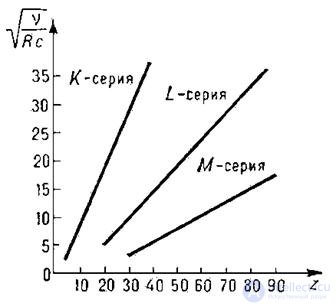
Fig. 5.30. Moseley's law confirmed the correctness of the placement of elements in D.I. Mendeleev's table and contributed to clarifying the physical meaning of Z
Video 5.8. Experimental verification of Moseley's law.
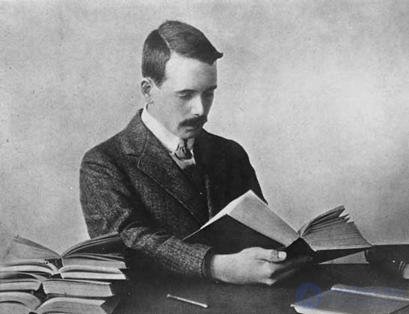
Fig. 5.31. Henry Gwyn Jeffreys Moseley, 1887–1915
Electron configuration of atoms
For the atom of any element we can specify its ground-state electron configuration. Let us now become acquainted with two rules that let us find, for the ground state of each atom, the value of its total moments: the spin moment S, the orbital moment L and the total moment J.
The first rule (Hund's rule)
|
The lowest energy is possessed by the atom with the largest possible value of S for a given electron configuration, and, for that S, the largest possible value of L. |
The second rule
|
If an unfilled subshell of an atom contains no more than half of the maximum possible number of electrons for it, then J = |L – S|. If, however, the subshell is filled more than half, then J = L + S. |
Hund's rule is empirical (that is, not derived from theory, but established experimentally); the second rule is derived from it and from the formula (5.19) obtained above for the
продолжение следует...
Часть 1 5. The theory of the atom
Часть 2 5.6. The Pauli Principle and the Valence of Elements -
Часть 3 - 5. The theory of the atom








Comments