
Lecture
Это окончание невероятной информации про уравнение шредингера.
...
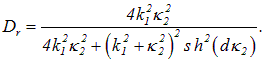
equation (4.49) follows the expression for the transmission coefficient
|
|
|
(4.53) |
If, as is usually the case, the argument

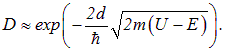
then the term with the hyperbolic sine dominates, and

Neglecting also the pre-exponential factors, we obtain the already familiar expression (4.34)
|
|
|
(4.54) |
Passage of light through a multilayer structure
In this section we shall consider the passage of a particle over a potential barrier composed of  rectangular finite barriers of width
  , with the inter-barrier spacing everywhere the same and equal to
  (Fig. 4.22).
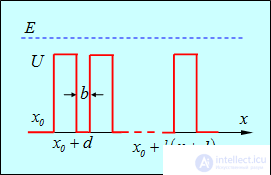
Fig. 4.22. Multilayer structure with period l = d + b, formed by N rectangular potential barriers of width d and inter-barrier spacing b
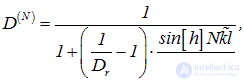
In principle, the problem of calculating the transmission coefficient  through such a «composite» barrier can be solved by the methods described above. Right now it is only important for us to understand the main physical result, so the formulas below are given without derivation and for reference only. The expression for the transmission coefficient has the form
|
|
|
(4.55) |
where  — is the transmission coefficient through a single rectangular barrier, calculated above (at =1 we obtain from (4.55)
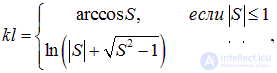
  ). The quantity

is called the quasi-wave vector (unlike the particle's wave vectors  and
and  it is marked with a tilde).
For the case of light, we use result (4.50) for  . The relation between the quasi-wave vector and the frequency of the incident light and the refractive index is then given by the expression
|
|
|
(4.56) |
where
|
|
|
(4.57) |
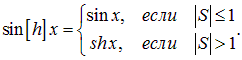
Finally, the functions entering (4.55) are defined as
|
|
|
(4.58) |
It is clear that for frequencies at which the rectangular barrier  is completely transparent, our composite barrier will also be transparent (
  in this case, as also follows from formula (4.55)). In addition, new transparency windows will appear. The situation here is very similar to the case of a diffraction grating. A numerical solution is shown in Fig. 4.23, where for definiteness we set
  = 1.52, = 0.9d.
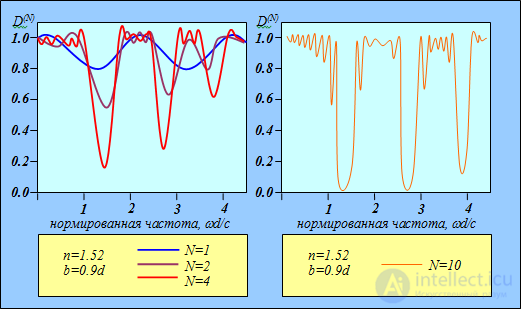
Fig. 4.23. Transmission coefficient as a function of the normalized frequency of the incident light (particle energy) for a small (left) and large (right) number
The left-hand figure shows the transmission coefficient for one, two, and four barriers, the right-hand one — for ten barriers. The last case, when the number of barriers is large  is of particular interest to us. The trends observed for = 10, in the limit

become more pronounced. Namely: as grows, some minima become deeper and wider, and in the limit the value of the transmission coefficient at them tends to zero. Conversely, the amplitude of the oscillations  at other frequencies becomes smaller, and the transmission coefficient tends to unity. The physical explanation of this phenomenon is that, under certain conditions, waves reflected from the ends of the rectangular barriers mutually cancel, extinguishing one another.
Let us emphasize once again: for the limiting case of a periodic structure

the dependence of the transmission coefficient

on the frequency of the incident light is such that:

for such frequencies the composite barrier is opaque, and light of these frequencies is completely reflected from the structure;

that is, for them the barrier is completely transparent, no reflection occurs, and the light propagates freely through such a structure (this phenomenon underlies the production of so-called anti-reflection coated lenses).
A similar phenomenon occurs in quantum mechanics for a particle moving in a periodic potential field. At certain values of the particle's energy, an infinite periodic sequence of potential barriers becomes completely opaque to it, even if the particle's energy exceeds the barrier height. At other energies, on the contrary, the periodic potential structure becomes absolutely transparent for the particle. This is how the so-called forbidden and allowed energy bands in a crystal arise, and we shall get to know them better in due course.
Часть 1 4. The Schrodinger equation
Часть 2 4.6. Bohr's correspondence principle - 4. The Schrodinger equation
Часть 3 - 4. The Schrodinger equation


Comments