
Lecture
Sniper is a highly qualified marksman capable of hitting targets at long range with high precision. He operates in the army, police special units, or intelligence services, performing surveillance, target neutralization, and unit support tasks.
Long-range sniper: operates at long distances (up to 1–2 km), engaging high-value targets with precision.
Urban sniper: operates in densely built-up areas, using cover and short distances.
Reconnaissance sniper: primary task is observation and information gathering rather than shooting.
Counter-sniper: hunts enemy shooters, identifies their positions, and neutralizes them.
Tactical coordinator: manages fire support, helping the unit occupy advantageous positions.
Guerrilla sniper: operates covertly in forests or mountains, often as part of small groups.
Psychological sniper: uses shots to demoralize the enemy, creating an atmosphere of fear.
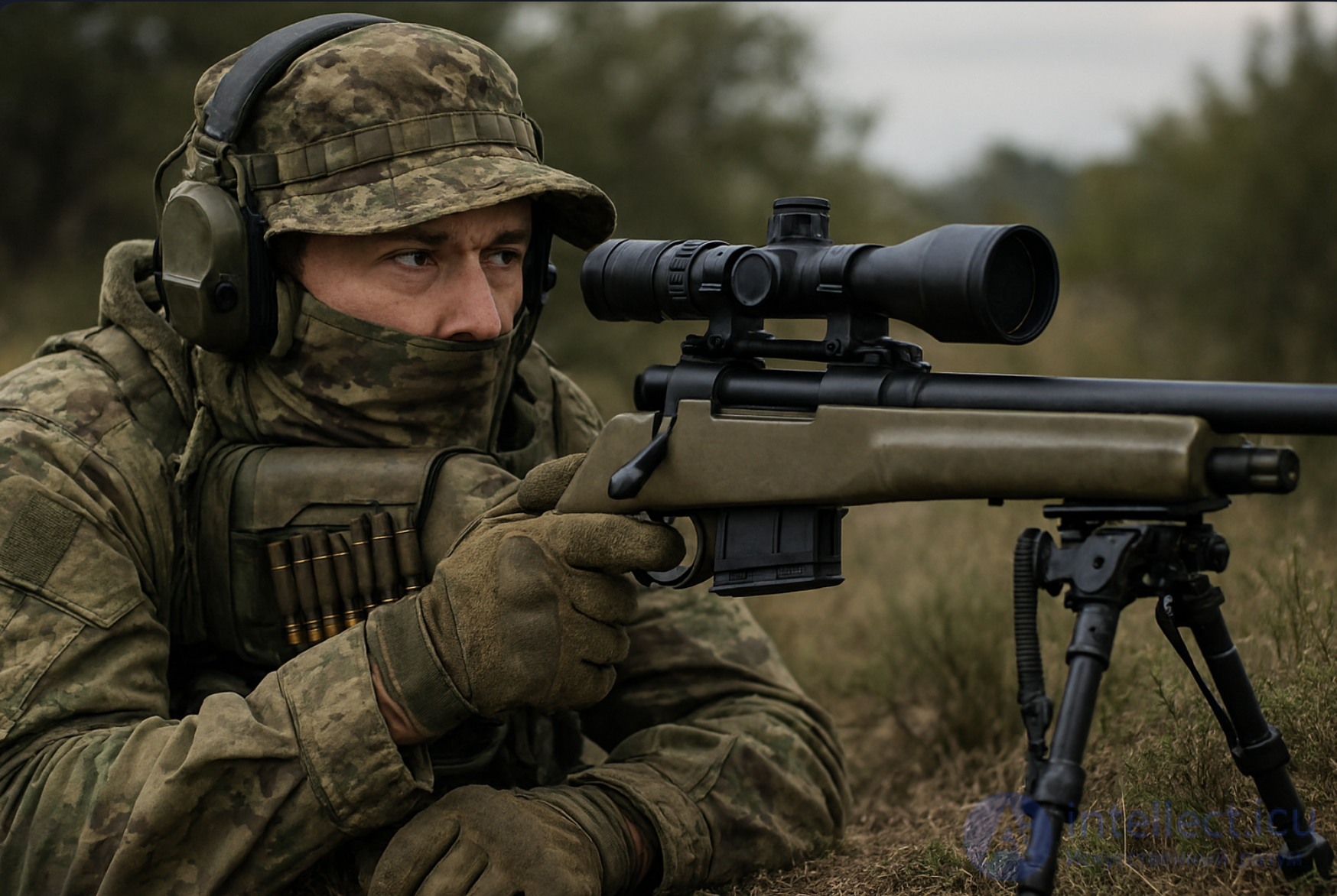
Long-range snipers require powerful rifles (.338 Lapua, .50 BMG).
Urban snipers more often use compact systems (7.62 NATO).
Reconnaissance snipers work in a pair with a spotter, using optics and drones.
Counter-snipers must be able to quickly analyze ballistics and the enemy's camouflage.
20/20 vision (correctable with glasses) and no color blindness.
Physical fitness: meeting military standards for weight, height, and physical tests.
General health: no chronic conditions that would hinder prolonged exertion and stress.
High stress resistance: the ability to maintain concentration in combat conditions.
Emotional stability: the ability to cope with moral dilemmas and isolation.
Focus and patience: long hours of observation and waiting for a target.
Self-control: avoiding impulsive actions.
Military courses: for example, the U.S. Army Sniper School (Fort Benning).
Specialization in the army: infantry, reconnaissance, special forces.
Additional training: camouflage, ballistics, working with optics.
| Country | Average Income |
|---|---|
| USA | $52,000–86,000 |
| China | $15,000–25,000 (estimate based on military data) |
| Russia | $10,000–18,000 |
| Ukraine | $8,000–15,000 |
| India | $6,000–12,000 |
| South Africa | $12,000–20,000 |
| Egypt | $5,000–10,000 |
| Israel | $20,000–35,000 |
Note: figures vary depending on branch of service, rank, and region.
Vision problems: eye strain from optics.
Hearing impairment: exposure to gunfire.
Post-traumatic stress: PTSD and emotional disorders.
Musculoskeletal problems: back and joint pain from prolonged static positions.
The sniper profession took shape relatively late, although marksmanship as a skill has existed since antiquity. Already in the Middle Ages, archers and crossbowmen capable of hitting a target from a great distance played a special role in battles. However, it was with the advent of rifled firearms in the 18th–19th centuries that the concept of a specialized marksman began to take shape.
During the Napoleonic Wars, British riflemen used rifled muskets to pick off enemy officers. Organized sniper units first appeared during the American Civil War.
The profession's true rise came during World War I, when trench warfare required fighters capable of covert observation and precision fire. In World War II, snipers became an integral part of armies, especially in the USSR, Germany, and Finland.
In the second half of the 20th century, the sniper's role expanded: he became not only a shooter but also a scout, observer, spotter, and specialist in psychological pressure on the enemy.
History knows many snipers whose names have become symbols of military skill:
Vasily Zaitsev (USSR) — one of the most famous snipers of World War II, a participant in the Battle of Stalingrad. His exploits played a significant role in the development of the Soviet sniping school.
Simo Hayha (Finland) — nicknamed the «White Death», considered one of the most effective snipers in history. His achievements during the Winter War became legendary.
Lyudmila Pavlichenko (USSR) — one of the most famous female snipers, a symbol of women's participation in combat professions.
Carlos Hathcock (USA) — a sniper of the Vietnam War who made a major contribution to the development of modern sniper training and doctrine.
It is worth noting that in the professional military community, the emphasis is not on personal «records», but on accomplishing missions and reducing casualties in one's own units.
Today, a sniper is a highly skilled specialist who performs a range of tasks:
covert observation and reconnaissance;
precision neutralization;
fire correction and target designation;
gathering tactical information;
working in a pair or small group under difficult conditions.
The modern sniper actively uses optics, ballistic calculators, communication and camouflage equipment, and also works together with unmanned systems.
The development of artificial intelligence, sensors, and unmanned systems is already significantly affecting the sniper profession.
automated analysis of the environment and imagery;
assistance in calculating ballistics and weather conditions;
intelligent scopes and decision-support systems;
drones for reconnaissance and target detection.
The profession is not expected to disappear entirely, but its nature will change:
AI will take over routine and computational tasks;
the human role will shift toward decision-making, context assessment, and responsibility;
in complex, dynamic, and ethically sensitive situations, the human factor will remain critically important.
The sniper of the future is not just a shooter, but also an operator of high-tech systems, an analyst, and a tactical specialist working in tandem with AI.
Scout/reconnaissance operative — working with information and observation.
Special operations officer — SWAT, counter-terrorism units.
Shooting instructor — training military and civilian personnel.
Security officer — private security firms.
Weapons industry worker — engineer, tester.
The sniper profession has come a long way — from lone marksmen to highly trained military specialists. The development of artificial intelligence will not destroy this profession but will transform it, raising the requirements for training, thinking, and responsibility. The human being in this role will remain a key element, especially where conscious choice, adaptation, and moral judgment of the situation are required.
This profession combines unique skills with high risk. It demands exceptional discipline and training, and career prospects are often linked to moving into related fields of security.

Comments