
Lecture
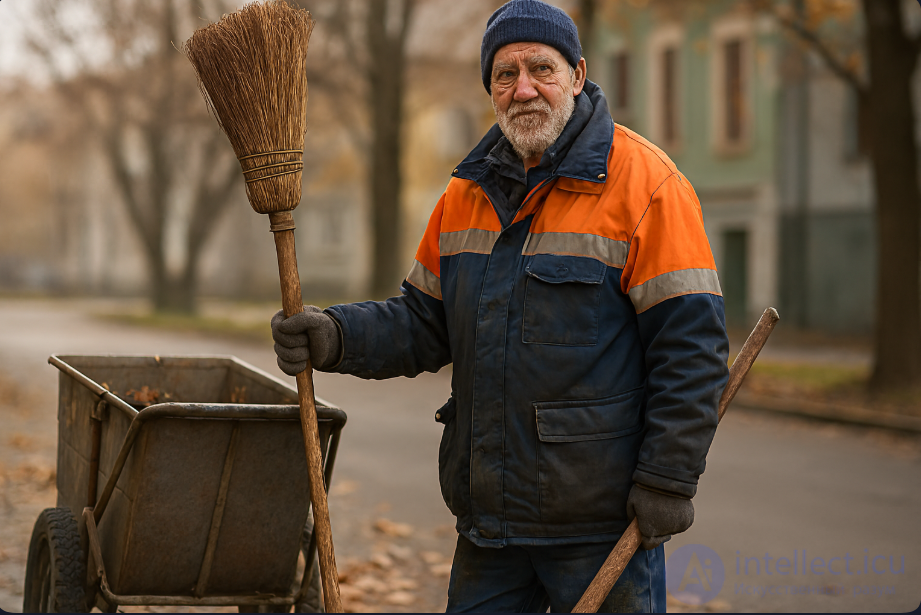
A street cleaner (yard keeper) is a specialist responsible for maintaining cleanliness and order in surrounding areas: courtyards, sidewalks, and public zones. Their work includes removing litter, sweeping, clearing snow, tending to green spaces, and minor repairs. Despite its apparent simplicity, this profession requires physical endurance, responsibility, and attentiveness.
To work as a street cleaner, it is important to meet the following medical criteria:
Absence of chronic illnesses that limit physical activity (for example, cardiovascular or musculoskeletal disorders)
Good vision and coordination of movement
Resilience to temperature fluctuations and weather conditions
No allergies to household chemicals and dust
The work requires:
Patience and stress resistance
Self-discipline and responsibility
The ability to perform monotonous work
The ability to work autonomously, without constant supervision
No formal education is required, but the following are welcomed:
Courses in occupational health and safety
Knowledge of the basics of sanitation and ecology
Skills in operating cleaning equipment
In many countries, employment is possible without a diploma, but having experience and references increases the chances of stable employment.
| Country | Average salary/month |
|---|---|
| USA | $2,000–$2,500 |
| China | $500–$800 |
| Russia | $300–$450 |
| Ukraine | $200–$300 |
| India | $150–$250 |
| South Africa | $400–$600 |
| Egypt | $150–$250 |
| Israel | $1,500–$2,000 |
Salary depends on the region, employer, scope of duties, and work schedule.
The most common ones:
Osteochondrosis, arthritis, back and joint pain
Allergies to dust and chemical substances
Frostbite and heatstroke
Varicose veins
Psychological and emotional burnout
Origin:
The Russian word «dvornik» comes from «dvor» (courtyard) — a person who keeps order in the courtyard.
The first mentions date back to the 16th–17th centuries in Russia, when street cleaners served estates, performing the duties of both a cleaner and a watchman.
19th century:
In the cities of the Russian Empire, street cleaners became full-time employees of households.
They cleaned the streets, maintained order, and sometimes performed police functions.
20th century:
In the USSR, street cleaners became part of the municipal services.
The profession became widespread, especially in cities.
In the 1960s–1980s, street cleaners were often pensioners or people with limited employment opportunities.
21st century:
The advent of machinery (vacuum cleaners, tractors, watering machines) changed the nature of the work.
In large cities, street cleaners work for management companies, servicing residential complexes, parks, and streets.
Despite the humility of the profession, some well-known figures started out as street cleaners:
Joseph Brodsky — a Nobel laureate in literature, worked as a street cleaner while in exile in the USA.
Vladimir Vysotsky — worked part-time as a street cleaner in his youth.
Alexander Bashlachev — a poet and rock musician, worked as a street cleaner during difficult periods of his life.
Yuri Nikulin — the future actor and circus director, performed the duties of a street cleaner while in the army.
These examples show that the profession can be a temporary stage on the path to creative or scientific achievements.
Automation:
Cleaning robots, monitoring drones, and smart trash bins are already in use today.
AI can optimize cleaning routes, predict pollution, and control machinery.
But the profession will not disappear entirely:
Manual labor remains indispensable in hard-to-reach places, when clearing snow, leaves, and small litter.
The human factor is important for assessing situations, communicating with residents, and responding to non-standard cases.
Transformation:
The street cleaner of the future is a machinery operator, an environmental inspector, an urban service agent.
The profession will become more technical, with elements of control and analytics.
Indoor cleaner
Landscape gardener
Plumber
Garbage collector
Utility service worker
General laborer
Landscaping worker

Comments