
Lecture
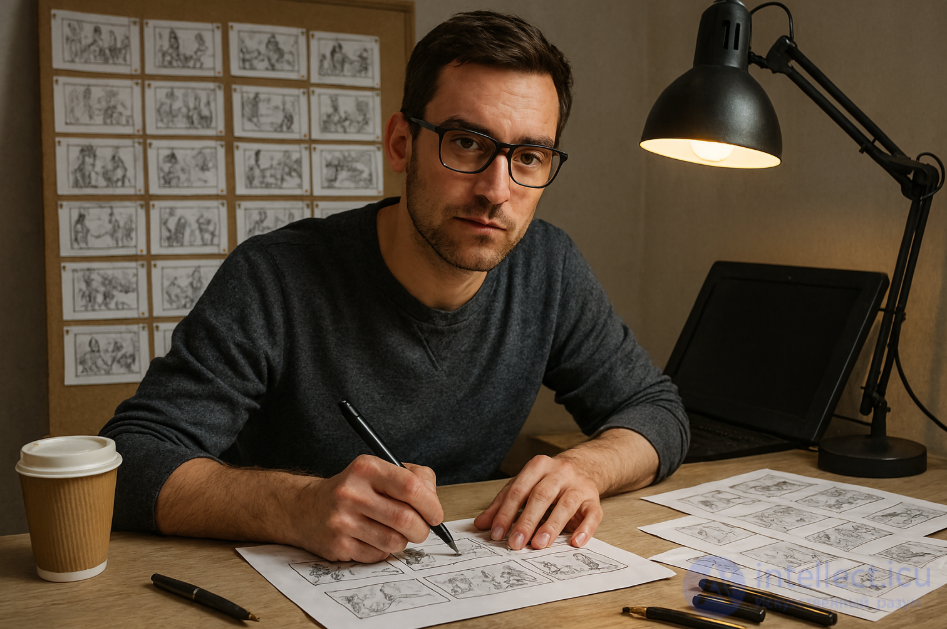
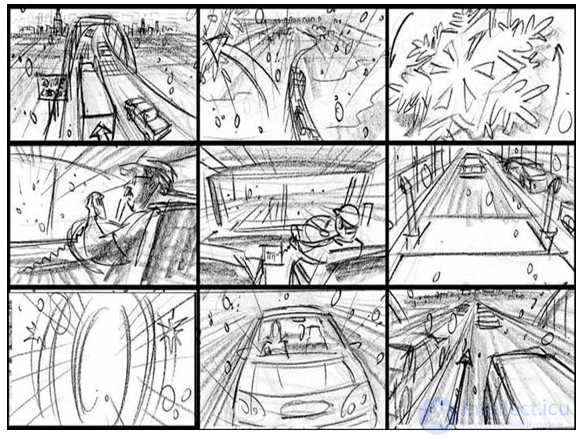
A storyboard artist is a specialist who visualizes the script of a film, series, commercial, or video game as a sequence of drawings. Their task is to turn the text of a script into clear frames that show composition, camera angles, camera movement, and the actions of the characters. These drawings serve as a «guide» for the director, camera operators, and the entire film crew.
Good eyesight (or corrected with glasses/lenses).
A healthy musculoskeletal system: the work involves prolonged sitting at a desk or computer.
No serious diseases of the hands and joints (carpal tunnel syndrome is a common problem).
Resistance to eye strain (prevention of myopia, dry eyes).
High concentration and perseverance.
Creativity and a well-developed imagination.
The ability to work in a team and accept criticism.
Emotional resilience: the work is often associated with deadlines and stress.
The ability to quickly adapt to changes in the script.
Art schools, faculties of design, animation, and film.
Courses in storyboarding, directing, and animation.
Proficiency in graphic editors (Photoshop, Storyboard Pro, Toon Boom).
Knowledge of the fundamentals of cinematography: frame composition, editing, camera movement.
The profession requires a combination of:
drawing and composition
an understanding of cinematic language
editing
dramaturgy
directing
A good storyboard artist is not just an artist, but a visual storyteller.
| Country | Average annual income (USD) |
|---|---|
| USA | 89,000 – 90,000 |
| China | ~30,000 – 35,000 |
| Russia | ~12,000 – 15,000 |
| Ukraine | ~8,000 – 10,000 |
| India | ~7,000 – 9,000 |
| South Africa | ~18,000 – 20,000 |
| Egypt | ~10,000 – 12,000 |
| Israel | ~35,000 – 40,000 |
Vision disorders (myopia, dry eye syndrome).
Diseases of the joints and spine (osteochondrosis, scoliosis).
Carpal tunnel syndrome.
Psycho-emotional burnout.
The profession in its modern form appeared in the 1930s at the Walt Disney Productions studio. It was there that scripts were first visualized not as texts, but as a sequence of drawings — frames that show how a scene will look.
One of the first innovators was Webb Smith — he proposed pinning drawings on a board and arranging scenes in sequence so that directors could «see» the film before it was made.
Later, storyboarding went beyond animation and began to be used in live-action film, advertising, and television. Directors started using storyboards for complex scenes:
action scenes
special effects
commercials
music videos
One of the first directors to actively use storyboarding was Alfred Hitchcock — he planned scenes so precisely that he sometimes said: «the film is already made — all that's left is to shoot it».
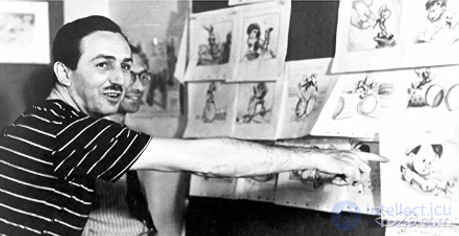
Before the 1930s, individual elements of storyboarding existed, but the profession itself as such did not.
For example:
directors made sketches of scenes by hand
in film, shot lists were used
in comics, sequential visual storytelling already existed
However, all of this was scattered — there was no dedicated specialist who did precisely this.
In the early 1930s, a breakthrough occurred at the Walt Disney Productions studio:
the artist Webb Smith proposed:
drawing scenes on separate cards
pinning them to a board
arranging them in sequence
This made it possible to:
«watch the film» even before animation
rearrange scenes
improve the dramaturgy
This is exactly how the cartoon
Snow White and the Seven Dwarfs was created — Disney's first full-length animated film.
Worked on the original Star Wars trilogy and made an enormous contribution to the visual style of the space battles.
Created storyboards for films such as The Graduate and Birdman of Alcatraz. His work was distinguished by its depth of composition.
A well-known comic book artist who applied the language of comics to film (for example, Raiders of the Lost Ark).
Today, storyboard artists work not only in film but also in the gaming industry, for example on projects by companies such as Blizzard Entertainment or Naughty Dog.
With the development of generative models (images, video, 3D previsualization), the profession is being greatly transformed.
AI can already:
generate quick previsualizations of scenes
suggest frame compositions
automatically turn script text into a rough storyboard
Short answer: no, but it will change
AI does not understand dramaturgy the way a human does
It generates pictures, but it does not feel the rhythm of a scene.
Directorial logic is needed
A storyboard is staging, not just drawing.
Team communication
The storyboard is a language of communication between the director, the camera operator, and the VFX team.
The storyboard artist of the future will:
work in tandem with AI tools
spend more time on staging and directing
do less drawing «by hand»
manage the visual style and rhythm of the scene
In effect, the profession will become closer to a visual director / previs artist.
Concept artist.
Illustrator.
Animator.
Character artist.
Environment artist.
Animation director.
Comic book artist.
This profession combines artistic talent with a technical understanding of the language of film. It suits those who want to be the «invisible architect» of visual storytelling, creating the foundation for future films and cartoons.
The storyboard artist profession has traveled the path:
Disney animation → film → advertising → games → virtual production and AI
And despite automation, it will not disappear, because its core is human storytelling, directing, and visual thinking.

Comments