
Lecture
Technological unemployment is the loss of jobs due to technological change. It is a key type of structural unemployment.
Technological unemployment — is the loss of jobs caused by technological change. Such changes usually involve the introduction of labour-saving machinery or more efficient production processes. A well-known historical example of technological unemployment is the impoverishment of artisan weavers[en] after the introduction of mechanized looms[en]. A modern example of technological unemployment is the reduction of cashiers in retail stores after the introduction of self-checkout registers.
It is widely acknowledged that technological change can lead to short-term job losses. The view that it can lead to a long-term rise in unemployment has for a long time been contested. Participants in the debate over technological unemployment can be divided into optimists and pessimists. Optimists agree that innovation can disrupt the functioning of jobs in the short term, but still believe that various compensating effects make it possible to avoid long-term negative consequences for jobs. Meanwhile, pessimists argue that under at least some circumstances new technologies can lead to a prolonged decline in the overall number of workers in employment. The phrase «technological unemployment» was popularized by Keynes in the 1930s . At the same time, the question of the displacement of human labour by machine labour has been discussed at least since the time of Aristotle.
Technological change usually involves the introduction of labour-saving machines with «mechanical muscles» or more efficient «mechanical mind» processes (automation), while the role of people in these processes is reduced to a minimum. Just as horses were gradually made obsolete by automobiles, people's jobs have also suffered throughout modern history. Historical examples include artisan weavers who were impoverished after the introduction of mechanized looms. During the Second World War, Alan Turing's Bombe machine compressed and decoded encrypted data over thousands of man-years in a matter of hours. A modern example of technological unemployment is the displacement of retail cashiers by self-checkout registers.
It is widely acknowledged that technological change can cause short-term job losses. The view that this can lead to a long-term rise in unemployment has long remained contested. Participants in the debate over technological unemployment can generally be divided into optimists and pessimists. Optimists agree that innovation can destroy jobs in the short term, but they nonetheless believe that various compensation effects ensure that innovation never has a negative impact on jobs in the long term. Meanwhile, pessimists argue that, at least under some circumstances, new technologies can lead to a long-term decline in the overall number of the employed. The phrase «technological unemployment» was popularized by John Maynard Keynes in the 1930s, who said that it was « Nevertheless, the problem of machines displacing human labour has been discussed at least since the time of Aristotle.
Before the 18th century, both the elite and ordinary people generally held a pessimistic view of technological unemployment, at least in cases where the issue arose. Because of the generally low level of unemployment throughout most of pre-modern history, the topic rarely gave rise to serious concern. In the 18th century, fears about the impact of machines on jobs intensified with the rise of mass unemployment, especially in Great Britain, which was then at the forefront of the Industrial Revolution. However, some economic thinkers began to object to these fears, arguing that innovation would generally not have a negative impact on jobs. These arguments were formalized in the early 19th century by the classical economists. In the second half of the 19th century, it became increasingly evident that technological progress benefited all strata of society, including the working class. Fears about the negative impact of innovation diminished. The term «Luddite fallacy» was coined to describe the notion that innovation would have a lasting detrimental effect on employment.
The view that technology is unlikely to lead to long-term unemployment has been repeatedly challenged by a minority of economists. In the early 1800s their number included Ricardo himself. Dozens of economists warned about technological unemployment during short-lived intensifications of the debate, which flared up sharply in the 1930s and 1960s. In the last two decades of the twentieth century, especially in Europe, new warnings emerged as commentators noted the steady rise in unemployment that has afflicted many industrially developed countries since the 1970s. Nevertheless, a clear majority of both professional economists and the interested public held optimistic views throughout most of the twentieth century.
In the second decade of the 21st century, a number of studies were published suggesting that technological unemployment may be rising worldwide. Oxford professors Carl Benedikt Frey and Michael Osborne, for example, estimated that 47% of jobs in the US are at risk of automation. However, their findings were often misinterpreted, and on PBS NewsHour they again made clear that their findings do not necessarily imply future technological unemployment. Although many economists and commentators still argue that such fears are unfounded, as was widely believed throughout most of the previous two centuries, concern about technological unemployment is once again growing. A 2017 report in Wired quotes knowledgeable people such as economist Gene Sperling and management professor Andrew McAfee, to the effect that addressing existing and looming job losses due to automation is a «serious problem». Regarding the recent statement by Treasury Secretary Steve Mnuchin that automation «will not have any large impact on the economy in the next 50 or 100 years», McAfee says, «I don't talk to anyone in the field who believes that". The latest technological innovations may make people unnecessary in professional, white-collar, low-skilled, creative fields and other «mental work».
The World Bank, in its 2019 World Development Report, argues that while automation displaces workers, technological innovation creates ever more new industries and jobs on balance. [10]
Lawrence Summers [11]
All participants in the debate over technological employment agree that a temporary loss of jobs can result from technological innovation. Likewise, it is beyond doubt that innovation sometimes has a positive impact on workers. The disagreement concerns whether innovation can have a lasting negative effect on overall employment. Levels of persistent unemployment can be quantified empirically, but the causes remain a matter of debate. Optimists allow that short-term unemployment can be caused by innovation, but nonetheless argue that after some time compensation effects will always create at least as many jobs as were initially destroyed. Although this optimistic view has been constantly challenged, it has dominated among mainstream economists throughout most of the 19th and 20th centuries. [12] [13]For example, labour economists Jacob Mincer and Stephan Danninger developed an empirical study using microdata from the Panel Study of Income Dynamics, and found that although in the short term technological progress seems to have an unclear effect on aggregate unemployment, it reduces unemployment in the long run. However, when they include a 5-year lag, the data supporting a short-term impact of technology on employment also seem to disappear, suggesting that technological unemployment «seems to be a myth». [14]
The concept of structural unemployment, a persistent level of unemployment that does not disappear even at the peak of the business cycle, became popular in the 1960s. For pessimists, technological unemployment is one of the factors contributing to the broader phenomenon of structural unemployment. Beginning in the 1980s, even optimistic economists increasingly agreed that structural unemployment had indeed risen in advanced economies (citation missing), but they tend to blame globalization and offshoring for it rather than technological change. Others argue that the main cause of the persistent rise in unemployment was the reluctance of governments to pursue expansionary policies after the displacement of Keynesianism that took place in the 1970s and early 80s. [12] [15] [16] In the 21st century, and especially since 2013, pessimists have increasingly argued that long-term technological unemployment worldwide represents a growing threat.
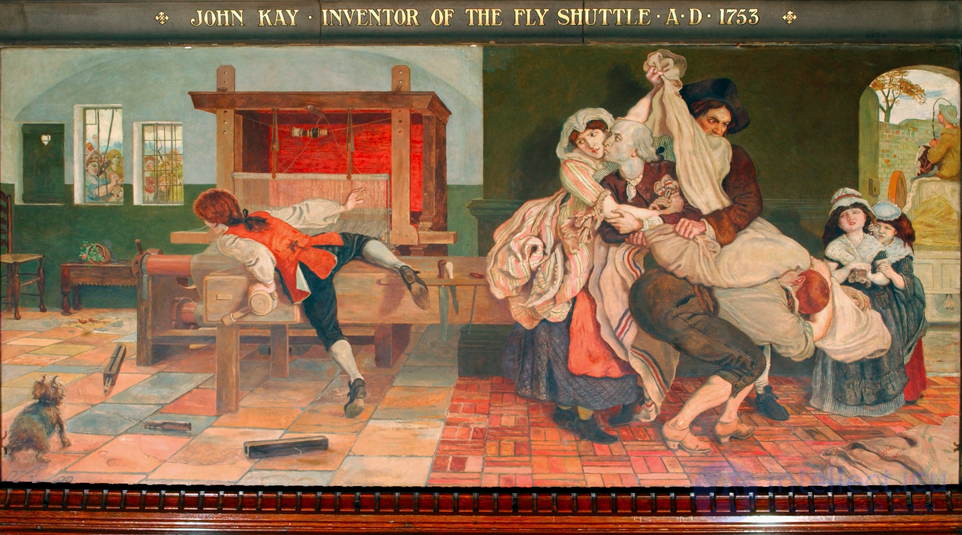
John Kay, inventor of the Fly Shuttle AD 1753, by Ford Madox Brown, depicting the inventor John Kay kissing his wife goodbye as men carry him out of his home to escape a mob angered by his labour-saving mechanical loom. The compensation effects were not widely studied at the time.
Compensation effects are the labour-favourable consequences of innovation that «compensate» workers for the loss of jobs initially caused by new technology. In the 1820s, Say described several compensation effects in response to Ricardo's assertion of possible long-term technological unemployment. Soon after, Ramsay McCulloch developed a whole system of effects. The system was named the «theory of compensation» by Marx, who set out to attack these ideas, arguing that none of the effects were guaranteed to work. Since then, disagreements over the effectiveness of compensation effects have remained a central part of the scholarly debate over technological unemployment. [16] [20]
Compensation effects include:
The «by new machines» effect is now rarely discussed by economists; it is often considered that Marx successfully refuted it. [16] Even pessimists often admit that product innovation, associated with the «by new products» effect, can sometimes have a positive impact on employment. An important distinction can be drawn between «process» and «product» innovation. [note 1] Data from Latin America seem to suggest that product innovation contributes significantly to employment growth at the company level, more so than process innovation. [21] The extent to which other effects succeed in compensating labour for the loss of jobs has been widely debated throughout the history of modern economics; the problem is still unresolved.[22] One such effect, which potentially complements the compensation effect, is a job multiplier. According to research conducted by Enrico Moretti, for each additional job created in high-tech industries in a given city, more than two jobs are created in the non-tradable sector. His findings show that technological growth and the resulting job creation in high-tech industries can have a more significant spillover effect than we expected. [23] Data from Europe also confirms such a job multiplier effect, showing that local high-tech jobs can create five additional low-tech jobs. [24]
Many economists who are pessimistic about technological unemployment acknowledge that compensation effects largely operated as the optimists claimed throughout most of the 19th and 20th centuries. However, they believe that the advent of computerization means that compensation effects are now less effective. An early example of this argument was made by Wassily Leontief in 1983. He acknowledged that after some disruption, the development of mechanization during the Industrial Revolution actually increased the demand for labour and also increased pay for labour due to effects stemming from higher productivity. While early machines reduced the need for muscle power, they were unintelligent and required large armies of human operators to remain productive. However, since the advent of computers in the workplace, the need not only for muscle power but also for human brainpower has declined. Consequently, even if productivity continues to grow, a lower demand for human labour may mean a reduction in wages and employment. [16] [18] [25] However, this argument is not fully supported by more recent empirical research. One study, conducted by Erik Brynjolfsson and Lorin M. Hitt in 2003, presented direct evidence indicating a positive short-term impact of computerization on firm-level measured productivity and output growth. In addition, they believe that in the long run the contribution of computerization and technological change to productivity may be even greater.
Alex Tabarrok [26]
The term «Luddite fallacy» is sometimes used to express the view that those who are concerned about long-term technological unemployment are committing a fallacy, as they fail to take compensation effects into account. People who use this term usually expect that technological progress will not have a long-term impact on the level of employment and will ultimately lead to higher wages for all workers, because progress helps to increase the overall welfare of society. The term is based on the example of the Luddites of the early 19th century. Throughout the 20th century and the first decade of the 21st, the prevailing view among economists was that belief in long-term technological unemployment was indeed a mistake. Recently there has been growing support for the view that the benefits of automation are distributed unevenly. [13] [27] [28]
There are two premises explaining why long-term difficulties may arise. Traditionally, the one attributed to the Luddites has been used (whether or not this is really an accurate generalization of their thinking), namely that there is a limited amount of work available, and if machines do this work, there can be no other work left for people. Economists call this the lump of labour fallacy, arguing that in reality no such limit exists. However, the other premise is that long-term difficulties may arise that have nothing to do with any lump of labour. From this point of view, the amount of work that can exist is infinite, but (1) machines can do most of the «easy» work, (2) the definition of what is «easy» expands as information technology develops, and (3) work that goes beyond the «easy» (work that requires more skill, talent, knowledge, and insightful connections between pieces of knowledge) may require greater cognitive abilities than most people can provide, since point 2 is constantly advancing. This latter view is supported by many modern proponents of the possibility of long-term systemic technological unemployment.
Among those who debate the impact of innovation on the labour market, it is a common view that it mainly affects people with low skills, but often benefits skilled workers. According to scholars such as Lawrence F. Katz, this may have been true throughout most of the twentieth century, but in the 19th century workplace innovations largely displaced costly skilled craftsmen and generally benefited the low-skilled. While 21st-century innovation replaces unskilled work, other low-skilled occupations remain resistant to automation, whereas white-collar work requiring intermediate skills is increasingly performed by autonomous computer programs.
However, some recent studies, such as a 2015 paper by Georg Graetz and Guy Michaels, have shown that, at least in the area they studied - the impact of industrial robots - innovation raises the wages of highly skilled workers, while having a more negative impact on low-to-medium skills. [32] A 2015 report by Carl Benedikt Frey, Michael Osborne, and Citi Research concluded that innovation had eroded medium-skill jobs, while at the same time predicting that over the next ten years the impact of automation would fall most heavily on those with low skills. [33]
Geoff Colvin of Forbes argued that forecasts about what work a computer will never be able to do have proven inaccurate. A better approach to predicting the skills that people will value would be to identify activities in which we will insist that humans be responsible for important decisions, for example, with judges, CEOs, bus drivers, and government leaders, or where human nature can only be satisfied by deep interpersonal connections, even if these tasks can be automated. [34]
By contrast, others believe that even skilled human workers are obsolete. Oxford scholars Carl Benedikt Frey and Michael Osborne predicted that computerization could make nearly half of jobs unnecessary; [35] of the 702 occupations assessed, they found a strong correlation between education and income and the susceptibility to automation, with office work and service jobs among those most at risk. [36] In 2012, Sun Microsystems co-founder Vinod Khosla predicted that over the next two decades 80% of doctors' jobs would be lost to automated, machine-learning medical diagnostic software. [37]
Numerous empirical studies have been conducted aimed at quantifying the impact of technological unemployment, mostly at the microeconomic level. Most existing company-level studies have found that technological innovation is labour-friendly. For example, German economists Stefan Lachenmaier and Horst Rottmann found that both product and process innovation have a positive impact on employment. They also found that process innovation has a more significant job-creating effect than product innovation. [38] This result is also confirmed by data in the United States, which shows that innovation by manufacturing firms has a positive impact on the total number of jobs, and not just on the behaviour of a particular firm. [39]
However, at the industry level, researchers have obtained mixed results regarding the impact of technological change on employment. A 2017 study of manufacturing and services in 11 European countries shows that a positive impact of technological innovation on employment exists only in medium- and high-tech sectors. There also seems to be a negative correlation between employment and capital accumulation, which suggests that technical progress could potentially contribute to labour savings, given that technological innovation is often embodied in investment. [40]
A limited amount of macroeconomic analysis has been conducted to study the relationship between technological shocks and unemployment. However, the small number of existing studies suggests mixed results. Italian economist Marco Vivarelli believes that the labour-saving effect of technological innovation appears to have affected the Italian economy more negatively than the United States. On the other hand, the job-creating effect of innovative products could be observed only in the US but not in Italy. [41] Another study, conducted in 2013, finds a more temporary rather than permanent unemployment effect of technological change. [42]
There are four main approaches that attempt to quantitatively capture and document technological innovation. The first of these, proposed by Jordi Galí in 1999 and developed by Neville Francis and Valerie A. Ramey in 2005, is to use long-term restrictions in a vector autoregression (VAR) to identify technological shocks, assuming that only technology affects long-run productivity. [43] [44]
The second approach is from Susanto Basu, John Fernald, and Miles Kimball. [45] They construct a measure of aggregate technology change with augmented Solow residuals, controlling for aggregate, non-technological effects such as non-constant returns and imperfect competition.
The third method, originally developed by John Shea in 1999, uses a more direct approach and employs observable indicators such as research and development (R&D) spending and the number of patent applications. [46] This measure of technological innovation is very widely used in empirical research, since it does not rely on the assumption that only technology affects long-term productivity, and it fairly accurately reflects the change in output based on the change in inputs. However, there are limitations with direct measures such as R&D. For example, since R&D measures only the input to innovation, the output is unlikely to be perfectly correlated with the input. In addition, R&D does not account for the uncertain lag between the development of a new product or service and its introduction to the market. [47]
The fourth approach, developed by Michelle Alexopoulos, examines the number of new titles published in the fields of technology and computer science to reflect technical progress, which turned out to be consistent with data on R&D spending. [48] Compared with research and development, this measure captures the lag between changes in technology.
According to author Gregory Woirol, the phenomenon of technological unemployment has probably existed at least since the invention of the wheel. [49] Ancient societies had various methods for alleviating the poverty of those who could not support themselves by their own labour. In Ancient China and Ancient Egypt, there may have been various centralized relief programs in response to technological unemployment, beginning at least in the second millennium BC. [50] The ancient Hebrews and adherents of the ancient Vedic religion had a decentralized response, in which helping the poor was encouraged by their faith. [50] In Ancient Greece, a large number of free workers could find themselves unemployed both because of the impact of ancient labour-saving technologies and because of competition from slaves («machines of flesh and blood» [51]). Sometimes these unemployed people died of hunger or fell into slavery themselves, though in other cases they were supported by handouts. Pericles responded to the perceived technological unemployment by launching public works programs to provide paid work for the unemployed. Conservatives criticized Pericles's programs as a waste of public money, but were defeated. [52]
Perhaps the earliest example of a scholar discussing the phenomenon of technological unemployment comes from Aristotle, who in the first book of the Politics speculated that if machines could become advanced enough, the need for human labour would disappear. [53]
Like the Greeks, the ancient Romans responded to the problem of technological unemployment by reducing poverty through handouts. Sometimes several hundred thousand families were supported in this way at once. [50] Less often, jobs were created directly through public works programs, for example those launched by the Gracchi. Various emperors went so far as to reject or ban labour-saving innovations. [54] [55] In one case, the introduction of a labour-saving invention was blocked when the Emperor Vespasian refused to allow a new method for the inexpensive transport of heavy loads, declaring: «You must allow my poor porters to earn their bread." [56]A labour shortage began to develop in the Roman Empire toward the end of the second century AD, and from that point mass unemployment in Europe seems to have largely declined for more than a millennium. [57]
During the medieval and early Renaissance period, both newly invented technologies and older ones that had been conceived but hardly used in the classical era were widely applied. [58] Mass unemployment again began to appear in Europe in the 15th century, partly as a result of population growth and partly because of changes in the availability of land for subsistence farming caused by the early enclosures. [59] As a result of the threat of unemployment, there was less tolerance for revolutionary new technologies. European authorities often sided with groups representing particular segments of the working population, such as guilds, banning new technologies and sometimes even executing those who tried to promote them or trade in them. [60]
In Great Britain, the ruling elite began to adopt a less restrictive approach to innovation somewhat earlier than in most of continental Europe, which has been cited as a possible reason for Britain's early lead in advancing the Industrial Revolution. [61] Nevertheless, concern about the impact of innovation on employment remained strong throughout the 16th and early 17th centuries. A famous example of the rejection of new technology occurred when the inventor William Lee invited Queen Elizabeth I to examine a labour-saving knitting machine. The Queen refused to grant a patent on the grounds that the technology could cause unemployment among textile workers. Having moved to France and failed to achieve success in promoting his invention, Lee returned to England, but for the same reason he was again refused by Elizabeth's successor James I. [18]
Especially after the «Glorious Revolution», the authorities became less sympathetic to workers' fears about the loss of work due to innovation. An increasingly influential strand of mercantilist thought held that the introduction of labour-saving technology would actually reduce unemployment, since it would allow British firms to increase their market share in the face of foreign competition. From the beginning of the 18th century, workers could no longer rely on the support of the authorities in combating the perceived threat of technological unemployment. Sometimes they took direct action, for example breaking machines in an attempt to protect themselves from disruptive innovation. Schumpeter notes that as the 18th century progressed, thinkers increasingly raised the alarm about technological unemployment, and von Justi was a striking example. [62] Nevertheless, Schumpeter also notes that the prevailing view among the elite consolidated around the idea that technological unemployment would not be a long-term problem. [18] [59]
It was only in the 19th century that the debate over technological unemployment became intense, especially in Great Britain, where many of the economic thinkers of the time were concentrated. Building on the work of Dean Tucker and Adam Smith, the political economists began to create what later became the modern economic discipline. [note 2] Rejecting much of mercantilism, participants in the new discipline mostly agreed that technological unemployment would not be a permanent problem. However, in the first few decades of the 19th century, several prominent political economists argued against the optimistic view, contending that innovation could cause long-term unemployment. These include Sismondi, [63] Malthus, J. S. Mill, and, from 1821, Ricardo himself. [64] As perhaps the most respected political economist of his time, Ricardo's view challenged others in the discipline. The first major economist to respond to it was Jean-Baptiste Say, who argued that no one would introduce machines if they were going to reduce the amount of product [note 3], and that, according to Say's law, supply creates its own demand, so any displaced workers would automatically find work elsewhere once the market had time to adjust. [65] Ramsay McCulloch expanded and formalized Say's optimistic views on technological unemployment and was supported by others such as Charles Babbage, Nassau Senior, and many other less well-known political economists. By the middle of the 19th century, Karl Marx joined the debate. Building on the work of Ricardo and Mill, Marx went much further, presenting a deeply pessimistic view of technological unemployment; his views attracted many followers and founded a lasting school of thought, but mainstream economics did not undergo a fundamental change. By the 1870s, at least in Great Britain, technological unemployment had faded as a popular concern and as a subject for scholarly debate. It became increasingly evident that innovation increased the welfare of all strata of British society, including the working class. As the classical school of thought gave way to neoclassical economics, mainstream thinking was tightened to take into account and refute the pessimistic arguments of Mill and Ricardo. [66]
During the first two decades of the 20th century, mass unemployment was not a serious problem as it had been in the first half of the 19th. While the Marxist school and some other thinkers still contested the optimistic view, technological unemployment did not cause serious concern among mainstream economic views until the mid-to-late 1920s. In the 1920s, mass unemployment once again became a pressing issue in Europe. At that time the US was generally more prosperous, but even there urban unemployment began to rise from 1927. American rural workers had been suffering job losses since the early 1920s; many were displaced by improved agricultural technologies such as the tractor. The center of gravity of economic debate had by this time shifted from Great Britain to the United States, and it was here that the two great periods of 20th-century debate over technological unemployment mostly took place. [67]
The peak periods of these two debates fell in the 1930s and the 1960s. According to economic historian Gregory R. Woirol, these two episodes have several features in common. [68] In both cases, the academic debates were preceded by an outbreak of public concern caused by a recent rise in unemployment. In both cases, the debates were not conclusively settled but subsided as unemployment declined due to the onset of war - the Second World War for the debates of the 1930s and the Vietnam War for the episodes of the 1960s. In both cases, the debate was conducted within the framework of the paradigm prevailing at the time, with little reference to earlier ideas. In the 1930s, the optimists based their arguments mainly on the neoclassical belief in the ability of markets to self-correct, so as to automatically reduce any short-term unemployment through compensation effects. In the 1960s, faith in the compensation effect was less strong, but mainstream Keynesian economists at the time mostly believed that government intervention would be able to counteract any persistent technological unemployment that was not eliminated by market forces. Another similarity was the publication of a major federal study toward the end of each episode, which generally found that there was no long-term technological unemployment (although the studies did agree that innovation was a major factor in the short-term displacement of workers, and recommended government action to provide assistance).
When the golden age of capitalism came to an end in the 1970s, unemployment rose again, and this time in most advanced economies it generally remained relatively high until the end of the century. Several economists once again claimed that this might be linked to innovation, and perhaps the most famous of them was Paul Samuelson. [69] In general, in the last decades of the 20th century, the greatest concern about technological unemployment was expressed in Europe, although there were several examples in the US [70]. A number of popular works warning about technological unemployment were also published. These include James S. Albus's 1976 book titled People's Capitalism: The Economics of the Robot Revolution; [71] [72] David F. Noble with works published in 1984 [73] and 1993; [74] Jeremy Rifkin and his 1995 book The End of Work; [75] and the 1996 book The Global Trap. [76] Nevertheless, for the most part, apart from the periods of intense debate in the 1930s and 60s, throughout the 20th century both professional economists and the general public maintained a consensus that technology does not cause long-term unemployment. [77]
Prof. Mark MacCarthy (2014) [78]
The general view that innovation does not cause long-term unemployment persisted throughout the first decade of the 21st century, although it continued to be challenged by a number of scholarly works, [16] [22] and popular works such as Marshall Brain's Robotic Nation [79] and Martin Ford's The Lights in the Tunnel: Automation, Accelerating Technology and the Economy of the Future. [80]
Since the publication of their book Race Against the Machine in 2011, MIT professors Andrew McAfee and Erik Brynjolfsson have been prominent among those expressing concern about technological unemployment. The two professors remain relatively optimistic, however, stating that «the key to winning the race is not to compete against machines, but to compete with machines»
Concern about technological unemployment grew in 2013, in part because of a number of studies predicting a substantial rise in technological unemployment in the coming decades, and empirical data indicating that in certain sectors employment worldwide is falling despite rising output, thus discounting globalization and offshoring as the only causes of rising unemployment. [17] [18] [88]
In 2013, Professor Nick Bloom of Stanford University stated that his fellow economists had recently changed their attitude toward technological unemployment significantly. [89] In 2014, the Financial Times reported that the impact of innovation on jobs had been a dominant theme in recent economic discussions. [90] According to academic and former politician Michael Ignatieff, writing in 2014, questions concerning the consequences of technological change «haunt democratic politics everywhere». [91] Concerns included data indicating a decline in employment worldwide in sectors such as manufacturing; a decline in the wages of low- and medium-skilled workers over several decades, despite the fact that labour productivity continues to grow; a rise in employment often mediated by non-standard platforms; and the emergence of «jobless recoveries» after recent recessions. In the 21st century, machines have partly taken over a wide range of professional tasks, including translation, legal research, and even low-level journalism. Care work, entertainment, and other tasks requiring empathy, which had previously been considered safe from automation, have also begun to be performed by robots.
Former US Treasury Secretary and Harvard economics professor Lawrence Summers stated in 2014 that he no longer believes automation will always create new jobs, and that «this is not some hypothetical future possibility. It is something emerging before us right now». Summers noted that more sectors of labour are already losing jobs than are creating new ones. [note 5] [11] [96] [97] [98] Casting doubt on technological unemployment, Professor Mark MacCarthy stated in the autumn of 2014 that the «prevailing view» now is that an era of technological unemployment has arrived. [78]
At the Davos meeting in 2014, Thomas Friedman reported that the link between technology and unemployment appeared to be the dominant theme of the discussions that year. A survey conducted at Davos in 2014 showed that 80% of the 147 respondents agreed that technology contributes to rising unemployment. [99] At Davos 2015, Gillian Tett found that almost all delegates present at a discussion about inequality and technology expected inequality to increase over the following five years, and attributed this to the technological displacement of jobs. [100] In 2015, Martin Ford won the Financial Times and McKinsey Business Book of the Year award for his Rise of the Robots: Technology and the Threat of Future Unemployment, and the first worldwide summit on technological unemployment was held in New York. In late 2015, new warnings about a possible worsening of technological unemployment came from Andy Haldane, chief economist of the Bank of England, and from Ignazio Visco, governor of the Bank of Italy. [101] [102] In an October 2016 interview, US President Barack Obama said that with the rise of artificial intelligence, society would be discussing «unconditional free money for all» within 10-20 years. [103] In 2019, computer scientist and AI expert Stuart J. Russell stated that «in the long run, almost all current jobs will disappear, so we need radical policy changes to prepare for a completely different economy of the future». In his book, Russell argues that «one rapidly developing picture is an economy in which far fewer people work, because work is not necessary». However, he predicted that employment in health care, home care, and construction would increase. [104]
Other economists have argued that long-term technological unemployment is unlikely. In 2014, Pew Research surveyed 1,896 technology professionals and economists and found disagreement: 48% of respondents believed that new technologies would displace more jobs than they create by 2025, while 52% said they would not. [105] Economics professor Bruce Chapman of the Australian National University reported that studies like those of Frey and Osborne tend to overstate the likelihood of future job losses, because they do not take into account new jobs that could be created by technology in currently unknown fields. [106]
Public opinion polls often show that people believe automation will affect jobs, but not the jobs held by the particular people surveyed.
Some highly skilled workers have moved on to higher-paying jobs, but there are very few of them. Most people ultimately find new work that requires lower qualifications, but the pay is also lower. That is, the labour market is steadily polarizing.
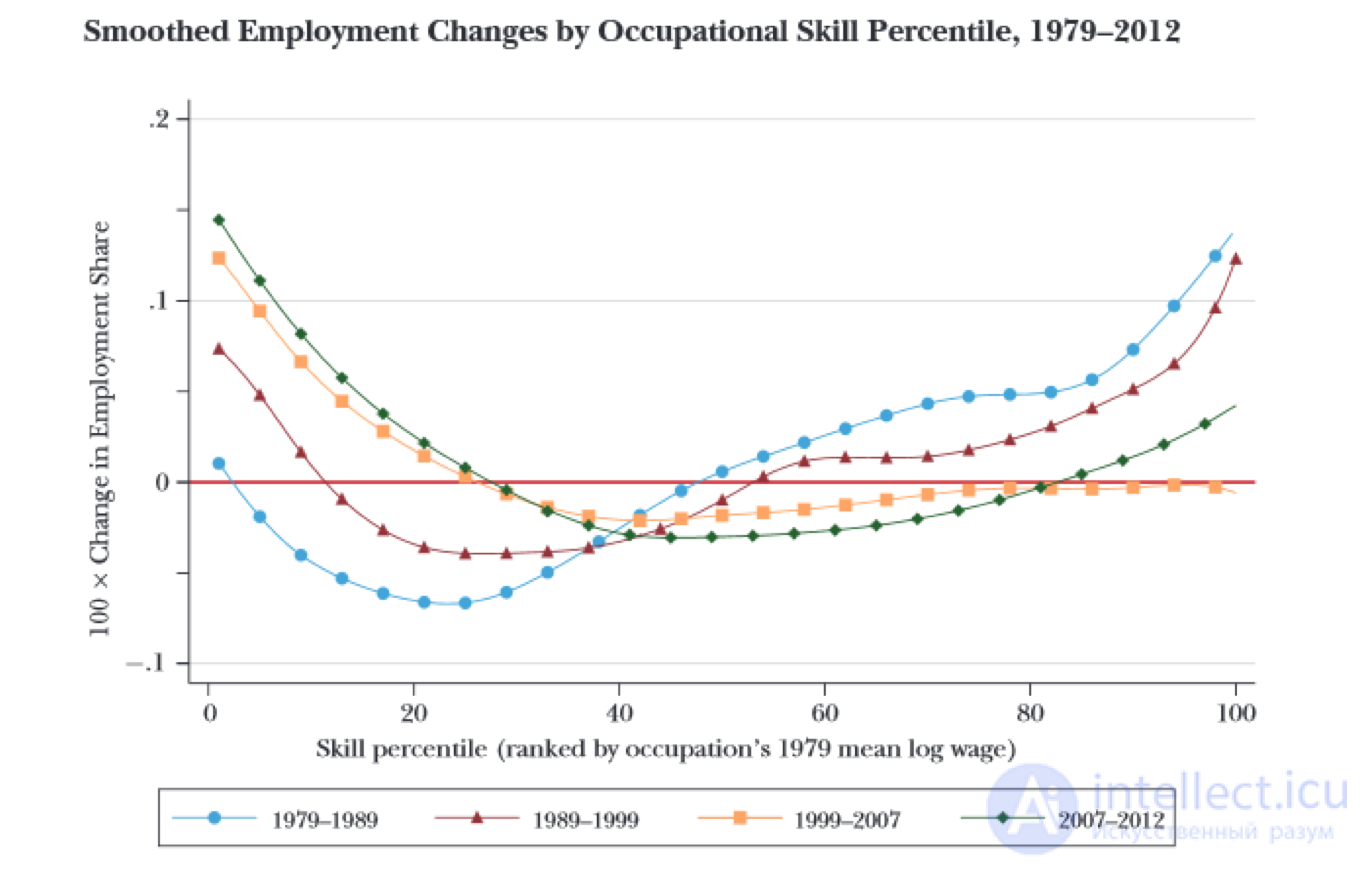
Decade after decade, jobs for medium-skilled people are being cut in production shops and offices, and those laid off find new, lower-skilled work. Those who lost their jobs due to robotization need something to live on, so in the end they settle for what they can get. At the same time, competition for such jobs is growing (while the labour market remains chaotic), and by agreeing to a reduction in wages, people take on any job offered to them in the race against machines. This also reduces the attractiveness of investment in automation. As an added bonus, automated jobs are more productive than most new jobs. Cheaper human labour and a growing number of low-productivity jobs lead to a «paradoxical» slowdown in productivity growth. In short, the labour market for medium-skilled workers is disappearing. This is the reality we have been observing over the past decades.
In 2017, a study was conducted whose authors analyzed the impact of industrial robots alone on jobs from 1993 to 2007. It turned out that each new robot replaces 5.6 workers, and each additional robot per 1,000 workers reduces the share of the total employed population by 0.34% and lowers wages by 0.5%. Over this 14-year period, the number of industrial robots quadrupled, while at the same time the number of jobs was reduced by somewhere between 360,000 and 670,000. As the authors note: «Interestingly, and perhaps surprisingly, we found no positive and offsetting gains in solving the employment problem in any area of activity or education». In other words, the lost jobs were not replaced by new jobs.
The number of industrial robots is expected to double by 2025, with 7 robots per 1,000 workers (in Toledo and Detroit there are already 9 robots per 1,000 workers). Building on the findings of Acemoglu and Restrepo, one can predict that by 2025 the number of jobs will be reduced by 3.4 million, wage growth will fall by 2.6%, and the share of the employed among the economically active population will fall by 1.76%. Note — we are talking only about industrial robots, not about all robots. We are not taking into account software and, of course, artificial intelligence. And the overall impact of all technologies will undoubtedly be higher.
A number of studies predict that automation will take over a large share of jobs in the future, but estimates of the level of unemployment this will cause vary. A study conducted by Carl Benedikt Frey and Michael Osborne of the Oxford Martin School found that employees performing «tasks following well-defined procedures that can easily be carried out by sophisticated algorithms» are at risk of dismissal. The study, published in 2013, shows that automation can affect both skilled and unskilled work, as well as high-paying and low-paying occupations; however, low-paid physical activity is at the greatest risk. It was estimated that 47% of jobs in the US are at high risk of automation. [18] In 2014, the economic think tank Bruegel published a study based on the approach of Frey and Osborne, which argues that in the 28 member states of the European Union, 54% of jobs are at risk of automation. The countries where jobs were least vulnerable to automation are Sweden (46.69% of jobs), Great Britain (47.17%), the Netherlands (49.50%), and France and Denmark (49.54%). The countries where jobs turned out to be most vulnerable are Romania (61.93%), Portugal (58.94%), Croatia (57.9%), and Bulgaria (56.56%). [108] [109]A 2015 Taub Center report found that 41% of jobs in Israel could be automated within the next two decades. [110] In January 2016, a joint study by the Oxford Martin School and Citibank, based on previous research on automation and World Bank data, found that the risk of automation in developing countries is much higher than in developed countries. It was found that 77% of jobs in China, 69% of jobs in India, 85% of jobs in Ethiopia, and 55% of jobs in Uzbekistan are under threat of automation. [111] The World Bank similarly used the methodology of Frey and Osborne. A study conducted by the International Labour Organization in 2016 found that 74% of paid positions in the electrical and electronics industry in Thailand, 75% of paid positions in the electrical and electronics industry in Vietnam, 63% of paid positions in the electrical and electronics industry in Indonesia, and 81% of paid positions in the electrical and electronics industry in the Philippines were at high risk of automation. [112] A 2016 United Nations report states that 75% of jobs in the developing world are at risk of automation, and it is predicted that more jobs could be lost when corporations stop outsourcing to developing countries after automation in industrially developed countries makes outsourcing to countries with lower labour costs less profitable. [113]
The Council of Economic Advisers, a US government agency tasked with providing economic research for the White House, in the 2016 Economic Report of the President used the data from the Frey and Osborne study to estimate that 83% of jobs with an hourly wage below $20, 31% of jobs with an hourly wage between $20 and $40, and 4% of jobs with an hourly wage above $40 were at risk of automation. [114] A 2016 study by Ryerson University found that 42% of jobs in Canada were at risk of automation, dividing them into two categories - "high-risk" and "low-risk" jobs. The high-risk jobs are mostly low-income jobs requiring a lower level of education than average. The low-risk jobs were on average more highly skilled. The report found a 70% probability that high-risk jobs and a 30% probability that low-risk jobs would be affected by automation in the next 10–20 years. [115] A 2017 study by PricewaterhouseCoopers found that up to 38% of jobs in the US, 35% of jobs in Germany, 30% of jobs in Great Britain, and 21% of jobs in Japan are at high risk of automation by the early 2030s. [116] A 2017 study conducted by Ball State University found that about half of jobs in the US are at risk of automation, many of them low-income jobs. [117] A McKinsey & Company report from September 2017 found that, as of 2015, 478 billion of the 749 billion working hours per year devoted to manufacturing, or $2.7 trillion of $5.1 trillion of labour, could already be automated. In low-skill areas, 82% of the workforce in apparel manufacturing, 80% in agriculture, 76% in food manufacturing, and 60% in beverage manufacturing were subject to automation. In medium-skill areas, 72% of basic materials manufacturing and 70% of furniture manufacturing were automated. In high-skill areas, 52% of the workforce in aerospace and defense and 50% of the workforce in advanced electronics could be automated. [118] In October 2017, IT decision-makers in the US and Great Britain found that most believed the majority of business processes could be automated by 2022. On average, they stated that 59% of business processes are subject to automation. [119] According to a November 2017 report by the McKinsey Global Institute, which analyzed about 800 occupations in 46 countries, between 400 and 800 million jobs could be lost by 2030 due to robotic automation, more so in developed than in developing countries because of the greater availability of capital for investment in automation. [120] Job losses and downward mobility, blamed on automation, have been cited as one of many factors in the resurgence of nationalist and protectionist politics in the US, Great Britain, France, and other countries.
However, not all recent empirical studies have found evidence supporting the idea that automation will cause mass unemployment. A study published in 2015 examining the impact of industrial robots in 17 countries between 1993 and 2007 did not find that an overall reduction in employment was caused by robots, and observed a small increase in overall wages. [32] According to a study published in McKinsey Quarterly [126] in 2015, the impact of computerization in most cases is not to replace employees but to automate part of the tasks they perform. [127] A 2016 OECD study found that among the 21 OECD countries surveyed, on average only 9% of jobs were in foreseeable danger of automation, but this varied greatly between countries: for example, in South Korea the figure for jobs at risk was 6%, whereas in Austria it was 12%. [128] Unlike other studies, the OECD study bases its assessment primarily not on the tasks that a job entails, but also includes demographic variables, including gender, education, and age. However, it is unclear why a job should be more or less automatable simply because it is performed by a woman. In 2017, Forrester estimated that automation would lead to a net loss of about 7% of jobs in the US by 2027, replacing 17% of jobs and creating new jobs equivalent to 10% of the workforce. [129] Another study argues that the risk of job automation in the US had been overestimated due to factors such as the heterogeneity of tasks within occupations and the failure to account for the adaptability of jobs. The study found that, taking this into account, the number of occupations at risk of automation in the US, all other things being equal, falls from 38% to 9%. [130]A 2017 study of the impact of automation on Germany found no evidence that automation causes an overall loss of jobs, but it affects the jobs that people hold; losses in the industrial sector due to automation were offset by gains in the service sector. Manufacturing workers were also not at risk from automation and, in fact, were more likely to continue working, although not necessarily performing the same tasks. However, automation did lead to a decline in the share of labour income, since it increased productivity but not wages. [131]
A 2018 study by the Brookings Institution, which analyzed 28 industries in 18 OECD countries from 1970 to 2018, found that automation is responsible for reducing wages. Although it concluded that automation did not reduce the overall number of available jobs and even increased them, it found that from the 1970s to the 2010s it reduced the share of human labour in labour value added and thus helped slow wage growth. [132] In April 2018, Adair Turner, former chairman of the Financial Services Authority and head of the Institute for New Economic Thinking, stated that it would already be possible to automate 50% of jobs with existing technology, and that it would be possible to automate all jobs by 2060.
The most striking statistic regarding robotization is the fact that almost the entire adult population of the US is aware of the loss of manufacturing jobs over the past thirty years. Pew Research conducted a survey of more than 4,000 US residents. As a result, it turned out that 81% of respondents are aware of this fact. However, few people know that at the same time overall output has increased. The US now produces more than ever, and only 35% of the country's adult population is aware of this fact. Only 26% of Americans know both of these facts.
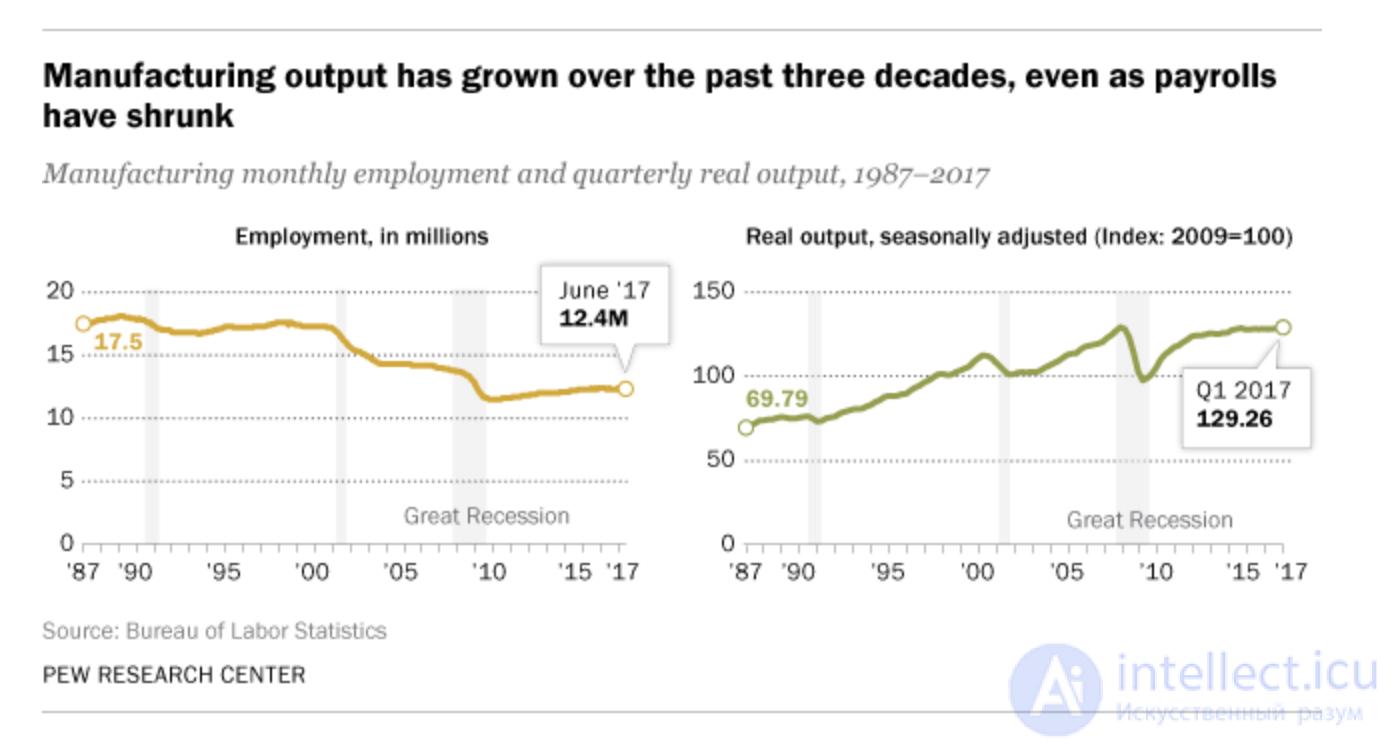
Only one in four Americans knows that, thanks to technology, output in the US has grown while the number of workers has declined. And the rest blame the loss of jobs on immigrants or attribute everything to the relocation of production abroad, although the latter is only possible with improvements in technology. Because of relocation abroad, we lost 13% of jobs in manufacturing. This is a problem. We will not be able to change anything if people do not know that the problem exists, or think that its very existence is a subject of debate. We cannot agree to solutions such as a guaranteed unconditional basic income, paid out as a productivity dividend, if productivity growth is increasingly becoming the cause of job losses, and in the debates this is treated as a future danger to our social order rather than a direct and clear threat.
Let us consider what will happen when the next recession comes. A drop in oil prices caused a recession in the oil industry, triggered mass unemployment, and spurred investment in robotization. What will happen when all industries respond with mass unemployment and investment in robotization? If we look at recent history, each successive downturn has led to a permanent contraction of the labour market. It seems that the labour market peaked back in 2000.
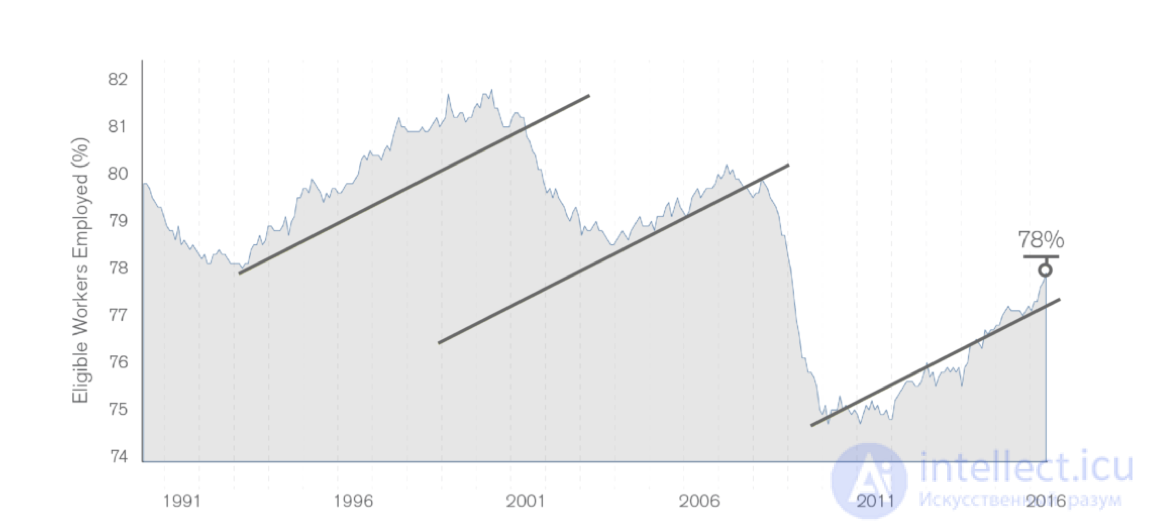
At the same time, technology increasingly makes production cheaper, so each successive downturn again shrinks the labour market and forces businesses to automate low-skilled labour and cut costs. The next recession is expected to leave more than ten million people unemployed. And for the production of the necessary amount of goods, these people are truly not needed. Where 79% of able-bodied people aged 25 to 54 used to work, a decline to 69% or lower is expected. At the current level of technological development, the economy simply does not need so many workers. And, to rub salt in the wound, it must be
продолжение следует...
Часть 1 Technological Unemployment, Robotization and Lights-Out Manufacturing
Часть 2 Solutions - Technological Unemployment, Robotization and Lights-Out Manufacturing




Comments