
Lecture
A security guard is a specialist who ensures the safety of people, property, and facilities. They can work in shopping centers, at enterprises, in banks, schools, residential complexes, and even escort valuable cargo. Their main tasks include access control, patrolling the premises, preventing offenses, and responding to emergencies.
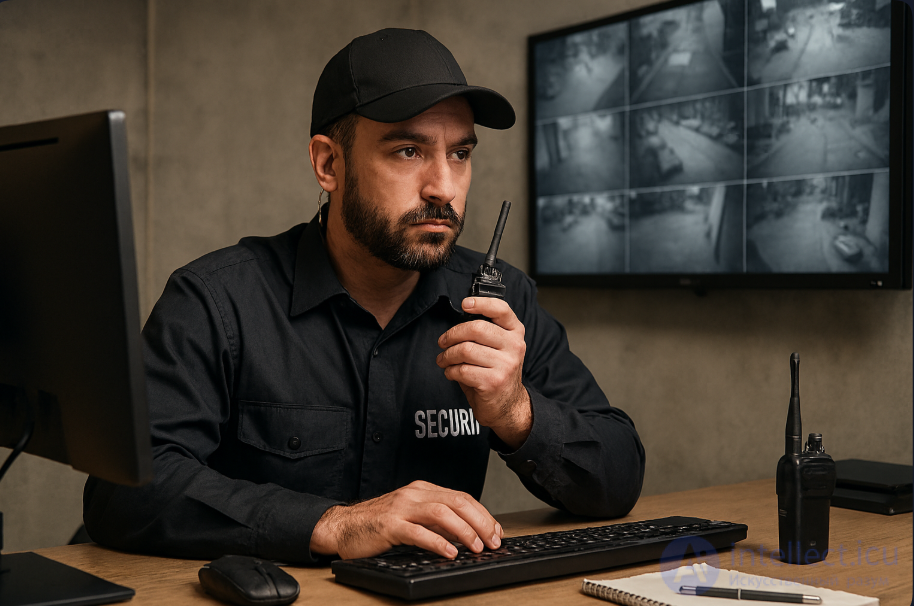
Access control. Checking the documents of people entering and exiting, controlling the entry/exit of vehicles, maintaining a visitor log.
Protection of facilities and property. Manning a post, patrolling the premises, preventing theft, property damage, and unauthorized entry.
Working with technical equipment. Monitoring video surveillance systems, security and fire alarms, checking that equipment is in good working order.
Responding to incidents. Taking action when an alarm goes off, detaining offenders, calling the police or emergency services.
Preparing documentation. Drawing up incident reports, keeping records, registering the movement of material assets.
Compliance with regulations and instructions. Knowing and applying internal rules, access control procedures, occupational safety and fire safety instructions.
Maintaining order. Preventing conflicts, monitoring compliance with the rules of conduct on the protected premises.
To work as a security guard, it is important to meet certain medical criteria:
Good eyesight and hearing (in some cases without correction)
Absence of chronic illnesses that interfere with duty (for example, epilepsy or serious cardiovascular diseases)
Physical endurance and the ability to stand on one's feet for long periods
Absence of mental disorders and addictions
In many countries, a medical examination is required before obtaining a license or clearance to work.
Working as a security guard requires a stable psyche and well-developed personal qualities:
Stress resistance and the ability to stay calm in conflict situations
The ability to make quick decisions
Attentiveness and a high level of concentration
Being non-confrontational and even-tempered
Responsibility and discipline
Education depends on the country and the level of security work:
Basic: secondary education and short-term security training courses
Advanced: licenses, certificates, training in physical and legal preparation programs
In some countries, mandatory training at accredited training centers and passing exams
Qualifications can be raised through grades, from a simple post guard to the head of a security service.
| Country | Average salary/month |
|---|---|
| USA | $2,500–$3,500 |
| Germany | $2,500 |
| Switzerland | $4,500 |
| Finland | $2,750 |
| Netherlands | $2,400 |
| Poland | $900 |
| Bulgaria | $850 |
| Greece | $1,100 |
| Slovakia | $1,150 |
| Portugal | $900 |
| Russia | $300-$900 |
| Ukraine | $270-$900 |
| China | $900 - $2,000 |
Salary depends on the level of training, the type of facility, the work schedule, and the region.
Working as a security guard can lead to a number of occupational risks:
Chronic musculoskeletal disorders (due to prolonged standing)
Sleep and circadian rhythm disturbances (with night shifts)
Increased levels of stress and anxiety
Cardiovascular problems
Psycho-emotional burnout
In some countries, such illnesses are officially recognized as occupational and entitle workers to compensation.
A security guard is part of the broad field of security. Related professions include:
Security service officer (within companies)
Occupational safety inspector
Private security company (PSC) officer
Bodyguard
Access controller
Operations duty officer
Video surveillance operator
Cybersecurity specialist (in a broader context)

Comments