
Lecture
An astronomer is a profession that combines science, philosophy, and technology. It requires extensive training, mental resilience, and readiness for a long educational journey. Below is a structured article following your outline.
An astronomer is a scientist who studies celestial bodies and phenomena in the Universe: stars, planets, galaxies, comets, black holes, and cosmic evolution. There are two main branches:
Observational astronomy — working with telescopes, collecting and analyzing data.
Theoretical astronomy — modeling and mathematically describing processes.
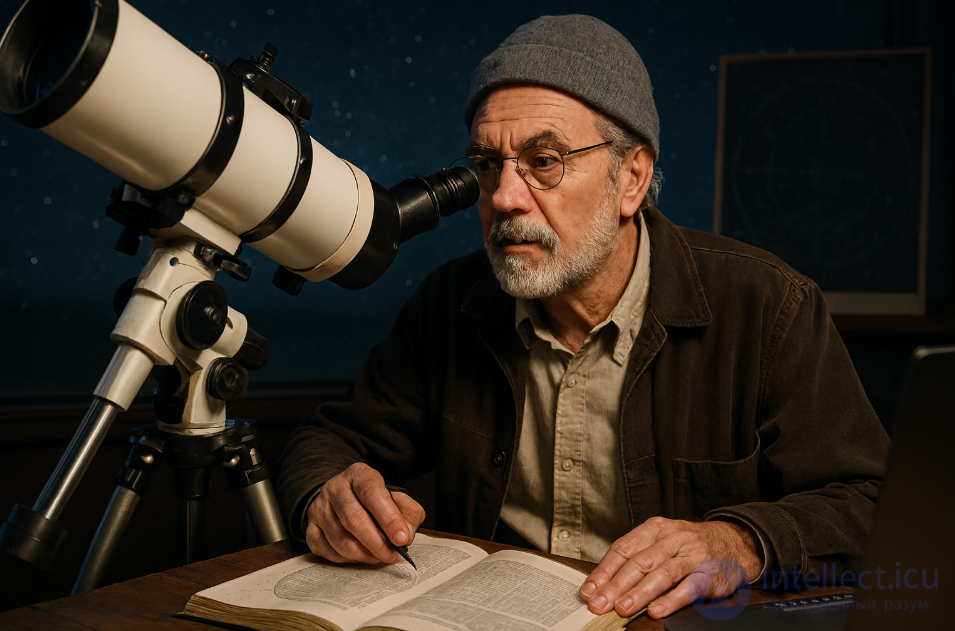
Good eyesight and the ability to work with high-precision instruments.
A healthy musculoskeletal system (long hours at the computer and instruments).
Absence of chronic illnesses that would interfere with nighttime observations and travel.
Tolerance for solitude and monotony: many studies are conducted in isolation.
High concentration and patience when processing large volumes of data.
Emotional resilience: the work often involves long waits for results.
A bachelor's degree in physics, astronomy, or related sciences.
A master's degree and, most often, a doctoral degree (PhD) in physics or astronomy.
Proficiency in mathematics, programming, statistics, and data processing methods.
| Country | Average annual income of an astronomer |
|---|---|
| USA | $95,000–132,000 |
| China | ~$45,000 |
| Russia | ~$20,000–25,000 |
| Ukraine | ~$12,000–15,000 |
| India | ~$14,000–16,000 |
| South Africa | ~$30,000 |
| Egypt | ~$10,000–12,000 |
| Israel | ~$40,000–50,000 |
Vision disorders (asthenopia, myopia) from working with instruments and screens.
Spine and joint problems from prolonged sitting.
Sleep disturbances from nighttime observations.
Stress and emotional burnout during long-term projects.
The profession of astronomer is one of the oldest scientific professions of humankind. Its origins go back to deep antiquity, when observing the sky served not only a cognitive but also a practical role: it made it possible to determine the seasons, predict floods, build calendars, navigate space, and plan agricultural work.
The first «astronomers» were priests and sages in Ancient Egypt, Mesopotamia, China, and among the Maya. They observed the Sun, the Moon, and the planets, created calendars, and linked celestial phenomena to earthly events.
The Sumerians and Babylonians created the first star catalogs and the system of zodiacal constellations.
The Egyptians calculated the length of the year with virtually modern accuracy.
Chinese astronomers left millennia-long records of comets, sunspots, and supernovae.
In Ancient Greece, astronomy became a philosophical science.
Aristotle, Hipparchus, and Ptolemy developed the first mathematical models of the motion of celestial bodies.
Hipparchus discovered the precession of the Earth's axis.
Ptolemy created the geocentric system, which prevailed for more than 1,400 years.
The largest observatories were built.
Precise measurements of the length of the year were made.
New star catalogs and tables were created.
From the 16th century, astronomy became an exact science.
Nicolaus Copernicus proposed the heliocentric system.
Johannes Kepler discovered the laws of planetary motion.
Galileo Galilei was the first to use a telescope for scientific observations.
Isaac Newton created the theory of gravity, explaining the motion of celestial bodies.
The advent of spectroscopy, photography, radio telescopes, and space probes completely transformed the profession.
Galaxies, the expansion of the Universe, and the cosmic microwave background were discovered.
Astrophysics — the physics of celestial objects — developed.
Space telescopes were created: Hubble, Chandra, Planck, James Webb.
«Stargazer» is the old name for an astronomer
Antiquity: Babylonian priests and Egyptian «stargazers» observed celestial bodies in order to predict river floods and harvests and to compile calendars.
Classical antiquity: In Ancient Greece, astronomy separated from astrology. Pythagoras, Hipparchus, and Ptolemy were already engaged in systematic observations and mathematical models.
The Middle Ages: In Europe, astronomy was often mixed with astrology. «Stargazers» could be court advisers who predicted fate by the stars.
The Renaissance: Copernicus, Galileo, and Kepler destroyed the image of the «stargazer» as a fortune-teller, turning astronomy into a rigorous science.
Modern times: With the invention of the telescope and the development of physics, the astronomer became a scientist, while «stargazer» remained a folkloric or poetic name.
Stargazer — a historical, often ironic or romantic name associated with mysticism and fortune-telling.
Astronomer — a modern scientific term denoting a researcher of the cosmos.
Nicolaus Copernicus
Founder of the heliocentric model. His ideas revolutionized scientific thinking.
Discovered the three laws of planetary motion, which became the foundation of celestial mechanics.
The first telescopic observer: he discovered the moons of Jupiter, the phases of Venus, and mountains on the Moon.
Created the theory of gravity and the laws of motion — the foundation of classical astronomy.
Predicted the return of a comet (Halley's Comet).
Proved the existence of other galaxies and discovered the expansion of the Universe.
Discovered the «period–luminosity» relationship of Cepheids — the key to measuring cosmic distances.
A popularizer of science, he participated in the «Voyager» programs and projects searching for extraterrestrial life.
Although a theoretical physicist, his work on black holes and cosmology is fundamental to astronomy.
AI is already radically changing astronomy, and the changes will only accelerate.
processing data from giant telescopes;
automatic recognition of galaxies, supernovae, and exoplanets;
generating simulations of cosmological processes;
controlling robotic observatories.
In a single night, a modern telescope can collect more data than the entire volume of 20th-century astronomy — which is why AI has become an indispensable tool.
No, it will not disappear. But it will change significantly.
AI will take over routine tasks:
sorting and filtering data;
searching for objects;
processing spectra;
calculating orbits;
modeling the Universe.
However, the key role of the human will remain:
posing scientific questions;
interpreting unexpected data;
creating new theories and models;
scientific intuition and the choice of research direction;
responsibility for the strategy of space missions.
The astronomer of the future is not merely an observer, but an analyst, an operator of AI systems, a cosmologist, an interpreter of data, and a researcher of new physical laws.
AI analyst astronomer;
specialist in automated observatories;
space data engineer;
developer of models for the search for exoplanets.
Astrophysicist — studies physical processes in the Universe.
Cosmologist — investigates the origin and evolution of the Universe.
Planetary scientist — studies planets and their systems.
Space data specialist — works with Big Data and modeling.
Space systems engineer — designs instruments and satellites.
The profession of astronomer is a path spanning decades, requiring robust health, mental resilience, and the highest level of education. It opens access to the mysteries of the Universe, but it demands sacrifices in the form of long training, moderate income in most countries, and high competition.
The astronomer profession has the most ancient history and continues to be one of the most high-tech sciences. With the development of AI, it will not disappear but will become even more significant, shifting the emphasis from observations and calculations — to analysis, data interpretation, and the creation of new theories about the nature of the Universe.

Comments