
Lecture
Ballet master — a specialist in the art of choreography who creates, stages, and refines dance numbers, ballet performances, choreographic compositions, and large-scale stage productions. They develop the artistic concept of a dance, select the musical accompaniment, conduct rehearsals, and oversee the quality of the performance.
Ballet masters work in opera and ballet theatres, musical theatres, dance companies, folk dance ensembles, circuses, television, film, concert venues, and educational institutions.
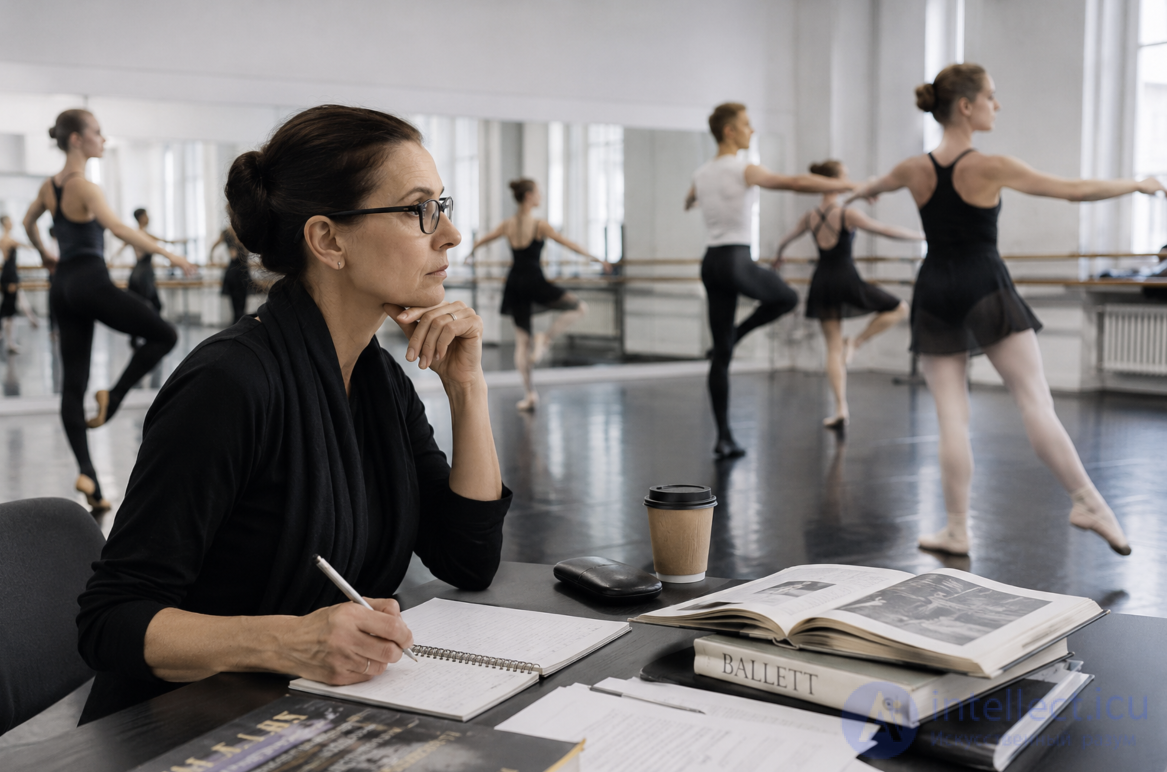
To work successfully, a ballet master must be in good health, since the profession involves heavy physical and emotional demands.
Main medical requirements:
good condition of the musculoskeletal system;
absence of severe diseases of the spine and joints;
normal vision (or corrected with glasses/contact lenses);
good hearing and a sense of musical rhythm;
normal functioning of the cardiovascular and respiratory systems;
sufficient physical endurance;
absence of conditions that limit active physical movement.
A ballet master must combine creative ability with organizational skills.
Main professionally important qualities:
creative thinking;
well-developed artistic imagination;
a sense of rhythm and musicality;
leadership ability;
sociability;
emotional stability;
discipline;
a well-organized approach to work;
a sense of responsibility;
patience;
strong concentration;
the ability to make quick decisions;
a good memory;
the ability to motivate a team;
resistance to stress.
As a rule, the profession requires specialized education in one of the following fields:
choreographic art;
the craft of ballet direction;
choreography pedagogy;
directing of theatrical productions.
An aspiring ballet master can pursue:
secondary vocational education (a choreographic college);
higher education (a bachelor's or master's degree in choreography).
Many theatres give preference to specialists with a higher choreographic education and practical experience as a ballet dancer or coach/répétiteur. Positions such as leading ballet master or ballet master-director usually require at least 3–5 years of work experience.
Income levels depend on the theatre's standing, the specialist's reputation, the country, and years of experience. In many cases, ballet masters are paid per production under contract or receive a fixed salary.
| Country | Average Income (USD per year) |
|---|---|
| USA | 55,000–110,000 |
| China | 20,000–60,000 |
| Russia | 12,000–35,000 |
| Ukraine | 4,500–8,000 |
| India | 6,000–18,000 |
| South Africa | 12,000–30,000 |
| Egypt | 5,000–15,000 |
| Israel | 30,000–65,000 |
Note. The earnings of internationally renowned ballet masters can significantly exceed these figures thanks to staging work, touring, teaching, and authorial royalties. In Ukraine, the median advertised salary is about 16–17.5 thousand UAH per month (roughly 4.5–5.5 thousand USD per year), although teachers and heads of major companies can earn considerably more.
Due to the specific nature of the profession, ballet masters often face occupational health problems:
osteochondrosis;
scoliosis;
joint arthrosis;
varicose veins;
chronic back pain;
inflammation of ligaments and tendons;
knee and ankle joint disorders;
muscle overstrain;
chronic fatigue;
emotional burnout;
stress-related disorders;
sleep disturbances.
The profession of ballet master emerged alongside the development of European ballet during the Renaissance. The earliest ballet performances arose in Italy in the 15th–16th centuries as courtly dance festivities. Later, the art of ballet developed extensively in France.
In the 17th century, the French king Louis XIV, who was himself passionate about dance, founded the Royal Academy of Dance (Académie Royale de Danse) in 1661. It was during this period that the first professional dance producers appeared, performing the functions of today's ballet masters. They devised movements, trained performers, and organized stage productions.
In the 18th century, ballet became an independent theatrical art form. Ballet masters began creating full-scale productions with plots, characters, and dramaturgy. A major contribution to the development of the profession was made by the French reformer Jean-Georges Noverre, who is considered the founder of modern ballet theatre. He argued that dance should convey feelings and tell a story, rather than being merely a beautiful sequence of movements.
In the 19th century, the Russian Empire became the center of world ballet. It was here that the profession of ballet master reached a high level of development. Large-scale classical productions emerged, many of which remain in the repertoire of the world's leading theatres to this day.
In the 20th century, the work of ballet masters expanded considerably. They began working not only in academic ballet but also in musical theatre, film, circus, television, contemporary dance shows, ice shows, and concert programs. Today, a ballet master is simultaneously a director, teacher, stager, organizer, and artistic director of a dance company.
A French ballet master known as the «father of modern ballet». He developed the principles of dramatic ballet and set them out in his book «Letters on Dancing and Ballets». International Dance Day (April 29) is celebrated on his birthday.
A French and Russian ballet master who worked in St. Petersburg for more than half a century. He created classical productions that became world masterpieces:
«The Sleeping Beauty»;
«Swan Lake» (together with Lev Ivanov);
«Raymonda»;
«Don Quixote»;
«La Bayadère».
He is regarded as the greatest classical ballet master in history.
A Russian ballet master, author of the famous «white acts» of «Swan Lake». His choreography is distinguished by its musicality and poetic quality.
An outstanding Russian choreographer and reformer of 20th-century ballet. He abandoned the stock movements of classical ballet and created plastically expressive productions, each with its own distinct style.
The founder of the American school of neoclassical ballet and the creator of New York City Ballet. His productions had an enormous influence on the development of world ballet in the 20th century.
One of the most renowned Soviet and Russian ballet masters. For more than 30 years he served as chief ballet master of the Bolshoi Theatre. Author of famous productions:
«Spartacus»;
«Ivan the Terrible»;
«The Golden Age»;
«The Legend of Love».
The development of artificial intelligence is already influencing the field of choreography. Modern AI systems are capable of:
generating dance movements;
analyzing music and selecting choreography for it;
creating 3D dance animations;
modeling human movement;
assisting in training dancers;
automatically correcting performance errors;
developing virtual stage sets;
creating digital avatars of performers.
However, artificial intelligence will not be able to fully replace a ballet master.
The main task of a ballet master lies not only in creating a sequence of movements, but also in conveying artistic intent, emotions, character, and interaction with the performers. These processes require creative thinking, intuition, life experience, and an understanding of human psychology — qualities that today's artificial intelligence systems do not possess.
In the coming decades, ballet masters will actively use AI as a professional tool:
to quickly generate draft versions of choreography;
to analyze dancers' movements;
to plan rehearsals;
to create virtual rehearsals in augmented and virtual reality (VR/AR);
to design lighting and stage effects;
to create digital copies of performances;
to prepare training materials.
At the same time, the final artistic decisions will still be made by people.
According to most experts in art and digital technology, the profession of ballet master will not disappear.
The nature of the work is highly likely to change:
the amount of routine preparation will decrease;
the use of digital technology will increase;
the importance of creativity will grow;
new areas of work will emerge — staging dances for virtual performers, digital productions, metaverses, and interactive shows.
Thus, artificial intelligence will become the ballet master's assistant, but will not replace them. Just as photography did not displace painting, and the computer did not replace the composer, AI will not be able to replace the artistic vision, emotional depth, and creative individuality of a professional ballet master. In the future, the specialists most in demand will be those who can combine classical choreographic traditions with modern digital technology.
Professions related in content to this one include:
choreographer;
choreography teacher;
ballet dancer;
ballet coach/répétiteur;
stage director;
dance instructor;
head of a dance company;
folk dance ensemble performer;
director of mass events;
contemporary choreography coach;
show program producer;
stage movement specialist.
The profession of ballet master combines art, pedagogy, and the management of a creative team. It requires a high level of professional training, excellent physical condition, artistic taste, and organizational skills. Despite significant physical and emotional demands, the work of a ballet master remains one of the most prestigious and sought-after in the field of choreographic art, making it possible to create unique stage works and develop the culture of dance.

Comments